Tag Archives: writing

Where I write

Maybe it’s a sign of my age or limited cognitive capacity, but I do all of my thought organizing on paper, not in some computer application. It just doesn’t feel as accessible to me if I have to open a program and scroll around looking for each bit that may be important to me at that moment. Add to this that I may want to look for information in several documents or programs, and there’s no way I can fit everything on the screen. My actual writing goes into a computer, yes, but all of the character descriptions, time lines, visual ideas, and back story goes on paper. After learning the hard way that paper can run away from its owner, I now prefer that such paper be bound together with other paper and protected with covers, so I am a notebook kind of guy. And while I don’t prefer the color black for things around the house, I do like it in a notebook. It’s no nonsense and not fussy. I don’t need a Power Puff Grrl or fancy stitching to look at me every time I want to write something down. I just want to write it down.

AmPad Gold FIber notebook, Miquelrius graph-lined notebook, Moleskine notebook

These are the three I’ve used in the past seven or eight years:

  • AmPad Gold Fiber notebook—This moderately large notebook, about an inch thick, has lined pages, a bookmark ribbon, and a hardcover binding (sewn through the fold, for those who care to know). It’s been jammed in my briefcase hundreds of times now, dropped, stepped on by a small child who admittedly didn’t weigh much, and after all of this abuse, it’s held up rather well. The pages feel substantial but perhaps let a bit too much ink show through on the other side. I do tend toward roller ball and felt-tip pens these days, so perhaps I’m being a bit hard on it. But overall it’s a good sized book, I like the rounded corners and reinforced edges, and as I’m one to dog-ear a corner on purpose, like that the paper holds up to me.
  • Miquelrius graph-lined notebook—Two jobs ago I hired a woman who showed up on her first day with this notebook, and she brought it to every meeting, copiously copying down whatever we were saying in case it would prove important later. No worries, she could have written a new bible in there, it was so thick with paper. I asked her where she got it, saying I’d never seen a notebook like it, and she pointed me to the tiny bookstore in town that stocked them. They come lined, blank, and with a square graph. I picked graph because I find the light blue lines helpful but not overpowering on the page, and sometimes I write down diagrams instead of words, which I find a graph aids. My employee, on the other hand, had a blank book. That’s as daring and carefree to me as a hang glider. This notebook has two inches of paper and an impenetrable glue perfect binding. It’s got a real leather cover that survived a late-night attack from one of my cats, but it is really heavy, weighing in around 2.5 pounds. It is good at letting me sneak a business card or other paper into it and not batting an eye, but who could tell anything else was in there for all the sheets of paper?
  • Moleskine ruled pocket notebook—Straight from Hemingway to hipsters to me. This is the notebook that people tease me about, but it doesn’t just play at being pocket-sized. It really is pocket-sized. I’m not as much of a purist with this notebook; any given Moleskine in my possession will have story ideas, grocery lists, character thoughts, directions to a city hours away, and my always-evolving writing to do list. It has, of course, a bookmark ribbon and an elastic band that keeps the book shut when say, you’re on an African elephant hunt. I shudder to think of Hemingway hunting elephants. What an ass of an avocation. At least we agree on a notebook. I’m also a fan of the little pocket in the back, and I’ve used it to collect receipts while I’m at a conference, or store a business card or something until I get home. It is hard bound (thread bound, this one) with a hard leather cover and rather thick pages so there isn’t a lot of bleed-through. But I do burn through a Moleskine quickly. Must be all those directions for Portland and Seattle.

Not really an excerpt

There are two kinds of writers in the world, those who overwrite and those who work for test laboratories.

I often write more than will end up in a story or piece of nonfiction, and I see this as a blessing rather than a curse, since trying to pack things on a skeleton of prose is for me, difficult and prone to introducing everything from a non sequitur to a blatant inconsistency—I’m much more orderly when I stick to my process, which is:

Write down initial idea—this can be anything from a character I keep thinking about to a rare astrophysical condition to some circumstance that would explain a mystery

Expand on initial idea—Aliens on Parade grew out of a question I had about how traveling by wormhole could go wrong once in the hands of a lazy or in-over-their-heads government. I started thinking about technology: if we “discovered” how to open wormholes in space, would we also inadvertently be inviting people in? If answer = yes, then what happens?

Identify the actors—my bio sketches start out very simple and I grow them from there. Age, race/ethnicity, gender, orientation all help me figure out their positions, power, and privilege in society, whether it’s a society I’m trying to reflect or invent. Because I see these things at play in the actual world, I feel responsible to bringing them to bear in my writing. But their back stories are more complex. I’ll put in things like “was mugged two weeks ago,” “has unmanaged bipolar disorder and self-medicates with alcohol,” “won’t let anyone meet her mom because she’s on welfare.” I don’t feel the need to write out absolutely everything about them if I’m writing a shorter story, and I try to come up with circumstances for them that let me see greater depth of character when I need to.

Visualize the scenes—this gets harder for longer work, so I keep it flexible, and I will add and subtract to this list over time. I think of this like one would map out a scene shoot for a film. What do we have, where do we have it? I deeply appreciate any writer who can create scene description and keep it interesting, and not just because it’s a magical street in a magical city, which is supposed to be magically interesting all on its own. Once I’ve got a sense of my characters, I try to come up with places where they will be best expressed and then make sure it will work with the plot. If I can find a perfect setting to enhance the tone, then great. In my short story, Underwater, I tried to paint a minimal picture to ask the user to fill in with their starkest memories, while keeping the places in the story bereft of emotion other than tired and empty. I think it works for a story that’s under 2,000 words like this one. My novel-length sci fi piece, Superqueers, spends a lot more time showing different neighborhoods in Washington, DC, because I wanted to work against the every-city feel of other comic book hero stories. Incidentally that story grew out of an image I knew I needed to write 20 years ago, of a small greasy spoon diner and a very large man who drinks coffee there, spilling a lot of it and using many, many packets of sugar in the process.

Do the first draft and don’t stop—At this point, I can’t not write any longer; I have to type words out through my fingers now now now. I will take a few pages to get up to speed, although I don’t like seeing it this way. I’d love to think my work was perfect out of the gate, but in reality I’m in last place until the final turn, to drag the metaphor through the mud, mix it and beat it like a dead horse. I and most everyone I know need to do an awful lot of rewriting before I will say the words have been crafted. No blacksmith made a nail with the first strike. But this rewriting process will come later. I don’t worry about it because I’m writing, I’m progressing, I’m telling the story. I may not use the section or piece of dialogue later, but I will save whatever I write in the first draft. Everything lives in the first draft. If I sit down at the computer on Day 2 and I hate everything I wrote, I can start anew if I can’t write anything else, but I will not delete the crap from Day 1. Draft Number 1 holds onto everything. While I’m getting through this first draft I will return to the character bios and the scene list and the original idea, and update them. Matilda is allergic to strawberries. I need the boat out at sea, not at the dock. Those two characters are too similar so I’ll merge them into one and make a note to rewrite the dialogue in chapters 1–3.

Rewrite until it doesn’t suck—other people may have higher expectations for their writing, but I’m shooting for not laughable. Perhaps I’m being too modest; I think I’m a good writer, but I don’t want to get stuck on myself, and I know by now that things can always be improved. I have no love for self-absorbed writers, no matter their level of talent, so I strive not to become one myself. I can’t say when I think a story is done, but when I go through on say, the 20th pass and only have tiny changes to my language, it starts to occur to me to work on something else. I’m either blind to the quality of prose or I’m deadened to making changes and now’s the time to go revise something else or start something new. All the while pitching my best stuff to agents and journals. But that’s another post for another day. This rewriting phase starts out intense and mellows out, kind of like March. I’ll cut whole scenes, chapters, characters, change the ending, put in or take out subplots. Thank goodness I’m writing and not building houses, because I’d destroy every budget I saw.

With that in mind, here is the very original dream from my memoir that drove me, eventually, to transition. It’s no longer in the memoir itself, but it’s referred to and is the backstory for the main character—uh, namely me—and I revised it something like 10 times before I struck it entirely, so it’s rougher than the rest of the writing at this point.

Trees, everywhere, mostly evergreens. He looked around at them, some clumped up closely, branches looped together with their neighbors, some isolated from the rest, the lot of them with varying heights and apparent ages, climbing up the side of the mountain. Far below the side of the mountain the trees were reflected back almost perfectly from the surface of a very still, large lake. He wondered how he’d gotten here, patting himself down absentmindedly, as if identifying the things in his pockets would reveal a useful memory. Looking down at his clothes, he recognized an icon of sorts. Is that what they’re called? Icons? Stereotypes? He was struck by the idea of lumberjacks. This was probably because he was wearing a red flannel jacket, or shirt, he wasn’t sure. It was something in between, and it would later occur to him that there is in fact, a hybrid jacket-shirt-thingy for sale on the men’s fashion market, if one used a very loose definition of the term, “fashion.” But he did notice, after taking in the color and texture of it, that it wasn’t quite warm enough for the brisk morning air. Wait, was it morning?

He squinted at the sky, a pearly blue with a few wisps of cirrus clouds high, high away. Well, he knew what the hell a cirrus cloud was, that was a start. When had he learned about cirrus clouds? He had a clear memory of Mrs. Warms’ 8th grade science class at that crappy Catholic school on the main drag in Princeton. The one with the scary nuns. And then on graduation day with their caps and robes on, they all looked like nuns and none of their parents were clued in to the trauma that their children were experiencing.

So okay, he’s made it past elementary school. Good to know.

He took a few steps, only then realizing he had on light brown worker’s boots, with his jeans pulled down neatly over the tops. It occurred to him to touch his head, and to his shock he realized he had on a knit cap. He took it off and inspected it. Navy blue, maybe, or black. Size 7. Carhart brand.

Holy shit, he really was a lumberjack. That couldn’t be right, could it? He looked around for an ax and a large blue beast of burden.

Before he could continue on trying to figure out who the hell he was, he heard a voice behind him.

“Daniel! Daniel! What are you doing over here?”

He turned around and saw a woman running up a trail he hadn’t noticed, what with the sky looking gorgeous and the trail looking blah. She was wearing her own knit cap, plaid jacket, jeans, and work boots. There apparently was some kind of outdoorsy uniform going on here. Her cheeks were bright red from the cold and her spontaneous bout of jogging. Brown curly hair stuck out in gravity-defying directions as soon as it cleared the tight hat. She left the impression of looking like a balding Troll doll that had spent some good quality time under a diffuser.

He had no idea why he knew what a diffuser was.

“Hi, Kathryn,” he mumbled. He knew her name. Another surprise. Who was Kathryn?

“Daniel, we need you at the mess. Why are you all the way up here? We’re running out of pancakes and French toast, and Jackie doesn’t know how to make the dishwasher run.” She put her hands on her knees as she bent over, panting.

“Daniel?” He looked at her. He knew her name, but he didn’t know why she was calling him this.

“Yes?”

“Who’s Daniel,” he asked.

“You, silly.” She stopped a moment. “What’s wrong with you?”

“Nothing. I just didn’t think that was my name.”

“Uh, what did you think your name was?”

He started to say and then stopped. It wasn’t right. Under this brightening sky, in the cold air, dressed like an extra from a Monty Python movie, something wasn’t right.

“Nothing, I’m kidding. I just wanted to catch the last of the sunrise.”

“Well, we need you, Dan. Come on, before the President runs out of breakfast.”

“The PRESIDENT is here,” he asked, following her, feeling his footsteps crunch as he made them on the frosty ground.

“The President of the Bucks County PTA. It’s their group that picked the campground for their stupid conference this weekend.” She looked at him like he’d lost all sense. She wasn’t far off the mark.

“Right, right.”

“Jesus, what did you do last night?” Her hair bounced around as she shook her head. He had the distinct impression that her cap was about to shoot off of her head from the pressure of her curls.

They walked into the mess and half a dozen children were upon him, tugging at his shirt/jacket and looking for more flapjakcs as if they might be hidden in his pockets. He hoped he could remember how to make a pancake, if he didn’t even know this name she was calling him.

He passed by a mirror, and got a look at himself just before entering the kitchen. Tallish, with a big, thick beard, hairy wrists and hands, twinkling brown eyes, wrinkles that implied he had smiled more often than frowned in his life. He was a mini Paul Bunyan, in fact. He realized precisely then that he had always wanted to be Paul Bunyan and only Paul Bunyan. He loved who he was now more than ever, and it had taken a long time for him to become the man these people needed and cheered. And that was really odd, for some reason.

And then I woke up.

When the circus came to town

Everett reading at the RoadshowWalla Walla was a blur of activity this weekend, what with a memorial for the lovely Mary Hanna, who passed away last month and whose illness I wrote about a couple of times, the short-lived attempt to hunt wild turkeys, and a party on Friday night, which was the setting upon which I agreed to wake before dawn to watch someone shoot at birds. But Saturday night wasn’t the terminus of our weekend plans. Sunday brought with it the Tranny Roadshow, also previously mentioned in this blog.

I was happy to provide an interview to the local paper. Well, I was happy and not a little trepidatious. A lot trepidatious, but who’s measuring? Turns out that the article was pretty well done, even if the editor did miss a typo in the first paragraph.

I prepped food for an after-party event at our house, and wandered over to the venue for the sound check an hour before the start time. Meeting the lead organizer as I walked in, he told me that they’d just had the fastest sound check ever and they were done already, two minutes in. And now I wasn’t sure what to do with myself. Ooh, new transpeople. I should talk to them. And then I remembered.

My experience with a lot of transfolk is that when we get into large enough groups, it starts feeling like it’s and after school special of Who’s Too Cool for School? Everyone gets dressed in extremely hip ways—they’re wearing ironic clothing, like shirts with religious overtones, or they’re sporting working class wear, like gas attendant jumpsuits or trucker hats, or they’re Goth, or something that makes it very clear they are not here for a wine tour. The next aspect of WTCfS is that everyone knows each other but not you, so for me, I get stuck standing a little outside their conversation circle, trying to find an in or at least hear what they’re discussing, but this is difficult for all of the inside jokes that I have previously not been privy. The only other option here is not an attractive one: I can try to jump in and say something, but I risk either being completely ignored, which makes me feel like a braces-wearing, pimply 8th grader all over again (and puberty twice is really enough), or I may get the quick, “uh huh,” said with a condescending jerk of the head before their previous line of conversation resumes. There is a very low chance that they may find me charming enough to step aside seven inches so that I’m not stuck outside the circle like some uninvited electron.

Trust me, these things have happened to me. I had been so excited for them to come to little Walla Walla, and I figured it would be a show some people in town really needed to see, but looking at the troupe I was worried, like I’d been sitting down with the Union-Bulletin reporter. Why should they have my best interest at heart? I wasn’t a hip, urban transman from DC anymore. I was some guy with neckwear from a tiny city in the middle of nowhere.

Okay, way to make it be all about me, I told myself, thus ensuring it was all about me, at least for the time it took my dendrites to send that message across my synapses. Just relax. Ask how their trip has been so far.

We made a little small talk. Some of the performers introduced themselves. They seemed friendly enough, if not way, way cooler than me. I watched as people made their way into the room, finding seats and getting comfortable. I wasn’t nervous to read in the slightest, but I was aware that I’d been alotted 10–12 minutes. I didn’t want to read too fast, but I didn’t want to go over my time, either.

Two older ladies sat right in the front, smiling broadly. I’d said in the article that the show was reminiscent of old Vaudeville. Were they here thinking they’d get Benny Goodman and Laurel and Hardy? Oh, crap.

A man came in with his mother, who appeared to be in her 70s. He asked Susanne, the faculty adviser for the event, if he could get coffee and bring it in here. She said sure. He looked uncomfortable through the whole show, but his mom had a blast.

Then there was an older couple who looked like two hippies from back in the day, him still sporting a long ponytail of now-white hair, she in a flowing flowery blouse. Directly behind them was The Knitter, who I recognize now from bleeding heart liberal events I’ve attended all over North America. There is always a knitter, as if there’s an underground knitting community who scour the notices about local events so that at least one of them will be in attendance at each. Because we have to remember that knitting is important. Or something. I suppose I do admire someone who can watch the stage and not drop a stitch. That’s real multitasking.

Red Durkin

Red Durkin, comedienne extraordinaire

The show began, with a comedienne, who made us all laugh, repeatedly, the whole time she was on stage, which is what is supposed to happen, so I gather. I’ve watched enough unfunny comics to wonder why the industry isn’t afraid we consumers will sue them for false advertising. But she was the real deal.

Second performer picked up a guitar and sang, self-created songs except for one Sarah Harmer cover, which he did well.

My turn. The “local performer.” I approached the stage, which uh, didn’t have a step, even though it was at least 26 inches off the floor. I was certain I would wipe out before I’d even made it up there.

I was not graceful, but I made it. Ha! I was triumphant. My knees were intact, sturdy, even. I remembered I was supposed to read something. Good thing it was in my hand.

“This is a story about Becky and Bertha,” I said, “who were the names of my breasts when I still had breasts, that is.”

And we were off to the races. I got a lot of laughs and even a guffaw or two. I might have sped up toward the end a little, still worrying about my time limit, as if Jim Lehrer were there to call time.

The rest of the show was fun, with another musician—she broke out a ukelele—a juggler, a couple of spoken word performers. The audience gave us more applause, and suddenly, we were done, sans big bows from the troupe, which I thought was a little unorthodox. But what about this wasn’t orthodox?

I dashed home while Susanne helped them pack up their things, as it was my job to set out the spread for the party. They weren’t ready for our hospitality, but they were happy for it, and we met up with a few students who had brought them to campus. The conversation was great, we focused on what we had in common, and I worried no longer that I didn’t fit in. It was a long, long breath of fresh air. And it made me want to make Walla Walla a more diverse place.

A life without poop

Sherman Alexie, writer of War Dances and The Absolutely True Diary of a Part-Time Indian and many other books of every writing style out there, came to Walla Walla last night. I hadn’t seen an Indian perform in oh, a year or so, not since Tomson Highway came to town, singing and telling stories. Actually, with so many native folks around here, it’s interesting that I don’t see them more often, not that I expect them to have neon signs over their heads, blinking “I’m an Indian!” That’s only for my fellow middle easterners, because we’re the terror threat. So Alexie came to town.

sherman alexie, authorHe’s self-deprecating, earnest, childlike, but also a touch cynical, down to earth, pretentious (admittedly so), and very literary. He’s also really prolific, having authored something like 628 distinct works of writing. Okay, it’s not that many, but it’s a lot. Every time I’ve seen him he’s been dressed like an absent-minded English professor, slightly worn sports jacket, dress shirt, open at the collar, jeans, khakis or some neutral chino trousers, and no tie. Tonight he had on a tie and a velvet smoking jacket, and all I could think was, I’ve never seen him in a tie. Won’t he get hot in that jacket?

I convinced Susanne to leave early because even though this reading would be taking place in the largest auditorium on campus, it was going to be packed. It’s not like Walla Walla also had a jazzfest, an opera, two staged plays and one movie on the green to compete with. And people absolutely revere Alexie, as well they should. She gave me one of her “Ev’s being funny again” looks and we left with 15 minutes to go to the performance. This was probably okay, as everyone in Walla Walla is late to everything. It’s as if everyone gets a 10-minute grace period. The only time this rule isn’t in play is when approaching an intersection with a yellow and sometimes even red, traffic light. At that point, grace periods are not in play and one must proceed to move as quickly as possible, through said intersection.

So we walked the block from our house to the lecture hall, and really, there was a stream of other people walking from all directions, direct to the hall. We were suddenly book zombies, being called by our leader to watch him turn printed pages and move his mouth with sound coming out. Susanne noted all of the others going to see him and told me I was right, to which she quickly added, “in this one instance.”

We got pretty good seats, smack in the middle of the room, roughly halfway back from the stage, and I was pleased as punch with myself (and actually, I don’t know what that means), until two others came and sat next to us, absolutely reeking of cigarette smoke. Cigarettes are bad enough, but when the smoke gets stale, like beer that’s been left to soak into a carpet for a week, it is gut-wrenching. A few minutes into sitting there, and we both had headaches, although I suspect it was just me with the bad college flashbacks. There was an open seat one chair away, so we moved over, hoping not to cause any drama.

He started off by reading some of his poetry, which I can appreciate but not replicate in any meaningful fashion. I like some repetition, I love the idea that poets could sit for days and weeks trying to isolate that one exact word that would perfectionize the poem. I don’t have any time for that nonsense, honestly. I love rewriting and I love craft, and I genuinely want to play with phrasing and word choice and meter, and I aim to do those things, but I can’t just suffer the slings and arrows while scrambling in my dictionary for perfection. I want my writing imperfect. I’m imperfect. But I do appreciate poets, and Alexie is a very good very good poet. He’s good enough to stop time for the duration of one small poem.

He pauses after a poem and begins this cycle of self-ridicule that is really a critique of white America. Why is he in a tie, he asks. Indians don’t wear ties, right? I tell myself I noticed the tie for different reasons, due to context and my own experience standing under stage lights. I wouldn’t wear one by choice. I tune back into him because he’s turned to another poem.

He stops to tell a story. He feels like he’s home, because he too is from eastern Washington. I suspect his eastern Washington isn’t going to make it to the cover of Wine Enthusiast anytime soon. He tells us what he likes about farm girls, including their calloused hands. He reads a poem about a farm girl he liked, and he clearly revels in the memory of it, or maybe that’s just for show. It’s hard to tell.

He tells us about a time when he crapped in his pants, as an adult, no less. This is because he couldn’t get everyone to raise their hands and admit they poop. So in true Alexie fashion he goes straight to the worst imaginable poop story in his personal experience, which is a little like the Jesus narrative if it was a lot more excretable. Or about excrement. I pooped for your poop, perhaps. He is raising his hand for all of us.

He tells the college students they’re smart, like every reader I’ve seen here tell them, but he quick fires straight away that they have massive amounts of privilege. They’ve probably heard that, too, and they laugh about it like people do when they’re embarrassed but not about to change their behavior. The most magnificent moment of the night, however, came after he was supposedly done reading, during what was a laughable Q&A. You’ve got Sherman Freaking Alexie on your stage, on your campus, and you can ask him anything.

And, silence. Then, out of the ruffling of the crowd, a frat boy-type shouts, “I love you, man!” Alexie looked at him, and in the quiet I felt his message: That is the stupiest thing you could say right now, man.

“I . . . love you too,” he said, raising his voice ever so slightly, as if the possibility of a interrogative would serve to call the entire exchange into question.

Then, another voice, this time rising out of the nervous chuckling making its way through the audience. It took me some effort to attach the voice to a person, but I found her, speaking in a crescendo as she tried to find a volume that would be heard by Alexie.

“Mr. Alexie, I have come all the way from [I couldn’t make out the name of the place] to see you. Your poems mean to much to me. You have saved my life.”

Again, he spent a few seconds taking in all of her and what she had said. He put his hands together and bowed, and then read the poem When Asked What I Think About Indian Reservations, I Remember a Deer Story. He read it to her, just for her.

The likes of others

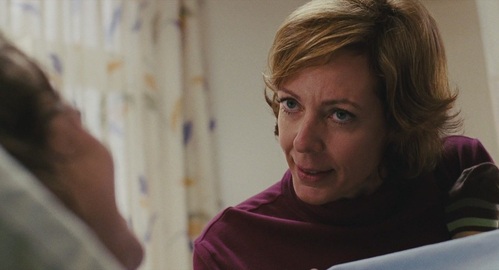
There’s a scene early on in Juno where the audience meets Allison Janney’s character, Bren MacGuff, and learns about her dog obsession. She’s got sweaters of knit dogs, a dog mouse pad, dog statuettes galore, they’re everywhere. I at least appreciated the absurdity of her character’s predilections, but it also served a purpose in Diablo Cody’s script, namely to knock us off guard. For she is the last person, this stepmother, who we all know are supposed to be evil doers in the world of the protagonist, to support the pregnant teenager. And then, she does, wonderfully, in fact.

And that is why I like absurdity, and humor writing, or in this case, a comic screenplay. It helps of course, that Allison Janney played her, because the woman has some really good timing, as evidenced throughout her Emmy-laden career on The West Wing. For what it’s worth, I would really love to see a series about congressional staffers and the polarization of the political parties, told in the same quickfire and witty way. I hear NBC has a few time slots they could use.

But seriously, humor is not easy to write. Good humor, anyway. Often, it demands accessible cultural reference, or audience identification with the situation and punchline. Some of the funniest stuff out there takes a common experience and turns it around, creating a completely new take, like making an origami swan out of a greasy KFC wrapper and giving it to one’s older brother as a lunch treat, since one had previously eaten the chicken inside that he was expecting to receive. Or something.

I was not a regular viewer of Seinfeld, but Larry David is very funny to me when it comes to showing the annoying side of people, and laughing through it. Elaine, stuck in a toilet stall, begging her neighbor for just one square of tissue paper, George’s unintentional killing of his fiancee because he insisted on buying the cheapest invitations to the wedding, and those came complete with toxic envelope glue, these are moments I remember even though it stopped airing in the last millennium. There’s also something about how humor makes for a full and breathing character—it takes loving big parts of George for viewers to be okay with the fact that he’s relieved he doesn’t have to get married, because otherwise, he’s an abhorrent person. Well, he’s kind of abhorrent anyway, but he’s still got his lovable parts. For me, David sometimes gets a bit too mean-spirited, so I can’t be counted among his big fans, but that’s okay, there’s a long list of folks I have to admire for their contributions to comedy.

All of this is to say comedy writers and humorists are supposed to make it look easy, to tap into our frustrations or insecurities and turn them inside out, exposing the fluffiness on the inside, if our experiences were like socks. My experiences have a couple of holes in them but mostly look okay, thanks to OxyClean. I just try to remember that my goal isn’t to make writing funny, it’s to reveal that finding life funny in general should be documented, in case anyone else agrees with me. I didn’t venture out to be a humor writer because most young writers really, really, powerfully want to write the next great novel, American or otherwise. But the humor kept showing up, like Uncle Lloyd at our Friday night dinners, and we never really knew why he kept hanging out with us until we realized his wife made really awful Van deKamp fish on Fridays and he was just looking for a non-fishy-smelly house. Two weeks in a row of Gorton’s finest imitation cod and we were free. No, I haven’t found a way to banish humor, but I’m not looking for one.

I am the prepackaged fish dinner of writers, and I’m okay with that.

All alone in the moonlight

I had an epiphany yesterday, round about 2 in the afternoon, that I should be contacting LGBT agents for my memoir. Why, I wondered, have I been trying only the mainstream folks—that’s like dressing up in my nerdy best and asking out the lead cheerleader to a rodeo (no offense to cheerleaders who like nerds). Trouble was, I didn’t really know how to find them, aside from searching for them on Google, your friendly neighborhood search engine. And that approach was fraught with danger, read, the Big Bad Fraudulent Agent. Apparently, they lurk everywhere, in the corners of the interwebs, waiting to steal one’s money (I don’t have much, so I’m safe there) and ideas (hey, if they can do anything with them, more power to them!). So I figured that for every name I identified, I’d just double-check them somewhere else. This presumes, of course, that there is a long line of clearly identifiable gay, lesbian, bisexual, and transgender literary agents just lined up for writers like me.

Perhaps I was off the mark a little. Or maybe I can blame the search engine algorithm. I did get some lovely lists of agents, and then . . . then I had to do some text searches. In a list of 100+ agents, there were maybe three or four who admitted they worked with GLBT writers specifically, or who represented gay/lesbian work. This was going to take some time.

I did come up with one name, for the few hours of my effort, and I sent along a queery [sic] to her. And then it was bowling time. I made the hour-long trek, grumbling that my iPod strangely decided not to play about a quarter of the songs I’ve fed it over the years. Damn update.

My bowling mate asked me how I was doing and I said I’d figured out I should try to find GLBT agents. She gave me a look.

“See, and I thought you were all smart and stuff,” she said. I lovingly punched her in the shoulder.

I figured the hunt for an agent would be renewed in the morning. But again, it’s like looking for a four-leaf clover. I’ve already gone through the small gay presses and not heard so much as a ping back, but looking at their book releases I can see why. I don’t write about being drug-addicted, or living in San Francisco, or going through a string of abusive lovers, or being homeless, or anything else edgy. I do write about mental illness, but well, that’s been done by very good writers. I write about the wonderfulness and insanity of city living, and we all know that great writers have tackled that one, many times over. So I think to myself, well, being an Arab American formerly gay transgender professional city-turned-country dweller who survived a bout of major depression, a bad relationship, and a dozen years of Catholic school, and grew up in a mixed race and ethnicity, mixed religion household in New Jersey and somehow came out of it without a Jersey accent, well, there are some marketable things in there, somewhere.

I’ve been working on something like a short story a month, cranking out the ideas that have been crowding around for attention, and then launching into rewriting for a few versions before beginning another one. I’m sure I’ll go through and revise them again, but my point this winter was just to keep writing, identify my best simmering point of productivity, and play with all of the things I love about the craft of writing, until I either decided it was time to go back to the super/stupid power story (in which queer folks save the world) or I decided to tackle another long-form project. The superpower story needs a major rewrite/redesign, and I have to change one of the stupid powers because I really can’t allow myself to reference Dan Savage anymore, after he came out with that ridiculous column last week about the Washington State Attorney General.

I’ve got a good outline for a mystery novel I began a few years ago, and I’ve wanted for a very long time to tackle a memoir or close-to-real story about my childhood, centered on my epilepsy. Really, I’d like to try to relay the experience of having memory gaps and false memories that petit mal and grand mal seizures gave me. They each had their own strategy. The petit mal seizures (which no one calls petit mal anymore) stole time away from me, leaving me hanging in the middle of a sentence and restoring me, many seconds or half a minute later, either attempting to finish what I’d started, or leaving me disoriented about my thoughts. My mind was wracked with 90 of them a day before the doctors—who wouldn’t tell my mother what was wrong with me—got them under control.

The grand mal seizures (they’re not called that anymore, either) played a different trick. They filled in the lost time with whatever my child’s experiences could cobble together. Singing Thanksgiving carols around a grand piano my school didn’t own. Winning the Showcase Showdown in a bright orange t-shirt. Seeing buildings by Route 33 in Hightstown burn to the ground and feeling, really feeling, the thick wave of heat it gave off. I’ve spent hundreds of hours thinking about this book, even as the gender change story was more urgent for the telling of it. I want to write this book in a way that isn’t trite or cliche. Agents apparently loathe book openings with dream sequences, but darn it, false memories aren’t dreams. They’re closer to near-death experiences, in the way I’ve encountered them, like reaching to a different plane or a sticking one’s face into a parallel universe for just a moment and then trying to write down everything seen. I want to write this book.

And I’ll write it even if there are no agents for it. Because writers are supposed to just push on and write.

Block’s writer

Gutenberg BibleI’m sure we’ve all heard the narrative a hundred times over: I’ve been a writer since I first held writing implement to fingers. And my Mom loves my stories, and all my friends say my book is a bestseller. And then we’re supposed to laugh condescendingly, because this little intrepid person is so clueless, clearly, about the publishing industry. Oh, if they knew about the publishing industry, we think smugly to ourselves, they’d know that Mom’s opinion doesn’t matter, and all their friends are wrong.

Just to give this some dimension, the US published 172,000 books in 2005, according to the geeks who count such things. Of these, let’s be generous and say that 200 of them counted as “best seller” status. (Anyone remember French Women Don’t Get Fat?) That’s one tenth of one percent of everything published that year. Of course, most of these books don’t even dream of topping any list: Unsolved Problems of Noise and Fluctuations, a fantastic tome on physics, probably didn’t make it to people’s holiday wish lists. But even taking just the fiction, memoir, poetry, and narrative nonfiction into account, the likelihood is very, very low, trust me.

This isn’t to say people shouldn’t write down their stories, or whatever things they have cavorting around in their heads. It just means that most stuff goes nowhere, but on a page, in a notebook, or onto the hard drive of a computer. And that’s really okay, because the vast majority of our human endeavor to create the amazing is actually quite awful. Total drivel. Buzzard crap, or that Canada geese shit that turns everything green and stinks of high heaven—hey, it was a life experience I won’t ever forget.

So why write, even? If it all sucks, why bother?

My answer is my answer alone. I write because it gets better when I rewrite it. The third time around, it starts to sound nuanced. The fourth revision I’m making specific language choices, listening to the rhythm of the words, the believability of the dialogue. The fifth time through I may do something drastic, like change the tense, cut the first 7 pages and have the narrative begin at a new point. Actually, I usually chop out my beginnings, trusting that the quotation I heard a long time ago is true: One should start a story like one would pick up a puppy, a little behind the front. I have no idea anymore who said it, maybe St. Vincent Millay or Doris Lessing or Eudora Welty. Now that woman wrote a lot.

By the time I get around to the tenth revision, I’m just nitpicking words and it’s more like talking about nothing at the end of a coffee date than actual editing. I just need to declare it’s over, we’ll meet again someday. At this point I’ve cleaned it up, swept out excessive prepositional phrases, changed sentence structure, evaluated my tone, simplified, simplified, simplified, and attempted to really cast a light on my characters without overwriting them. I like it when readers pick up different aspects of my protagonists, when they almost like the foils to those protagonists, but for the fact that they’re really despicable.

If enough time goes by, my relation to my stories changes. I used to think of this as watching the story fall behind me as I charged ahead, a steam engine train of a person. I now see that we’re both moving, in some kind of random, and certainly unpredictable direction from each other. Sometimes we swing back around, like a comet passing through a solar system every 76.2 years, and old ideas make a new kind of sense to us. But sometimes we never occupy the same space again. Maybe that was the story best understood by my 17-year-old self, and my 39-year-old brain simply doesn’t want to hang onto it anymore. Or maybe I’ll enjoy seeing where I once was in capability, craft, and idea, even as I acknowledge that I’m in a new place.

In any case, I’m glad I’ve written down as much as I have. And while I would be thrilled, say, with an appearance on Ellen, I’m not presuming anything I write would be a bestseller. It’s true that after years of messing around with fiction, with literary analysis, and the reading of thousands of books, I really needed to write a memoir about my transition.

I really haven’t talked about why with anyone except my writing coach, Lea, who has more than one hand on the pulse of the universe and who I see as a really friendly, astute guide through this whole publishing rigamarole. First, I had some demons to exorcise, and writing was the best way to do that. A lot of that writing was just for me, not for any book, and most certainly not for anyone else’s retinas. But it did let some of the experience percolate and then steep, and gave me a blueprint for organizing the past 6 years into a sturdy narrative. There was some motivation stemming from my “mentoring” of a young female-to-male transsexual who was asking many of the same questions I’d pondered at the start of my experience. I’ve spent copious hours online, asking and later, answering the strangely narrow-banded litany of inquiries people have about transitioning: will my family hate me forever? Will my partner desert me? Am I just disfiguring myself? These are really all smaller branch questions that have popped out from one solid root question:

Am I crazy?

The answer none of us wants to admit is, maybe. Maybe we/you/they are crazy. But we’re probably not crazy, because crazy people don’t formulate questions on the Internet, research their options in a rational way, get opinions, sift through information, try different methods of managing what turns out to be an illness—crazy people behave less from a place of information gathering, and more from a place of irrational. Crazy people respond differently to the therapies around gender identity dysphoria. Transsexual people see their happiness and sense of well being increase dramatically after even the most mundane or simple changes to their sex and gender identity.

Could a memoir bring these points across? I thought so. Could I tell a story in which a fairly ordinary person realizes something extraordinary? And has the daring to see it through? Could I make getting a sex change seem like the right notion for a protagonist? I thought about it and decided yes. I don’t think I’m the trans Messiah; this isn’t an especially rare narrative, even as it’s certainly a twist on the boy meets girl tale.

And heck, in this memoir, there is boy-meets-girl, if readers are okay with boy-who-used-to-be-girl-meets-girl-who-usually-likes-other-girls.

Perhaps agents think the concept is too out there, and that’s why I’ve had trouble selling this. But I believe in this story and this project. I know that there are thousands of people who would guffaw at the hilarity I’ve lived through, and fret through the hard parts, and have questions like I’ve had, about medical services and people’s judgment and how strange it is to see the world through completely new lenses. I have faith in this book, and I just have to keep pitching it, even as I work on other stories that want their 15 minutes of fame on my keyboard.

I used to spend a lot of time getting stuck as a writer, but then I pushed through on the memoir project and now everything I bottled up wants to come out to play. And that’s how I know the memoir is a story that needs telling. And though we may cross each other in space at some point, hurtling in new directions, it will retain at least a core of interest for me, and hopefully for some agent and publisher out there.

And hey, my sister thinks it’s great.

Excerpt from Bumbling into Body Hair

This is an excerpt from the memoir I’m shopping around. I’m not going to provide any context because there’s no point in extra yammering.

Bumbling into Body Hair: Tales of a Klutz’s Sex Change

Lying on the couch after my surgery, time stopped having meaning. I went off the Gregorian calendar and started one of my own. On Day 12 of the Drains from Breasts of Yore they started accumulating a cloudy brown fluid. However one defined “good,” this wasn’t it. I called the doctor’s office twice in two days, but both times they said to be patient, slow down, stop being so active, wait until they’re putting out less fluid. Two nights later I checked the right drain. I had obviously transitioned to Kermit the Frog, looking at the green fluid in the floppy drain cup. The tube itself was clear yellowish. After thinking about how few things in the human body made it to that part of the color spectrum, I called the doctor’s answering service, saying simply who I was, my phone number, and what was happening. Nobody called me back.

When I’d called on Friday, otherwise known as the Day Before My Bodily Fluid Celebrated St. Patty’s Day, I told them that my partner was heading out of town this weekend and if I’d need a person with me to get the drains out, could we please do it now? She said not until the drains were producing less on both sides.

“Now, you’re in Philadelphia, right?” Good Lord, she’s not pulling a chart, is she?

“No, I’m in DC,” I corrected.

“Well, still, they need to be making less fluid.”

The following Monday, now called the Day of the New Week of Oblivion, Nurse Barbara called me to say, “Your drains have been in a long time. Come in today so we can take them out.” I asked, gently, again, if I need someone to come with me. “That would be advisable, yes.”

Somehow my direct payment of $7,000 didn’t preclude me getting a different answer depending on whom I talked to. No, you can’t come in on Friday and it will be fine if you come alone, and no, you should have come in before and you really should have someone with you. How about I split the difference, I wondered. I’ll agree that I should have been allowed to come in before, and I’ll come by my own self.

I hoped I’d be much happier once the drains were out, if only because cleaning myself wouldn’t continue to consist of a series of soapy and wet washcloths while standing over a sink.

*   *   *

The fluid saga had not ended. I was getting dressed for work, which, 3 weeks post-op, included stuffing my surgical vest with maxi pads, to increase the compression on the hurt parts and help speed healing. Maxi pads, to their credit, have a nebulous outer layer kind of like a black hole that sucks in material at terminal velocity, crushing it into an infinitely small, infinitely dense piece of matter. When connected to wormholes, by the way, they deposit all of this material into a new location. Thus it was possible, I theorized, that our universe had been formed by the big bang of millions of crushed maxi pad deposits.

So I was getting dressed, and I snagged a suture on the left side of my chest in the maxi pad. It hurt beyond description, which I articulated by screaming. Being a maxi pad, I couldn’t get the suture out of it, so I tiptoed to the bathroom, holding up the vest/maxi pad combo, for of course I stuck the adhesive of the pad to the vest. I tried not to jiggle the suture and was fortunate that brand new man boobs weren’t prone to such things as actual jiggling. I cut the suture, still feeling pained, covered the cut end with some paper tape, and proceeded to finish getting dressed. I got in my car, thrilled, somehow, to be commuting again.

Four hours into my workday, I was beyond uncomfortable. It felt like I’d pulled a muscle, or cracked my sternum, or something else awful: a searing, stabbing pain that took the place of whatever else had previously occupied my thoughts. I muddled through the rest of my day—my supervisor had been keeping my workload low, out of sympathy or a seething need to get me off every project—and left a little early. The second I got home I ripped off all my shirts in a “get the leeches off of me,” way, not an exotic dancer way. Nothing looked wrong. The tape was still there. The incisions were clearly healing. But it felt like something was pulling the sutures out. It was a little like when I’d had shingles, years earlier. I took a few ibuprofen and tried to feel better, but the pain just got worse. I called the surgeon, who said that pulling a suture may have damaged some of the scar tissue, and that it was a painful thing to have happen, but should be better in 24 to 48 hours. She thought ibuprofen was a good idea, too, since it’s also an anti-inflammatory. I didn’t sleep well, but I made it to 5:30 a.m. And I woke with a new friend: the return of Bertha, my old right breast! It was the morning of Breast Resurrection Day.

Bertha appeared to be very irate at my choice to excoriate her. She was red, hot to the touch, and something like a B-cup. As the day went on Bertha decided to install an addition under my right armpit. I called the surgeon’s office again, and one of the nurses said, “oh, you can’t have an infection this late. Just rest up and don’t be so active.” Always with the “not so active.” What were they, paid by the junk food lobby? And what was that about a 2-week recovery period again?

In two more days, otherwise known as the Day of the Breastal Revolt, Bertha had turned hard to the touch. She felt like the pectoral muscle of the statue of David. Only this was not what I’d had in mind for rock-hard musculature. I called the doctor’s office again. I got the nurse to agree to call in another antibiotic prescription for me, and she sighed while I said I had to look up the pharmacy number of the CVS near me. She reminded me that it’s “very, very rare to have an infection this far out.” More likely was an allergic reaction to the sutures. But who could know without looking at me?

I posted my symptoms online and asked if anyone knew what I was experiencing. I did research on mastectomy outcomes and incidences. I told my friends I didn’t feel well, and I started to feel crazy for having such a hard time. Not to mention guilty for not going to work.

Susanne flew back in Friday from her interview in California after getting bumped off of her original, earlier flight. I felt like death in a frying pan. That night I woke up several times with the chills. I was sick of something being wrong. I sat around a lot all weekend, although I did go to a “Friend’s Thanksgiving” dinner, assuming I could deal with sitting up for a few hours. When two of the dining attendees broke out guitars and amps and started messing around like stinky 13-year-old boys, I turned in for the evening, Susanne nipping on my heels. I noted quietly to myself that if I were ever in a band, I would only do my music with friends who also liked to do that with me, or ask them in advance if they’ve brought their ear plugs.

Regular names of the week came back to me as I renewed my full work schedule. Monday and Tuesday I’d been signed up at work to go to an annual recap of the literature in my field, so I figured if I could sit at home, I could do it in an office building, too. I went home early the first day and kept cursing myself for not feeling well. I couldn’t make it past six hours of sitting. Why am I such a baby?

Wednesday morning I had my quarterly visit with my endocrinologist, who was also an internist. Susanne and I were happy that some medical professional was going to actually see my face. Ace looked at me with my shirt off.

“Holy shit, Everett!” This, the man with no sense of humor or intense expression. He ordered me to call the surgeon, and I told him I couldn’t seem to get past the nursing staff. I’d only managed to get to the doctor once on the phone.

“Look,” he said, actually expecting I would then look directly at him, “she took you to the dance, she can take you home. No other doctor is going to go near this.”

“Hey, you watch how you talk about Bertha there.” He grinned.

“Just go up there and insist that she see you.”

Oh my God. It must really be bad.

I left his office and called the surgeon’s office once more, getting one of the nursing staff.

“I’ve got a 100-degree fever now,” I said.

“Well, a 100-degree fever isn’t that high a fever,” she replied.

What, I was going to need to cough up a kidney before they said yes to me?  Was there a magic word I was missing here? Open sesame!

“My internist told me I had to come see you.”

She suddenly got interested. “Oh, is that an option? Where do you live? Are you local?” Had I not told them I lived in DC in each and every conversation?

Of course, I thought, people fly in for this from everywhere. They probably don’t do a lot of follow up on FTMs.

She told me to come in the next two hours. She didn’t realize I was still in my car, illegally on my cell phone. I saw that snow was starting to fall. I had to get out of the city, fast, before people started walking around with A-frame boards pronouncing that the end of days were nigh. The first winter snow in DC always brought out the hysterics.

I spent the next 90 minutes driving in the left lane behind nervous drivers going 30 miles an hour. My chest throbbed, my pulse, which was already too high, was pounding, I still felt terrible, and I walked into the surgeon’s office. They took me to an exam room and I undressed and showed the nurse my chest.

“Those are stretch marks,” she said, looking at the red lines streaming across my torso from the incision line.

“I don’t have stretch marks,” I muttered. Wow, I feel like crap.

“Sure you have lots of stretch marks,” she said, arguing with me, apparently concerned for my general health, if not the acute problem that had gone unchecked for more than a week.

“I don’t have stretch marks in the middle of my chest!”

Yelling did the trick, and Nurse Barbara left the room, dismissing me with her departure. Another more daring nurse came in and saw me.

“You have cellulitis.”

“Itis,” I knew, was a suffix that means, to us laypeople, infection. Cellulitis is an infection under the innermost layer of skin, and it is bad news, because it quickly becomes septic, meaning that it can travel to one’s bloodstream, and then one is in for a bad ride. It was like Dr. G, Medical Examiner bad. The surgeon came in, scrubs on from just finishing up someone else’s top surgery. Her smile disappeared as she took one look at me, and she immediately started ordering all kinds of supplies to the room, things with names I didn’t understand. They took off my opened-up shirts, and the doctor gave me a local and then opened up a few of my stitches. This is when I peed out of my rib cage—at least it felt like peeing, as I had a sense of relief, and warm liquid streaming over my skin. Well, I don’t exactly pee down my legs, but it was the closest life experience my brain could register, and it’s what occurred to me as I was being aspirated. I felt a big dose of happy as the disgusting ooze left my body. And it was a strange experience to watch my chest deflate. I could almost hear Bertha screaming like the Wicked Witch of the West, “Nooooooo, water, nooooooo, I’m mellllllllllllting!”

The surgeon looked at me kindly as I side-urinated. She put her hand on my shoulder. “I’m sorry, Ev, you’re the one percent outcome.”

“I’ll go buy a lottery ticket,” I said.

They gave me an IV bag to re-hydrate me—for all my liquids had been going to Bertha the Undead—and a strong antibiotic. They put in a new drain on that side, a floppy plastic tube with no collection cup. I stayed in the dark room for a couple of hours, drifting in and out of sleep until the bag was empty. I returned two days later to get my side rechecked. It looked much better, even though I had some more recovery to do now. I saw the surgeon again a few days later, now clearly on her radar screen. She’d even given me her home number so I could call her directly. And I had finally earned my VIP pass with the nurses.

Long writing journey into something

Ever since I read in Stuff White People Like that Moleskines are a staple of white pretentiousness and posturing, I’ve been self-conscious about mine. Christian Lander had me nailed, right down to the MacBook Pro sitting next to it as I sipped at a non-fat latte in an overpriced coffee house. At least I hadn’t procured mine with a credit card—I’d scraped together cash from around the house, on the premise that if I only used loose change, it was like a free purchase, like how sucking on a mint after an outing to Sonic is free of calories. How idiotically white of me.

mocha latteTo make matters worse, this is not my first Moleskine. It is, in fact, my second. And if anyone cared to study this little black ruled book, they would discover a “2” written  in on the bottom, where the gold leaf should be, I guess.

Perhaps it’s better that I used up a whole book already, because at least I write in them, and no, they’re not just full of grocery lists and directions to IKEA.

I also don’t have anything in here worthy of da Vinci or Hemingway, two of the Moleskine’s more famous users, and Hemingway was a stuck up misogynist anyway. His best short story is six words long (his assertion, not mine).

No, I write in this notebook to keep track of query letter submissions, the inevitable rejections, submissions to journals, and the places I might submit to someday but for what I consider exorbitant submission fees (read, $10). I also keep track of my work in progress’ progress, scheduling deadlines for myself like an agent or editor would. That way I can have arguments with myself over why I’m giving excuses on missing important dates and don’t I know what this is doing to my career, and who is going to want to work with me after this?

I’m sure I still have my mind. It’s right in a box over there.

All of this ponderance about Moleskine notebooks comes because I’m sitting at PDX airport waiting to meet my mother who will be visiting us or a week. A technology professional is at the table next to mine, speaking loudly into his cell phone describing the apparently delicious and speciously nutritious drink he’s just purchased from Jamba Juice: a little bit of banana, strawberry, and mango, he declares loudly to his wife, plus some SOY PROTEIN! and ESSENCE OF WHEATGRASS! It sounds particularly disgusting to me, but then I’m the schmuck with a $4 nonfat mocha in a world-preserving, 100% recycled cup, so what do I know? And writing in a Moleskine. Damn Moleskine.

I don’t feel particularly pretentious, but then again, white people never do. We’re pretty much blind to it, save the very extreme examples—here I’m thinking of German avant garde artists from the 1980s, or say, people from Massachusetts named Biff Wellesley or Chauncy Milton who wear plaid shorts unironically and race in regattas around the Cape. Maybe I feel a bit incognito partly because I am sans my titanium Apple accessory this evening, and partly because I am in green cargo pants and a black hoodie. I fit right in to PDX, the city, not the airport. Come to think of it, who nicknames their city after their airport? I bet if I asked everyone in earshot who had a Moleskine to whip it out and wave it like they just don’t care, 39 percent of the folks here would be showing off their pretentiousness inside of 16 seconds.

The airport announcer is saying, for the fourth time, that Jesse Bauer really needs to meet his party at the Panda Express. Jesus, Jesse, get moving, their dinners are going to get cold.

I left Walla2 right after receiving notice from an agent in Seattle that they just didn’t quite connect to my manuscript, so they won’t be moving forward with me on this project. Moving forward. I note that they didn’t rule out moving left, or upward. Perhaps those options are still open.

My mind reads this rejection sentence and immediately thinks of a shoreline. I’m not sure why. Perhaps it goes back to that oft-repeated line about the footprints of Jesus as he carries his ignorant follower who somehow doesn’t get that hello, JESUS IS CARRYING YOUR DUMB ASS. I’m not sure with whom I’ll be moving forward, but if Jesus is doing any agenting, I’m open to the idea. I bet he could work wonders with publishers, yuk yuk.

She went on to say in her letter that it wasn’t me, it was her, and just, perhaps, a matter of taste. This Dear John letter tone didn’t sit well with me. A matter of taste? She was looking for a Prada clutch, and I was a Jacqueline Smith pocketbook on the clearance rack at KMart? Or perhaps it just wasn’t what she was looking for right now. Maybe three years from now humorous memoirs about klutzes who get sex changes will be all the rage. But why say perhaps? Doesn’t she know? It’s her opinion she’s offering.

Well, it comes down to platform, I get that. Mr. Dan Savage of the Stranger, another GLBT author working with a Seattle agent, has readership. So okay, I’ll work on having a platform and see if my words suddenly sound better, or become more connectable to people.

The second paragraph of her letter was just as brief. She wanted to encourage me to continue trying. I genuinely appreciate that. But why? Or more to the point, how? She said there was much to recommend about my writing. What, specifically? The font? The careful avoidance of split infinitives? The witty banter among urban dwelling queers? What? I’m left, as after my other rejections, in the middle of a guessing game. So far, my guesses have been wrong, if success is measured in contract proposals.

But I’ll tally ho and try again, because I am a writer with nothing to lose. JK Rowling got 13 rejections of her original Harry Potter book. I have just surpassed her with this 14th rejection.

Take that, JK!

Speaking of lies

I try to listen when the universe at large brings up points for me to consider. A few weeks ago, the message I heard was “be comforting.” I was actually told no fewer than three times, by three entirely different people—a student with twitchy senioritis, a transgender woman on the edge, and a professional who is having difficulty with a superior—that my words to them were comforting. These conversations happened in the midst of the anguishing last stages of a woman’s life here in town, a woman about whom I’ve written before and for whom many people have a particular fondness. And as I’ve seen her caretakers looking increasingly exhausted, the concept of what is comforting, when, and for whom have swirled around in my head. We often forget, it seems, to support the caretakers, and they, the front guard, need a lot of comfort themselves.

On another level, we attempt to provide comfort for the terminally ill, in the form of hand-holding and increasingly desperate dosages of opioids. It’s the medical equivalent of building a sea castle. We wring our hands when we fear our efforts aren’t enough, and of course they’re not enough. And so we hope that our well wishes, our prayers, our food offerings—for surely they can’t concentrate on cooking, for God’s sake—will do enough for now. Sometimes hope and a bite of warm supper is all we have.

The message this week, if I’ve got it correctly, is not to lie. Surely this is something my parents and a plethora of clergy attempted to teach me when I was a child. The script back then was simply that lying is wrong, a concept predicated on a young person’s monolithic understanding of morality: you do right just because. You avoid doing wrong just because.

What I see about lies now, on the cusp of my fourth decade, is the devastation in their wake, like the wrecked ideals of a partner who has put such effort into someone he then realizes doesn’t have his best interest at heart. Or the sudden calamity that avalanches down on a person who gets laid off after disingenuous promises from her boss that she can trust him. It’s not the lies themselves, necessarily, that are wrong, because who really wants to hear that they look awful in their favorite pair of trousers, it’s the shock wave from the lies and the intent in the heart of the liar that we want to avoid.

In an online writing chat today there was much discussion about lying in fiction. Yes, I know, it’s fiction. I think “lie” stood in, on several occasions, for “believability.” It does raise an interesting question to me. We’re so quick as readers to spot flaws in what makes a story believable or not—we come into a book with cynical expectations and have our guards up for the first sign of trouble. But these are just books. Raise the stakes and talk about people and relationships, ask us to make an investment in what they mean to us, and we become myopic, willing to believe even preposterous tales just to keep our vision of reality stable. And then we lose, bit by bit, our own sense of well-being and comfort, because while we may not want to admit to it, our confidence erodes under the constant swell of those lies.

I am not immune to any of this, and when I was ten, fifteen years younger, I went to lies as a coping strategy, oh sure, I did. I am a storyteller, after all, but I’d lost sight of where make-believe was okay and where it wasn’t. I’ve spent time in the prison camp of cowardice, aligning myself with dominant personalities and then wondering how I could squirm out from under them. Mostly I just figured out how to exist in the cramped space they allowed me, but one of those survival skills was lying. It didn’t even matter after a time what the lie was about, as long as I had something all to myself, a tiny corner of truth about which they didn’t know. These were infinitesimally small victories; stacked all together I could have fit them on the head of a pin, but they were mine, mine, mine, and somehow they were enough, mostly because my dreams were absurdly small.

And then, though they were so tiny, they were numerous, and like the Big Bang that arose out of a submicroscopic particle, they exploded all over me and I had to admit to them and myself what I had been doing. I was a juggler of little lies who had slipped. But it helped me to see what a waste of time all of that nonsense really was. I hadn’t been ready to let go of them, but they left all on their own, and lo and behold, I found new ways to meet people. In fact, I met better people, ones who would never corner me until I found my 5-year-old self’s coping strategy. It was like moving to a house with a dishwasher, me promising never to go back. Who wants to go back to scalding their hands, after all?

I’m inclined toward direct, unwavering truth-telling these days, even as it has sometimes meant making difficult decisions, like oh, turning my life upside-down and living as the opposite gender (and not just so I could write a book about the experience). But it is a life unafraid, at least.

And uh, I take comfort in that.