 There is nothing that fazes the Seattle barista. She is self-assured, extremely well trained, and fearless. Every possible additive, custom request, and black market good has probably been mixed into brewed coffee in this city. I bet I could even find a barista to take my order in Klingon. (Not that I know Klingon.)
There are as many kinds of coffee shops in Seattle as there are permutations of coffee drinks. The sit and work shop, with loads of sturdy tables and electrical outlets. The drive-through shacks that look ready to fall over. Fancy, plush shops with comfortable seating but few places to hook up a laptop. Evil shops that make patrons pay for the wifi. Well, we all know I don’t spend any time at those.
If coffee shops are the standard bearer for commercial space in Seattle, then there are a few set uniforms one wears within their confines. The options, it appears to me, at least in my first month here, include:
The Very Serious Not Happy Rather Intense Intellectual—Ninety percent of these folks are men, because women have difficulty becoming quite this pretentious. Black hooded sweatshirt, rumpled jeans that, if one were to venture close enough, would smell of the carpet from the wearer’s bedroom, and black sneakers. At the height of summer the footwear could be flip flops, but only because the sneakers couldn’t be found under yesterday’s jeans. Optionally this person may be wearing thick black glasses, retro styled. It is questionable whether his eyesight warrants correction, however. But be quiet around him, because he’s writing something very important, and he doesn’t want his craft interrupted.
 The Hat-Wearer—Also mostly of the male persuasion. We’re not talking baseball caps, either, since those are so omnipresent as to be unremarkable in every way. We’re talking either the old man’s wool cap like the one here, or the plaid Fedora hat, like the kind popularized by Jason Mraz. They’re definite statement-makers. Nobody puts on either of these head toppers without giving a good stare at themselves in the mirror before leaving home. Should it be cocked a little to one side? Tilted back? Pulled down low? Hmm, so many options to consider for one item. They’re clearly just accessories, as neither does anything to say, keep one’s ears warm in the winter.
The tech geeks—They have walked so far from their office, maybe even three-quarters of a block. They shield themselves from the bright lamp in the sky the rest of us know as the sun. They keep their work badges clipped tightly to their clothing, lest some non-techie refuse them reentry into their natural environment. These are the folks from Yahoo! or Amazon or Microsoft who felt some need to get caffeine from some place other than the 14 Starbucks in their office building. Nevertheless, all they talk about out in the real world is work. Fortunately for the rest of us in the coffee house, they never stay long. Their badges may self-destruct if they’re too far away from their computers for long.
The Shoppers—Lest everyone think I’m sexist, I do admit that this species comes in male and female versions. Few coffee shops in Seattle are all that far from some other retail establishment, zoning being what it is. They’ll sit down with their bags from REI, or Anne Taylor Loft, Sur La Table, or Banana Republic, drink up some brew, and head back out for round 2. We should all thank them for keeping up their end of the economy-consuming bargain.
 The Holders of the Blackberries—At first, they look like good friends. Old friends. People who are out in the world, enjoying each other’s company. But then, almost with no warning, the small electronic devices are drawn, like guns at high noon, and then there they are, cramping their thumb muscles, scanning for some tiny typed email that they’ll care about for the next 18 seconds, however long it takes to scroll through, whichever comes sooner. Unless whatever missive is of interest to both of them, they’ll fall silent, typing and scrolling, clicking and chewing on their lips, lost to all of us in their hyperspace environment. And just when one forgets about them, up they’ll pop, back in our shared universe, giggling and tittering, or guffawing about the stupid spam their friend just passed along to them. Oh, those LOLCats are funny!
Despite all of this, I cherish the coffee house as a place to write, because as the youngest of many, I need external stimulation to tune out just to get in my groove. There is nothing worse to me than being able to hear a pin drop. So it’s a wonder why I went with Sprint for my phone service, but that’s another story.
Several writer’s groups in town meet in coffee shops, presumably for their ample flat surfaces and their stimulant-laced beverages. I finally made it to one yesterday, having been flummoxed in my first attempt by evening commute traffic. It was great to meet other science fiction writers, even if there were only two of them, and even if they gave me, individually, conflicting advice. I’ve signed up for a few more meet ups, and overall, I’m sure I’ll have some strong comprehension about how to rewrite my novel in progress. And if I don’t get that, at least I’ll have met some fellow lit geeks along the way. As long as the blackberry people stay away.
Just to note, Everett Maroon owns a black hooded sweatshirt, black plastic glasses, an a Kangol hat. But not a Blackberry.
Note #2: Scott Perkins has decided to take some kind of offense to my blog post and make it all about him, but at least he had the courtesy to offer a defense of his hat-wearing, which, cleverly, is apparently for the protection of the people around him, and not his own laziness at styling the hair on his head. Well done, Scott!
 I went back to Whidbey Island yesterday to hear
  A couple of weeks ago,
  Here’s the stereotype: the serious writer, a man of some undisclosed age, forehead pressed into wrinkles of determination, a bottle of almost good Scotch on the desk next to his trusty typewriter, pounds away on the keys creating the Next Great American Novel. Cigarette smoke hangs in the air from the three packs of unfiltered goodness that were previously consumed. He writes in isolation, lost in the characters, nuance, and craft.
 This is a great analogy, one that the mean, bitter, isolated writer would spare no effect to mock, but it shows the importance of community: a reminder that we face the same struggles as unpublished (and even published) writers, and we all sting when we get another rejection or have another challenging writing day. Community is vital because we can put our few data points together and see patterns—everyone starts somewhere, everyone pours energy into writing well, everyone comes up against what looks like impossible resistance. And everyone thinks of giving up. It’s only when we see that others have been in these positions before that we figure out this is the topography, this is the process. We need to get backed into corners because then we fight for our work. We need to look at our writing and stay humble, willing to revise, always, but not let the bottom fall out and crumple it into the trash or, for 21st Century folks, delete the file and light the laptop on fire. So knowing other writers we have a built-in stop gap to keep us from our most desperate acts when we’re in the throes of self-loathing. Part of the process, part of the process, that frustration.
 Over on Twitter last Monday, folks were conversing about the concept of confession—in 140 characters or less, which is more demanding that it might seem at first glance. It got me thinking, as good conversations do, about confession. According to Merriam-Webster, confession means:
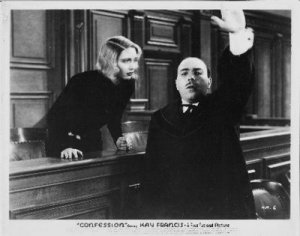 Confession can sure be hokey. Or absurd and unbelievable. It seems to me that confession is a pretty good barometer of how well one’s plot is holding together; if the confession seems funny when it’s serious, or causes eyerolls for the reader, it’s a bridge to far, and that means the plot has gone too far on its own out of solid story territory.


 Trans/plant/portation