Tag Archives: Walla Walla

A life without poop

Sherman Alexie, writer of War Dances and The Absolutely True Diary of a Part-Time Indian and many other books of every writing style out there, came to Walla Walla last night. I hadn’t seen an Indian perform in oh, a year or so, not since Tomson Highway came to town, singing and telling stories. Actually, with so many native folks around here, it’s interesting that I don’t see them more often, not that I expect them to have neon signs over their heads, blinking “I’m an Indian!” That’s only for my fellow middle easterners, because we’re the terror threat. So Alexie came to town.

sherman alexie, authorHe’s self-deprecating, earnest, childlike, but also a touch cynical, down to earth, pretentious (admittedly so), and very literary. He’s also really prolific, having authored something like 628 distinct works of writing. Okay, it’s not that many, but it’s a lot. Every time I’ve seen him he’s been dressed like an absent-minded English professor, slightly worn sports jacket, dress shirt, open at the collar, jeans, khakis or some neutral chino trousers, and no tie. Tonight he had on a tie and a velvet smoking jacket, and all I could think was, I’ve never seen him in a tie. Won’t he get hot in that jacket?

I convinced Susanne to leave early because even though this reading would be taking place in the largest auditorium on campus, it was going to be packed. It’s not like Walla Walla also had a jazzfest, an opera, two staged plays and one movie on the green to compete with. And people absolutely revere Alexie, as well they should. She gave me one of her “Ev’s being funny again” looks and we left with 15 minutes to go to the performance. This was probably okay, as everyone in Walla Walla is late to everything. It’s as if everyone gets a 10-minute grace period. The only time this rule isn’t in play is when approaching an intersection with a yellow and sometimes even red, traffic light. At that point, grace periods are not in play and one must proceed to move as quickly as possible, through said intersection.

So we walked the block from our house to the lecture hall, and really, there was a stream of other people walking from all directions, direct to the hall. We were suddenly book zombies, being called by our leader to watch him turn printed pages and move his mouth with sound coming out. Susanne noted all of the others going to see him and told me I was right, to which she quickly added, “in this one instance.”

We got pretty good seats, smack in the middle of the room, roughly halfway back from the stage, and I was pleased as punch with myself (and actually, I don’t know what that means), until two others came and sat next to us, absolutely reeking of cigarette smoke. Cigarettes are bad enough, but when the smoke gets stale, like beer that’s been left to soak into a carpet for a week, it is gut-wrenching. A few minutes into sitting there, and we both had headaches, although I suspect it was just me with the bad college flashbacks. There was an open seat one chair away, so we moved over, hoping not to cause any drama.

He started off by reading some of his poetry, which I can appreciate but not replicate in any meaningful fashion. I like some repetition, I love the idea that poets could sit for days and weeks trying to isolate that one exact word that would perfectionize the poem. I don’t have any time for that nonsense, honestly. I love rewriting and I love craft, and I genuinely want to play with phrasing and word choice and meter, and I aim to do those things, but I can’t just suffer the slings and arrows while scrambling in my dictionary for perfection. I want my writing imperfect. I’m imperfect. But I do appreciate poets, and Alexie is a very good very good poet. He’s good enough to stop time for the duration of one small poem.

He pauses after a poem and begins this cycle of self-ridicule that is really a critique of white America. Why is he in a tie, he asks. Indians don’t wear ties, right? I tell myself I noticed the tie for different reasons, due to context and my own experience standing under stage lights. I wouldn’t wear one by choice. I tune back into him because he’s turned to another poem.

He stops to tell a story. He feels like he’s home, because he too is from eastern Washington. I suspect his eastern Washington isn’t going to make it to the cover of Wine Enthusiast anytime soon. He tells us what he likes about farm girls, including their calloused hands. He reads a poem about a farm girl he liked, and he clearly revels in the memory of it, or maybe that’s just for show. It’s hard to tell.

He tells us about a time when he crapped in his pants, as an adult, no less. This is because he couldn’t get everyone to raise their hands and admit they poop. So in true Alexie fashion he goes straight to the worst imaginable poop story in his personal experience, which is a little like the Jesus narrative if it was a lot more excretable. Or about excrement. I pooped for your poop, perhaps. He is raising his hand for all of us.

He tells the college students they’re smart, like every reader I’ve seen here tell them, but he quick fires straight away that they have massive amounts of privilege. They’ve probably heard that, too, and they laugh about it like people do when they’re embarrassed but not about to change their behavior. The most magnificent moment of the night, however, came after he was supposedly done reading, during what was a laughable Q&A. You’ve got Sherman Freaking Alexie on your stage, on your campus, and you can ask him anything.

And, silence. Then, out of the ruffling of the crowd, a frat boy-type shouts, “I love you, man!” Alexie looked at him, and in the quiet I felt his message: That is the stupiest thing you could say right now, man.

“I . . . love you too,” he said, raising his voice ever so slightly, as if the possibility of a interrogative would serve to call the entire exchange into question.

Then, another voice, this time rising out of the nervous chuckling making its way through the audience. It took me some effort to attach the voice to a person, but I found her, speaking in a crescendo as she tried to find a volume that would be heard by Alexie.

“Mr. Alexie, I have come all the way from [I couldn’t make out the name of the place] to see you. Your poems mean to much to me. You have saved my life.”

Again, he spent a few seconds taking in all of her and what she had said. He put his hands together and bowed, and then read the poem When Asked What I Think About Indian Reservations, I Remember a Deer Story. He read it to her, just for her.

Note to self: chai means spicy

I’ve got a reading coming up Sunday evening as a local performer in the Tranny Roadshow, and thus I wasn’t terribly surprised when the Union-Bulletin, the local rag here in town, contacted me for an interview. I mean, it would never have happened had I remained in DC, unless one counts the Mirror company as a reputable newspaper. As it is, the “U-B” as people (affectionately) call it, is a bit more than a stone’s throw from being a paper that one retrieves gratis from the brightly colored  bins that litter the sidewalk like plasticized hawkers near a carnival. Apartment Guide! Great Jobs Listing! FREE Yellow Pages!!

It’s not that I have anything against the U-B, it’s that people I like have things against the U-B. Their Web site needs an overhaul, for one, with a one-inch column in the middle for the actual article content, and a thick bar at the right advertising things I will never buy, even if I live for 100 more years. I just can’t get worried enough about my nonexistent prostate, and I am not going to learn some random mom’s secret for white teeth. I suspect malware is part of her solution, see. But really, my indifference to the U-B is that there doesn’t seem to be any real reason to get a copy. I hear everything I need to from word of mouth or my news feeds. I know when the WW Balloon Stampede is coming, and I’ll be there. The rodeo happens the same Labor Day weekend every summer. If a resident of Walla Walla knows more than 5 people in town, then she probably will hear about every event for the next upcoming weekend that she cares about. If I wanted to know what the Elks Lodge is up to, I need only walk three blocks over and ask them. It’s just not that big a town. And I’m sure they know that’s a stumbling block to keeping revenue up.

So maybe I’ve been missing out by not procuring the U-B regularly, and now that one can’t read their articles online anymore without subscribing (even the New York Times is cheaper), perhaps I’m too cut off from the goings-on in my own city. After all, Walla Walla is light years away from having any interest in a Wallist-type blog.

The other thing that concerned me when I got the reporter’s email was that my bleeding heart liberal friends tell me the U-B is unflinchingly conservative. Now, I don’t care what they do in their own home, but I don’t want that stuff shoved in my face, know what I mean? Just what kinds of questions were they going to put to me regarding something called the Tranny Roadshow? On the other hand, I’m the one peddling my sex change memoir to every agent I can Google, so I’m not exactly hiding in a cave.

I thought about her offer, and talked to a few people, and said okay, let’s meet up. We agreed to meet at Cafe Perk, in the middle of downtown, which granted, is two blocks wide by six blocks long, but it has a heart, damn it. I tend to go to this place only when I’m having a meet up with someone, because the Patisserie has too many people I know in it, and I don’t want to blow the feeling of just rightness that I have when I’m trying to bang out another chapter or short story with memories of invasive questions and avoidant answers, the kind of repartee that Sarah Palin wishes she had with Katie Couric.

I got there a little early on Monday morning, and ordered a nonfat chai. I forgot to specify a vanilla chai, since out here in the Pacific Northwest, “chai” means “burn your mouth out” and true to form, I felt the tastebuds on my tongue sizzle and die. For some reason this made it a little difficult to speak, like I’d experienced when I’d gotten my tongue pierced at 28 and the thing had blown up to twice its normal size. Three days later I was fine, I swear, but in the meantime I sounded like I was wearing vampire teeth. Great. Maybe my mouth would settle down in the next 8 minutes.

It did not.

She seemed extremely young, like 4, so maybe she was a prodigy or maybe she would just ask softball questions, not wanting to get into the nitty gritty of What It Means To Be Transgendererer. I smiled. She looked like she was from Minnesota. Very Nordic. I guessed her father’s name was Thor.

Gosh, she was just so excited to write this article, to run in Thursday’s edition. Usually she got to write about things she knew. I could picture the small and worn-out newsroom: buzzing fluorescent lights in the ceiling, desk calendars filled with notes (buy ham) and doodles (Obama with horns on his head) dotting the desks, a ripped section of carpet fixed unceremoniously with duct tape, and one very tired entertainment editor contemplating retirement as he reads the press release that just came over the fax machine. Trans what? Give it to the pre-schooler, I’m not handling this.

I decided to give her a break. If I was the first trans person she’d ever met, maybe I shouldn’t be a total card.

We talked about how I’d come to know the Roadshow even existed. It’s not a very interesting story, and hopefully it will be revealed in tomorrow’s paper. It’s true that I met my future wife there, but it wasn’t our first date. I was still in the wake of a crappy breakup with a crappy person who’d spent two plus years being crappy to me, but I noticed that there was a cute, smart woman at the show. So what if our first date wasn’t until 10 months later? When she asked me why I thought people should go to the show, I had regular, plain, somewhat accurate things to say, but I did flippantly include the “you never know, you could meet your future partner there” line. I’m curious to see if that made it in there.

She didn’t ask either of the two worst questions to ask a trans person, which, for everyone’s edification, are:

1. What was your name before?

2. Can you come to the ladies room and drop your pants so I can see your hee haw?

Both of these have been asked of me, one on many occasions. I won’t say which.

She did ask, however, how I identified, and I didn’t want to answer that one, mostly because I didn’t think it was relevant to the article—it would be like asking the bronco riders how they identified as rodeo participants—but also because I didn’t want to be pinned down for all of my fellow residents to read, at least, not until they all jump on some list that gets hung on Main Street listing their most embarrassing moment, because that seems about equal to me. But her manner of asking was nice, almost apologetic. So I said that these terms are in contestation within the trans community and that they have different meaning in mainstream culture, and I didn’t want to take all of that on in this one article as my personal legacy.

See? I should go be a politician. We moved on to the show and I said it would be a lot of fun, tickets aren’t usually free, and people should check it out. She asked why I’d pointed the show organizers to the local liberal arts college. The smart ass in me wanted to reply that I thought it better than sending them to the local Jesus Christ of Latter-Day Saints church. But honestly, I don’t know about venues in town outside of the college. The Fairgrounds seem a skosh too big.

The reporter was nice, nodded a lot, didn’t seem to want to make me out to be a laughing stock—which we all know I do quite well enough on my own—and I felt pretty good after it was over. Now we’ll see, tomorrow, what the editors have done to the story. And come Sunday night, I’ll know how much of a success it was. For all of the LGBT folks in town who don’t get a lot of open air gay time, I think this will be a good thing.

And yes, I’ll pick up a copy of the U-B tomorrow. It’ll be the first one I’ve bought.

Requiem for a job

smurfette in her declineI spent a lot of time thinking about what I should do, occupation wise, when I grew up. I had a poster of a smiling Smurfette sliding down a powerfully bright rainbow, exhorting that girls can do anything. Being a precocious 8-year-old, I aimed straight for the top, Icarus or no Icarus, and settled on POTUS. Why not president, after all? After a time I saw reason, and selected doctor instead. This wasn’t as big a leap as it might seem, since I spent a good amount of time as a child in hospitals and medical offices, and doctor clearly equaled boss. Which is who I was. I was boss, at least until I stepped out of the house to wait for the bus and came into uncomfortable proximity with the bullies from my neighborhood, and at that point I was pretty much clear that they weren’t responding to my personal sense of leadership.

For a decade, I had picked physician, and it’s difficult for me to explain why I was quite so attached to the concept for so long. I was a kid who thought that there would come a point in my life during which I would have learned everything there is to learn. I hadn’t thought about the progress of humans, clearly, but I also hadn’t given any quality thinking time to the space after I’d absorbed it all. What would I do then? Reread it all? Become a globe of light?

Someone at some moment exposed me to the idea of histology, and my dreams of Dr. Maroon evaporated. That just seemed too hard. I went with the wave of young women giving up, perched as we were, at the precipice over the ocean, quietly taking our turns leaping in. So willing, those lemmings. My friends had gone from talking about fighting fires and scuba diving to find new marine life to being secretaries and nurses. Don’t get me wrong, there is nothing wrong with office employment or nursing. There is something wrong, in my book, with giving up on one major life goal due to insecurity, but to add the arbitrary nonsense of insecurity from one’s gender, race, or ethnicity, and the world starts to go off the rails a little.

And yet, even as I write this, there are four women in orbit around Planet Earth. Clearly the confines of the 1970s have relaxed quite a bit. I only had the Space Camp movie and Sally Ride as models and hell, I was a long in the tooth teenager by then, my fate already sealed. Okay, of course it wasn’t but I also believed, having not yet acquired a distrust of stupid talking people, everything adults said to me, even when they were clearly incorrect or limited statements. For example, upon graduating high school after 12 years of Catholic education, I honestly believed that people were only ever one of the following:

  • Catholic
  • Jewish
  • Protestors

I have no explanation; we all had to take world religions our third year of high school. I read about Confucius and Hinduism and the Qaran, but I didn’t see those kids in my world, so they must not have been in the United States, or at least, New Jersey. But these contradictions didn’t worry me one bit; I bought what was told to me soup to nuts, and trusted that I was not science-y enough to be a physician. I did get praise, however, for my writing.

rorschach inkblot testWriter, however, was not a word that instilled happiness in my parents. It sounded to them like a straight shot to poverty and narcissistic delusion. Before I could blink my mother whisked me off to Philadelphia to take a battery of tests otherwise known as career counseling. I sat in a wooden chair for 6 hours filling out Myers-Briggs questions, a Stanford Binet IQ test, ink blot and other occupation-oriented tests. And voila, a couple of weeks later, a lovely letter came in the mail with the answer, as if a civil servant and a carnival fortune-teller had a love child with a fixation on material wealth.

I was strongest in expressing myself, I had a genius ability to handle spatial relations, and I was scraping genius on verbal ability, with an exceptionally average ability at math. So of course they decided I should be a lemon grower. Okay, they didn’t say lemon grower. And sadly, there is no Lego Building major at our institutions of higher education, anywhere. The letter said I’d be good at mass communication, journalism, writing, and oh gosh, this was probably the worst news for my parents. And now they were out $400 to boot.

I considered a career as a book editor. That was steady salary and I still got to play with books and words. And suddenly, it was my career path, until I realized that I could easily lose my mind doing such a thing.

I hit college and realized I’d been letting everyone else make my decisions for me, however well intentioned they’d been. I took classes in television writing and directing, only to learn that collaborative writing entails other writers, who are sometimes burned out, sycophants to someone else, or mind-numbingly closed off to learning new stories. One workshop had Sally Field’s son in it, and he was a good writer, but the professor couldn’t do enough to rave on and on about every word he farted out of his ass. For what it’s worth, I thought his work in the workshop was boring and a little too misanthropic for me, but hey, we were all there to learn and grow, right? Over time the prof started showing up drunk, and then he stopped coming altogether. Word in the Hall of Languages was that he was going through a divorce. I just wanted feedback on my story, or for some of his colleagues to help him out. Neither happened.

I realized the end of my college career was fast approaching, so I did what any reasonable person would do, I took the Graduate Record Exam and went straight into graduate school. Even deferring the real world for two years was better than nothing, and when that was over, I looked at my 24-year-old self and still wasn’t sure what the hell to do with my life. I knew I was tired of living on a $9,000 stipend, but I didn’t—still—feel any confidence in my skill set. So I puttered around my college town for a few years and finally took a job selling and buying books down in the nation’s capitol.

It was a terrible, painful, unproductive job, with overworked staff who wanted to know why the boss had hired outside of them, who the fat white girl was, and how long I would last. Anyone who’d placed a bet on less than a calendar year, I hope you made some good money off of me. Ten months later I was out the door, scrambling to find anything in the very-more-expensive-than-upstate-New-York city. Four months into my search—it was well before the tech bubble burst—I found a job as a publications coordinator. This started me down a waterslide of jobs into the heart of information technology, and 8 years later, I was pretty much at the top of the technical ladder. None of this had come from an ink blot.

Moving out to Walla Walla, the people who read this blog regularly already know, has been a helluva big adjustment, and not just because I haven’t found a single decent job lead since we moved. But I do think that it’s given me some things I haven’t had before: time to write and work on my craft, a sense that I can really sit back and think about my next career move, absent the kind of heart-pounding pressure I’ve felt before, and an opportunity to re-evaluate self-evaluation. Maybe I am not my career. Maybe I don’t have to take job names: usability specialist, bookseller, writer, and pretend they are all I am. Those are good things.

I’m not sure what my next move is, although I did get a call from the Census (two, actually, which makes me wonder how many people they’re actually about to hire this spring) to do enumeration for the next ten weeks, and I may have a job with Microsoft, which up until this move has been like spokesperson for Satan. And yet I know that if I go with either of these options, I don’t have to make them about me. I can just be me.

Smurfette taught me I can be anything, after all. And while I didn’t really take any vocational advice from her, that rainbow in the picture? It made me kind of gay.

Walla Walla round up

flying pigsFreecyle in Wallyworld has been interesting of late. One person is currently looking for free “horse, unicorn, and pig decor.” Um, decor? Really? I mean, there is pig kitsch out there, there are tons of plastic horses and ceramic unicorns, I know, because I had them all over my bedroom when I was 9. But decor? I don’t think anything related to any of those beasts could be classified as interior design accessories. And I can only see powerfully bad installations of said horse, unicorn, and pig-related objects. Add to this that the same person is also looking for chicken feed and a working VHS recorder, and I really start to get nervous.
Superior Court for the County of Walla Walla is going to get X-rated as a two-day trial begins on some wretch/letch accused of owning child pornography. I am morbidly fascinated, and I think I may head over there to see how Walla Wallans define such things. I’m not aiming to be the next Truman Capote or Dominick Dunne, but I think it will be interesting also to see what kind of coverage the trial gets here.

Speaking of local coverage, I’m giving a short interview on Monday morning to a reporter from the Union-Bulletin, in advance of the Tranny Road Show coming to town next weekend. I’ll be a local reader, pulling something from my memoir, most likely. I’ll also be interested to see what angles the reporter takes on the show, and if there’s any way to create an article about the event without it becoming a Trans 101 lecture. I’ll be careful with my quotes, I promise.

Finally, the SuperNanny is coming to Walla Walla! Or more precisely, the SuperNanny producers are actively looking for a family in the area so they can do a show here. I’m not sure why they’d pick Walla Walla, of all places. It won’t be easy to get all of their equipment here. But I’ll keep a lookout for the London taxi, cuz of course I’ll be snapping pictures of JoJo and Company if I see them.

Buddy movies never go like this

A guy, his wife, his mother, and 25 million frozen sperm go for a road trip to Portland. No, it’s not the beginning of a joke. I took a road trip to Portland with my wife, my mother, and a million frozen sperm. Just for kicks, really. Okay, not for kicks. If it could have been avoided I would have, trust me, avoided it like the plague, like . . . oh, forget it. Who would wish such an event on themselves? But I’ll at least start at the beginning.

Some gentle readers may recall that we’ve tried this whole conception thing before, specifically last fall. It did not take, so we’re trying again, many months and lab results and sonograms later. Whereas the delivery fella from FedEx was uncomfortably cavalier the first time, on this occasion he was terse, almost gruff. It seemed he was frustrated with our incapacity to already be pregnant so he didn’t have to haul the 22-pound thermos to our doorstep.

“Good morning,” he said to me, loudly, with twelve minutes left before post meridian would take over. I’m glad he wished me a good 12 minutes. It was almost like he was casting his bet to Drew Carey from Contestant’s Row, but with no enthusiasm.

I didn’t really know what to say back to him, so I kind of nodded and kind of grunted a salutation.

“Guess I’m back here again,” he said, relishing in my humiliation, or something. I could have told him he was being redundant, throwing the shame of the moment onto him, but I was more interested in just completing our little transaction and having a door between us, as it was meant to be.

I hauled the plastic container inside. My mother, who was visiting us, took one look at it and suddenly seemed touched.

“Aw, it’s like a little robot,” she said.

I rolled my eyes at her, even as I appreciated her support.

Truth be told, our little million friends were joining us late; they were supposed to arrive the previous Saturday, but the bank in San Francisco hadn’t sent them out, and were horrified on Monday morning when I called to inquire. In their haste to make things right they reversed all of the shipping charges, which trust me, were plenty expensive, and promised we’d have them on Tuesday morning. So with a dozen minutes remaining, we had just gotten our guaranteed delivery.

I had disclosed to my mother earlier about our attempts at creating what Susanne still called a “parasitic fetus,” changing this to “baby” when I communicated with Mom so that she wouldn’t worry about our hearts being in the right place about this. Mom was on board and excited, as was Susanne’s mother when she was told of our plans. I actually wonder if there isn’t a room in her house, back in the Midwest, where all sorts of toys and clothing and supplies are piling up in expectation of our announcement that we’re having a child, because she seems that thrilled about it. But as we’re 2,600 miles away, we’re not privy to any potential hoarding, and we’re not about to ask.

Also, we considered it bad timing that my Mom’s visit was coinciding with the probable ovulation date, but I at least was willing to stick my fingers in my ears and shout, “blah blah blah” to pretend there weren’t any strange boundaries being crossed. Mom and Susanne really just seemed to prefer that I not discuss the issue with either of them.

So there we were, all standing around in the foyer, looking at our friend the robot with his little stash of swimming life-bearers. Should all sperm feel so attended to. Or not.

An ultrasound the day before this delivery indicated that we should attempt to knock Susanne up at precisely 11AM on Wednesday. This was not convenient news, as my Mom’s flight back home was scheduled for 12:15PM on Wednesday, out of Portland Airport, 3 and a half hours’ drive from here. So our options went from uncomfortable to awful to worse. We could, it appeared, pick from the following:

1. I could take Mom out to Portland and Susanne could do the whole kit and kaboodle herself, back at home. That was a non-starter.

2. I could take Mom out to Portland really super early and speed right back and do the deed. Grossly unrealistic, and risky, in terms of my driving at the end of the 8-hour round trip, and then being able to see my hands in front of me to know what I was doing back in Walla Walla.

3. We could take the robot and entrails along with us to Portland, stay the night, take Mom to the airport, and attempt to conceive in the hotel room.

We picked the last option, feeling like the first two were really just red herrings.

I broke the news to Mom, who was fine with it. “Well, you have to do what you have to do,” she said. I figured no matter the situation, it was pretty much always a little weird anyway.

Susanne had taken to calling it the Bargain Baby, because it was half off with the free shipping and all. That would be her kind of baby. I told her we couldn’t ever tell a child we’d called it that. She questioned my commitment to frugality. I attempted to reassure her.

multnomah falls, oregonReceipt of robot completed, our plan swung into action. I had already loaded up the car with everything else—foodstuffs for the trip, our suitcases, laptop computers, a pillow, and an updated iPod. Down Route 12 we traveled, out to the gorge west of Walla Walla, Lowden, and Touchet, along the banks of the Columbia, the deep blue water coursing through red rock covered in sage brush that stretched to the cloudless sky. It was a nice farewell to my mother’s visit, direct from Washington State, the Pretend Evergreen State. Mom oohed and ahed at the landscape but noted how lonely it looked out here. I agreed.

Susanne, for her part, slept almost the whole trip, until we pulled over at Mulnomah Falls just outside Portland. We walked around, and I tried not to think about everything in the trunk. Of the car, that is.

We’d driven so long, and not eaten much, so by the time we made it from our airport hotel to an Italian eatery in the Hollywood neighborhood, everything tasted like heaven. I nearly ate the table, just for the fiber.

“Oh, isn’t this marinara sauce wonderful,” asked my mother.

“It really is,” said Susanne, agreeing exuberantly. Jesus, we were eating cheese toast with red sauce. You’d have thought it was black truffle on top of foie gras and drizzled with saffron oil and Beluga caviar. But wow did it taste good.

Coming back to our hotel we settled in for some laptopping and crossword puzzling time. We slept like rocks until, at 5:30, with the sky still in stubborn nightfall, there came a great rumbling from the room above. Smash, went the ceiling. Pound, pound, pound, pound, said the heavy-footed occupant upstairs. It was like an elephant practicing her catwalk. Back and forth, back and forth. My mother sent me to the front desk. I looked a sight, with dark bags under my eyes, my face somewhat puffy, dried drool on my cheek, and my hair pointing in so many directions I looked like that guy from She Blinded Me with Science.

“Hi,” I announced. This is where telepathy would have been handy, but darn it, I had to use words.

“Hi,” he said. I could only guess at his expectation for why I was standing in front of him with an inside-out t-shirt and dingy Old Navy pajama pants.

“The person in the room above us is very loud, and has woken up my mother. Next my wife will be up. Please help.”

I probably should have explained my predicament in a different, better way, but he seemed to understand enough.

“Are you sure it’s the room directly above you?”

This was not a question I’d anticipated. I didn’t really even understand it, come to think of it. “What other room would it be?”

“You know, maybe it’s to one side or the other.”

Well, screw me for not memorizing the building blueprints before selecting this gem of a hotel on Priceline. I thought about the pounding noises.

“No, it was directly above us, right in front of where the beds would be.”

“Okay, I’ll take care of it,” he assured me.

I reported back to my bunkmates. There was hardly any way our circumstances could have been more awkward.

Susanne, who was of course awake after all of this, remarked that no way would the front desk knock on the door of the prancing pounder. She had worked at a hotel, and no way would she ever have checked on someone in a room unless she heard screams of bloody murder. But lo and behold, a few minutes later, the pacing ceased, and we went back to sleep for a time.

And then we needed to get Mom to the airport, which was around a corner, down a street, next to a highway, make another turn, and voila! Kisses and hugs goodbye, chirps of “what a wonderful visit” and “good luck with robot,” and then we were back in the car, making our way, making our way, making, our, uh oh, we missed a turn. And then another turn. And somehow we were at IKEA, and wow, 4 grand, 64 indecipherable instruction sheets, 2,387 tiny screws and dowels, and 28,291 swear words later, I hate IKEA. Especially when I’m trying to get to the frigging airport hotel so I can impregnate my wife. This is exactly when I am seriously not interested in buying an $89 POANG chair.

We needed to admit we were stressing out. Susanne gruffly suggested I call 411 and get directions from the airport to the airport hotel. Who was I to argue?

Finally, we pulled into the parking spot we’d left earlier that morning. Eleven o’clock was our time to trot, and it was 10:49. We raced back to the room, and I took off my shoes, because of course shoes would inhibit bargain baby robot creation. Susanne pointed to the storage container. Almost invisible, hanging loosely around the metal clasp, reveling in its securityness, was a thin plastic cuff. We had remembered to bring oven mitts to get at the vial in the frozen nitrogen—not wanting to sacrifice fingers to the cause—but we’d forgotten scissors. I scratched at it with a key.

I might as well have been trying to scratch my way out of Alcatraz. This was not the Shawshank Redemption.

I returned to the front desk. There was a new employee there, a young woman. Maybe I would impress her with my street clothes, since I’d changed out of my sleep wear.

She was reticent to lend me scissors, but I must have looked just pleading and pathetic enough. I went back upstairs and cut the plastic. Victory! I turned back to the door.

“Wait, there’s another one.”

Thank goodness one of us had some intelligence. I cut the second cuff. Back downstairs, return the scissors, back upstairs, sweating and really not in the mood for any of this nonsense anymore. I donned the mitts and opened the tank inside and pulled out the vial holder thingy, and . . . .

THERE WAS NO VIAL.

Now then, at this point, to say we were on our last nerve would be a bit of an understatement. I believe I screamed, and I believe I heard Susanne take in such a quantity of air as to resemble any kind of animal that has great lung capacity, and no, I would never call my lovely wife a whale. But a large lobed lungfish, maybe.

I plunged my mitt in again and pulled out the whole canister, and dumped it upside down on the desk, freezing the fake leather blotter, as the vial tumbled out. Screw you anyway, fake leather blotter. I put all the robot bits back and let the vial thaw on the desk. It was 11:06.

Finally, we were back on the road home, having made our checkout time of noon, and we enjoyed the sun and the light traffic as we sped through the rainforest side of Oregon.

We like the trees.

Dead cows tell no tales

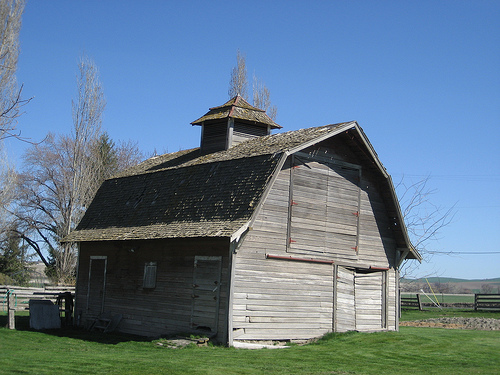
When Mom visited us last week, we tooled around town. No really, we tooled around town, on the outskirts, north, east, and west. This is surprisingly easy, because two streets this way or that, and suddenly one finds oneself in a wheat field. Or at least, we thought it was wheat. It’s been a while since my farm girl of a mother saw wheat up close, but then there she was, clambering out of the car and her head down near the ground, surveying and investigating. She could have been Jessica Fletcher scouring a crime scene.

abandoned barnAs she was looking at the bright green whateveritwas, a man in a pickup truck drove by us on the dusty road. He managed to keep a tall western hat on his head, and he gave me the man nod as I waited for my parent to finish checking out the foliage. I nodded in return, but I’m not really sure why. What is the man nod supposed to mean? That I’m not here to pillage your town? That I’m in agreement on giving the most masculine salutation afforded by social expectations? It doesn’t make a lot of sense to me, even as I acknowledge that rolling down our windows to high five wouldn’t have made any more sense. But still, I nodded back at him.

She got back in her seat and announced to the two of us that in fact, it was wheat.

“I just didn’t remember it looking like grass,” she said, almost as if she really wanted to check the earth one last time, like running back into the house to make sure the oven is really, really, super turned off. We rumbled back along this road I’d never traveled, kicking up red dust behind us. We could have been a Mars rover, for all the wheat fields knew, although they were probably more certain than I was of where they came from.

We dead-ended at a T intersection, the car idling, bored, while I tried to figure out if Walla Walla was to our left or our right.

I picked right, making a guess. At noon the sun wasn’t going to give me any indication of where I headed. Where were my so familiar DC streets with their quadrant markers?

It should be noted that DC was once a small town in the midst of farms, fields, and livestock. Pierre L’Enfant liked it because of its intersection of two large waterways, the Potomac and Anacostia rivers. In that way it wasn’t very unlike what Walla Walla is now, I suppose. But certain things—population density of the East Coast, cheapness of land at the time, intentional urban planning by L’Enfant and Masons—helped DC metamorphosize into the large metropolis that it now is. Those things don’t really exist for the Wheat Farming Town that Could, even as it was the site of incorporation for the State of Washington, and its original capitol. Now Walla Walla is only big compared to Dixie, Washington, which has only a single school, and Milton-Freewater in Oregon, best known for the frog statues that run along its main thoroughfare.

So Walla Walla doesn’t need quadrants.

We drove past a farm with several head of cattle, and I saw one cow nudging its face on the still body of a calf. The baby was indeed lying at an awkward angle.

“Oh no,” I said, “I think that calf died.”

Mom looked through my side window. She nodded.

“That’s so sad!”

“Well, maybe he’s just resting,” she said, patting me on my knee.

“No, really?” We’d passed them now so I couldn’t keep looking back.

“I mean, I’ve never seen a calf rest like that, but sure, maybe.”

My mother was mothering her nearly 40-year-old child who really didn’t live in the if-I-don’t-know-for-certain-it-might-not-be-real world anymore. But it was nice, for a minute, to pretend that I was still that gullible.

Sheepishness

sheep in the blue mtns.With my mother visiting for a week, I came up with an ambitious list of things to do in and around Walla Walla. The Colville Street Patisserie. Klicker’s farmer’s market and antiques. Petit Noir chocolatiers down in Milton-Freewater. Main Street and downtown. The Kirkman House, Pendleton Mills factory, Ice Burg drive-in, and the college campus. I added items on the vacation to do list never thinking about my mother’s energy levels or capacity for long car rides. Seems my tolerance for getting from Point A to Point B has expanded since we moved here, like Mercury comparing itself to the gas giant Jupiter.

Reality, at some point, was bound to take over. It had watched me with my black felt pen and growing list and chuckled quietly to itself, knowing it wouldn’t have to do much to stymie my plans.

We did make it to most things in and around town, except the museum. Something about a historic house with a suffrage exhibit just wasn’t grabbing my mother, who obviously takes voting for granted. She did get some sorbet at the Patisserie, and a chance to look around.

“So this is where you write,” she asked. I nodded.

“Hmm,” was her response. It’s a little difficult to ascertain what was layered into such a mouthful, but I think she approved. I know already she thinks I’m a little weird, so that’s not a big deal anymore.

We looked at items in a home furnishings store on Main Street. She told the owner everything was overpriced. I covered my face with my right hand, a 3-year-old’s response of “if I can’t see you, you can’t see me.” I explained to her that most of the shops on Main Street aren’t for Walla Wallans, they’re for the wine tourists from Seattle, the executives who like to show off to their friends about things they’ve purchased. It doesn’t make any sense to this grown-up farm girl. It just sounds like tinny silliness.

Traveling down to Milton-Freewater in Oregon, I show her the obsession they have with frogs. I can’t tell her how it started because I don’t know, and everyone I’ve asked seems not to know the origin, either. But literally every 50 yards there is another frog statue or mural.

“There’s a whole group of people out there who love frogs,” she says, and in my brain I morph it into one of those annoying Facebook statuses: There are two types of people in the world, it begins. People who love frogs, and people who don’t give a shit.

I am in the latter. Nonetheless, the frog statuary are kind of cute.

She takes a while chatting with the chocolatiers in Petit Noir, while I smile and pretend not to worry that we’re there too long. Mom thinks it’s all just nice conversation, and maybe it is, but I’m wondering if as customers, we are using our bizarre power over them to hold them hostage, all for the promise of buying $30 worth of prettily packaged product. I’ve certainly paid people to talk to me before, but there was usually some therapy or counseling going on in the exchange. And I mean that literally, not as some euphemism for “I pay prostitutes for my mental health,” so don’t go there. Mom’s back starts to ache so we head back to the car and head back to Walla Walla, leaving Pendleton unexplored.

“Is Pendleton open on Monday,” she asks.

“Pendleton’s a town, Mom.”

“I mean the mill.”

“Oh. I don’t know.”

“I know Pendleton’s a town, silly.” She laughs, in the same way I’ve taken to laughing.

We go tooling around the next day, east of town, over to Klicker’s, the strawberry pickers. I just made that up. I should sell that phrase to them for a couple of berry buckets. They’ve probably already thought of it. Mom likes the antique store, even though it’s littered with faketiques—things are made to look old, but were mass produced a few years ago. She can spot the real things easily. I pick up the handle on an old phone, the kind with a tube for a mouthpiece and two brass bells at the top like eyes, and marvel at how heavy the ear piece is.

“We had one of these on the farm,” she says, referring to Section 28, where she grew up in Saskatchewan. So the weight doesn’t surprise her. She hands it back to me and I hang it back on the hook. Immediately she flips it over. “It goes that way,” she tells me, smiling at my ignorance.

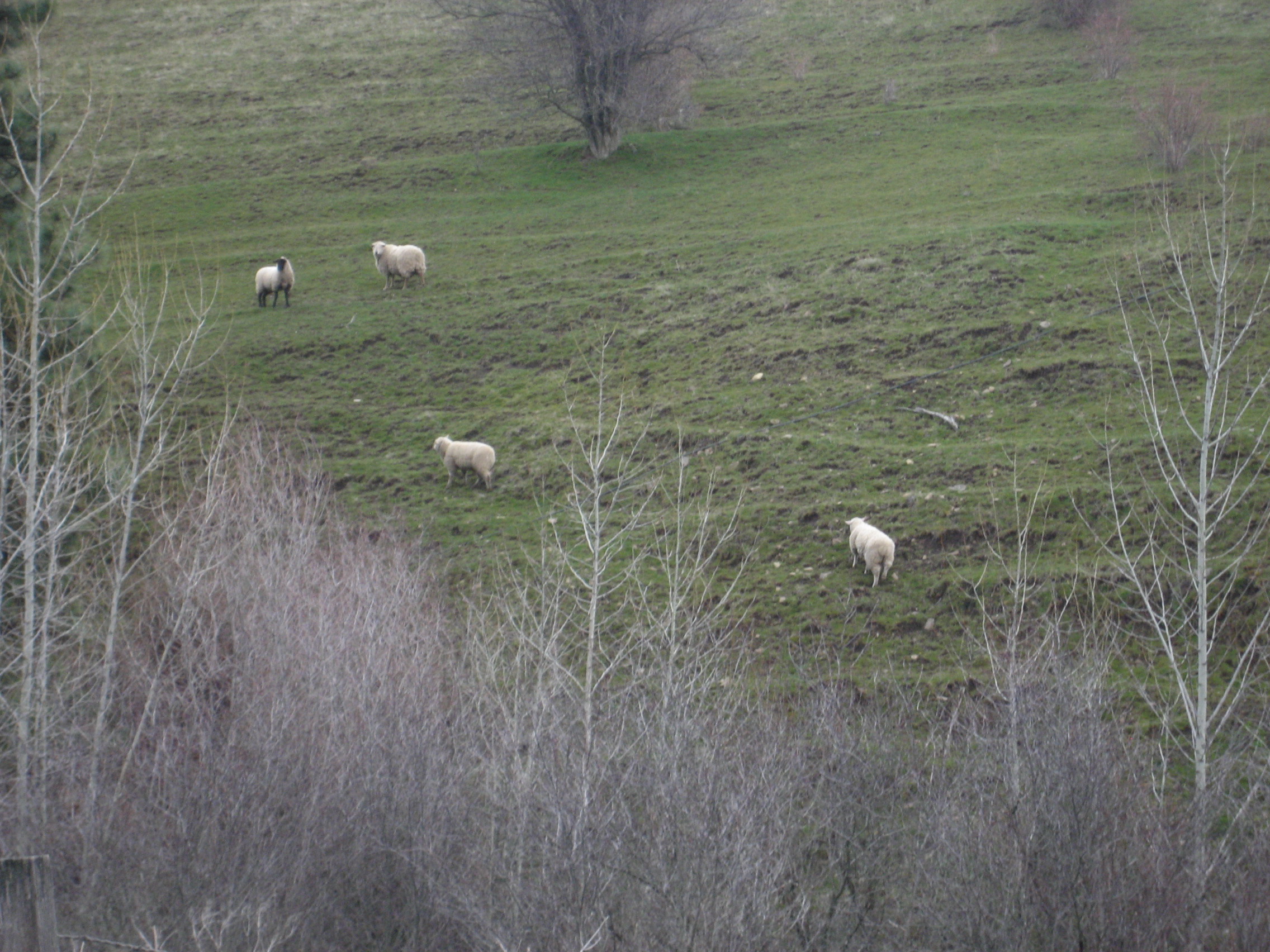
At the end of a winding road into the Blue Mountains we see sheep, and she gasps. She didn’t have any excitement for the horses or cattle or goats we’ve seen, but the sheep get her to draw a sharp intake of breath. A dog comes out onto the road, barking at us for coming too close to his house. Thirty yards away the county road stops and their private road takes over.

“My back hurts,” she says.

I say I’m sorry, I thought these bucket seats were pretty comfortable.

“It’s not the seat, it’s my back.”

I laugh, and Mom asks what I think is so funny.

“It’s not the hot coals, it’s my feet,” I say. Now she’s laughing.

“It’s not the machete, it’s my bleeding cut.” We laugh harder.

We can coast at 50 m.p.h. on the downward slope out of the mountains. We’re still laughing.

“I can try to tell Gary about this,” she says, referring to her husband, “but I think you had to be there.”

Northwesterners wear black in spring

This year winter was like a photo negative of last year; except for a few inches of snow in December, none has fallen on the streets of Walla Walla. The last month didn’t even bluster much, with a few days of overcast and a few days of rain, and a whole lot of days during which we didn’t ask much of the heater in the basement, so it sat there like a sleeping dragon with a chest cold, happy not to cough up any fire for us. Back out in DC all of our friends were moaning, then foaming, then apoplectic about the endless bands of snow that covered absolutely everything. They posted angry statuses on Twitter and Facebook. They took pictures as evidence. With way too much time on their hands, they made time-lapse movies of porches increasingly blanketed, forgotten toys buried, and personal vehicles inconveniently blocked in by an inconceivable amount of frozen precipitation. I watched this all from 3,200 miles away, exhaling in wonder and relief that my nonconsensual isolation in the house from 30 inches of snow and no plowing last year did not repeat itself. It would have been some kind of very cruel irony if I’d been back in DC this winter. And to everyone who had copious amounts of time with their loved ones while they were instructed to stay home, day after agonizing day, you have my sympathy.

Spring clearly has sprung around here, has been springing for a while, actually. The wineries are readying for the tourist onslaught, and people are smiling with notable more frequency, often looking at the big yellow ball in the sky, so happy for their skin to generate some vitamin D, even as their retinas fry away from the radiation.

But this is the Pacific Northwest, well, kind of, and damned if we’re not all still wearing earth tones and lots of black and gray and navy blue. We have to separate ourselves from the color of daffodils, after all, for we might confuse pollinators otherwise. It’s an ecological imperative, see. We feel that much warmer when the sun beats down on our black hoodies than if we were simply wearing a white t-shirt. There is absolutely nothing wrong with wearing a down vest over a dark gray long-sleeved shirt (or even better, a black hoodie), even if it’s 74 degrees outside because look, just over there, see the mountains? Snow on the mountains! Never mind that they’re 3,000 feet higher than us. If we can see snow, it must be cold.

Some Northwesterners complement these heavy jackets with wool socks and Birkenstock sandals. It’s actually a rather popular look, and it separates the wheat from the chaff; people with any hesitation about wearing socks and sandals together, especially with cargo shorts, have simply not lived in the PacNW long enough. People who wear this combination and live in some other geographic area, you need to put everything you can fit in your car and move out here, because you have some like-minded crazy people out here who really, really want to meet you.

Sure, we enjoy spring. We don’t want to compete with it. We’ll walk through wildflowers and scrub brush, and all the sage that survived becoming tumbleweeds over the reasonably short winter, but we’ll walk through it in ecologically friendly clothing and gear, we’ll take reusable water bottles with us, and some of us will  cover up our tracks on the way back, lest we leave anything behind that wasn’t there before we passed by. And when the temperature hits 100 degrees in June, then fine, okay, we’ll ditch the socks. But the synthetic down vest stays.

Speaking of lies

I try to listen when the universe at large brings up points for me to consider. A few weeks ago, the message I heard was “be comforting.” I was actually told no fewer than three times, by three entirely different people—a student with twitchy senioritis, a transgender woman on the edge, and a professional who is having difficulty with a superior—that my words to them were comforting. These conversations happened in the midst of the anguishing last stages of a woman’s life here in town, a woman about whom I’ve written before and for whom many people have a particular fondness. And as I’ve seen her caretakers looking increasingly exhausted, the concept of what is comforting, when, and for whom have swirled around in my head. We often forget, it seems, to support the caretakers, and they, the front guard, need a lot of comfort themselves.

On another level, we attempt to provide comfort for the terminally ill, in the form of hand-holding and increasingly desperate dosages of opioids. It’s the medical equivalent of building a sea castle. We wring our hands when we fear our efforts aren’t enough, and of course they’re not enough. And so we hope that our well wishes, our prayers, our food offerings—for surely they can’t concentrate on cooking, for God’s sake—will do enough for now. Sometimes hope and a bite of warm supper is all we have.

The message this week, if I’ve got it correctly, is not to lie. Surely this is something my parents and a plethora of clergy attempted to teach me when I was a child. The script back then was simply that lying is wrong, a concept predicated on a young person’s monolithic understanding of morality: you do right just because. You avoid doing wrong just because.

What I see about lies now, on the cusp of my fourth decade, is the devastation in their wake, like the wrecked ideals of a partner who has put such effort into someone he then realizes doesn’t have his best interest at heart. Or the sudden calamity that avalanches down on a person who gets laid off after disingenuous promises from her boss that she can trust him. It’s not the lies themselves, necessarily, that are wrong, because who really wants to hear that they look awful in their favorite pair of trousers, it’s the shock wave from the lies and the intent in the heart of the liar that we want to avoid.

In an online writing chat today there was much discussion about lying in fiction. Yes, I know, it’s fiction. I think “lie” stood in, on several occasions, for “believability.” It does raise an interesting question to me. We’re so quick as readers to spot flaws in what makes a story believable or not—we come into a book with cynical expectations and have our guards up for the first sign of trouble. But these are just books. Raise the stakes and talk about people and relationships, ask us to make an investment in what they mean to us, and we become myopic, willing to believe even preposterous tales just to keep our vision of reality stable. And then we lose, bit by bit, our own sense of well-being and comfort, because while we may not want to admit to it, our confidence erodes under the constant swell of those lies.

I am not immune to any of this, and when I was ten, fifteen years younger, I went to lies as a coping strategy, oh sure, I did. I am a storyteller, after all, but I’d lost sight of where make-believe was okay and where it wasn’t. I’ve spent time in the prison camp of cowardice, aligning myself with dominant personalities and then wondering how I could squirm out from under them. Mostly I just figured out how to exist in the cramped space they allowed me, but one of those survival skills was lying. It didn’t even matter after a time what the lie was about, as long as I had something all to myself, a tiny corner of truth about which they didn’t know. These were infinitesimally small victories; stacked all together I could have fit them on the head of a pin, but they were mine, mine, mine, and somehow they were enough, mostly because my dreams were absurdly small.

And then, though they were so tiny, they were numerous, and like the Big Bang that arose out of a submicroscopic particle, they exploded all over me and I had to admit to them and myself what I had been doing. I was a juggler of little lies who had slipped. But it helped me to see what a waste of time all of that nonsense really was. I hadn’t been ready to let go of them, but they left all on their own, and lo and behold, I found new ways to meet people. In fact, I met better people, ones who would never corner me until I found my 5-year-old self’s coping strategy. It was like moving to a house with a dishwasher, me promising never to go back. Who wants to go back to scalding their hands, after all?

I’m inclined toward direct, unwavering truth-telling these days, even as it has sometimes meant making difficult decisions, like oh, turning my life upside-down and living as the opposite gender (and not just so I could write a book about the experience). But it is a life unafraid, at least.

And uh, I take comfort in that.

Next to the Blue Mountains is a roastery

I come here on Monday afternoons because my favorite coffee haunt is closed, but truth be told, they make a very good cup of coffee at this place, which I suppose one can achieve when one has roasted the beans that very morning. This place also has the benefit of sitting at the foothills of the Blue Mountains, so if one cares to say, type on one’s laptop outside, on say, an overcast day in which one can actually read one’s screen, one can take in the beauty of snowcapped moutains, even in July.

Walla Walla, February 2010There is a downside, namely a professor from one of the town’s institutions of higher learning who tends to date his students. He does that lean in too close to gauge your reaction thing that pushy people do. I mean, this is never directed to me, of course, given that he seems to focus on people other than fat, nearing-middle-age men who wear wedding bands. I feel like I’ve dodged a bullet, I suppose. But he absolutely flees my presence whenever I show up. I’ve never said one word to him, though I’ve heard several of his conversations with coeds. One time, at the start of the fall semester, a newly minted alum sat across from him, at the table next to me.

“I’m so glad we waited,” she cooed, not nearly enough under her breath.

“I’m so glad you’re here.” He has, it goes without saying, unwavering eye contact. Their hands were mere inches from each other, teasing at touching.

“Summer took so long,” she said, and I felt a shudder of uncomfortableness go through me. “But it’s so worth it.”

“You packed everything,” he asked. My mind, against my will, flashed to a pill container of ecstasy, some bright pink rope, and a French maid’s outfit. I cursed myself for forgoing my iPod that day. I would have listened to anything to drown them out: metalhead, steampunk. Slam poetry. And I really detest slam poetry.

Before I was an unwilling witness to this grotesquery of a dating lead-in, he didn’t really notice me if we were in the same space. But since then, he has absolutely fled the room when I come in, or if I’m somewhere ahead of him, he doesn’t stay for long. I wonder if I’ve raised one too many eyebrows or if he realized I was disgusted by his machinations with the barely-legal set. I don’t speak to him, so I don’t know.

A few months ago I decided to conduct a decidedly not scientific experiment to see if maybe we were just two ill-timed ships attempting to pass in the night, like the Andrea Doria and the Stockholm. Well, that didn’t go so well, I suppose. But, I thought, perhaps this was just a schedule conflict. And seeing as I have this amazingly flexible schedule, well, why not sneak a peek into some kind of insight?

I have thus showed up at the roastery at 11am, noon, 1pm, and 2pm. And each time I come in, if he’s here before me or comes in after, he stays an average of 14 minutes and then skeedaddles. Sometimes he’s had to gulp down his beverage, other times he seemed to be blithely carrying on, typing into his laptop or grading papers. But in each case, he was gone, usually less than a quarter hour later.

I’m not sure what this is about. I don’t think of myself as an intimidating figure, in my Merrel sneakers and comfortable hoodie that continually proclaims “Capitol Hill”, confusing anyone from that Seattle neighborhood. (It’s for the other Capitol Hill, FYI.) Maybe he’s embarrassed that I heard him that day, which means he knows what he’s doing is wrong. Or perhaps I’m just so handsome he figures he has no chance with a pretty girl if I’m even in his vicinty, and the idea that he’s cock-fighting with me nearly drives me into peals of hysterical laughter.

Anyway, he’s around so often when I’m writing that I’m a little concerned he’s going to make it into one of my stories, or that sexual predatory-ness will become some kind of unconscious theme in my work, and then people will be wondering about me, not him.

And then, at long last, the terrorists will have won. Damn it.