Orlando United Vigil in Walla Walla, June 15, 2016
This is the transcript of my piece said during the vigil.
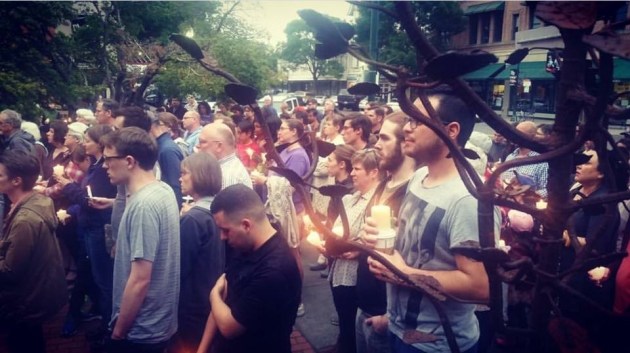 I’m sorry. I’m sorry that 47 years since the Stonewall Inn riots, 43 years since being gay was no longer listed as a mental disorder, and 13 years since the Supreme Court decriminalized being gay, that this tragedy at The Pulse nightclub in Orlando has occurred. I’m sorry that in the many years since Brandon Teena’s murder and Matthew Shepard’s murder and since Tyra Hunter was refused life-saving medical care, we are here tonight, mourning the loss of so many good people. I’m sorry because I thought that after the AIDS crisis where tens of thousands of gay men passed away while our leaders made inappropriate jokes, that we were moving through the worst of this hatred for us. I thought that the quiet anti-discrimination legislation enacted by more than twenty states, and that seeing marriage equality become the law of the land meant we were entering an era of acceptance. I thought my generation would be the last to face disparate levels of depression, suicide, unemployment, and harassment.
I was wrong. I am sorry.
I stand here tonight shocked—again—at how easy it seems to take away dozens of lives in the manner of a few minutes to a few hours. I stand here, wondering which of the hateful things I’ve heard over the past two decades may have lead to this moment. Was it the refusal by extremists to sign marriage licenses for gay and lesbian couples? Was it the preacher who interprets scripture to mean that killing LGBT people is a holy mission? Was it the lawyer who argues that discriminating against gay, lesbian, bisexual, and transgender people is simply an act of religious freedom? Was it the national organization that insists transgender people in bathrooms are a danger to the public and to our children? Was it the candidate who called immigrants rapists and refugees a threat to national security?
I am angry and inconsolable that people who expected they could be themselves in the confine of a nightclub, traditionally a space where LGBT people could find temporary sanctuary, died there. And yet we see triumph even in that hell—the mother who, dancing with her gay son, saved his life with a final gift by blocking bullets with her body. The Indian American former marine who helped 70 people survive by breaking open an exit door. The young Latino man who used a bandana to staunch a neck wound of his friend. Stories will continue to emerge about our strength in the midst of tremendous pain, and this is how I understand our collective journey.
All of us are stronger than hate. All of us are more resilient than a lobbying organization. We reject the false narrative of abomination and perversion and we embrace our pride, our community, and our shared journey.
We are determined. We insist on ending garbage pronouncements about what LGBT lives mean for our society or our morality. We are determined to make this world better for our youth. To our youngest LGBT members: your elders and your allies sincerely care about you. We see you and we know there is a lot of chaos and pain that comes your way. We are here for you, just as we are here to honor the people we have lost. We will find our way together, in solidarity. Peace to you all.
Vote NO on Initiative 1515!
 One of the more atrocious things the Walla Walla City Council did, after the brouhaha with the toy store’s mural faded away, was to pump in classical music at Heritage Square, a little strip of grass between storefronts on the downtown Main Street shopping district. At one point there was a playground structure, some limestone boulders to climb on, and a shelter like you would fine in a regional park; now only the shelter remains. As the city’s heroin epidemic grew, so did the numbers of drug dependent people in Heritage Square, hanging out on the toddler slides, or perched up against the wall of a building grotesquely painted to look like a Wild West-era trading post. We were perhaps not ready for the “two Wallas” to intersect right in the heart of the tourism office’s territory. Legal alcohol consumption as part of local wine industry, everyone can get behind. Illicit heroin use, on the other hand, is not to occur in the open. To drive away injection users, the city began streaming classical music to Heritage Square, as if the melodies of Mozart and Brahms were naturally antagonistic, like slipping on high frequency bracelets to keep mosquitos at bay. In its essence, the move was problematic.
 It’s not often that a bonafide famous person steps into Walla Walla, much less a celebrity known for being an intelligent, interesting thinker and speaker, specifically Neil DeGrasse Tyson, astrophysicist and host of the redux of Cosmos. Rather, living in a town as conservative as Walla Walla it was pretty unsurprising that Susanne and I would jump at the chance to see him give a ninety-minute talk, even if the tickets cost $50 each. The seal on the deal was the reality that we don’t go on dates all that often, what with two children under the age of three—so between presumed smart lecture on science, sitting in a hall with other less-than-Tea-Party people, and Date Night, it was a no brainer (see what I did there?) to spring for the tickets. And just like I thought would happen, we saw all manner of acquaintances and like-minded comrades. There were many school-age kids there, which was nice. At least at first.
 Now then, before people balk at the idea of the city boy and his offspring venturing into such a rural experience, I am no noob to the rodeo. I went to Girl Scout horse camp in South Jersey twice, sleeping in two-week stints in an overgrown tent, and I’ve gone to at least a dozen rodeos in the Northeast—though truth be told, my favorite is the
 Now then, the market in DC offered fresh local chicken, a gourmet cheese counter, eggs, all manner of fresh sausages, fresh seafood and fish (which we never bought, given Susanne’s allergies), cakes, pies, cookies, loads of produce, and the requisite crafty junk I’m never interested in buying, like handmade jewelry and such. In Walla Walla there is also a ton of produce during the season, a woman who sells lamb, and two farmers who sell pork. You can also get fresh milled flour out here and that wasn’t available in DC, but for the most part there was a lot more diversity in the city than here. But going back to the conversation, I do tend to like my neighbors in Walla Walla more than my neighbors in DC. Some of my city neighbors were kind of snarky. Not that I know anything about that.


 Trans/plant/portation