Tag Archives: the business of writing

First day at PNWA

I showed up at the Pacific Northwest Writer’s Association annual conference having taken the 560 bus from my friend’s house in West Seattle, raring to get there early so I could grab a latte before an all-day writing workshop. It was workshop in the conference sense, not the creative writing circle sense. Which was fine. But I waited a while for the hotel shuttle to show up at the airport, so I wound up waiting until the first break, some hours later, before having anything other than water for breakfast. Poor planning on my part constituted a high level of frustration on the part of my stomach.

I found a seat in the large ballroom—which is another funny word, since I’m fairly sure nobody has ever danced in this room of the conference center—and turned on my iPad. Realization dawned on me when it redirected to a pay-only/give password access page. Only cheap hotels have free WiFi. They need it as a selling point. The Hilton, even the SeaTac Hilton, does not need such leverage over its guests. I saw two women at the back of the room on laptops. Being the extrovert I am, I walked up to them and asked if they knew the password.

“Oh, there’s no network for this conference,” one of them told me, fiddling with her cell phone. “The conference didn’t arrange it.”

I relayed my shock and dismay in her general direction. She responded by walking up to the tech guy in the corner of the room and asking if he could help her get her Bluetooth to work. And wonderfully for us, he used her device to set up a network. What a guy!

She came over to my chair and gave me the password, and I thanked her with great enthusiasm. Now I was online with my iPad and could live-Tweet the workshop. So here’s the transcript, more or less, of what I wrote and sent out today:

PNWA! – Just starting the first workshop…writing the novel. Kind of a big subject!

New writers have a 90 percent failure rate. We’re just like restaurants.

BTW Thanks to Johanna Harness for getting me online today.

You should be able to say what your book is in one sentence.

This is all from Bob Mayer, who has 40 books in print.

The original idea is usually the heart of your pitch.|| sure, but they happen a long time apart from each other.

Write what you want to know. Elizabeth George isn’t British. She’s a damn good researcher.

Write what you read, what you’re interested in. Don’t worry about what’s hot. || he just gave me permission to write about transfolk!

Don’t write from a place of fear. People will know something about you from what you write.

Get each sentence right. Think about every word you put down. || well, I get to this place, but not usually in my first draft.

What makes you shiver, and how can you communicate that shiver?

We’re watching Joachaim Phoenix as Johnny Cash replacing all the instances of “song” with “book.”

It’s an example of listening to agents and getting over fear.

Give readers a good payoff at the end. You want them to get something new out of successive readings.

I already think about narrative structure and character, so whew on that.

How is your idea different? It isn’t. But we create new characters, plot, setting, intent to make it fresher.

Writers need to have strategic goals. Book goals, career goals, writing goals. Perswrvere.

Or, perservere.

Protagonist: must want something, be in trouble, unique voice, be different, be someone readers can identify with

Antagonist: must be someone audience respects/fears, drives the plot initially, should be a single person.

I’m not personally a believer of the single trigger leading to main motivation, but I’m not arguing with Bob here.

Conflict can arise from people having the same goal, conflicting goals, different goals. Be clear about what’s happening.

You must know, before you start writing, what your climactic scene is going to be. We’re not all Stephen King.

Use the POV that will work best for your story. Be willing to dissect your own books.

Look at the narrative flow of a movie by looking at the scene selection on the DVD. Think about what gets introduced first, char or prob.

Details drive your story. Flake on the details, bad news.

Outlining: get it out of your head. You’re a writer, write it down.

Back story should fill half your outline. And it’s all before the initial scene. You need to know all of it, your readers don’t.

Backstory: you can’t use your opening to set up your book.

Make clear to readers what is flashback and what is memory. || I don’t always do this. Intentionally.

The initiating event must introduce the protagonist, the problem, or both. Whew! Bumbling into Body Hair gets both.

Introduce your protagonist before they’re aware of the problem. It helps set their motivation.

The opening scene often mirrors the climactic scene, just at a lower level.

The bigger the story, the smaller the opening. And vice versa.

Think about your first shot. It sets your tone, your story.

Remember that suspense comes from caring about the characters. So make characters believable.

Fate works because it is layered on top of the existing base conflict. Coincidence merely is the conflict.

Break coming up. I’ll be back!

Only have one last scene after your climax. Otherwise you haven’t closed out your subplots well enough.

Show how the protagonist has changed by the end of the story.

Setting is time and place. And mood. And a character.

The when is part of your setting.

Get all five senses involved in putting together your setting.

You have to do intense research on your setting before you write it. Your readers don’t need to know it, you do.

Think about how time affects your narrative structure, conflict, suspense. Time can wreck it or enhance it.

Know the purpose of every scene. Make sure it has its own protagonist and antagonist.

Once you hook, the reader, trust them to stay connected. Don’t jar them and take them out of the story.

I like that we’re watching a lot of Paul Newman scenes in this presentAtion.

Dialogue: establishes character, advances the plot, shows off conflict, controls pace, gives expository info. But beware the last one.

Don’t use dialogue tags. Readers notice when writers say shrieked, exclaimed, sighed.

My takeaway about dialogue is that it’s very easy to get wrong. I speak mine out loud to make sure it’s sayable.

Stuff on writer’s block. Nobody cares about that, right?

Don’t over edit. You leave subconscious seeds that should stay in. It might not make sense to you yet, but it may someday.

3 ways to write: following the outline, followed subconscious seeds, rewrote and added.

You have to be your own best editor.

Have beta readers for your work. They must be good readers, not writers.

Readers point out problems. You’re the writer, you find the solutions. All the problems have to be erased. You can’t explain, you must fix.

Story editing: answer why now, what’s the mood, setting, who are the actors? Do the turning points aid motivation? Conflict escalating?

More editing: can your book be better?

Stick your characters into Maslow’s hierarchy to see where they are. They’re never self actualized at the start of the book.

Your characters all have blind spots. As an author, you need to know yours.

List your characters, their main traits, and their flaws. Flaws can be just needs in the extreme.

Your character has to have motivation and back story, but you don’t have to explain to the reader. At least, not at first.

Time for lunch. Catch you all later!

Checkov: don’t have a gun in act I unless you’re going to shoot it by act III.

Show, don’t tell.|| I know! I guess we all keep doing that if they keep saying it.

Character description: keep it brief, distinctive. Use placeholders of people you know so you have a visual image while writing.

Don’t have your char stand in front of a mirror. || Unless they’re a vampire! Kidding.

Try not to make ridiculous names for your character. Users shld be able to pronounce. || Unless that’s the point. I’ve done it on purpose.

Writers interested in getting published should join the romance writers of America, bc they’ve got the most professionals.

Profile yourself for a week, then see how much time you waste that you could have been writing.

Writers should take the Myers-Briggs. One of the 16 types is author. It’s opposite? Promoter.

Writer’s groups should make sure they’re moving forward. Goals, goals, goals!

Top character trait of writers is the ability to change. || I had a sex change, does that count?

#bookmarket I’m at PNWA, listening to a talk on the book market. Follow me for my live twitter feed.

Only 5 percent of people can change themselves at the rate we writers need.

When characters make decisions, they either dismiss it, feel stuck by it, or stick with it.

Nothing in your writing should be by chance. You’re the architect. Architect it.

Decisions leads to sustained action, leads to change. This is how characters develop.

Moments of enlightenment leads to decisions, which start the process.

The stages of death: denial, anger, bargaining, depression, acceptance. It’s just like publishing!

To show your character has changed, they must act differently.

During lunch break, lit judge agreed with me: tell agents I’m willing to do whatever it takes to get pub interest.

Everything you put in a book, use two ways. Back story, plot grease, character develop.

Don’t be afraid to refer to other points and arcs in the story.

Bob Mayer: I hate it, but know what genre you’re in. You must know exactly what you’re in. 56 percent of sales is romance, FYI.

There is no reality. So think hard about what POV you will use. POV is the number 1 problem writers have that keeps them from selling.

In communication, the receiver is more Important than the sender. So know your readers.

Don’t be afraid to let your books grow. If pub wants more out of one narrative, write more books!

If the reader doesn’t need it, don’t tell them. The more you put In it, the more you may introduce something they don’t like.

Beware the subconscious negative: to be honest, or else, mocked…

Don’t have too many POV angles.

First person is good for a lot, but not for building suspense. || unless readers think the narrator is dead!

Try not to start too many sentences with “the” unless you’re writing omniscient.

A change POV if it makes sense. Read thru to make sure you know when/why it shifts.

Start writing your next book before you start querying your first. Let the first one sit for a while. Get some distance.

Remember it’s voice that sells. Must be distinctive. In third POV, voices must sound different.

The voice that is your best voice is the one you want least to write in. Because it’s so close to you.

You will tend to write in the voice you most enjoy reading.

Ex. Of Courage Under Fire as a way of using POV as a narrative/plot device.

Selling Your Book. When yr story becomes product. Figure out what you want to achieve.

You may be asked to cut, add, simplify, restructure. Do you want to sell it or not?

The writer is working in conflict with their own environment and the publishing world. Have clear goals and plans.

It’s not supposed to be a war with writers and agents.

Don’t spend your time reacting, get to acting. Successful writers get beyond reacting.

Every writer who thinks they have it made fails. Perserverence makes you successful.

Fixed minset vs. a growth mindset. Writers must be prepared to reinvent themselves.

Have measurable goals. External, visible outcomes. Time lock for achieving goals. Keep it positive.

Face your freaking fears. Often the fear is what you have to do.

Ask yourself: what was my original goal as a writer? Should you return to it? Change it? Make it happen.

If you don’t state that you want to be a NY Times bestselling author, you won’t be. Tell others, too, If this is your goal.

Have specific tactical goals: read PUblishers Weekly, go to specific confs, write 5 pages a day,etc. Write down your goals.

Prioritize your goals, but make sure you keep writing.

Keep your options open. Look for direct and indirect approaches. It’s never a good time to be a writer, so get over that.

Study other books like yours. It’s part of your work. It’s your job. Network and ask for help.

Read blogs by agents, authors and editors, but understand they all have a POV.

If you’re type A, publishing will break you of that. You must have persistence and patience.

Have a three year mindset. Publishing’s processes take time.

Traditional publishing is planning for books in 2012, 2013.

You need to figure out what your platform is. Your anger, your idea, your background. Understand the market you’re trying to reach.

If you’ve written a funny story, your query letter should be funny. Match tone.

The aggressive person wrote a good book, the obnoxious person wrote a bad one.

Find the right publisher by knowing imprints, genres, market, small presses, ebook possibilities.

Copyright symbols on queries and ms copies are turn-offs for agents.

Don’t pay attention to slush pile statistics. The slush pile is supposed to be worse than your writing.

Cover letter: 2 para on idea, 2 para on you, one page total. Don’t say anything valenced–no praise or negative comments about your work.

Don’t hold back the ending to your book in the query letter! Give the entire story arc. Be terse with your synopsis, though.

Only mention the pro tag, antagonist, main supporting character. Don’t use bullets in your query. If it’s a genre, say what it is.

Don’t put subplots in your query letter. Just show the main storyline. In a query, less is more.

Think about using snail mail queries. Email lets agents track you, may serves walls to getting representation.

I really don’t like the predictive keyboard on this iPad. It keeps introducing typos!

Go to writer’s conferences and retreats.

Do multiple submissions, don’t tell them it’s a multiple; that’s a subconscious negative.

Agents and editors don’t read like readers. They scan.

They also don’t read in their offices. They cram it in when they can.

If you want to get published in New York, you MUST have an agent. They actually support writers’ careers.

Small pubs with no advances, regional presses, if those are your goals, you don’t need an agent.

Ask agents: recent sales in your genre, how long in the biz, submission timelines, contract types, how do they like to communicate.

Nasty rejections are mostly myth. But if you get one, stop reading and delete it. Just move on.

It’s simple. Just don’t quit. Be wiling to market yourself.

Thinking your agent will market your book is like thinking your OB-GYN will raise your child.

When you get your first book published, market the hell out of it. You have to work hard to succeed.

We want to love indie bookstores, but it’s the big stores that stock all genres. || eh, I still like ’em.

Go ahead and self-promote, even if you’re worried about being self-promoting.

Balance your promotion with supporting others. Keep yourself honest.

Don’t make your Twitter avatar your book jacket. You’re going to write more than one book, right?

Writers, it’s likely you will have to get out of your comfort zone to promote yourself.

Average sell through on a book is 50 percent. That is why publishing is struggling.

Booksignings are not cost-effective. But they’re good for networking and fan base. Get creative with venues.

Publicists are more important for non fiction. Jon Stewart sells more books than anyone else on TV.

Write a book on your blog. You’re going to write 100,000 words anyway.

Think about viral marketing for your book on You Tube. Do everything you can to find your audience.

If you’re a new writer, get traditionally published. 950,000 books last year (out of 1.2M) sold 99 copies or fewer.

If there were a formula for success, everyone would be doing it. Be open to possibility and find what works for you.

Generate good will. It will go far to your success. For more info, follow @bob_Mayer and go to bobmayer.org.

Don’t self publish fiction. Your work will get buried.

Publishers control distribution. That is why ebooks are confounding to the industry.

That’s it for today. I’ll see what I can Tweet out tomorrow, folks. So far so good!

The writer’s conference that could be

I fly out in about a week to attend the Pacific Northwest Writer’s Association annual conference in Seattle. I’m excited, working on my pitch to agents, and a mite trepidatious about what I’ll find there. I’ve been to conferences before, sure, but no writer’s conference. As a quick recap, so far in my life, personal conference attendance has included:

The Popular Culture Association conference—This was held in the Chicago Hilton where they filmed the remake of The Fugitive, starring Harrison Ford. It wasn’t the closest I’ve come to meeting Ford, since that distinction goes to the Arlington, Virginia location of the Capitol City Brewery, when Ford and I were seated only two tables apart. For what it’s worth, he seemed like a genuinely nice person. As far as the conference goes, I’ve never had so much fun at an event as this one, and I’m pretty sure it’s not just because I was a completely broke graduate student who subsisted on sneaking in at the ends of coffee hours to eat from the appetizer tables. There’s something about going to a conference where one is giving a paper on Single White Female in the next ballroom to a serious discussion regarding why Bugs Bunny cross-dressed that makes boring conference centers more lively. I like the academization of The X-Files.

National Association for Welfare Research and Statistics—This would have been one of the more dry conferences I’ve seen, except for the moment when a garden variety social worker called out a speaker from the Heritage Foundation on using misleading numbers to say that poor Americans don’t have it so bad because look, they have televisions and telephones. I never saw so many angry middle aged women in one place. The other great thing about this conference was that it took place in Madison, Wisconsin, and that turned out to be a very cute, charming town.

American Association for Public Opinion Research—May in Phoenix is not a good idea, and not just if one is a Latina migrant farmer. It’s bad all around. It should not be 106 degrees in May unless one is standing in a shadow on the surface of Mars. And that’s a bad idea because of the whole lack of oxygen thing. I did appreciate skipping one afternoon of the conference to go golfing with a colleague, and meeting James Brown (the sportscaster, not the king of funk) on the plane to Las Vegas. The workshops and panels, however, were really far from what I would call intellectually rigorous. Sorry, AAPOR, it’s true.

Philadelphia Trans-Health Conference—I love this conference like a younger sibling who doesn’t know how to behave. I don’t really get the hyphen in the title, either. Trans . . . health to not health? What is the trans connecting? Oh, transgender people! Then say it’s about the people, people. Anyway, this is a vital meeting up for the trans community, even as it quickly descends into near meat-market status, with folks checking out each others’ outfits for minimal levels of hipness and outsider status. The more buttons on one’s backpack, the better. And every time I attend this conference, I see middle-aged trans women walking alone, not nearly cool enough for the too cool for school kids. It makes my heart ache. The workshops here are hit and miss, but again, they’re some peoples’ only conduit of information off the Web and/or means of meeting other like-minded people. I try to remember that.

So what will PNWA 2010 be like, I wonder? Are there writers squirreled away in tiny corners of the Northwest, just waiting for their weekend of fun? Will everyone be more successful than me—a low bar, I grant that—or will there be other folks in similar situations to mine? Will I totally screw up and puke on an agent? I mean, I really want to be more socially adept than George H.W. Bush in Japan.

I’m sure it will go well. At least I’ll have my little finalist ribbon to wear around, looking as dorky yet proud as possible. And for giggles, I’ll try tweeting a few workshops if it’s not too interruptive to the panelists. If anyone’s interested, I’m 4evermore over on Twitter.

A special kind of love

Finding an agent, so I keep reading, is like falling in love. If query letters to agents are like little love missives, the idea is that the agent will be spellbound, struck with wanting for more from the would-be author, desperate for that partial manuscript or book proposal. When their love connection is made, they can ride off into the sunset of the publication industry. Wait a minute. Something’s not right here.

I think this is a strange model for a business proposition. Of course I would want anyone interested in representing me to like my work. It couldn’t happen any other way. But there’s something about the rhetoric around finding representation that turns my stomach.

Maybe it’s that I’m really bad at dating. High school was a bizarre experience, with my school enforcing the “only guys ask girls out” code and me of the girl set who only got asked to make out behind the bleachers so nobody would know we’d “dated.” College didn’t make life any easier—half the guys I thought were interesting and attractive turned out to be gay. This apparently, by the way, is a common straight woman’s complaint. They make whole movies and books out of this stuff.

  • There was the date in which I arrived on time and he was late by an hour, the time during which I got to have an interrogation, excuse me, a chat, with his mother.
  • There was the guy who really did break out a calculator to see how much tip he should pay the waiter. Boy, you need to learn to do math in your head if you’re going to be a cheapskate.
  • There was the one who asked me to build him a bed frame because he’d “always wanted to watch a butch do carpentry in my living room.” And yes, I built the frame.

So forgive me if I’m not a little trepidatious about doing anything on a “dating” model.

I sent out my first, second, and third round of query letters, starting way back last August. I figured it would be like entering a contest; I’d send out my hopeful scouts into the literary world and I would just sit on my hands and wait for the responses to come back. Do de do, I hummed, I’m sure they’ll just reply in no time. . . .

Plink! I got an email! With burning fingers I pounded the mouse button to open it. Someone had fallen in love with me! Me!

Thank you so much for your query. While your project certainly has merit, I’m just not the right agent for this material.  I wish you the very best in your search for representation.

Warm regards.

Oh. Oh, okay. Well, so that wasn’t the response I was looking for, but she said it had merit. But what did that mean, just not the right agent? I remembered some article or other that I’d read about how writers over-parse the responses from agents. Don’t over-parse, don’t over-parse. That was like being told to think about anything except little green monkeys.

Two days later, I got another response:
Thanks for your query. I’m afraid, however, that I don’t think I’m the best agent for your work.

I wish you the best of luck in your publishing endeavors.

Afraid? That was strange. But okay, I got the point. Nobody was falling in love with my query letter. I went back to the drawing board, tried not to think about wallflowers at high school dances, and rewrote it. And I changed the title of my memoir.

Batch after batch of query letters came back with mostly nice but regretfully not in love responses. I did still more research online, akin but not akin to figuring out how to meet Mr. Right or the Next Hot Momma. I tried to improve my query some more, changing it from 3rd person to my own point of view. Condense, shorten, personalize each query with the name of a book I’d read that said agent had worked on. Thank goodness I’m an avid reader.

I discovered agent blogs. Now, not every agent has a blog, but a lot of them do, so instead of continuing to shoot arrows into the dark I’d stick with agents who revealed something about themselves online, and I’d try not feel like a stalker while doing it.

I had become something of a fisherman with an elaborate bait box. Heeeeere, agent agent agent, try my juicy strip of squid! You’ll like it! You’ll fall in love.

At some point my insanity level decreased, to the delight and relief of my friends and family. I went back to writing and took a break from querying, and in the process, wrote and revised three short stories—two in the speculative fiction/sci fi genre, and one straight literary. One story made the rounds of sci fi journals, rejected every time, with a bit more terseness than I’d received from my memoir query letters, but with enough positive feedback that I’ll probably try it at a few more at some point.

I’d learned, it seemed, to be patient. Or at least more patient. At a few points an agent would write back asking for a full manuscript, or my book proposal. So I learned to write a book proposal. I would become excited with possibility, only to be disappointed when they’d write back again saying they just weren’t the right agent for me. Now I understood that this phrase was code.

One agent only took submissions through a Web form, and I was aghast that I was only allowed to fit 400 characters into the submission. Four hundred characters? My first paragraph of this post is more than that. I snipped, no, I chopped out whole sections of my query. My beautiful words, falling to the floor, and the final result resembled nothing of my careful prose. I pressed send, figuring I’d never hear from her again.

In the meantime, I submitted my memoir to my regional writer’s association literary contest, and registered for their annual conference in July. I knew I just needed to meet other writers, talk to some agents informally, see what I could do to make myself more appealing. I had heard a lot about having an online presence, and I already—as an unemployed person in the middle of nowhere—had an active Twitter account, Facebook account, and this blog. I started dreaming up things I could write about, like local restaurant owners in Walla Walla, that could get me more visitors to my Web site. In the spring I hooked up with a couple of writers I’ve known online for years who were starting a blog on pop culture. And social commentary via pop culture analysis started humming out of my keyboard on a near-daily basis. I really was working on an audience, even though at the time I just was excited to have some fun writing this stuff and reading others’ work.

And then I got a one-line response from the agent with the very limiting submission form: Please send me the first three chapters of your memoir.

Ho-hum, I thought, now the pessimist. I’m sure she’ll write back in three weeks and tell me she doesn’t feel the love. But okay, here are the first three chapters. Have at it, Ms. Agent.

She wrote back again. She really likes it! What? Please send my book proposal. I took a brief look at it, punched it up a little and updated it (because I really never stop revising something once I’ve written it, and if that’s wrong, well, I kind of can’t help myself) and sent it on. I was reservedly hopeful.

A few days later I heard back from her again. This time she had questions for me. Questions! That’s kind of exciting—it felt like I was sending text messages to Orion and back. The twinkling heavens have questions for me. How could I not answer the twinkling heavens?

I received word from the literary association that my memoir was a finalist in the literary contest. I passed this happy news onto the agent. She thanked me for sending it, and she had some things she wanted me to change to my book proposal. It was the first specific feedback or insight I’d gotten from an agent in this whole process, and I was thrilled to receive it. Even if she later decided not to represent me, I at least had this great experience and knew that I wasn’t just a crazy person with word processing software.

In the middle of last month, she asked for my full manuscript. I went to Kinko’s while on vacation in DC and mailed it out to her. I haven’t heard back from her yet, but I feel like I’ll hear something, and I’m happy she’s going to this same conference in a couple of weeks.

I still get uncomfortable with the romance model of finding an agent, but at least I understand now why people are using it.

Not really an excerpt

There are two kinds of writers in the world, those who overwrite and those who work for test laboratories.

I often write more than will end up in a story or piece of nonfiction, and I see this as a blessing rather than a curse, since trying to pack things on a skeleton of prose is for me, difficult and prone to introducing everything from a non sequitur to a blatant inconsistency—I’m much more orderly when I stick to my process, which is:

Write down initial idea—this can be anything from a character I keep thinking about to a rare astrophysical condition to some circumstance that would explain a mystery

Expand on initial idea—Aliens on Parade grew out of a question I had about how traveling by wormhole could go wrong once in the hands of a lazy or in-over-their-heads government. I started thinking about technology: if we “discovered” how to open wormholes in space, would we also inadvertently be inviting people in? If answer = yes, then what happens?

Identify the actors—my bio sketches start out very simple and I grow them from there. Age, race/ethnicity, gender, orientation all help me figure out their positions, power, and privilege in society, whether it’s a society I’m trying to reflect or invent. Because I see these things at play in the actual world, I feel responsible to bringing them to bear in my writing. But their back stories are more complex. I’ll put in things like “was mugged two weeks ago,” “has unmanaged bipolar disorder and self-medicates with alcohol,” “won’t let anyone meet her mom because she’s on welfare.” I don’t feel the need to write out absolutely everything about them if I’m writing a shorter story, and I try to come up with circumstances for them that let me see greater depth of character when I need to.

Visualize the scenes—this gets harder for longer work, so I keep it flexible, and I will add and subtract to this list over time. I think of this like one would map out a scene shoot for a film. What do we have, where do we have it? I deeply appreciate any writer who can create scene description and keep it interesting, and not just because it’s a magical street in a magical city, which is supposed to be magically interesting all on its own. Once I’ve got a sense of my characters, I try to come up with places where they will be best expressed and then make sure it will work with the plot. If I can find a perfect setting to enhance the tone, then great. In my short story, Underwater, I tried to paint a minimal picture to ask the user to fill in with their starkest memories, while keeping the places in the story bereft of emotion other than tired and empty. I think it works for a story that’s under 2,000 words like this one. My novel-length sci fi piece, Superqueers, spends a lot more time showing different neighborhoods in Washington, DC, because I wanted to work against the every-city feel of other comic book hero stories. Incidentally that story grew out of an image I knew I needed to write 20 years ago, of a small greasy spoon diner and a very large man who drinks coffee there, spilling a lot of it and using many, many packets of sugar in the process.

Do the first draft and don’t stop—At this point, I can’t not write any longer; I have to type words out through my fingers now now now. I will take a few pages to get up to speed, although I don’t like seeing it this way. I’d love to think my work was perfect out of the gate, but in reality I’m in last place until the final turn, to drag the metaphor through the mud, mix it and beat it like a dead horse. I and most everyone I know need to do an awful lot of rewriting before I will say the words have been crafted. No blacksmith made a nail with the first strike. But this rewriting process will come later. I don’t worry about it because I’m writing, I’m progressing, I’m telling the story. I may not use the section or piece of dialogue later, but I will save whatever I write in the first draft. Everything lives in the first draft. If I sit down at the computer on Day 2 and I hate everything I wrote, I can start anew if I can’t write anything else, but I will not delete the crap from Day 1. Draft Number 1 holds onto everything. While I’m getting through this first draft I will return to the character bios and the scene list and the original idea, and update them. Matilda is allergic to strawberries. I need the boat out at sea, not at the dock. Those two characters are too similar so I’ll merge them into one and make a note to rewrite the dialogue in chapters 1–3.

Rewrite until it doesn’t suck—other people may have higher expectations for their writing, but I’m shooting for not laughable. Perhaps I’m being too modest; I think I’m a good writer, but I don’t want to get stuck on myself, and I know by now that things can always be improved. I have no love for self-absorbed writers, no matter their level of talent, so I strive not to become one myself. I can’t say when I think a story is done, but when I go through on say, the 20th pass and only have tiny changes to my language, it starts to occur to me to work on something else. I’m either blind to the quality of prose or I’m deadened to making changes and now’s the time to go revise something else or start something new. All the while pitching my best stuff to agents and journals. But that’s another post for another day. This rewriting phase starts out intense and mellows out, kind of like March. I’ll cut whole scenes, chapters, characters, change the ending, put in or take out subplots. Thank goodness I’m writing and not building houses, because I’d destroy every budget I saw.

With that in mind, here is the very original dream from my memoir that drove me, eventually, to transition. It’s no longer in the memoir itself, but it’s referred to and is the backstory for the main character—uh, namely me—and I revised it something like 10 times before I struck it entirely, so it’s rougher than the rest of the writing at this point.

Trees, everywhere, mostly evergreens. He looked around at them, some clumped up closely, branches looped together with their neighbors, some isolated from the rest, the lot of them with varying heights and apparent ages, climbing up the side of the mountain. Far below the side of the mountain the trees were reflected back almost perfectly from the surface of a very still, large lake. He wondered how he’d gotten here, patting himself down absentmindedly, as if identifying the things in his pockets would reveal a useful memory. Looking down at his clothes, he recognized an icon of sorts. Is that what they’re called? Icons? Stereotypes? He was struck by the idea of lumberjacks. This was probably because he was wearing a red flannel jacket, or shirt, he wasn’t sure. It was something in between, and it would later occur to him that there is in fact, a hybrid jacket-shirt-thingy for sale on the men’s fashion market, if one used a very loose definition of the term, “fashion.” But he did notice, after taking in the color and texture of it, that it wasn’t quite warm enough for the brisk morning air. Wait, was it morning?

He squinted at the sky, a pearly blue with a few wisps of cirrus clouds high, high away. Well, he knew what the hell a cirrus cloud was, that was a start. When had he learned about cirrus clouds? He had a clear memory of Mrs. Warms’ 8th grade science class at that crappy Catholic school on the main drag in Princeton. The one with the scary nuns. And then on graduation day with their caps and robes on, they all looked like nuns and none of their parents were clued in to the trauma that their children were experiencing.

So okay, he’s made it past elementary school. Good to know.

He took a few steps, only then realizing he had on light brown worker’s boots, with his jeans pulled down neatly over the tops. It occurred to him to touch his head, and to his shock he realized he had on a knit cap. He took it off and inspected it. Navy blue, maybe, or black. Size 7. Carhart brand.

Holy shit, he really was a lumberjack. That couldn’t be right, could it? He looked around for an ax and a large blue beast of burden.

Before he could continue on trying to figure out who the hell he was, he heard a voice behind him.

“Daniel! Daniel! What are you doing over here?”

He turned around and saw a woman running up a trail he hadn’t noticed, what with the sky looking gorgeous and the trail looking blah. She was wearing her own knit cap, plaid jacket, jeans, and work boots. There apparently was some kind of outdoorsy uniform going on here. Her cheeks were bright red from the cold and her spontaneous bout of jogging. Brown curly hair stuck out in gravity-defying directions as soon as it cleared the tight hat. She left the impression of looking like a balding Troll doll that had spent some good quality time under a diffuser.

He had no idea why he knew what a diffuser was.

“Hi, Kathryn,” he mumbled. He knew her name. Another surprise. Who was Kathryn?

“Daniel, we need you at the mess. Why are you all the way up here? We’re running out of pancakes and French toast, and Jackie doesn’t know how to make the dishwasher run.” She put her hands on her knees as she bent over, panting.

“Daniel?” He looked at her. He knew her name, but he didn’t know why she was calling him this.

“Yes?”

“Who’s Daniel,” he asked.

“You, silly.” She stopped a moment. “What’s wrong with you?”

“Nothing. I just didn’t think that was my name.”

“Uh, what did you think your name was?”

He started to say and then stopped. It wasn’t right. Under this brightening sky, in the cold air, dressed like an extra from a Monty Python movie, something wasn’t right.

“Nothing, I’m kidding. I just wanted to catch the last of the sunrise.”

“Well, we need you, Dan. Come on, before the President runs out of breakfast.”

“The PRESIDENT is here,” he asked, following her, feeling his footsteps crunch as he made them on the frosty ground.

“The President of the Bucks County PTA. It’s their group that picked the campground for their stupid conference this weekend.” She looked at him like he’d lost all sense. She wasn’t far off the mark.

“Right, right.”

“Jesus, what did you do last night?” Her hair bounced around as she shook her head. He had the distinct impression that her cap was about to shoot off of her head from the pressure of her curls.

They walked into the mess and half a dozen children were upon him, tugging at his shirt/jacket and looking for more flapjakcs as if they might be hidden in his pockets. He hoped he could remember how to make a pancake, if he didn’t even know this name she was calling him.

He passed by a mirror, and got a look at himself just before entering the kitchen. Tallish, with a big, thick beard, hairy wrists and hands, twinkling brown eyes, wrinkles that implied he had smiled more often than frowned in his life. He was a mini Paul Bunyan, in fact. He realized precisely then that he had always wanted to be Paul Bunyan and only Paul Bunyan. He loved who he was now more than ever, and it had taken a long time for him to become the man these people needed and cheered. And that was really odd, for some reason.

And then I woke up.

The likes of others

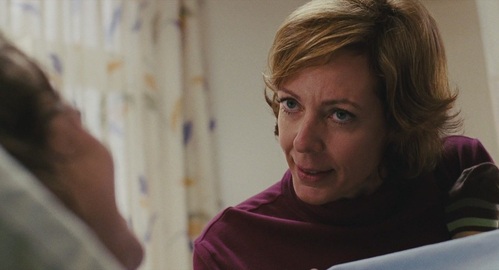
There’s a scene early on in Juno where the audience meets Allison Janney’s character, Bren MacGuff, and learns about her dog obsession. She’s got sweaters of knit dogs, a dog mouse pad, dog statuettes galore, they’re everywhere. I at least appreciated the absurdity of her character’s predilections, but it also served a purpose in Diablo Cody’s script, namely to knock us off guard. For she is the last person, this stepmother, who we all know are supposed to be evil doers in the world of the protagonist, to support the pregnant teenager. And then, she does, wonderfully, in fact.

And that is why I like absurdity, and humor writing, or in this case, a comic screenplay. It helps of course, that Allison Janney played her, because the woman has some really good timing, as evidenced throughout her Emmy-laden career on The West Wing. For what it’s worth, I would really love to see a series about congressional staffers and the polarization of the political parties, told in the same quickfire and witty way. I hear NBC has a few time slots they could use.

But seriously, humor is not easy to write. Good humor, anyway. Often, it demands accessible cultural reference, or audience identification with the situation and punchline. Some of the funniest stuff out there takes a common experience and turns it around, creating a completely new take, like making an origami swan out of a greasy KFC wrapper and giving it to one’s older brother as a lunch treat, since one had previously eaten the chicken inside that he was expecting to receive. Or something.

I was not a regular viewer of Seinfeld, but Larry David is very funny to me when it comes to showing the annoying side of people, and laughing through it. Elaine, stuck in a toilet stall, begging her neighbor for just one square of tissue paper, George’s unintentional killing of his fiancee because he insisted on buying the cheapest invitations to the wedding, and those came complete with toxic envelope glue, these are moments I remember even though it stopped airing in the last millennium. There’s also something about how humor makes for a full and breathing character—it takes loving big parts of George for viewers to be okay with the fact that he’s relieved he doesn’t have to get married, because otherwise, he’s an abhorrent person. Well, he’s kind of abhorrent anyway, but he’s still got his lovable parts. For me, David sometimes gets a bit too mean-spirited, so I can’t be counted among his big fans, but that’s okay, there’s a long list of folks I have to admire for their contributions to comedy.

All of this is to say comedy writers and humorists are supposed to make it look easy, to tap into our frustrations or insecurities and turn them inside out, exposing the fluffiness on the inside, if our experiences were like socks. My experiences have a couple of holes in them but mostly look okay, thanks to OxyClean. I just try to remember that my goal isn’t to make writing funny, it’s to reveal that finding life funny in general should be documented, in case anyone else agrees with me. I didn’t venture out to be a humor writer because most young writers really, really, powerfully want to write the next great novel, American or otherwise. But the humor kept showing up, like Uncle Lloyd at our Friday night dinners, and we never really knew why he kept hanging out with us until we realized his wife made really awful Van deKamp fish on Fridays and he was just looking for a non-fishy-smelly house. Two weeks in a row of Gorton’s finest imitation cod and we were free. No, I haven’t found a way to banish humor, but I’m not looking for one.

I am the prepackaged fish dinner of writers, and I’m okay with that.

All alone in the moonlight

I had an epiphany yesterday, round about 2 in the afternoon, that I should be contacting LGBT agents for my memoir. Why, I wondered, have I been trying only the mainstream folks—that’s like dressing up in my nerdy best and asking out the lead cheerleader to a rodeo (no offense to cheerleaders who like nerds). Trouble was, I didn’t really know how to find them, aside from searching for them on Google, your friendly neighborhood search engine. And that approach was fraught with danger, read, the Big Bad Fraudulent Agent. Apparently, they lurk everywhere, in the corners of the interwebs, waiting to steal one’s money (I don’t have much, so I’m safe there) and ideas (hey, if they can do anything with them, more power to them!). So I figured that for every name I identified, I’d just double-check them somewhere else. This presumes, of course, that there is a long line of clearly identifiable gay, lesbian, bisexual, and transgender literary agents just lined up for writers like me.

Perhaps I was off the mark a little. Or maybe I can blame the search engine algorithm. I did get some lovely lists of agents, and then . . . then I had to do some text searches. In a list of 100+ agents, there were maybe three or four who admitted they worked with GLBT writers specifically, or who represented gay/lesbian work. This was going to take some time.

I did come up with one name, for the few hours of my effort, and I sent along a queery [sic] to her. And then it was bowling time. I made the hour-long trek, grumbling that my iPod strangely decided not to play about a quarter of the songs I’ve fed it over the years. Damn update.

My bowling mate asked me how I was doing and I said I’d figured out I should try to find GLBT agents. She gave me a look.

“See, and I thought you were all smart and stuff,” she said. I lovingly punched her in the shoulder.

I figured the hunt for an agent would be renewed in the morning. But again, it’s like looking for a four-leaf clover. I’ve already gone through the small gay presses and not heard so much as a ping back, but looking at their book releases I can see why. I don’t write about being drug-addicted, or living in San Francisco, or going through a string of abusive lovers, or being homeless, or anything else edgy. I do write about mental illness, but well, that’s been done by very good writers. I write about the wonderfulness and insanity of city living, and we all know that great writers have tackled that one, many times over. So I think to myself, well, being an Arab American formerly gay transgender professional city-turned-country dweller who survived a bout of major depression, a bad relationship, and a dozen years of Catholic school, and grew up in a mixed race and ethnicity, mixed religion household in New Jersey and somehow came out of it without a Jersey accent, well, there are some marketable things in there, somewhere.

I’ve been working on something like a short story a month, cranking out the ideas that have been crowding around for attention, and then launching into rewriting for a few versions before beginning another one. I’m sure I’ll go through and revise them again, but my point this winter was just to keep writing, identify my best simmering point of productivity, and play with all of the things I love about the craft of writing, until I either decided it was time to go back to the super/stupid power story (in which queer folks save the world) or I decided to tackle another long-form project. The superpower story needs a major rewrite/redesign, and I have to change one of the stupid powers because I really can’t allow myself to reference Dan Savage anymore, after he came out with that ridiculous column last week about the Washington State Attorney General.

I’ve got a good outline for a mystery novel I began a few years ago, and I’ve wanted for a very long time to tackle a memoir or close-to-real story about my childhood, centered on my epilepsy. Really, I’d like to try to relay the experience of having memory gaps and false memories that petit mal and grand mal seizures gave me. They each had their own strategy. The petit mal seizures (which no one calls petit mal anymore) stole time away from me, leaving me hanging in the middle of a sentence and restoring me, many seconds or half a minute later, either attempting to finish what I’d started, or leaving me disoriented about my thoughts. My mind was wracked with 90 of them a day before the doctors—who wouldn’t tell my mother what was wrong with me—got them under control.

The grand mal seizures (they’re not called that anymore, either) played a different trick. They filled in the lost time with whatever my child’s experiences could cobble together. Singing Thanksgiving carols around a grand piano my school didn’t own. Winning the Showcase Showdown in a bright orange t-shirt. Seeing buildings by Route 33 in Hightstown burn to the ground and feeling, really feeling, the thick wave of heat it gave off. I’ve spent hundreds of hours thinking about this book, even as the gender change story was more urgent for the telling of it. I want to write this book in a way that isn’t trite or cliche. Agents apparently loathe book openings with dream sequences, but darn it, false memories aren’t dreams. They’re closer to near-death experiences, in the way I’ve encountered them, like reaching to a different plane or a sticking one’s face into a parallel universe for just a moment and then trying to write down everything seen. I want to write this book.

And I’ll write it even if there are no agents for it. Because writers are supposed to just push on and write.

Block’s writer

Gutenberg BibleI’m sure we’ve all heard the narrative a hundred times over: I’ve been a writer since I first held writing implement to fingers. And my Mom loves my stories, and all my friends say my book is a bestseller. And then we’re supposed to laugh condescendingly, because this little intrepid person is so clueless, clearly, about the publishing industry. Oh, if they knew about the publishing industry, we think smugly to ourselves, they’d know that Mom’s opinion doesn’t matter, and all their friends are wrong.

Just to give this some dimension, the US published 172,000 books in 2005, according to the geeks who count such things. Of these, let’s be generous and say that 200 of them counted as “best seller” status. (Anyone remember French Women Don’t Get Fat?) That’s one tenth of one percent of everything published that year. Of course, most of these books don’t even dream of topping any list: Unsolved Problems of Noise and Fluctuations, a fantastic tome on physics, probably didn’t make it to people’s holiday wish lists. But even taking just the fiction, memoir, poetry, and narrative nonfiction into account, the likelihood is very, very low, trust me.

This isn’t to say people shouldn’t write down their stories, or whatever things they have cavorting around in their heads. It just means that most stuff goes nowhere, but on a page, in a notebook, or onto the hard drive of a computer. And that’s really okay, because the vast majority of our human endeavor to create the amazing is actually quite awful. Total drivel. Buzzard crap, or that Canada geese shit that turns everything green and stinks of high heaven—hey, it was a life experience I won’t ever forget.

So why write, even? If it all sucks, why bother?

My answer is my answer alone. I write because it gets better when I rewrite it. The third time around, it starts to sound nuanced. The fourth revision I’m making specific language choices, listening to the rhythm of the words, the believability of the dialogue. The fifth time through I may do something drastic, like change the tense, cut the first 7 pages and have the narrative begin at a new point. Actually, I usually chop out my beginnings, trusting that the quotation I heard a long time ago is true: One should start a story like one would pick up a puppy, a little behind the front. I have no idea anymore who said it, maybe St. Vincent Millay or Doris Lessing or Eudora Welty. Now that woman wrote a lot.

By the time I get around to the tenth revision, I’m just nitpicking words and it’s more like talking about nothing at the end of a coffee date than actual editing. I just need to declare it’s over, we’ll meet again someday. At this point I’ve cleaned it up, swept out excessive prepositional phrases, changed sentence structure, evaluated my tone, simplified, simplified, simplified, and attempted to really cast a light on my characters without overwriting them. I like it when readers pick up different aspects of my protagonists, when they almost like the foils to those protagonists, but for the fact that they’re really despicable.

If enough time goes by, my relation to my stories changes. I used to think of this as watching the story fall behind me as I charged ahead, a steam engine train of a person. I now see that we’re both moving, in some kind of random, and certainly unpredictable direction from each other. Sometimes we swing back around, like a comet passing through a solar system every 76.2 years, and old ideas make a new kind of sense to us. But sometimes we never occupy the same space again. Maybe that was the story best understood by my 17-year-old self, and my 39-year-old brain simply doesn’t want to hang onto it anymore. Or maybe I’ll enjoy seeing where I once was in capability, craft, and idea, even as I acknowledge that I’m in a new place.

In any case, I’m glad I’ve written down as much as I have. And while I would be thrilled, say, with an appearance on Ellen, I’m not presuming anything I write would be a bestseller. It’s true that after years of messing around with fiction, with literary analysis, and the reading of thousands of books, I really needed to write a memoir about my transition.

I really haven’t talked about why with anyone except my writing coach, Lea, who has more than one hand on the pulse of the universe and who I see as a really friendly, astute guide through this whole publishing rigamarole. First, I had some demons to exorcise, and writing was the best way to do that. A lot of that writing was just for me, not for any book, and most certainly not for anyone else’s retinas. But it did let some of the experience percolate and then steep, and gave me a blueprint for organizing the past 6 years into a sturdy narrative. There was some motivation stemming from my “mentoring” of a young female-to-male transsexual who was asking many of the same questions I’d pondered at the start of my experience. I’ve spent copious hours online, asking and later, answering the strangely narrow-banded litany of inquiries people have about transitioning: will my family hate me forever? Will my partner desert me? Am I just disfiguring myself? These are really all smaller branch questions that have popped out from one solid root question:

Am I crazy?

The answer none of us wants to admit is, maybe. Maybe we/you/they are crazy. But we’re probably not crazy, because crazy people don’t formulate questions on the Internet, research their options in a rational way, get opinions, sift through information, try different methods of managing what turns out to be an illness—crazy people behave less from a place of information gathering, and more from a place of irrational. Crazy people respond differently to the therapies around gender identity dysphoria. Transsexual people see their happiness and sense of well being increase dramatically after even the most mundane or simple changes to their sex and gender identity.

Could a memoir bring these points across? I thought so. Could I tell a story in which a fairly ordinary person realizes something extraordinary? And has the daring to see it through? Could I make getting a sex change seem like the right notion for a protagonist? I thought about it and decided yes. I don’t think I’m the trans Messiah; this isn’t an especially rare narrative, even as it’s certainly a twist on the boy meets girl tale.

And heck, in this memoir, there is boy-meets-girl, if readers are okay with boy-who-used-to-be-girl-meets-girl-who-usually-likes-other-girls.

Perhaps agents think the concept is too out there, and that’s why I’ve had trouble selling this. But I believe in this story and this project. I know that there are thousands of people who would guffaw at the hilarity I’ve lived through, and fret through the hard parts, and have questions like I’ve had, about medical services and people’s judgment and how strange it is to see the world through completely new lenses. I have faith in this book, and I just have to keep pitching it, even as I work on other stories that want their 15 minutes of fame on my keyboard.

I used to spend a lot of time getting stuck as a writer, but then I pushed through on the memoir project and now everything I bottled up wants to come out to play. And that’s how I know the memoir is a story that needs telling. And though we may cross each other in space at some point, hurtling in new directions, it will retain at least a core of interest for me, and hopefully for some agent and publisher out there.

And hey, my sister thinks it’s great.

Long writing journey into something

Ever since I read in Stuff White People Like that Moleskines are a staple of white pretentiousness and posturing, I’ve been self-conscious about mine. Christian Lander had me nailed, right down to the MacBook Pro sitting next to it as I sipped at a non-fat latte in an overpriced coffee house. At least I hadn’t procured mine with a credit card—I’d scraped together cash from around the house, on the premise that if I only used loose change, it was like a free purchase, like how sucking on a mint after an outing to Sonic is free of calories. How idiotically white of me.

mocha latteTo make matters worse, this is not my first Moleskine. It is, in fact, my second. And if anyone cared to study this little black ruled book, they would discover a “2” written  in on the bottom, where the gold leaf should be, I guess.

Perhaps it’s better that I used up a whole book already, because at least I write in them, and no, they’re not just full of grocery lists and directions to IKEA.

I also don’t have anything in here worthy of da Vinci or Hemingway, two of the Moleskine’s more famous users, and Hemingway was a stuck up misogynist anyway. His best short story is six words long (his assertion, not mine).

No, I write in this notebook to keep track of query letter submissions, the inevitable rejections, submissions to journals, and the places I might submit to someday but for what I consider exorbitant submission fees (read, $10). I also keep track of my work in progress’ progress, scheduling deadlines for myself like an agent or editor would. That way I can have arguments with myself over why I’m giving excuses on missing important dates and don’t I know what this is doing to my career, and who is going to want to work with me after this?

I’m sure I still have my mind. It’s right in a box over there.

All of this ponderance about Moleskine notebooks comes because I’m sitting at PDX airport waiting to meet my mother who will be visiting us or a week. A technology professional is at the table next to mine, speaking loudly into his cell phone describing the apparently delicious and speciously nutritious drink he’s just purchased from Jamba Juice: a little bit of banana, strawberry, and mango, he declares loudly to his wife, plus some SOY PROTEIN! and ESSENCE OF WHEATGRASS! It sounds particularly disgusting to me, but then I’m the schmuck with a $4 nonfat mocha in a world-preserving, 100% recycled cup, so what do I know? And writing in a Moleskine. Damn Moleskine.

I don’t feel particularly pretentious, but then again, white people never do. We’re pretty much blind to it, save the very extreme examples—here I’m thinking of German avant garde artists from the 1980s, or say, people from Massachusetts named Biff Wellesley or Chauncy Milton who wear plaid shorts unironically and race in regattas around the Cape. Maybe I feel a bit incognito partly because I am sans my titanium Apple accessory this evening, and partly because I am in green cargo pants and a black hoodie. I fit right in to PDX, the city, not the airport. Come to think of it, who nicknames their city after their airport? I bet if I asked everyone in earshot who had a Moleskine to whip it out and wave it like they just don’t care, 39 percent of the folks here would be showing off their pretentiousness inside of 16 seconds.

The airport announcer is saying, for the fourth time, that Jesse Bauer really needs to meet his party at the Panda Express. Jesus, Jesse, get moving, their dinners are going to get cold.

I left Walla2 right after receiving notice from an agent in Seattle that they just didn’t quite connect to my manuscript, so they won’t be moving forward with me on this project. Moving forward. I note that they didn’t rule out moving left, or upward. Perhaps those options are still open.

My mind reads this rejection sentence and immediately thinks of a shoreline. I’m not sure why. Perhaps it goes back to that oft-repeated line about the footprints of Jesus as he carries his ignorant follower who somehow doesn’t get that hello, JESUS IS CARRYING YOUR DUMB ASS. I’m not sure with whom I’ll be moving forward, but if Jesus is doing any agenting, I’m open to the idea. I bet he could work wonders with publishers, yuk yuk.

She went on to say in her letter that it wasn’t me, it was her, and just, perhaps, a matter of taste. This Dear John letter tone didn’t sit well with me. A matter of taste? She was looking for a Prada clutch, and I was a Jacqueline Smith pocketbook on the clearance rack at KMart? Or perhaps it just wasn’t what she was looking for right now. Maybe three years from now humorous memoirs about klutzes who get sex changes will be all the rage. But why say perhaps? Doesn’t she know? It’s her opinion she’s offering.

Well, it comes down to platform, I get that. Mr. Dan Savage of the Stranger, another GLBT author working with a Seattle agent, has readership. So okay, I’ll work on having a platform and see if my words suddenly sound better, or become more connectable to people.

The second paragraph of her letter was just as brief. She wanted to encourage me to continue trying. I genuinely appreciate that. But why? Or more to the point, how? She said there was much to recommend about my writing. What, specifically? The font? The careful avoidance of split infinitives? The witty banter among urban dwelling queers? What? I’m left, as after my other rejections, in the middle of a guessing game. So far, my guesses have been wrong, if success is measured in contract proposals.

But I’ll tally ho and try again, because I am a writer with nothing to lose. JK Rowling got 13 rejections of her original Harry Potter book. I have just surpassed her with this 14th rejection.

Take that, JK!