Tag Archives: popular culture

On the Road for an Unknown Writer’s Book Tour
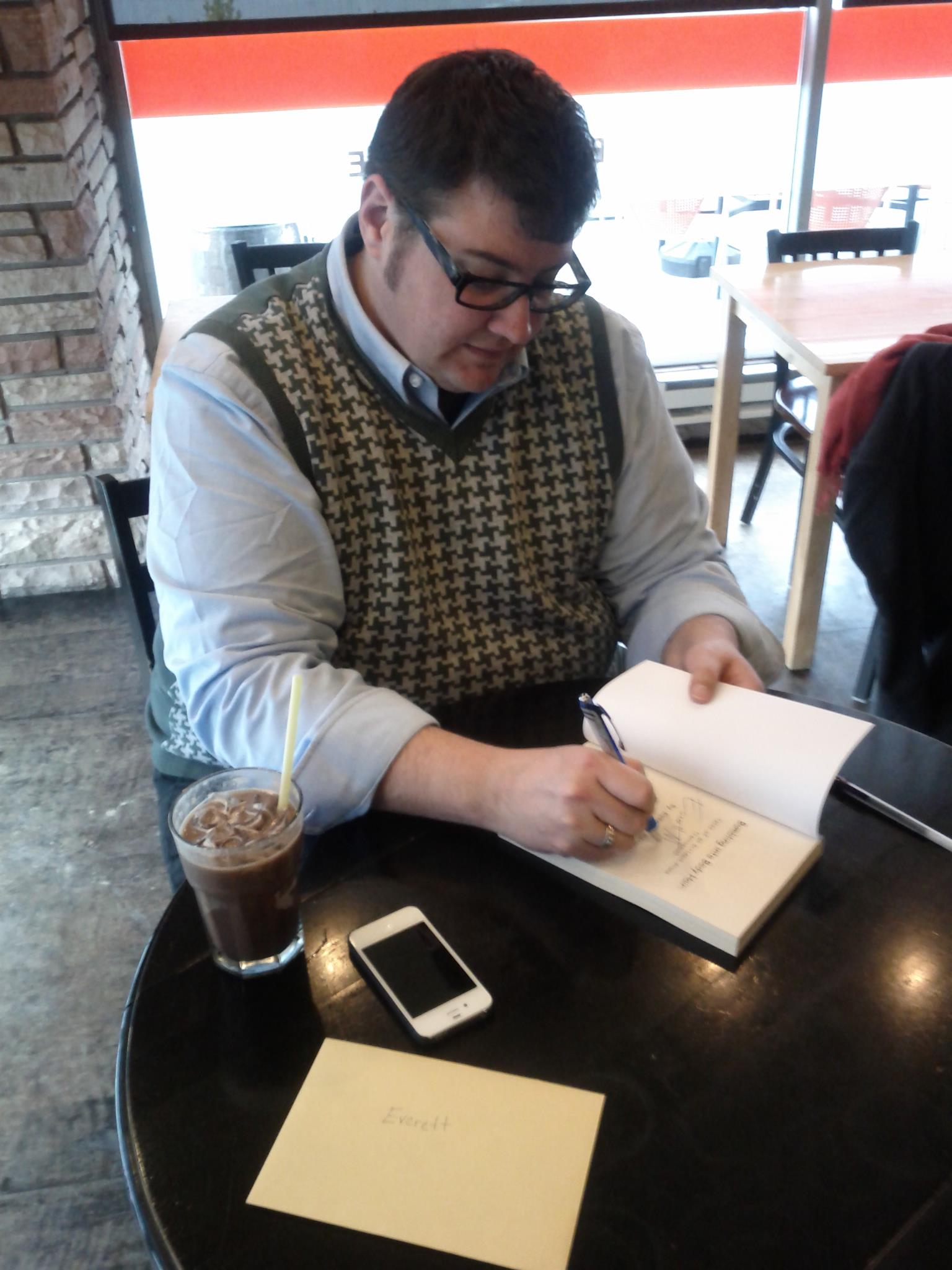
The book tour is an endangered species, part of the soon-to-be archaic practice of publishers in getting publicity for top- and mid-list authors when their latest books hit the market. I remember book tours from the bookstore perspective, because I was once a book buyer and I coordinated readings up in Syracuse, New York. Stephen King, impeccably nice. Oliver Stone, not so nice. Mollie Katzen had lots of culinary tips, William Bennet was reserved, and Donna Shalala had a great booming laugh. For each of these events we ordered 30, 40, 75 copies of their tomes, and the lines stretched out of the store and into the student life building atrium. We’d put extra people on shift and listen to the cash registers ring with sales. It was something of an assembly line: customers waiting, picking up books, paying for books, getting books signed, out the door. A signing could last one or two hours before the interest petered out. We tried not to frown when people arrived with their own books or with books that had been released years earlier, because the authors were sure glad to see everyone. Some of the authors had requests up front or in their contracts that we had to fulfill, things like having sparkling water, or having a rival’s books tucked out of sight, and of course, of course, we were more than happy to oblige them.

When I do a reading, I count it as lucky if the store remembers I’m showing up that night. One reading had me and a few friends standing nervously on the sidewalk, the store dark and empty of staff, while I called my publicist. We were saved from reading on the street or walking away in sorrow when a random car with three store employees drove by us, wheeled around, and opened up the building. By the time I started reading in the quickly rearranged room, 15 people had shown up. Read More…

Guessing the Killer

I originally wrote this for I Fry Mine in Butter in 2010.

Perry MasonWhen I get a little afraid to admit just how many hours I’ve spent watching cop shows and courtroom dramas, I just add up all the hours spent reading, which is impossible, I suppose, and then I feel better. Because even loving popular culture the way I do, I still worry that what my elementary school teachers told me is true: TV will rot my brain.

Here I am, still intact in the higher functioning way. I must still have a few capable synapses. So since I’ve made it with all these years of television viewership under my belt, I’d like to spend a little time looking at one sliver of television narrative: the giveaway shot.

I want to give some due to the camera action that does what foreshadowing did for Mary Shelley. It’s usually less than a second, sometimes is accompanied by dialogue, but mostly not. I like to think it’s something TV picked up from Alfred Hitchcock, because he really started the quick cuts and shots that we have come to expect in suspenseful storytelling. Read More…

Macho Sport Meets Female Body

I originally wrote this for I Fry Mine in Butter in 2010.

2000 China women's gymnastics teamThis week the Chinese women’s gymnastics team that competed in the 2000 Sydney Olympics was stripped of its bronze all-around team medal for having a member under the minimum age of 16. That so much evidence existed and was in the public for years before this move by the International Olympic Commission—including the athlete’s personal blog and inconsistent birth certificates—is compelling, especially given the furor during the Beijing Olympics in which the same rumors swirled around the 2008 team. Several sports writers and experts have written that the IOC caved in and refused to call China on its willful doctoring of documentation because it was the host country that year and heck, for various other potential reasons that run the gamut from probable to a conspiracy theorist’s dream.

What I want to know is, what is the advantage of the too-young gymnast? Well, when it comes to women’s gymnastics, smaller is better. A shorter length from head to foot increases the likelihood of balance, which is important for pretty much all of the exercises; smaller bodies don’t receive as much stress on their joints from the whipping through the air and hard landings and dismounts; and pre-pubescent bodies still have flexible cartilage at the ends of the bones that make the body slightly more flexible and presumably, a modicum lighter. Read More…

Fleeing vs. Invading

This originally appeared on I Fry Mine in Butter.

In thinking about the anti-immigrant it’s-okay-to-use-racial-profiling law that passed in Arizona last week, my mind flashed back to V, all the way back to 1983. Knowing that it’s only a matter of time before the Gestapo, I mean, the Visitors, come to take them away for being illegal, I mean, scientists, they ask their former landscaper, Sancho, to get them over the border. Though this storyline and plot moment is fraught with all kinds of stereotypes about Latinos, Jews, police, and the power dynamics between these, it’s still written from the point of view of the smuggler as hero. Of the Latino smuggler as hero, no less. I can wrack my brain (okay, I have wracked my brain, through a nasty course of stomach flu, in fact) and I cannot come up with another instance in the last 40 years in which a mainstream television show or movie depicted illegal immigration by Latinos in this way. (To see the clip, start watching about a minute into the segment below.)

I can, however, come up with dozens of positive depictions of other people fleeing across borders illegally and/or without proper documentation, including, but certainly not limited to: Read More…

Television’s Sidekicks of Color

Author’s note: This post originally appeared on I Fry Mine in Butter in June 2011. 

Feeling somewhat blue in the doldrums of summer reruns and the NFL off season, I gladly tuned in last year to see the then-new show, Royal Pains. It was about an E.R. doctor who gets unjustly fired from his job for helping a sicker but less wealthy patient, and winds up going into extremely private practice for the extremely wealthy in the Hamptons, New York. Catch the irony there? It’s subtle, I know.

It was enjoyable enough, with Mark Feuerstein as the good doctor Hank Lawson (son of being lawful, get it?), Paolo Costanzo as his well intentioned, extremely frustrating brother Evan, and Reshma Shetty as Divya Katdare, a woman of Indian heritage who secretly becomes a physician’s assistant, hiding her vocation from her family. Watching through the season, it was her character who supported the brothers through Evan’s monotony of stupid schemes—how his character didn’t take the grand prize in the Darwin Awards, I have no idea—and Hank’s challenging sense of insecurity to become the backbone of “Hank Med,” Evan’s stupid name for the practice. She reminded me a bit of Stephanie Zimbalist in Remington Steele, although Hank was by most measures not a complete charlatan.

Then the fall rolled around and I took in the premiere of The Good Wife,which I’ve written about on here twice now. And lo and behold, in the midst of the fictional Florrick Sex Scandal of 2009, there’s a cutting-edge investigator at the defense attorney firm: an Indian woman, Kalinda Sharma, played by Archie Panjabi. Wait a minute, my brain fired at me. Is this just coincidence? What’s going on here with the sidekickery? Read More…

Out of Order

Author’s note: This is reblogged from I Fry Mine in Butter, from June 2011 when I originally wrote it.

I was still a teenager when Law & Order started on NBC, and while I liked it just fine, I don’t remember being immediately taken with it. Actually, it seemed a bit like one of my boyfriends, the first of three Scotts I dated in high school and college—fairly likable, but I wondered about how long it would last. Law & Order, on the other hand, grew on me over time; I may not have caught each and every episode as they aired that first season, but I would read the tiny printed previews in my parents’ TVGuide and remember to watch. Hey, it was 1990, after all, and the newspaper’s television guide was often wrong. Oh, life was so hard.

I wanted to know what was up with Ben Stone, the ADA who seemed a little, well, crazy. Robinette was the cool and collected one, often mediating between Stone and Adam Schiff, the District Attorney. Every episode the cops were nearly precognitive, until the attorney’s office took over and had to deal with the technicalities that threatened to have the case for the people thrown out. It was as if Giuliani’s New York weren’t even possible because these criminals knew it was a cakewalk. Still, with a little bit of magic and finesse, and a hell of a lot of drinks over what I can only presume were extremely old bottles of scotch, Schiff got his convictions. Or at least very intimidating plea bargains. Read More…

It’s Not the Same Press Anymore

This article originally ran at I Fry Mine in Butter.

Once upon a time, newspapers like the Boston Globe, the New York Times, the Philadelphia Inquirer, the Washington Post, and so on all had reporters posted in far away places from Moscow to Johannesburg, Rio de Janeiro to London. These folks were part of a press corps that wrote daily or near-daily stories and sent them back to their editors in the paper’s home town. Each paper published different articles on similar topics, because the ideas around what was “newsworthy” were generally the same, although it was common for one paper to run a story and another not to, if the first paper had confirmation of all of the details but the second one couldn’t muster them together. This is how we all came to know the concept of “getting the scoop” on the competition. Political reporters tried to form relationships with people in the political arena, so that they could get first dibs on juicy quotes or source material. I presume that a lot of backroom dealmaking popped up in this kind of relationship. Agreeing not to mention President Roosevelt’s wheelchair meant that one got to continue to sit in the White House press corps, for example. Agreeing not to mention JFK’s many affairs got them something I don’t know. But something. Read More…

The Coen Brothers Know How to Murder

Author’s note: This is reblogged from I Fry Mine in Butter, published in May 2011.

Please note, this post contains and focuses on images of fictional violence.

I was a fan of the Coen Brothers before Fargo came out, and then it was all over, I was nuts about Coen Brothers movies. I still think there’s never been a better movie opening than the one in Raising Arizona. There are a lot of things I could write about with regard to their work, but fortunately for me, it’s mostly been covered by the blogosphere. What I haven’t seen, however, is this, and coincidentally enough, it’s one of my most favorite aspects of their work—it is freaking hard to kill someone. On a larger level, it is inordinately hard to be a criminal. Shit just doesn’t work out very well.

In two films, the aforementioned Fargo and Burn After Reading, people who are otherwise desperate or ignorant try to deal with their circumstances by identifying get rich quick schemes. They even had the best intentions to start out, but faced with two juggernauts as adversaries—well established, smart and greedy businessmen, and oh, the Russian embassy, respectively—they fold like a house of cards in a day care center. Read More…

Ode to Libraries

Carnegie Free LibraryI often insist to people who ask about my early education that Catholic school was just fine for preparing me in the ways of the three R’s, even if I did believe, upon high school graduation, that the world consisted of Catholics, Jews, and protesters. I could diagram my sentences, perform passable algebraic calculations, type 85 words per minute, and name every state capitol city (Trenton! Montpelier! Madison!). But more importantly I had a curiosity for learning and wanted to get the hell out of Dodge. For while parochial school had some fine qualities for me the student, it certainly lacked in other areas, like its library.

I read through most of the sections by 5th grade, and I only started at that school as a third-grader. Soon enough I was pestering my mother to get a Princeton Public Library card, and devouring books on maritime history, the American Civil War, young adult fiction, and anything by Stephen King. Now there were too many books for me to read, but I took that as a challenge instead of demotivation. Nothing suited a precocious child more than the idea that the world’s knowledge is just at their fingertips. Read More…

Spree Killer Contradictions

I refuse to write his name because he’s not the point, the is-he-or-isn’t-he faking psychosis mass murderer who destroyed dozens of families last weekend in his quest for selfishness. As much as we want to aim our fingers at him in judgment, this act of violence isn’t about him, just as it wouldn’t be about the lone terrorist who stuffed a bomb into his underwear, or the two disgruntled men who took out the Federal building in Oklahoma City all those Aprils ago. I don’t absolve any of these men of their acts, certainly not, but I can’t abide providing them the public attention they crave and that they receive from so many media outlets.

One wonders where people even get the idea (CSI) to gun down (Call of Duty) large groups of people (The Closer, NCIS) in a twisted sense of justice (Breaking Bad, Dexter) or superhuman power (The X-Men, The Dark Knight). And we could ponder why we see these events as solely the actions of a broken brain (Criminal Minds, Numb3rs, The Silence of the Lambs) are at their core individual episodes and not related in any way to larger systems that have a perverse need to produce violence.

I just don’t know how we get here, where a stream of life-ending bullets descends onto a crowd gathered for a movie, and it takes everyone too long to realize they’re actually under attack. Susanne called this aspect of Friday night’s tragedy particularly sad, and she’s got a good point there. Who are we as a culture that extreme violence is so much of our contemporary entertainment narratives?

Also weird to me is the utter silence around potentially productive conversations we could be having right now but aren’t. The National Rifle Association balked when people were upset about a tweet they posted after the shooting:

NRA tweet

Read More…