Trans & Gender Nonconforming Reading: Moderator Notes on Trans Literature
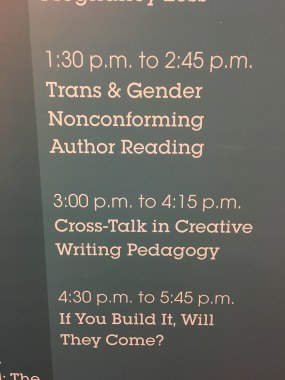 NOTE: These remarks were delivered at AWP17 on February 11, 2017 in Washington, DC.
People ask, “What is trans literature? Is it literature about trans people or by trans people? Is it emerging? Is it literary or folk? Is it in vogue or invisible? Is it limited to a form or a genre or is it a post-modern queering of narrative?”
These questions miss the point. Further, this questioning enforces an authenticity of the poetic and the literary not demanded of cis writers or cis-centered literature. As many writers on the margins have pointed out, as Dr. Nafisi said to us Thursday night in her stunning rebuke of tyrannical, Western cultural norms that seek to delegitimize Iranian cultural production and cultural identity, the mainstream ideology never seeks its own authenticity, it can only, in a kind of Freudian compulsive repetition, work to pull down the provenance of marginalized literatures. Mainstream literary ideals continually misunderstand the value, the meaning, the quality, and the scope of trans literature.
Just last week the White House and its team of dementors and destructors floated language for a new executive order that would erase the legal foundation for trans civil rights in America. This horrendous mashup of reactionary illegal-ese written in the dungeons of the Family Research Council and the Heritage Foundation, if signed by President Hairdemort, would define for the first time, by any government in the world, that “sex is an immutable characteristic from birth.” At the exact moment that the United States is pondering the erasure of trans and gender nonconforming people from the legal landscape, we are facing an ongoing question in the literary world: “What is trans literature?” Read More…
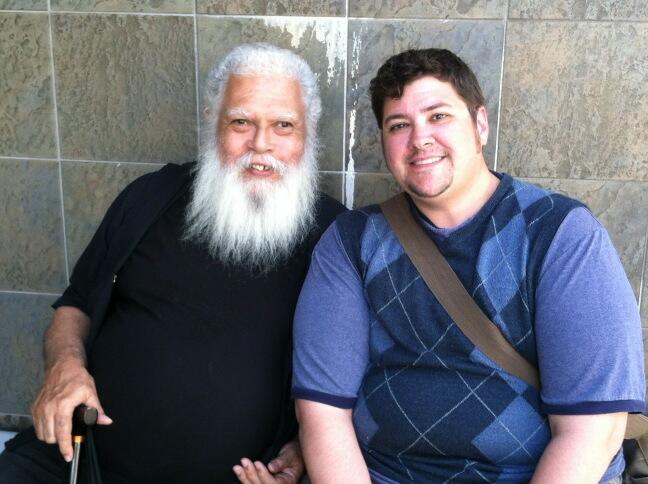
 We’ve read through all of the fiction writers’ pieces and handed back critiques, treating each work and editorial process seriously and concentrating like whoa on giving good specific feedback. After five days I feel raw and exhausted, but good. It’s like whittling deadwood, sloughing off the bits I don’t need (I’m looking at you, insecurity and bad literary habits). Now I can focus my attention on word choice, craft, storytelling, and because Chip has hammered it into me, description. It may very well be that every story I write for the next few years, I will write for his eye and ear and sense of prose.
 We’re here, we’re queer, and we’re critiquing each other’s work. So came the second full day of the retreat, enshrouded in mist once again and with a chilly breeze that made me glad I’d chosen a sweater vest for the morning. Thank goodness I discovered how to command hot water out of my shower, because a second event of freezing liquid was just not going to work for me. I woke up at 6:30 and went through my new French press coffee routine, then groomed myself.
 Okay, here I am. I can stand on the slant of the hill and gaze upon the San Fernando Valley, when the mist and/or the smog isn’t hiding it, that is. It’s pretty, and like a lot of the West Coast, covered in desert plants. None of the palm trees I see are native to Southern California, but I appreciate them anyway. Palm trees, for me, mean that I’m somewhere not considered home. They ring vacation to me, because you can never really lose the New Jersey, I guess.
 Life this winter and spring has been less about balance and more about fulcrums. You know, like when you’re moving up and down a lot but not getting anywhere. At least a roller coaster has forward momentum and a few thrills along the way. A seesaw just lifts up and crashes down with a jolt at the end of each direction. Nearly all of the endeavors I’ve made since last fall have come with commensurate concussions. Case manager is leaving for a full-time job. Hire new case manager. Send in manuscript to potential agent and wait. . . finally getting rejected by potential agent (but in the nicest way possible). Move office to other side of town, deal with people yelling on the phone that the office has moved. Start new manuscript, get sidelined by a different project. Apply to literary contest, fail to make the finals. Apply to writer’s workshop with no hope of getting accepted.


 Trans/plant/portation