Latest from the Blog

Express Delivery

EDITOR’S NOTE: This is the second part in the story about Lucas’s birth. Also, I really wanted to write “EDITOR’S NOTE.”

me holding LucasIt’s strange to me to spend time in a hospital these days. I logged so so many hospital hours when I was growing up—between my epilepsy, nighttime seizures, and a bout with the once-named pseudotumor cerebri, I knew the floor plans of at least three medical centers—that there are strange factoids about these places that persist in my knowledge. Rounds happen way too early. Vitals are taken every four hours. Every fifth blood pressure cuff sucks. And nurses come in a vast variety of specializations and competence.

When I spent a week at the Children’s Hospital of Philadelphia, I learned I had two clear favorites, though at this point their names are lost to me. One was taller than a Redwood pine, the other a stout, short woman who cast fear into the hearts of doctors. The tall one always had a compliment. The short one always told me the truth. And when the line of residents came into my room to see how messed up my retinas were, all carrying their own blinding penlight, short nurse was there to steer them away after a couple of minutes.

I realized early on that hospitals are spaces of contradiction. They make people well, even as they’re the easiest place to catch a cold or communicable disease. They’re full of kindness in the light of progressive, inescapable illness, which is anything but kind. Their personnel have a wealth of knowledge about physiology, hematology, pharmacology, surgery, and so on, and often they don’t know anything at all related to an individual’s specific problem. Health care providers have been asked to absorb the latest and greatest in the scientific literature and retain their fundamental training. And because they work the middle of a normal distribution like flies to a cherry pie, an outlier’s power to confound is heightened. Read More…
Forget the Waiting Game

Humans love patterns. I don’t mean a Scottish plaid or a pink paisley (although those of course have their place in the world), I’m thinking more of the repetitions and unrandom occurrences that permeate our lives from which we derive meaning, seek comfort, glean knowledge, etc. Some play Sudoku, reveling in combinations of numbers, or look to discover new patterns in math, Fibonacci sequences being old hat and all. Others love fractals, genetic sequencing, a field of clovers, the lines that a purebreed dog is supposed to exhibit, whatever strikes their interest and fancy. There are patterns of things and histories and people out there to suit every interest. And beyond patterns there are trends, or pattern forecasting, if you will. Once we start talking statistics, it’s a whole new world of hit and miss—is this thing a pattern or isn’t it? can we count on this pattern to continue?—and though experts may collude that a given pattern is definitely, absolutely, perfectly true, well, I think we all know better.

Here I turn to pregnancy. Show me a woman with a 28-day cycle and I’ll show you thirty more who cycle in a different pattern, or via no pattern at all. (They live with an annoying label of “irregular.”) If Western medicine loves a broad pattern on which to base its practices, women’s reproductive systems are the proverbial fly in the ointment. All of science still fails to understand how the start of labor is even triggered. Is the uterus like, “I’m done?” Is it a sign from the fetus? A signal from the placenta? Somebody’s hippocampus? Ted Cruz? Despite all of the not knowing going on, we are presented again and again as hopeful parents to be with the same ill-fitting narrative: most women will experience X. If a given woman experiences X+2 or even Z, that’s on her.

We’ve  seen Susanne get some symptoms of pregnancy and not others, some for a longer or shorter duration than the Mayo Clinic’s book suggests will happen, and she’s had different experiences over both of these pregnancies. Why do these things change or vary?

Who the hell knows? Read More…

Waiting Games

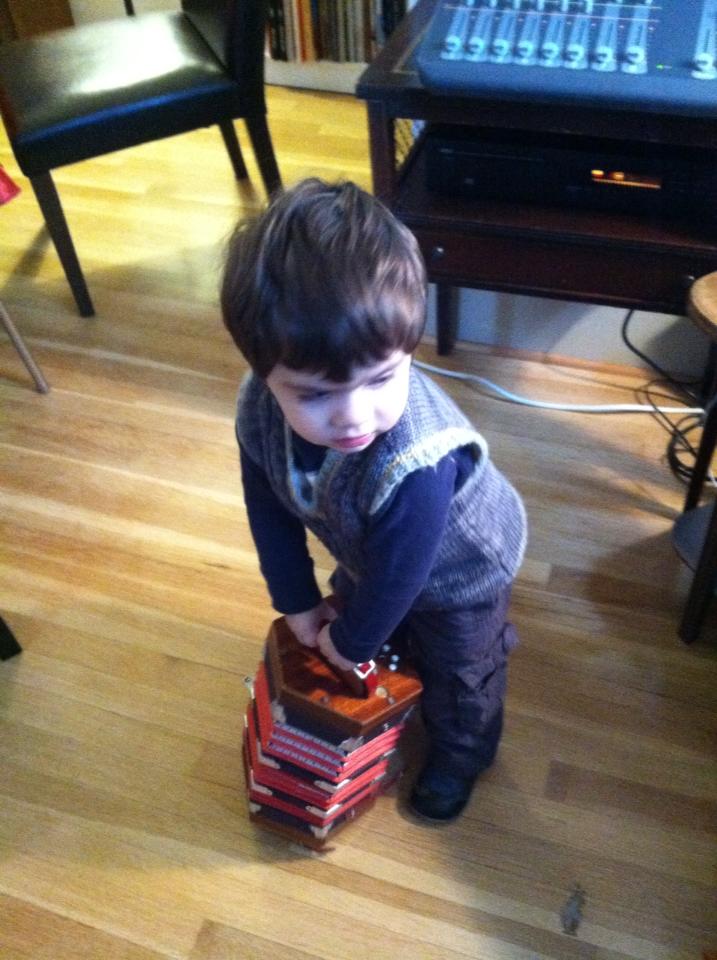
Emile and an accordionIt’s public knowledge that toddlers are not known for their vast quantities of patience. Instead, the image is more of screaming, purple cries, stomping feet and/or thrashing on the floor. I often cover my face so I don’t get hit while Emile does his version of tilting at daddies. But he calms down quickly, at least, as I remind him of the obvious, saying “We don’t hit each other in this family.”

“But I want to,” is often his counter. And then there’s a discussion of why wanting to do something isn’t always a good enough reason to do it. At some point he will likely tack on a “But why?” and then we’ll have a whole new level of explanation to provide whilst ducking tiny blows.

Another tactic—I guess—is modeling the good behavior we want to see in him. Sometimes I tell him when I feel exasperated, but more often he notices my frustration and asks me what’s going on.

“Daddy just wishes the traffic light would turn green already.” “Well, I’ve been on hold for a while now and I would just like to resolve my customer service problem.” I’m sure a lot of this is over his head, but the point is that I’m talking despite my negative emotions, I’m digging a little deeper to continue being patient with an aggravating set of circumstances. That’s the lesson here, right?

We’re in Week 39 of Susanne’s pregnancy, and our patience at this point is thinner than a string of fibre optics carrying NSA eavesdroppers across the Atlantic Ocean. The baby is squirming, bonking Susanne from the inside, and throwing triple axels in a bid to become the youngest Olympian ever. It was several weeks ago now that mom redux started throwing her hips forward in a bid to maintain her center of gravity while walking, and now she’s just ready for a tiny human to emerge from her body. The cocoon is closing, kid. I whispered to her belly this morning, “Get out.” So far child number two ignores us as well as Emile does. Read More…

Befrazzled

I’m working on two grant applications for work and I’ve nominated myself (I know, how ostentatious of me) for the Lambda Literary Foundation’s emerging writer award, the application for which is due by March 7. I’ve already applied for two writing grants, am looking at three submission deadlines at the end of the month for short work, and submitted two other pieces for consideration in anthologies. Meanwhile Susanne and I have cobbled together the new baby’s nursery, hesitatingly accepted an invitation to a baby shower, and put together various things for our second kid. Her physician tells us that the baby could come at any time, even though we’re two weeks away from the due date. We have a backup plan in case labor begins before her mother flies into town. I’m trying to get my office ready for my short absence, and manage to keep a semblance of a writing schedule up until the rush to the hospital. And oh, my debut novel is due to be released in a little more than a week.

I’m not sleeping through the night anymore. Please don’t worry for me. It makes perfect sense, after all. There’s a lot going on. (See: preceding paragraph.) I’m no longer the French vaudeville guy spinning plates on sticks in front of a hostile audience. I’m spinning plates and juggling fire-torches at the same time. Or something. Forget it, it’s a sucky metaphor. In my 90 minutes of insomnia a night I play a little sudoku, read twenty pages of a novel, and roll over like a hot dog at 7Eleven. Once or twice I’ve groped my way out of bed to try to write a little and I wind up deleting the disaster the next day. I remember going to an exhibit in DC several years ago about women artist and insomnia, and there was this one wall—seriously, the whole gallery wall—that was a series of pen points that created a behemoth picture. I can’t even recall what the picture was. It could have been pugs dancing in tutus for all I know. The thing that stuck with me was the three gazillion dots on the wall. Dot. Dot. Dot. Dot. Dot. It was intricate, and mad, and just under the threshold of out-of-control.

My insomnia is nothing like that. It’s not tortured or angsty. It doesn’t feel like the edge of a precipice so much as it feels like I’m about to emerge out of a long tunnel that is curved just enough to keep from letting any light reach my retinas. It’s traveling through a space just dark enough to inspire or frighten one’s trust. So far I’ve got that trust, layered with excitement. I’m thrilled for the family to grow. I’m stressing over the external sleeplessness I know comes with round-the-clock feedings. I wasn’t worried when Susanne was laboring to bring Emile into the world that she’d be unable to walk for more than a month, but now I am. Knowledge is maybe not always power.

Don’t get me wrong; I’m happy, I’m fulfilled, I’m chocked up with anticipation, and the kinetic energy I contain on a daily basis this month is too much for my brain to get me to a decent sleep level. And so, I look forward to her labor, to my moment of giving her my best support, and the time when they lay a little body on her chest and she falls instantly in love with her newest child. I just have to get a ton of shit done before then, because there’s no way I’ll care about it afterward.

Echoes of Chamber Music

guitar up closeThe mythology goes something like this: when I was three years old, I told my parents I wanted a piano. They may have chuckled, or pet me on the head, I don’t really know, but the upshot was that I was not taken seriously. I mean, why would anyone entrust a toddler with an expensive musical instrument that would test the floor joists? So I asked them again a little while later. And again. Persistence was my modus operandi. When I turned five, I got a Baldwin upright piano from my folks, a chestnut brown instrument with carefully turned legs and brass pedals. My brother David promptly scratched it up with his hair pick, but it almost looked like a whimsical music bar, so I mostly ignored the destruction of the varnish. I practiced with a teacher, mostly by ear, learning boogies and ragtime and all kinds of classical songs with a contemporary piece thrown in here and there. I won an award when I was seven, but I don’t think I was ever much good at playing. I had heart, though.

Over the years I developed an eclectic taste in music, and I still love any artist who can surprise me or do something new. I’m also a big fan of music education because I think it gives young students so much—it’s helpful with math, creativity, developing auditory skills, teamwork, practice, and patience. In a world where mere participation in group activities earns one a blue ribbon (rendering blue ribbons what? a simple color?), learning a piece of music is a rich reward all in itself. I may have gotten away from playing as an adult, but I still have a fondness for the feel of polished keys, and I can still tell if any of an instrument’s 88 keys are off in tone. Read More…

The Rhetoric of Trans According to Popular Culture

Trigger Warning: This post discusses suicide and violence toward trans people.

This week the Williams Institute at UCLA released further analysis from the National Transgender Discrimination Survey conducted a couple of years ago with the National Task Force (formerly NGLTF). The point of analysis? Transgender suicide attempts, which the survey found had occurred in forty-one percent of the more than 6,000 responses. This would mean that suicide ideation—thinking about suicide or considering suicide—would be even higher (but these data weren’t captured in the survey itself). The Williams Institute analysts, Ann Haas, Philip Rogers, and Jody Herman (a dear friend of mine), looked at other correlations in the data in order to find any drivers for suicide attempts. You can read their full analysis at the link above.

In the context of this month’s completely inappropriate article in Grantland.com, in which an aspiring sportswriter outed a trans woman and in which that outing led to her suicide, it was declared by Bill Simmons, Grantland’s Editor-in-Chief, that they should have known better than to run the article in part because trans people have “an appallingly high rate of suicide.” I would argue that these carefully analyzed data show the reverse emphasis to be true—that transpeople are exposed to repeated instances of rejection, alienation, harassment, threats, and violence, and that suicidal ideation and attempts are a direct consequence of such stress. In other words, transgender and gender non-conforming people suffer from an appallingly high rate of abuse, including invasive journalism, as it turns out.

Given these data, I feel compelled to trace out some of the narratives and rhetoric around transition and about the trans community that lend to this sense of disrespect, vulnerability, and hopelessness. Read More…

Afterthoughts and Aftershocks: Why a Dozen Different Editors Failed Dr V

Another trans voice dissatisfied with Bill Simmons’s apology on behalf of Grantland, about the death of Dr. V.

Requiem for Journalistic Integrity

Last week, Grantland.com, which is ultimately controlled by ESPN, ran a story ostensibly about a well designed golf putter and its inventor. The actual story was about much more, namely the counterfeit credentials of the inventor, Dr. Essay Anne Vanderbilt, which led the author of the piece, Caleb Hannan to discover that she had a transgender history. The very beginning of the piece frames the tone, as Mr. Hannan writes:

Strange stories can find you at strange times.

He remarks that in his early investigation about her revolutionary putter design, he couldn’t find any photos or videos of her on the Internet. Because of course women should be plastered all over the Web, but no matter. He digs. He’s an earnest, unknown journalist (so new, he’s never heard of the word “communique”). But I get it. Mr. Hannan finds out that actually, “Dr. V.” didn’t earn a doctorate at MIT, and actually, she didn’t exist on paper before 2000. And then, after he’s told us how brazen she was to get her club design past the world’s top club maker, he tells us that when he tried to contact her, she was obfuscatory; please focus your piece only on the design and not me. The author goes on to describe her in turn as quirky, with a strange vocabulary, a history that was both colorful and absent, and an extremely tall physical frame. Mr. Hannan may not have known it as he was researching this story or writing it, but the piece screams transphobia in its insistence on and obsession with her differences from his expectations for women. He wants them knowable, archived, ordinary, and visible. Dr. V. is none of those things, and so he persists in his probe. Read More…

Why I Wrote The Unintentional Time Traveler

The short answer, of course, is “Because I wanted to.” Last summer at the Lambda Literary Foundation’s Emerging Writer Workshop in Los Angeles, someone asked Sarah Schulman how she figures out if she should “trunk” (meaning put aside) a book project. She may have blinked once or twice before answering, but her response was her classic curtness:

Why would I start any book I didn’t want to finish?

Well played, Ms. Schulman. And of course, it makes sense for a veteran writer and focused activist to say something along those lines. I try to write with confidence. Fortunately, it comes more easily during book number 5 (with two earlier trunked books in a forgotten computer somewhere in my house) than in my first foray for long form. Now if an idea kicks around in my head long enough, I grant it some kind of existence, either as back story, short story, or full-fledged novel.

So it was with The Unintentional Time Traveler. I’ve wondered and pondered my past history as an epileptic for a couple of decades now, trying to process what it meant for a person who didn’t know any differently at the time. I also love time travel stories, everything from H.G. Wells to Dr. Who. The more I tried to come up with reasons to write this story, the more reasons I identified, as if some kind of narrative fission was happening.  That was also a sign that this was a story worth telling and never ever trunking. So here are just a few ideas behind the book: Read More…

An Open Letter to America

IMG_5181I don’t understand us humans. No really, I don’t get it. Maybe I’m getting dumber in my middle age, but it could be that we really have stopped making sense. If Emile texted me while I was in a movie theater, I would totally text him back. And I would expect not to get shot just because I told my kid “hi” while I was away. Why can’t we have a respectful conversation about guns and gun control? Why don’t the rank and file NRA members stand up and say, enough is enough, there has to be a way to balance our Second Amendment rights and public safety? And why are we so unwilling to admit our mistakes and where our public policies have gone wrong? We agreed to make legal opiates available to the general public (in the form of Oxycontin and Percoset, etc.) knowing that some percentage of people would become addicted to them, and disabuse ourselves of a comprehensive program to help them out of addiction?

Why are we so willing to throw away people after they’ve made mistakes, imprisoning heroin and pot users, or devaluing individuals, like telling poor people we won’t give them food stamps, telling poor kids they should have to work for that free breakfast at school? Why didn’t we pass a background check law last year when 90 percent of Americans wanted it? Why are we okay when a natural gas company contaminates the drinking water for 300,000 people in West Virginia? Why are we not talking about the shooting of schoolchildren in Sandy Hook after Wayne LaPierre, head of the NRA, asked us to have a one-year moratorium which is now over? Why did we even have to entertain the notion of armed guards at every school in America? Read More…