Latest from the Blog

Walla Walla round up

flying pigsFreecyle in Wallyworld has been interesting of late. One person is currently looking for free “horse, unicorn, and pig decor.” Um, decor? Really? I mean, there is pig kitsch out there, there are tons of plastic horses and ceramic unicorns, I know, because I had them all over my bedroom when I was 9. But decor? I don’t think anything related to any of those beasts could be classified as interior design accessories. And I can only see powerfully bad installations of said horse, unicorn, and pig-related objects. Add to this that the same person is also looking for chicken feed and a working VHS recorder, and I really start to get nervous.

Superior Court for the County of Walla Walla is going to get X-rated as a two-day trial begins on some wretch/letch accused of owning child pornography. I am morbidly fascinated, and I think I may head over there to see how Walla Wallans define such things. I’m not aiming to be the next Truman Capote or Dominick Dunne, but I think it will be interesting also to see what kind of coverage the trial gets here.

Speaking of local coverage, I’m giving a short interview on Monday morning to a reporter from the Union-Bulletin, in advance of the Tranny Road Show coming to town next weekend. I’ll be a local reader, pulling something from my memoir, most likely. I’ll also be interested to see what angles the reporter takes on the show, and if there’s any way to create an article about the event without it becoming a Trans 101 lecture. I’ll be careful with my quotes, I promise.

Finally, the SuperNanny is coming to Walla Walla! Or more precisely, the SuperNanny producers are actively looking for a family in the area so they can do a show here. I’m not sure why they’d pick Walla Walla, of all places. It won’t be easy to get all of their equipment here. But I’ll keep a lookout for the London taxi, cuz of course I’ll be snapping pictures of JoJo and Company if I see them.

Buddy movies never go like this

A guy, his wife, his mother, and 25 million frozen sperm go for a road trip to Portland. No, it’s not the beginning of a joke. I took a road trip to Portland with my wife, my mother, and a million frozen sperm. Just for kicks, really. Okay, not for kicks. If it could have been avoided I would have, trust me, avoided it like the plague, like . . . oh, forget it. Who would wish such an event on themselves? But I’ll at least start at the beginning.

Some gentle readers may recall that we’ve tried this whole conception thing before, specifically last fall. It did not take, so we’re trying again, many months and lab results and sonograms later. Whereas the delivery fella from FedEx was uncomfortably cavalier the first time, on this occasion he was terse, almost gruff. It seemed he was frustrated with our incapacity to already be pregnant so he didn’t have to haul the 22-pound thermos to our doorstep.

“Good morning,” he said to me, loudly, with twelve minutes left before post meridian would take over. I’m glad he wished me a good 12 minutes. It was almost like he was casting his bet to Drew Carey from Contestant’s Row, but with no enthusiasm.

I didn’t really know what to say back to him, so I kind of nodded and kind of grunted a salutation.

“Guess I’m back here again,” he said, relishing in my humiliation, or something. I could have told him he was being redundant, throwing the shame of the moment onto him, but I was more interested in just completing our little transaction and having a door between us, as it was meant to be.

I hauled the plastic container inside. My mother, who was visiting us, took one look at it and suddenly seemed touched.

“Aw, it’s like a little robot,” she said.

I rolled my eyes at her, even as I appreciated her support.

Truth be told, our little million friends were joining us late; they were supposed to arrive the previous Saturday, but the bank in San Francisco hadn’t sent them out, and were horrified on Monday morning when I called to inquire. In their haste to make things right they reversed all of the shipping charges, which trust me, were plenty expensive, and promised we’d have them on Tuesday morning. So with a dozen minutes remaining, we had just gotten our guaranteed delivery.

I had disclosed to my mother earlier about our attempts at creating what Susanne still called a “parasitic fetus,” changing this to “baby” when I communicated with Mom so that she wouldn’t worry about our hearts being in the right place about this. Mom was on board and excited, as was Susanne’s mother when she was told of our plans. I actually wonder if there isn’t a room in her house, back in the Midwest, where all sorts of toys and clothing and supplies are piling up in expectation of our announcement that we’re having a child, because she seems that thrilled about it. But as we’re 2,600 miles away, we’re not privy to any potential hoarding, and we’re not about to ask.

Also, we considered it bad timing that my Mom’s visit was coinciding with the probable ovulation date, but I at least was willing to stick my fingers in my ears and shout, “blah blah blah” to pretend there weren’t any strange boundaries being crossed. Mom and Susanne really just seemed to prefer that I not discuss the issue with either of them.

So there we were, all standing around in the foyer, looking at our friend the robot with his little stash of swimming life-bearers. Should all sperm feel so attended to. Or not.

An ultrasound the day before this delivery indicated that we should attempt to knock Susanne up at precisely 11AM on Wednesday. This was not convenient news, as my Mom’s flight back home was scheduled for 12:15PM on Wednesday, out of Portland Airport, 3 and a half hours’ drive from here. So our options went from uncomfortable to awful to worse. We could, it appeared, pick from the following:

1. I could take Mom out to Portland and Susanne could do the whole kit and kaboodle herself, back at home. That was a non-starter.

2. I could take Mom out to Portland really super early and speed right back and do the deed. Grossly unrealistic, and risky, in terms of my driving at the end of the 8-hour round trip, and then being able to see my hands in front of me to know what I was doing back in Walla Walla.

3. We could take the robot and entrails along with us to Portland, stay the night, take Mom to the airport, and attempt to conceive in the hotel room.

We picked the last option, feeling like the first two were really just red herrings.

I broke the news to Mom, who was fine with it. “Well, you have to do what you have to do,” she said. I figured no matter the situation, it was pretty much always a little weird anyway.

Susanne had taken to calling it the Bargain Baby, because it was half off with the free shipping and all. That would be her kind of baby. I told her we couldn’t ever tell a child we’d called it that. She questioned my commitment to frugality. I attempted to reassure her.

multnomah falls, oregonReceipt of robot completed, our plan swung into action. I had already loaded up the car with everything else—foodstuffs for the trip, our suitcases, laptop computers, a pillow, and an updated iPod. Down Route 12 we traveled, out to the gorge west of Walla Walla, Lowden, and Touchet, along the banks of the Columbia, the deep blue water coursing through red rock covered in sage brush that stretched to the cloudless sky. It was a nice farewell to my mother’s visit, direct from Washington State, the Pretend Evergreen State. Mom oohed and ahed at the landscape but noted how lonely it looked out here. I agreed.

Susanne, for her part, slept almost the whole trip, until we pulled over at Mulnomah Falls just outside Portland. We walked around, and I tried not to think about everything in the trunk. Of the car, that is.

We’d driven so long, and not eaten much, so by the time we made it from our airport hotel to an Italian eatery in the Hollywood neighborhood, everything tasted like heaven. I nearly ate the table, just for the fiber.

“Oh, isn’t this marinara sauce wonderful,” asked my mother.

“It really is,” said Susanne, agreeing exuberantly. Jesus, we were eating cheese toast with red sauce. You’d have thought it was black truffle on top of foie gras and drizzled with saffron oil and Beluga caviar. But wow did it taste good.

Coming back to our hotel we settled in for some laptopping and crossword puzzling time. We slept like rocks until, at 5:30, with the sky still in stubborn nightfall, there came a great rumbling from the room above. Smash, went the ceiling. Pound, pound, pound, pound, said the heavy-footed occupant upstairs. It was like an elephant practicing her catwalk. Back and forth, back and forth. My mother sent me to the front desk. I looked a sight, with dark bags under my eyes, my face somewhat puffy, dried drool on my cheek, and my hair pointing in so many directions I looked like that guy from She Blinded Me with Science.

“Hi,” I announced. This is where telepathy would have been handy, but darn it, I had to use words.

“Hi,” he said. I could only guess at his expectation for why I was standing in front of him with an inside-out t-shirt and dingy Old Navy pajama pants.

“The person in the room above us is very loud, and has woken up my mother. Next my wife will be up. Please help.”

I probably should have explained my predicament in a different, better way, but he seemed to understand enough.

“Are you sure it’s the room directly above you?”

This was not a question I’d anticipated. I didn’t really even understand it, come to think of it. “What other room would it be?”

“You know, maybe it’s to one side or the other.”

Well, screw me for not memorizing the building blueprints before selecting this gem of a hotel on Priceline. I thought about the pounding noises.

“No, it was directly above us, right in front of where the beds would be.”

“Okay, I’ll take care of it,” he assured me.

I reported back to my bunkmates. There was hardly any way our circumstances could have been more awkward.

Susanne, who was of course awake after all of this, remarked that no way would the front desk knock on the door of the prancing pounder. She had worked at a hotel, and no way would she ever have checked on someone in a room unless she heard screams of bloody murder. But lo and behold, a few minutes later, the pacing ceased, and we went back to sleep for a time.

And then we needed to get Mom to the airport, which was around a corner, down a street, next to a highway, make another turn, and voila! Kisses and hugs goodbye, chirps of “what a wonderful visit” and “good luck with robot,” and then we were back in the car, making our way, making our way, making, our, uh oh, we missed a turn. And then another turn. And somehow we were at IKEA, and wow, 4 grand, 64 indecipherable instruction sheets, 2,387 tiny screws and dowels, and 28,291 swear words later, I hate IKEA. Especially when I’m trying to get to the frigging airport hotel so I can impregnate my wife. This is exactly when I am seriously not interested in buying an $89 POANG chair.

We needed to admit we were stressing out. Susanne gruffly suggested I call 411 and get directions from the airport to the airport hotel. Who was I to argue?

Finally, we pulled into the parking spot we’d left earlier that morning. Eleven o’clock was our time to trot, and it was 10:49. We raced back to the room, and I took off my shoes, because of course shoes would inhibit bargain baby robot creation. Susanne pointed to the storage container. Almost invisible, hanging loosely around the metal clasp, reveling in its securityness, was a thin plastic cuff. We had remembered to bring oven mitts to get at the vial in the frozen nitrogen—not wanting to sacrifice fingers to the cause—but we’d forgotten scissors. I scratched at it with a key.

I might as well have been trying to scratch my way out of Alcatraz. This was not the Shawshank Redemption.

I returned to the front desk. There was a new employee there, a young woman. Maybe I would impress her with my street clothes, since I’d changed out of my sleep wear.

She was reticent to lend me scissors, but I must have looked just pleading and pathetic enough. I went back upstairs and cut the plastic. Victory! I turned back to the door.

“Wait, there’s another one.”

Thank goodness one of us had some intelligence. I cut the second cuff. Back downstairs, return the scissors, back upstairs, sweating and really not in the mood for any of this nonsense anymore. I donned the mitts and opened the tank inside and pulled out the vial holder thingy, and . . . .

THERE WAS NO VIAL.

Now then, at this point, to say we were on our last nerve would be a bit of an understatement. I believe I screamed, and I believe I heard Susanne take in such a quantity of air as to resemble any kind of animal that has great lung capacity, and no, I would never call my lovely wife a whale. But a large lobed lungfish, maybe.

I plunged my mitt in again and pulled out the whole canister, and dumped it upside down on the desk, freezing the fake leather blotter, as the vial tumbled out. Screw you anyway, fake leather blotter. I put all the robot bits back and let the vial thaw on the desk. It was 11:06.

Finally, we were back on the road home, having made our checkout time of noon, and we enjoyed the sun and the light traffic as we sped through the rainforest side of Oregon.

We like the trees.

The San Francisco treat

Day 2 in San Francisco and I had a much clearer, well rested brain in my head. I decided to brave the BART and check out the Castro district. Primarily I wanted to see the GLBT museum and check out the bookstore, since I really loved the stretch of Connecticut Avenue between Lambda Rising and Kramerbooks when I lived in DC. I’ve ascertained that I really miss a good, robust bookstore, even as I find them sometimes annoying—not for the books, but for the other pretentious people and the conversations they sometimes insist on having in them. Do note that I include myself in the “pretentious people” category, because I think pretentious conversations can be like twisting back and forth on a squeaky chair: fun for the user and irritating for everyone else.

There’s a BART stop right outside the hotel here at uh, what’s the name of this neighborhood again, Embarcadero, right. I’ve realized I’d be screwed if I lived in California because I can’t seem to remember any of the Spanish names to places. It’s like I get so concerned about pronouncing the name right, even just to myself, that it seems to prevent memory implantation. Damn all those years of studying French. They weren’t even that helpful for reading Lacan or Derrida, the latter of which was written intentionally to be confusing in any language. Maybe Susanne will get into a conference in Montreal. But this day, I was in San Francisco, trying to remember Embarcadero, Embarcadero. So I pulled a Sarah Palin and wrote it on my left palm. Actually, I knew how to crib notes in 7th grade, but unlike Sarah, I chose not to.

Down the subway stairs I went, it smelling a little bit like New York City, looking a little bit like DC. The maps to the subway, the information scientist in me notes, are not nearly as good as DC’s Metro, because they only show the names of the stations. On DC’s subway grid map, you can also see, in gray, almost like a background, the names of the streets that lie above the grid, so you have a context for the stations and don’t need to know in advance that you’re looking for a given station. Moreover, many of the station names are the same as the neighborhood, like Woodley Park, Van Ness, Foggy Bottom. And even though I thought it was a giant waste of money at the time (it cost Metro $100,000 to change all the signs and maps in the system), I can see how adding names to stations, like Foggy Bottom/GWU, is helpful for newbies or tourists.

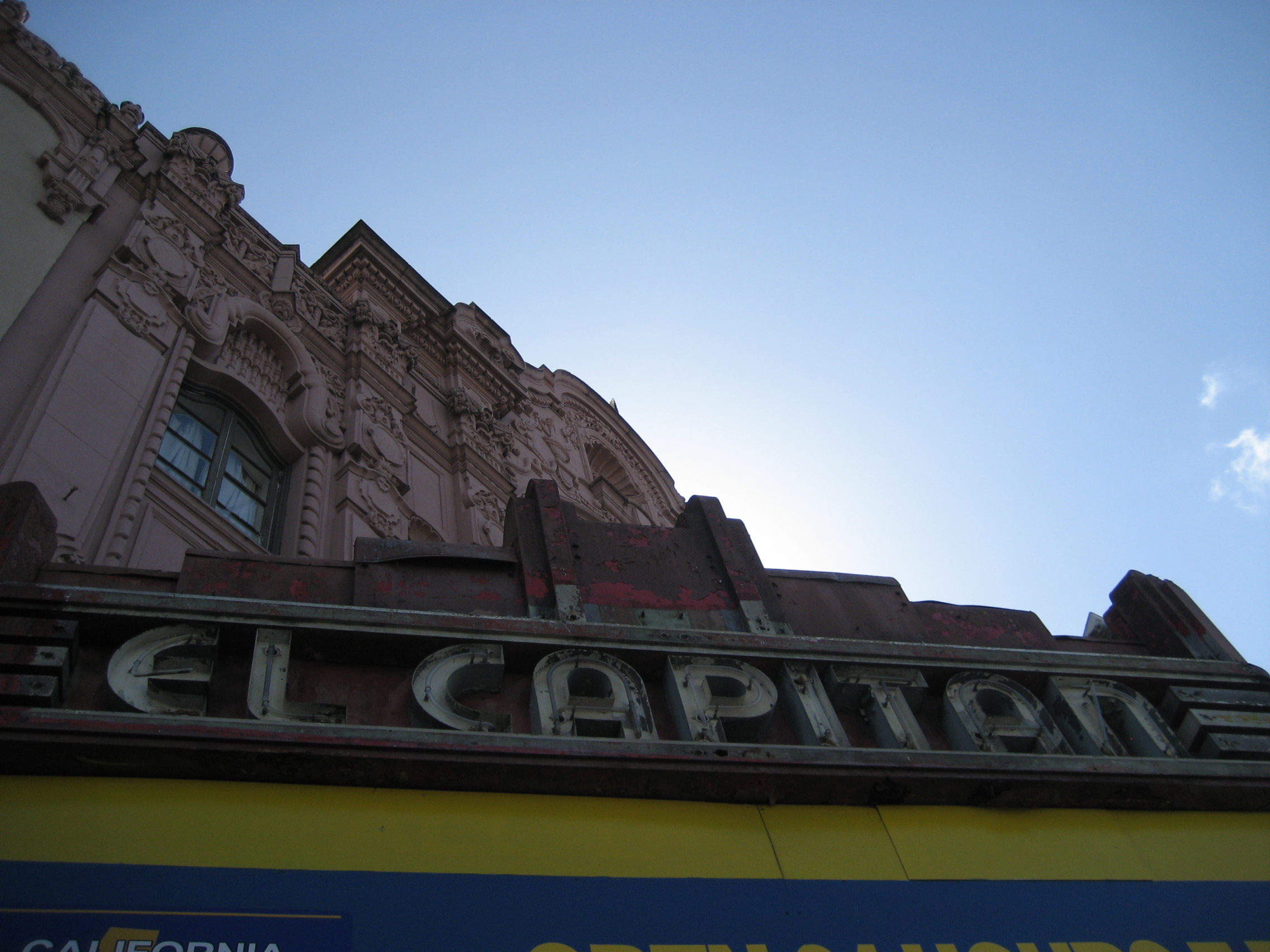
El Capitan in the Mission, SFAnd now here I was, a newbie, clueless, staring at this map like I was waiting for a religious conversion to BARTism. Castro, Castro, I knew it was southwest of Embarkingdare-o, but where? I glared at the plastic screen over the map and sighed. Standing next to me was a Don Lake lookalike and a little person all decked out in San Francisco giant-labeled clothing. I asked them which stop to take for the Castro. I was a tourist on a mission and without a map, and Embarcadero scrawled on my left palm, so I was going for broke here.

“Oh,” said Don, leaning over the map, which did not give me any confidence, because if we were in the District and he asked me how to get to. . . well, anything I can come up with like Bethesda, the White Flint Mall, Arlington Cemetery, they’re all clearly illuminated as Metro stops. But my point is, I’d know how to tell him to go without looking at the grid. I would use the grid only as a teaching tool for my temporary pupil. This is not what Don was doing.

“Here you go,” he said, pointing to something below what looked like Oakland. I was pretty sure the Castro was not in Oakland. Harvey Fucking Milk was not on the city council of Oakland. I nodded and thanked him. In the midst of this the walking art installation/ode to the SF Giants concurred, that Castro Valley was right over there. He got that Don didn’t have a clue what he was saying, and was being clever about sending a secret message to me. Hmm, I wondered, what other little person had a secret message for people, and doesn’t San Francisco have a neighborhood called Twin Peaks?

It was more than I could bear, this place filled with randomness collapsing into old television narrative. I had become postmodernism! I thanked them, but now I was supposed to stand on this side of the platform, waiting for my train to Oakland. I didn’t want to let Don down, but no way was I going to get on a train headed in the wrong direction. So since the next one was coming in eight minutes, I pretended to find a place to sit down, and then jumped on the train on the other side of the platform. I knew the Castro was somewhere around 18th Street, but I had no idea from the subway grid where the Castro Street was. So I opted to check out the Mission. Maybe I would find a street map or a bookstore.

The Mission reminded me of DC’s Adams Morgan in the days before the Williams mayoral administration started gentrifying everything. Adams Morgan at one point was a Latino/a community, and walking down the sidewalk of say, Columbia Avenue, a passerby would see several Spanish-named bancos, a laundromat, one or two grocery stores, a cellphone store, the windows filled with phone cards that screamed their low, low prices if one wanted to call Latin America, Mexico, or Spain. But really Adams Morgan was about the smells, the lovely aromas of Hispanic, country food that made my mouth water and my mind do a quick assessment of how much cash was in my wallet so I could just slip in and get a torta or fish taco, always wrapped in brown paper that did its best to illuminate the food inside as the grease from cooking coalesced at its edges and folds.

The Mission is kind of like that. There were also short, squat grocery counters, and I realized that all of these foods were local because hello, I’m in California. I didn’t want to stop walking, though, and I promised myself I’d come back later. I have no idea when later is. I also got a good vantage point of the hilliness of San Francisco without having to sacrifice my knees. I took in the row houses; there are some I’ve seen that just look depressing in their run-down condition, but these were like tittery older ladies sitting around on Sunday in their worn but nice fancy clothes and hats. It made me homesick for tiny, old women of color streaming out of church in DC, their headwear three times as big as their bodies, and all bright with every color Roy G. Biv could imagine.

I walked and walked, looking down the side streets for the pearls I suspected were there; a crepe maker here, cheap haircuts from cosmetology students there, the standard cell phone dealer, a blacksmith, of all things. My legs started sending me Morse code by clicking and popping as I walked the uneven sidewalk, so I figured it was time to head back to the BART and rest up before heading out, this time to the Castro for reals.

parade of the angry clownsBack in Alacarta, or wherever I was, I was awakened from my catnap by rhythmic drumbeats. I figured I might as well check out what was going on. I looked out my fifth floor window and saw marchers. Or demonstrators. It was difficult to tell which from my height. But they were chanting something, I couldn’t tell what.

And then I saw the clowns. The very angry, protesting clowns. Wearing G-strings. Hoo boy. Okay, here was the San Francisco I’d heard about. Not the angry, rise from the dead every 27 years to feast on small children Stephen King clowns, but pissed off, make fun of Tea Partiers on April 1st clowns. Whatever, I’m not a fan of clowns, period, because they freak me out and make me think of John Gacy. There seemed to be people dressed in all sorts of outfits, like Abraham Lincoln and Greek . . . goddesses? I really wasn’t getting what the message was. Did people need a parade to see how screwed up the Tea Party is? I thought that contingent was making it clear all on their own.

I put my head back down and after a time, ventured back out again, this time to check out the City Lights Bookstore, a bit north of Chinatown. I hopped a cab and $7 later was perusing the books, surprised at how small the place was. I figured it would be at least as big as Kramerbooks in DC, a well-known independent bookstore, infamous for refusing to turn over the receipt for a certain book of Walt Whitman poetry to Kenneth Star. This place, instead, was packed tight with progressive books and sections of shelves that would make any liberal reasonably happy, since we’re too pretentious to get actually excited: Praxis, Gender Theory, Surrealism. I spent a good amount of time looking at new takes on old classics and contemporary literature. Everything in there was serious, and eventually I wanted something else, but City Lights wouldn’t offer it to me. I hoped I wasn’t too Barnes&Nobleized.

I passed by the palm reader with only a moment’s hesitation, thought about getting a beer at the pub across the street from the bookstore but didn’t want to be the middle-aged guy drinking alone on a weekday afternoon, and kept walking. I walked right into Chinatown, with its glare of plastic lanterns and “import” shops of Asian kitsch, if there is such a thing. Samuri swords for $14.95. Aren’t Samuri Japanese, I asked myself, wondering if it mattered to the 9-year-old children who would lose their minds trying to cajole their parents into buying one for them. Probably not.

I walked and walked for a while, listening and looking and occasionally snapping a picture of something interesting. The Bank of Guam turned out to be roughly the border between Chinatown and the financial district, and my knees started complaining again. Darn knees. I want my knees of three years ago back again. How could 36-year-old knees and 39-year-old knees be so different? Especially when my ankles and hips were just hunky-dory. I looked to find a cab, but every taxi was already on route somewhere with passengers. I could not find one to save my life. Maybe another street corner would be better. Maybe I looked like a terrible fare, or something, with my black hoodie sweatshirt, jeans, and sneakers. I walked some more. Fifteen minutes later I finally caught a cab with a sweet older male driver. Sikh, wearing a really nice blue turban that he’d matched to his shirt. How great that Sikh men can accessorize that way, I thought, collapsing onto the vinyl seat.

“Where to,” he asked, sounding like Barry White. I looked at my hand.

“Hyatt Regency Embarcadero,” I proudly announced.

“That is four blocks away!” Oh, crap. I apologized profusely. I hoped he wouldn’t throw me out of his cab because even if it were only four blocks away, I had no idea which four blocks they were. I could be wandering around for hours. Okay, maybe not hours.

He turned off his meter and we turned a corner. The Hyatt stood tall in front of us.

“Yup, there it is,” I said, rather sheepishly.

“So it tis,” he said. His meter blanked out—I suspected he didn’t want his dispatcher to see this stupid fare he’d taken—I asked him how much for the ride.

“Oh, whatever,” he said. I was really sad to have pissed off India’s answer to the R&B giant. I handed him $5 and thanked him again. “And now you can get another fare,” I said.

“Why thank you,” he responded.

Perhaps it was time I collected myself with another bit of rest. I saw a box on the sidewalk, apparently left behind by the protesting clowns earlier in the day.

THINK INSIDE THE BOX, it read.

Rice-a-Roni

people on the sidewalk with umbrellasInitially we debated whether to stay up or sleep for three hours, because our flight left at 5:56AM from an airport an hour away. We suspected we had lost our minds somewhere along the way, and then opted to sleep.

For those out there not so educated on this, hearing a clock alarm blare at 3 in the morning is like having a woodpecker attempt to find sustenance in one’s right ear. Definitely not the left ear, and if you feel that, you should call your doctor quickly. I stood up, not sure why, teetering just a little, because I suspect I was only using my lizard brain, waiting for things like my frontal lobe and memory of self to come online.

Susanne was more than happy for me to take the first shower. She’s a clever one.

I remembered to step into the tub, which was orders of magnitude more intelligent of me than I had been just 30 seconds earlier. I knew I was getting on a plane, although I still wasn’t sure why. By the time the water had hit my skin and I realized I needed greatly warmer water, I could recall every second of my life again.

San Francisco, Susanne’s politics wonk conference. My time to explore a place I’d never before seen, but had heard about for years.

It’s mythological, legendary, about lots of people, but certainly for people who have “teh ghey.” Would it be a nonstop Folsom Street Fair, with nary a stitch of clothing because everyone was decked out in leather and rubber and spandex? Would I see lines of rainbow flags, heralding in ships to the Bay? Was there a gay trumpeter? There had to be a gay trumpeter.

I jest, but some of this wondering is serious. When Susanne and I took a weekend trip to New Hope, Pennsylvania in the spring of 2006, I told her to expect a lot of gayness. I’d grown up across the Delaware River and hung out there a lot in high school, usually around the record store and a short line of shops next to the river. I was there for the comradery of friends, true, but I noticed that there were a lot of references to this alternative lifestyle, as I remember it being called then.

Susanne told her friends about our upcoming trip, and one of them who was also from the area, remarked that she’d never noticed any such thing. She was kind enough to stop short of saying I was making it all up, but I’m pretty sure she thought it.

room in new hope, PASo we showed up at the bed and breakfast that was around the corner from the main thoroughfare, The Wishing Well. The manager greeted us with bear hugs and a high-pitched, “Hulloooo! Welcome to New Hope!” He went on to tell us, excitedly, that we were the first guests of the day and if we wanted, we could sneak around the house to check out all of the rooms before settling into ours.
“But of course, you’re in the nicest room,” he said, practically gushing, “the Cathedral Room!”

Before I knew it, I had oohed. I looked at Susanne. Her jaw hung open a little, as she took in the lovely aura of the B&B. The gay aura.

We unpacked and freshened up a little, and still being a new couple at the time, took some time to check each other’s breath. And then we walked to the first cluster of stores. One was charmingly named Suzy’s Hot Shop, so of course I beseeched Susanne to pose for a snapshot, which she was kind enough to do, even as she gave me a withering look, eternally now captured on film. We decided to check out the store.

The proprietor was happy to have customers on what was still a frigid day, and she apparently needed more human contact than she was getting, because she went on about her girlfriend and their two dogs for what seemed like half an hour. We bought a small bottle of Ecuadorian tabasco sauce, and waved goodbye.

“Okay, it’s a pretty gay town,” said Susanne. Next up was a chocolate shop, the man behind the counter flitting and making a happy fuss to show us the freshest chocolates he’d just made that morning. He only seemed bereft of a feather boa, and he could have gone through half the music of La Cage Aux Folles* for us.

We shopped through a few more places, coming back to our B&B for a rest before dinner. I asked our host for recommendations. He led us to The Raven, a fine dining establishment. Many potted plants set near tall mirrors lined the walls, and the two-level dining room was decked out in many, many flower centerpieces and long white tablecloths. We looked around at the diners and it was as if we’d taken the Hot Tub Time Machine to 1976, East Village. I think everyone in there was gay or lesbian. They seemed mostly segregated, the women with each other and the men likewise, although there were a few daring sort who had gone for a mix at their tables. And they were all, every single one of them, over 40. We took our seats and enjoyed a fine, if not fantastic, dinner, a little on the edge of being over-gayed or gayed-out. For those who don’t know what this is like, one wants in these moments, usually, to find a traditional gendered outfit that is also mature or even dowdy (because a pink frilly dress won’t do here), and some country music sung by a man about a woman. Or one could simply make a trip home and all feelings of gay freedom will cease immediately.

But we weren’t quite there yet. We were still amused and to some degree, in shock. I had said the place was gay. I hadn’t say it was a gay explosion.

So I’ve always thought, I suppose, that if New Hope is gay, then San Francisco is sequin-squirting, pink frilly lei, Cher and Madonna GAAAAAAAY. Having gotten to the end of my 30s is as good a time as any to find out, I figured. How nice for Susanne’s discipline to select this city as this year’s conference site.

This, all this, was why I was standing in an off-temperature shower at 3AM. To see if I could surpass New Hope.

We put ourselves together about as well as two people can on three hours of sleep, and I plugged the iPod into the car so that I’d have something other than engine and road to listen to as I drove through utter darkness to the airport. We parked in the long-term lot which is laughably 10 feet and a fence from the short-term lot, and dragged our bags up to the security checkpoint. The TSA officer asked if I needed any help putting my toiletries into a quart-sized bag, and I showed her my pre-made bag. We must have been the only regular travelers that morning, because she visibly relaxed. I wondered if there was anyone left who hasn’t flown post 9/11.

I found out the answer almost immediately.

We boarded our flight, setting our bags on the rack next to the Canadair regional jet, and took our seats, neither of us caring that our necks didn’t like sleeping while sitting. A woman came on after us and clearly had not flown often in her lifetime, and most definitely not in the last 8 years. She had sixteen questions for the stewardess, blocking other people who were trying to board. She sat in her window seat, next to a woman who clearly had difficulty getting up and down. Five minutes later she had another question for the flight attendant, so she got up again. And then she sat down again. And then she got up again, this time to take the open seats behind us. I pretended to be asleep.

Right before we landed in California she tugged on my sleeve from behind. I had actually fallen asleep, apparently.

“Yes,” I asked.

“We’re so low but we’re still over water,” she said anxiously.

“It’s okay,” I said. Again, I wasn’t really in full control of my faculties yet.

“But why,” she asked. She looked mid-30s to me, but maybe she was 6. Maybe she was Benjaminette Button.

“It’s a water approach,” said Susanne, and Susanne is so nice you really have to know her to know she sounds annoyed.

This woman clearly had no idea what water approach meant, and probably figured it meant we were going to pull a Hudson River landing on her.

“The land will start before we touch ground,” I said, smiling so she knew we should all remain calm.

“Oh.”

That little bit of inanity over, we grabbed our bags and cabbed it to the hotel. I saw a sign for San Jose to our south. The song played in my head for the rest of the day.

And now, I’m off to see just how gay this city really is.

*As an aside, I saw La Cage Aux Folles with my mom and sister when I was 15, and I was just amazed that they could get Joan Rivers and Cher in the same performance. And then my mom told me they were all men, and blew my little mind.

All alone in the moonlight

I had an epiphany yesterday, round about 2 in the afternoon, that I should be contacting LGBT agents for my memoir. Why, I wondered, have I been trying only the mainstream folks—that’s like dressing up in my nerdy best and asking out the lead cheerleader to a rodeo (no offense to cheerleaders who like nerds). Trouble was, I didn’t really know how to find them, aside from searching for them on Google, your friendly neighborhood search engine. And that approach was fraught with danger, read, the Big Bad Fraudulent Agent. Apparently, they lurk everywhere, in the corners of the interwebs, waiting to steal one’s money (I don’t have much, so I’m safe there) and ideas (hey, if they can do anything with them, more power to them!). So I figured that for every name I identified, I’d just double-check them somewhere else. This presumes, of course, that there is a long line of clearly identifiable gay, lesbian, bisexual, and transgender literary agents just lined up for writers like me.

Perhaps I was off the mark a little. Or maybe I can blame the search engine algorithm. I did get some lovely lists of agents, and then . . . then I had to do some text searches. In a list of 100+ agents, there were maybe three or four who admitted they worked with GLBT writers specifically, or who represented gay/lesbian work. This was going to take some time.

I did come up with one name, for the few hours of my effort, and I sent along a queery [sic] to her. And then it was bowling time. I made the hour-long trek, grumbling that my iPod strangely decided not to play about a quarter of the songs I’ve fed it over the years. Damn update.

My bowling mate asked me how I was doing and I said I’d figured out I should try to find GLBT agents. She gave me a look.

“See, and I thought you were all smart and stuff,” she said. I lovingly punched her in the shoulder.

I figured the hunt for an agent would be renewed in the morning. But again, it’s like looking for a four-leaf clover. I’ve already gone through the small gay presses and not heard so much as a ping back, but looking at their book releases I can see why. I don’t write about being drug-addicted, or living in San Francisco, or going through a string of abusive lovers, or being homeless, or anything else edgy. I do write about mental illness, but well, that’s been done by very good writers. I write about the wonderfulness and insanity of city living, and we all know that great writers have tackled that one, many times over. So I think to myself, well, being an Arab American formerly gay transgender professional city-turned-country dweller who survived a bout of major depression, a bad relationship, and a dozen years of Catholic school, and grew up in a mixed race and ethnicity, mixed religion household in New Jersey and somehow came out of it without a Jersey accent, well, there are some marketable things in there, somewhere.

I’ve been working on something like a short story a month, cranking out the ideas that have been crowding around for attention, and then launching into rewriting for a few versions before beginning another one. I’m sure I’ll go through and revise them again, but my point this winter was just to keep writing, identify my best simmering point of productivity, and play with all of the things I love about the craft of writing, until I either decided it was time to go back to the super/stupid power story (in which queer folks save the world) or I decided to tackle another long-form project. The superpower story needs a major rewrite/redesign, and I have to change one of the stupid powers because I really can’t allow myself to reference Dan Savage anymore, after he came out with that ridiculous column last week about the Washington State Attorney General.

I’ve got a good outline for a mystery novel I began a few years ago, and I’ve wanted for a very long time to tackle a memoir or close-to-real story about my childhood, centered on my epilepsy. Really, I’d like to try to relay the experience of having memory gaps and false memories that petit mal and grand mal seizures gave me. They each had their own strategy. The petit mal seizures (which no one calls petit mal anymore) stole time away from me, leaving me hanging in the middle of a sentence and restoring me, many seconds or half a minute later, either attempting to finish what I’d started, or leaving me disoriented about my thoughts. My mind was wracked with 90 of them a day before the doctors—who wouldn’t tell my mother what was wrong with me—got them under control.

The grand mal seizures (they’re not called that anymore, either) played a different trick. They filled in the lost time with whatever my child’s experiences could cobble together. Singing Thanksgiving carols around a grand piano my school didn’t own. Winning the Showcase Showdown in a bright orange t-shirt. Seeing buildings by Route 33 in Hightstown burn to the ground and feeling, really feeling, the thick wave of heat it gave off. I’ve spent hundreds of hours thinking about this book, even as the gender change story was more urgent for the telling of it. I want to write this book in a way that isn’t trite or cliche. Agents apparently loathe book openings with dream sequences, but darn it, false memories aren’t dreams. They’re closer to near-death experiences, in the way I’ve encountered them, like reaching to a different plane or a sticking one’s face into a parallel universe for just a moment and then trying to write down everything seen. I want to write this book.

And I’ll write it even if there are no agents for it. Because writers are supposed to just push on and write.

Dead cows tell no tales

When Mom visited us last week, we tooled around town. No really, we tooled around town, on the outskirts, north, east, and west. This is surprisingly easy, because two streets this way or that, and suddenly one finds oneself in a wheat field. Or at least, we thought it was wheat. It’s been a while since my farm girl of a mother saw wheat up close, but then there she was, clambering out of the car and her head down near the ground, surveying and investigating. She could have been Jessica Fletcher scouring a crime scene.

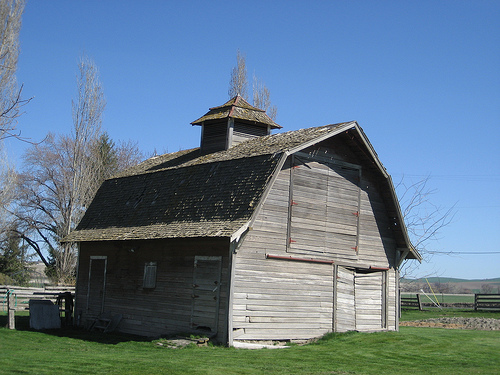
abandoned barnAs she was looking at the bright green whateveritwas, a man in a pickup truck drove by us on the dusty road. He managed to keep a tall western hat on his head, and he gave me the man nod as I waited for my parent to finish checking out the foliage. I nodded in return, but I’m not really sure why. What is the man nod supposed to mean? That I’m not here to pillage your town? That I’m in agreement on giving the most masculine salutation afforded by social expectations? It doesn’t make a lot of sense to me, even as I acknowledge that rolling down our windows to high five wouldn’t have made any more sense. But still, I nodded back at him.

She got back in her seat and announced to the two of us that in fact, it was wheat.

“I just didn’t remember it looking like grass,” she said, almost as if she really wanted to check the earth one last time, like running back into the house to make sure the oven is really, really, super turned off. We rumbled back along this road I’d never traveled, kicking up red dust behind us. We could have been a Mars rover, for all the wheat fields knew, although they were probably more certain than I was of where they came from.

We dead-ended at a T intersection, the car idling, bored, while I tried to figure out if Walla Walla was to our left or our right.

I picked right, making a guess. At noon the sun wasn’t going to give me any indication of where I headed. Where were my so familiar DC streets with their quadrant markers?

It should be noted that DC was once a small town in the midst of farms, fields, and livestock. Pierre L’Enfant liked it because of its intersection of two large waterways, the Potomac and Anacostia rivers. In that way it wasn’t very unlike what Walla Walla is now, I suppose. But certain things—population density of the East Coast, cheapness of land at the time, intentional urban planning by L’Enfant and Masons—helped DC metamorphosize into the large metropolis that it now is. Those things don’t really exist for the Wheat Farming Town that Could, even as it was the site of incorporation for the State of Washington, and its original capitol. Now Walla Walla is only big compared to Dixie, Washington, which has only a single school, and Milton-Freewater in Oregon, best known for the frog statues that run along its main thoroughfare.

So Walla Walla doesn’t need quadrants.

We drove past a farm with several head of cattle, and I saw one cow nudging its face on the still body of a calf. The baby was indeed lying at an awkward angle.

“Oh no,” I said, “I think that calf died.”

Mom looked through my side window. She nodded.

“That’s so sad!”

“Well, maybe he’s just resting,” she said, patting me on my knee.

“No, really?” We’d passed them now so I couldn’t keep looking back.

“I mean, I’ve never seen a calf rest like that, but sure, maybe.”

My mother was mothering her nearly 40-year-old child who really didn’t live in the if-I-don’t-know-for-certain-it-might-not-be-real world anymore. But it was nice, for a minute, to pretend that I was still that gullible.

Block’s writer

Gutenberg BibleI’m sure we’ve all heard the narrative a hundred times over: I’ve been a writer since I first held writing implement to fingers. And my Mom loves my stories, and all my friends say my book is a bestseller. And then we’re supposed to laugh condescendingly, because this little intrepid person is so clueless, clearly, about the publishing industry. Oh, if they knew about the publishing industry, we think smugly to ourselves, they’d know that Mom’s opinion doesn’t matter, and all their friends are wrong.

Just to give this some dimension, the US published 172,000 books in 2005, according to the geeks who count such things. Of these, let’s be generous and say that 200 of them counted as “best seller” status. (Anyone remember French Women Don’t Get Fat?) That’s one tenth of one percent of everything published that year. Of course, most of these books don’t even dream of topping any list: Unsolved Problems of Noise and Fluctuations, a fantastic tome on physics, probably didn’t make it to people’s holiday wish lists. But even taking just the fiction, memoir, poetry, and narrative nonfiction into account, the likelihood is very, very low, trust me.

This isn’t to say people shouldn’t write down their stories, or whatever things they have cavorting around in their heads. It just means that most stuff goes nowhere, but on a page, in a notebook, or onto the hard drive of a computer. And that’s really okay, because the vast majority of our human endeavor to create the amazing is actually quite awful. Total drivel. Buzzard crap, or that Canada geese shit that turns everything green and stinks of high heaven—hey, it was a life experience I won’t ever forget.

So why write, even? If it all sucks, why bother?

My answer is my answer alone. I write because it gets better when I rewrite it. The third time around, it starts to sound nuanced. The fourth revision I’m making specific language choices, listening to the rhythm of the words, the believability of the dialogue. The fifth time through I may do something drastic, like change the tense, cut the first 7 pages and have the narrative begin at a new point. Actually, I usually chop out my beginnings, trusting that the quotation I heard a long time ago is true: One should start a story like one would pick up a puppy, a little behind the front. I have no idea anymore who said it, maybe St. Vincent Millay or Doris Lessing or Eudora Welty. Now that woman wrote a lot.

By the time I get around to the tenth revision, I’m just nitpicking words and it’s more like talking about nothing at the end of a coffee date than actual editing. I just need to declare it’s over, we’ll meet again someday. At this point I’ve cleaned it up, swept out excessive prepositional phrases, changed sentence structure, evaluated my tone, simplified, simplified, simplified, and attempted to really cast a light on my characters without overwriting them. I like it when readers pick up different aspects of my protagonists, when they almost like the foils to those protagonists, but for the fact that they’re really despicable.

If enough time goes by, my relation to my stories changes. I used to think of this as watching the story fall behind me as I charged ahead, a steam engine train of a person. I now see that we’re both moving, in some kind of random, and certainly unpredictable direction from each other. Sometimes we swing back around, like a comet passing through a solar system every 76.2 years, and old ideas make a new kind of sense to us. But sometimes we never occupy the same space again. Maybe that was the story best understood by my 17-year-old self, and my 39-year-old brain simply doesn’t want to hang onto it anymore. Or maybe I’ll enjoy seeing where I once was in capability, craft, and idea, even as I acknowledge that I’m in a new place.

In any case, I’m glad I’ve written down as much as I have. And while I would be thrilled, say, with an appearance on Ellen, I’m not presuming anything I write would be a bestseller. It’s true that after years of messing around with fiction, with literary analysis, and the reading of thousands of books, I really needed to write a memoir about my transition.

I really haven’t talked about why with anyone except my writing coach, Lea, who has more than one hand on the pulse of the universe and who I see as a really friendly, astute guide through this whole publishing rigamarole. First, I had some demons to exorcise, and writing was the best way to do that. A lot of that writing was just for me, not for any book, and most certainly not for anyone else’s retinas. But it did let some of the experience percolate and then steep, and gave me a blueprint for organizing the past 6 years into a sturdy narrative. There was some motivation stemming from my “mentoring” of a young female-to-male transsexual who was asking many of the same questions I’d pondered at the start of my experience. I’ve spent copious hours online, asking and later, answering the strangely narrow-banded litany of inquiries people have about transitioning: will my family hate me forever? Will my partner desert me? Am I just disfiguring myself? These are really all smaller branch questions that have popped out from one solid root question:

Am I crazy?

The answer none of us wants to admit is, maybe. Maybe we/you/they are crazy. But we’re probably not crazy, because crazy people don’t formulate questions on the Internet, research their options in a rational way, get opinions, sift through information, try different methods of managing what turns out to be an illness—crazy people behave less from a place of information gathering, and more from a place of irrational. Crazy people respond differently to the therapies around gender identity dysphoria. Transsexual people see their happiness and sense of well being increase dramatically after even the most mundane or simple changes to their sex and gender identity.

Could a memoir bring these points across? I thought so. Could I tell a story in which a fairly ordinary person realizes something extraordinary? And has the daring to see it through? Could I make getting a sex change seem like the right notion for a protagonist? I thought about it and decided yes. I don’t think I’m the trans Messiah; this isn’t an especially rare narrative, even as it’s certainly a twist on the boy meets girl tale.

And heck, in this memoir, there is boy-meets-girl, if readers are okay with boy-who-used-to-be-girl-meets-girl-who-usually-likes-other-girls.

Perhaps agents think the concept is too out there, and that’s why I’ve had trouble selling this. But I believe in this story and this project. I know that there are thousands of people who would guffaw at the hilarity I’ve lived through, and fret through the hard parts, and have questions like I’ve had, about medical services and people’s judgment and how strange it is to see the world through completely new lenses. I have faith in this book, and I just have to keep pitching it, even as I work on other stories that want their 15 minutes of fame on my keyboard.

I used to spend a lot of time getting stuck as a writer, but then I pushed through on the memoir project and now everything I bottled up wants to come out to play. And that’s how I know the memoir is a story that needs telling. And though we may cross each other in space at some point, hurtling in new directions, it will retain at least a core of interest for me, and hopefully for some agent and publisher out there.

And hey, my sister thinks it’s great.

Sheepishness

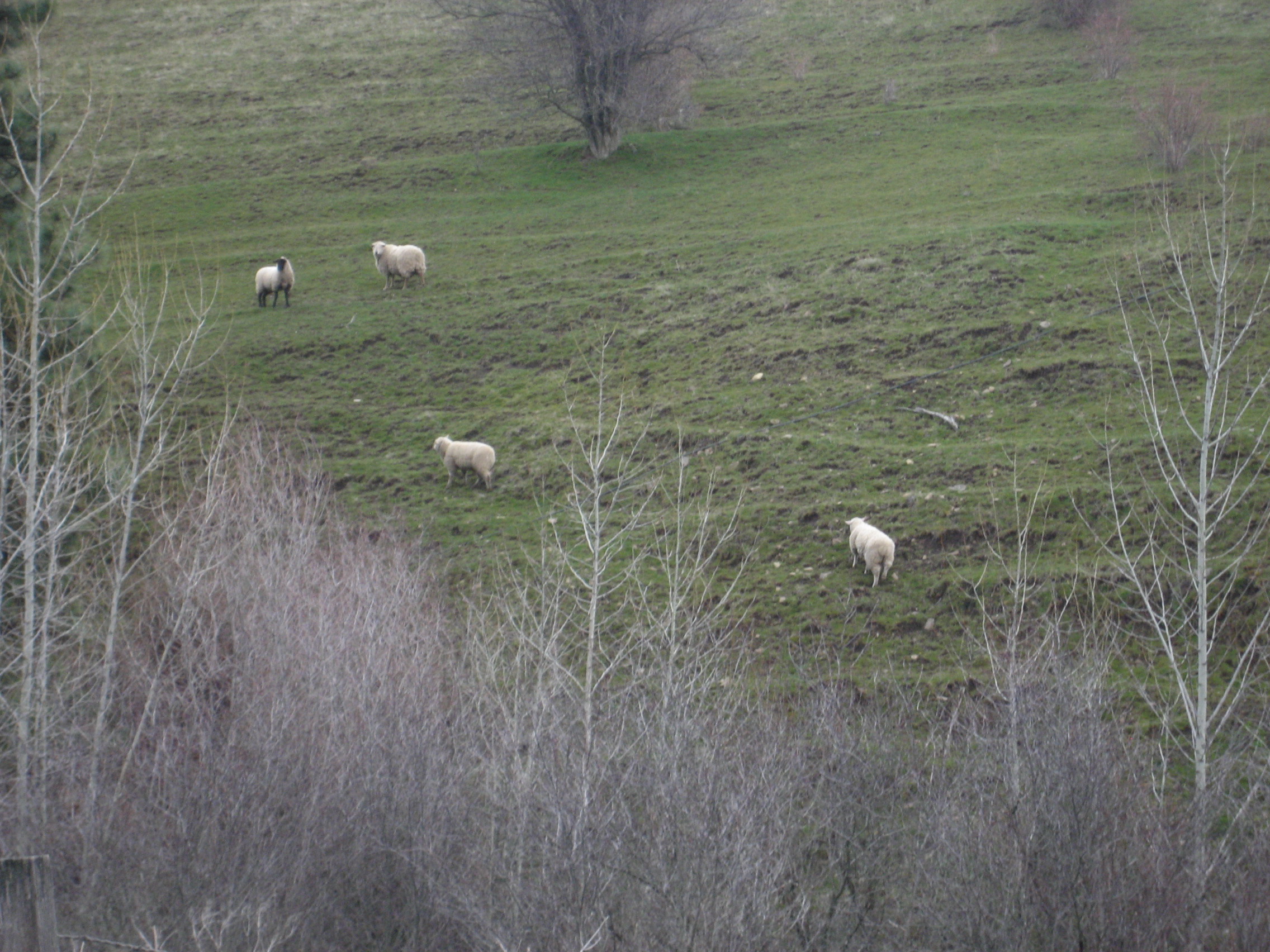
sheep in the blue mtns.With my mother visiting for a week, I came up with an ambitious list of things to do in and around Walla Walla. The Colville Street Patisserie. Klicker’s farmer’s market and antiques. Petit Noir chocolatiers down in Milton-Freewater. Main Street and downtown. The Kirkman House, Pendleton Mills factory, Ice Burg drive-in, and the college campus. I added items on the vacation to do list never thinking about my mother’s energy levels or capacity for long car rides. Seems my tolerance for getting from Point A to Point B has expanded since we moved here, like Mercury comparing itself to the gas giant Jupiter.

Reality, at some point, was bound to take over. It had watched me with my black felt pen and growing list and chuckled quietly to itself, knowing it wouldn’t have to do much to stymie my plans.

We did make it to most things in and around town, except the museum. Something about a historic house with a suffrage exhibit just wasn’t grabbing my mother, who obviously takes voting for granted. She did get some sorbet at the Patisserie, and a chance to look around.

“So this is where you write,” she asked. I nodded.

“Hmm,” was her response. It’s a little difficult to ascertain what was layered into such a mouthful, but I think she approved. I know already she thinks I’m a little weird, so that’s not a big deal anymore.

We looked at items in a home furnishings store on Main Street. She told the owner everything was overpriced. I covered my face with my right hand, a 3-year-old’s response of “if I can’t see you, you can’t see me.” I explained to her that most of the shops on Main Street aren’t for Walla Wallans, they’re for the wine tourists from Seattle, the executives who like to show off to their friends about things they’ve purchased. It doesn’t make any sense to this grown-up farm girl. It just sounds like tinny silliness.

Traveling down to Milton-Freewater in Oregon, I show her the obsession they have with frogs. I can’t tell her how it started because I don’t know, and everyone I’ve asked seems not to know the origin, either. But literally every 50 yards there is another frog statue or mural.

“There’s a whole group of people out there who love frogs,” she says, and in my brain I morph it into one of those annoying Facebook statuses: There are two types of people in the world, it begins. People who love frogs, and people who don’t give a shit.

I am in the latter. Nonetheless, the frog statuary are kind of cute.

She takes a while chatting with the chocolatiers in Petit Noir, while I smile and pretend not to worry that we’re there too long. Mom thinks it’s all just nice conversation, and maybe it is, but I’m wondering if as customers, we are using our bizarre power over them to hold them hostage, all for the promise of buying $30 worth of prettily packaged product. I’ve certainly paid people to talk to me before, but there was usually some therapy or counseling going on in the exchange. And I mean that literally, not as some euphemism for “I pay prostitutes for my mental health,” so don’t go there. Mom’s back starts to ache so we head back to the car and head back to Walla Walla, leaving Pendleton unexplored.

“Is Pendleton open on Monday,” she asks.

“Pendleton’s a town, Mom.”

“I mean the mill.”

“Oh. I don’t know.”

“I know Pendleton’s a town, silly.” She laughs, in the same way I’ve taken to laughing.

We go tooling around the next day, east of town, over to Klicker’s, the strawberry pickers. I just made that up. I should sell that phrase to them for a couple of berry buckets. They’ve probably already thought of it. Mom likes the antique store, even though it’s littered with faketiques—things are made to look old, but were mass produced a few years ago. She can spot the real things easily. I pick up the handle on an old phone, the kind with a tube for a mouthpiece and two brass bells at the top like eyes, and marvel at how heavy the ear piece is.

“We had one of these on the farm,” she says, referring to Section 28, where she grew up in Saskatchewan. So the weight doesn’t surprise her. She hands it back to me and I hang it back on the hook. Immediately she flips it over. “It goes that way,” she tells me, smiling at my ignorance.

At the end of a winding road into the Blue Mountains we see sheep, and she gasps. She didn’t have any excitement for the horses or cattle or goats we’ve seen, but the sheep get her to draw a sharp intake of breath. A dog comes out onto the road, barking at us for coming too close to his house. Thirty yards away the county road stops and their private road takes over.

“My back hurts,” she says.

I say I’m sorry, I thought these bucket seats were pretty comfortable.

“It’s not the seat, it’s my back.”

I laugh, and Mom asks what I think is so funny.

“It’s not the hot coals, it’s my feet,” I say. Now she’s laughing.

“It’s not the machete, it’s my bleeding cut.” We laugh harder.

We can coast at 50 m.p.h. on the downward slope out of the mountains. We’re still laughing.

“I can try to tell Gary about this,” she says, referring to her husband, “but I think you had to be there.”

Excerpt from Bumbling into Body Hair

This is an excerpt from the memoir I’m shopping around. I’m not going to provide any context because there’s no point in extra yammering.

Bumbling into Body Hair: Tales of a Klutz’s Sex Change

Lying on the couch after my surgery, time stopped having meaning. I went off the Gregorian calendar and started one of my own. On Day 12 of the Drains from Breasts of Yore they started accumulating a cloudy brown fluid. However one defined “good,” this wasn’t it. I called the doctor’s office twice in two days, but both times they said to be patient, slow down, stop being so active, wait until they’re putting out less fluid. Two nights later I checked the right drain. I had obviously transitioned to Kermit the Frog, looking at the green fluid in the floppy drain cup. The tube itself was clear yellowish. After thinking about how few things in the human body made it to that part of the color spectrum, I called the doctor’s answering service, saying simply who I was, my phone number, and what was happening. Nobody called me back.

When I’d called on Friday, otherwise known as the Day Before My Bodily Fluid Celebrated St. Patty’s Day, I told them that my partner was heading out of town this weekend and if I’d need a person with me to get the drains out, could we please do it now? She said not until the drains were producing less on both sides.

“Now, you’re in Philadelphia, right?” Good Lord, she’s not pulling a chart, is she?

“No, I’m in DC,” I corrected.

“Well, still, they need to be making less fluid.”

The following Monday, now called the Day of the New Week of Oblivion, Nurse Barbara called me to say, “Your drains have been in a long time. Come in today so we can take them out.” I asked, gently, again, if I need someone to come with me. “That would be advisable, yes.”

Somehow my direct payment of $7,000 didn’t preclude me getting a different answer depending on whom I talked to. No, you can’t come in on Friday and it will be fine if you come alone, and no, you should have come in before and you really should have someone with you. How about I split the difference, I wondered. I’ll agree that I should have been allowed to come in before, and I’ll come by my own self.

I hoped I’d be much happier once the drains were out, if only because cleaning myself wouldn’t continue to consist of a series of soapy and wet washcloths while standing over a sink.

*   *   *

The fluid saga had not ended. I was getting dressed for work, which, 3 weeks post-op, included stuffing my surgical vest with maxi pads, to increase the compression on the hurt parts and help speed healing. Maxi pads, to their credit, have a nebulous outer layer kind of like a black hole that sucks in material at terminal velocity, crushing it into an infinitely small, infinitely dense piece of matter. When connected to wormholes, by the way, they deposit all of this material into a new location. Thus it was possible, I theorized, that our universe had been formed by the big bang of millions of crushed maxi pad deposits.

So I was getting dressed, and I snagged a suture on the left side of my chest in the maxi pad. It hurt beyond description, which I articulated by screaming. Being a maxi pad, I couldn’t get the suture out of it, so I tiptoed to the bathroom, holding up the vest/maxi pad combo, for of course I stuck the adhesive of the pad to the vest. I tried not to jiggle the suture and was fortunate that brand new man boobs weren’t prone to such things as actual jiggling. I cut the suture, still feeling pained, covered the cut end with some paper tape, and proceeded to finish getting dressed. I got in my car, thrilled, somehow, to be commuting again.

Four hours into my workday, I was beyond uncomfortable. It felt like I’d pulled a muscle, or cracked my sternum, or something else awful: a searing, stabbing pain that took the place of whatever else had previously occupied my thoughts. I muddled through the rest of my day—my supervisor had been keeping my workload low, out of sympathy or a seething need to get me off every project—and left a little early. The second I got home I ripped off all my shirts in a “get the leeches off of me,” way, not an exotic dancer way. Nothing looked wrong. The tape was still there. The incisions were clearly healing. But it felt like something was pulling the sutures out. It was a little like when I’d had shingles, years earlier. I took a few ibuprofen and tried to feel better, but the pain just got worse. I called the surgeon, who said that pulling a suture may have damaged some of the scar tissue, and that it was a painful thing to have happen, but should be better in 24 to 48 hours. She thought ibuprofen was a good idea, too, since it’s also an anti-inflammatory. I didn’t sleep well, but I made it to 5:30 a.m. And I woke with a new friend: the return of Bertha, my old right breast! It was the morning of Breast Resurrection Day.

Bertha appeared to be very irate at my choice to excoriate her. She was red, hot to the touch, and something like a B-cup. As the day went on Bertha decided to install an addition under my right armpit. I called the surgeon’s office again, and one of the nurses said, “oh, you can’t have an infection this late. Just rest up and don’t be so active.” Always with the “not so active.” What were they, paid by the junk food lobby? And what was that about a 2-week recovery period again?

In two more days, otherwise known as the Day of the Breastal Revolt, Bertha had turned hard to the touch. She felt like the pectoral muscle of the statue of David. Only this was not what I’d had in mind for rock-hard musculature. I called the doctor’s office again. I got the nurse to agree to call in another antibiotic prescription for me, and she sighed while I said I had to look up the pharmacy number of the CVS near me. She reminded me that it’s “very, very rare to have an infection this far out.” More likely was an allergic reaction to the sutures. But who could know without looking at me?

I posted my symptoms online and asked if anyone knew what I was experiencing. I did research on mastectomy outcomes and incidences. I told my friends I didn’t feel well, and I started to feel crazy for having such a hard time. Not to mention guilty for not going to work.

Susanne flew back in Friday from her interview in California after getting bumped off of her original, earlier flight. I felt like death in a frying pan. That night I woke up several times with the chills. I was sick of something being wrong. I sat around a lot all weekend, although I did go to a “Friend’s Thanksgiving” dinner, assuming I could deal with sitting up for a few hours. When two of the dining attendees broke out guitars and amps and started messing around like stinky 13-year-old boys, I turned in for the evening, Susanne nipping on my heels. I noted quietly to myself that if I were ever in a band, I would only do my music with friends who also liked to do that with me, or ask them in advance if they’ve brought their ear plugs.

Regular names of the week came back to me as I renewed my full work schedule. Monday and Tuesday I’d been signed up at work to go to an annual recap of the literature in my field, so I figured if I could sit at home, I could do it in an office building, too. I went home early the first day and kept cursing myself for not feeling well. I couldn’t make it past six hours of sitting. Why am I such a baby?

Wednesday morning I had my quarterly visit with my endocrinologist, who was also an internist. Susanne and I were happy that some medical professional was going to actually see my face. Ace looked at me with my shirt off.

“Holy shit, Everett!” This, the man with no sense of humor or intense expression. He ordered me to call the surgeon, and I told him I couldn’t seem to get past the nursing staff. I’d only managed to get to the doctor once on the phone.

“Look,” he said, actually expecting I would then look directly at him, “she took you to the dance, she can take you home. No other doctor is going to go near this.”

“Hey, you watch how you talk about Bertha there.” He grinned.

“Just go up there and insist that she see you.”

Oh my God. It must really be bad.

I left his office and called the surgeon’s office once more, getting one of the nursing staff.

“I’ve got a 100-degree fever now,” I said.

“Well, a 100-degree fever isn’t that high a fever,” she replied.

What, I was going to need to cough up a kidney before they said yes to me?  Was there a magic word I was missing here? Open sesame!

“My internist told me I had to come see you.”

She suddenly got interested. “Oh, is that an option? Where do you live? Are you local?” Had I not told them I lived in DC in each and every conversation?

Of course, I thought, people fly in for this from everywhere. They probably don’t do a lot of follow up on FTMs.

She told me to come in the next two hours. She didn’t realize I was still in my car, illegally on my cell phone. I saw that snow was starting to fall. I had to get out of the city, fast, before people started walking around with A-frame boards pronouncing that the end of days were nigh. The first winter snow in DC always brought out the hysterics.

I spent the next 90 minutes driving in the left lane behind nervous drivers going 30 miles an hour. My chest throbbed, my pulse, which was already too high, was pounding, I still felt terrible, and I walked into the surgeon’s office. They took me to an exam room and I undressed and showed the nurse my chest.

“Those are stretch marks,” she said, looking at the red lines streaming across my torso from the incision line.

“I don’t have stretch marks,” I muttered. Wow, I feel like crap.

“Sure you have lots of stretch marks,” she said, arguing with me, apparently concerned for my general health, if not the acute problem that had gone unchecked for more than a week.

“I don’t have stretch marks in the middle of my chest!”

Yelling did the trick, and Nurse Barbara left the room, dismissing me with her departure. Another more daring nurse came in and saw me.

“You have cellulitis.”

“Itis,” I knew, was a suffix that means, to us laypeople, infection. Cellulitis is an infection under the innermost layer of skin, and it is bad news, because it quickly becomes septic, meaning that it can travel to one’s bloodstream, and then one is in for a bad ride. It was like Dr. G, Medical Examiner bad. The surgeon came in, scrubs on from just finishing up someone else’s top surgery. Her smile disappeared as she took one look at me, and she immediately started ordering all kinds of supplies to the room, things with names I didn’t understand. They took off my opened-up shirts, and the doctor gave me a local and then opened up a few of my stitches. This is when I peed out of my rib cage—at least it felt like peeing, as I had a sense of relief, and warm liquid streaming over my skin. Well, I don’t exactly pee down my legs, but it was the closest life experience my brain could register, and it’s what occurred to me as I was being aspirated. I felt a big dose of happy as the disgusting ooze left my body. And it was a strange experience to watch my chest deflate. I could almost hear Bertha screaming like the Wicked Witch of the West, “Nooooooo, water, nooooooo, I’m mellllllllllllting!”

The surgeon looked at me kindly as I side-urinated. She put her hand on my shoulder. “I’m sorry, Ev, you’re the one percent outcome.”

“I’ll go buy a lottery ticket,” I said.

They gave me an IV bag to re-hydrate me—for all my liquids had been going to Bertha the Undead—and a strong antibiotic. They put in a new drain on that side, a floppy plastic tube with no collection cup. I stayed in the dark room for a couple of hours, drifting in and out of sleep until the bag was empty. I returned two days later to get my side rechecked. It looked much better, even though I had some more recovery to do now. I saw the surgeon again a few days later, now clearly on her radar screen. She’d even given me her home number so I could call her directly. And I had finally earned my VIP pass with the nurses.

Long writing journey into something

Ever since I read in Stuff White People Like that Moleskines are a staple of white pretentiousness and posturing, I’ve been self-conscious about mine. Christian Lander had me nailed, right down to the MacBook Pro sitting next to it as I sipped at a non-fat latte in an overpriced coffee house. At least I hadn’t procured mine with a credit card—I’d scraped together cash from around the house, on the premise that if I only used loose change, it was like a free purchase, like how sucking on a mint after an outing to Sonic is free of calories. How idiotically white of me.

mocha latteTo make matters worse, this is not my first Moleskine. It is, in fact, my second. And if anyone cared to study this little black ruled book, they would discover a “2” written  in on the bottom, where the gold leaf should be, I guess.

Perhaps it’s better that I used up a whole book already, because at least I write in them, and no, they’re not just full of grocery lists and directions to IKEA.

I also don’t have anything in here worthy of da Vinci or Hemingway, two of the Moleskine’s more famous users, and Hemingway was a stuck up misogynist anyway. His best short story is six words long (his assertion, not mine).

No, I write in this notebook to keep track of query letter submissions, the inevitable rejections, submissions to journals, and the places I might submit to someday but for what I consider exorbitant submission fees (read, $10). I also keep track of my work in progress’ progress, scheduling deadlines for myself like an agent or editor would. That way I can have arguments with myself over why I’m giving excuses on missing important dates and don’t I know what this is doing to my career, and who is going to want to work with me after this?

I’m sure I still have my mind. It’s right in a box over there.

All of this ponderance about Moleskine notebooks comes because I’m sitting at PDX airport waiting to meet my mother who will be visiting us or a week. A technology professional is at the table next to mine, speaking loudly into his cell phone describing the apparently delicious and speciously nutritious drink he’s just purchased from Jamba Juice: a little bit of banana, strawberry, and mango, he declares loudly to his wife, plus some SOY PROTEIN! and ESSENCE OF WHEATGRASS! It sounds particularly disgusting to me, but then I’m the schmuck with a $4 nonfat mocha in a world-preserving, 100% recycled cup, so what do I know? And writing in a Moleskine. Damn Moleskine.

I don’t feel particularly pretentious, but then again, white people never do. We’re pretty much blind to it, save the very extreme examples—here I’m thinking of German avant garde artists from the 1980s, or say, people from Massachusetts named Biff Wellesley or Chauncy Milton who wear plaid shorts unironically and race in regattas around the Cape. Maybe I feel a bit incognito partly because I am sans my titanium Apple accessory this evening, and partly because I am in green cargo pants and a black hoodie. I fit right in to PDX, the city, not the airport. Come to think of it, who nicknames their city after their airport? I bet if I asked everyone in earshot who had a Moleskine to whip it out and wave it like they just don’t care, 39 percent of the folks here would be showing off their pretentiousness inside of 16 seconds.

The airport announcer is saying, for the fourth time, that Jesse Bauer really needs to meet his party at the Panda Express. Jesus, Jesse, get moving, their dinners are going to get cold.

I left Walla2 right after receiving notice from an agent in Seattle that they just didn’t quite connect to my manuscript, so they won’t be moving forward with me on this project. Moving forward. I note that they didn’t rule out moving left, or upward. Perhaps those options are still open.

My mind reads this rejection sentence and immediately thinks of a shoreline. I’m not sure why. Perhaps it goes back to that oft-repeated line about the footprints of Jesus as he carries his ignorant follower who somehow doesn’t get that hello, JESUS IS CARRYING YOUR DUMB ASS. I’m not sure with whom I’ll be moving forward, but if Jesus is doing any agenting, I’m open to the idea. I bet he could work wonders with publishers, yuk yuk.

She went on to say in her letter that it wasn’t me, it was her, and just, perhaps, a matter of taste. This Dear John letter tone didn’t sit well with me. A matter of taste? She was looking for a Prada clutch, and I was a Jacqueline Smith pocketbook on the clearance rack at KMart? Or perhaps it just wasn’t what she was looking for right now. Maybe three years from now humorous memoirs about klutzes who get sex changes will be all the rage. But why say perhaps? Doesn’t she know? It’s her opinion she’s offering.

Well, it comes down to platform, I get that. Mr. Dan Savage of the Stranger, another GLBT author working with a Seattle agent, has readership. So okay, I’ll work on having a platform and see if my words suddenly sound better, or become more connectable to people.

The second paragraph of her letter was just as brief. She wanted to encourage me to continue trying. I genuinely appreciate that. But why? Or more to the point, how? She said there was much to recommend about my writing. What, specifically? The font? The careful avoidance of split infinitives? The witty banter among urban dwelling queers? What? I’m left, as after my other rejections, in the middle of a guessing game. So far, my guesses have been wrong, if success is measured in contract proposals.

But I’ll tally ho and try again, because I am a writer with nothing to lose. JK Rowling got 13 rejections of her original Harry Potter book. I have just surpassed her with this 14th rejection.

Take that, JK!