Latest from the Blog

An extremely brief outline of confession

Over on Twitter last Monday, folks were conversing about the concept of confession—in 140 characters or less, which is more demanding that it might seem at first glance. It got me thinking, as good conversations do, about confession. According to Merriam-Webster, confession means:

1: an act of confessing; especially : a disclosure of one’s sins in the sacrament of reconciliation b : a session for the confessing of sins <go to confession>
2: a statement of what is confessed: as a : a written or oral acknowledgment of guilt by a party accused of an offense b : a formal statement of religious beliefs : creed
3: an organized religious body having a common creed
In the vernacular, confession seems a bit more broad, including the telling of a deeply held secret, not necessarily one created by the teller. But that aside, it’s clear that confession is powerful—character- and plot-changing, something that can twist our expectations of the same—but it also, on further inspection, can be done in a manner of ways, some novel and some cliche. I think there are ten miles between those poles, too. So just to look at some aspects:
  • When is the confession made? Up in the prologue, to be semi-forgotten until later? Opening scene? Two-thirds through? Final page, leaving up primed for a next novel?
  • Who makes the confession? Maybe we’ll be reading about a flawed protagonist making up for his/her misdeeds. Maybe we’ve seen into the mind of the antagonist, giving us a more complex picture of that character’s relationship to the protagonist. Maybe the confessor is a side character with a large measure of effect on everyone else.
  • Is the confession made voluntarily? Are we watching someone with a gun to his head, or a character so distressed they can’t hold it in any longer? Does the confessor think this confession will do good for the telling of it? Or is it made to harm someone?
  • Is the confession whole? There’s a difference between saying, “Samira is not your mother,” and saying, “I’m your mother.” How would the state of completeness generate further conflict or draw things to a crisis?
  • Where does the confession take place? Courtroom? Bedroom? Out in the woods over the grave one is digging for their victim?
  • Who hears this confession? People who will use it for good? For ill? Who will retell it accurately? People who are implicated by the confession? People who already knew the story before it was confessed? People who are not allowed to tell anyone else about the confession?
Confession can sure be hokey. Or absurd and unbelievable. It seems to me that confession is a pretty good barometer of how well one’s plot is holding together; if the confession seems funny when it’s serious, or causes eyerolls for the reader, it’s a bridge to far, and that means the plot has gone too far on its own out of solid story territory.
We should be engrossed in a confession, even if it only leads us to another big moment, but if that’s the case, this can’t be the pivotal moment. We writers all want to think that we can write in this twist and that, and that’s fine, but there can only be one big pivot, because that’s where the characters make their important shifts, if we believe in the “characters must change from the beginning to the end of a story” concept.
I believe in that concept.
Confession is not merely a revelation, and not merely the opening of a new angle to the story the writer has already shared with readers; it must shift something important within the bounds of the story’s world. Protagonist, possible outcomes, direction of the plot, something. It must be concurrent with the idea of that character who is telling it—drama divas usually deliver it with flair: “You can’t HANDLE the truth!” Quieter characters may tell it so softly it goes unnoticed for hundreds of pages. Or it could be something confessed only to the readers by a character not otherwise in the book or the Unseen Narrator.
What’s lovely and fascinating to me is that there are as many kinds of confession as there are characters. And I love it when they’re as well nuanced.

Pen vs. sword

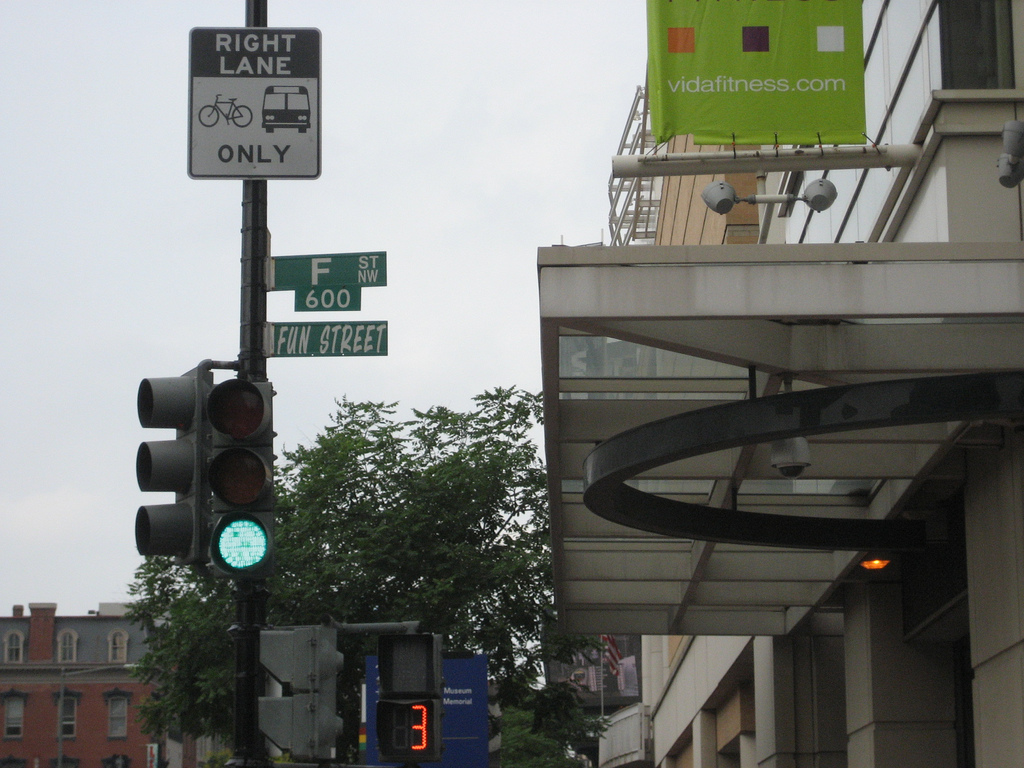
outside the Verizon Center in DCOver the years, the neighborhoods in DC in its northwest quadrant, though they were mostly stable, suffered from a little geography creep. Georgetown, annexed as a town when the District of Columbia was formed, is in the same place, to be sure, but its eastern boundary gets a little fuzzy as it mixes with Foggy Bottom, nearer to the GW University campus. Similarly Chinatown has shrunk a bit along its southern edge of H Street, flexing out more into 6th and 5th Streets, like one of those viscous-liquid-in-plastic-tubing toys that are sold in bins in cheap and touristy stores.

These tiny movements made some otherwise incongruous pairings possible, like the arrival of Fado, an Irish pub, right at the Chinatown arch. Fado was a fun place to go out of a slew of taverns I would never set foot into, because it had very comfortable seating, no smoking, Guinness on tap at the most perfect temperature possible on Earth, and Monday Night Pub Quiz. I will also note here that when Ireland and England met in the championship game of the rugby something-or-other, I was there at 5:30 in the morning to watch it with some coworkers, and  I have loved blood sausage ever since.

But Pub Quiz was the place we returned, despite any kind of weather, horrible conditions for parking, and throngs of suit-clad people just leaving the nearby court buildings. There was no limit to the size of one’s team: sometimes I saw 20 people crammed around a chipped, dark wood table, all staring at the picture round’s piece of paper, shouting to each other about what the answers should read. I am amazed at what 15 years and $25,000 in cosmetic surgery can do to change a person’s appearance after having their senior picture snapped.

There also were no restrictions on team names. And since it was DC, a lot of these names tried to incorporate/mock politics. I can recall the following, roughly seven years later: 14,000 Pages and No Character Development (a reference to the report President Bush delivered to the UN to justify invading Iraq), Faceless Bureaucrats (poor sots), It’s Cold as Balls Outside (from one February game), and The Flip-Floppers (I think we all know that reference). We played a full seven rounds of 10 questions each, and the whole enchilada took about 3 hours out of our lives, time during which we collectively drank something like 4 kegs worth of beer, for there were a lot of teams there. I refused to drink more than two pints on any given Monday because hey, I needed my wits about me. But they did come complete with little shamrocks carved into the froth, when the bartenders had enough time to add flourish, that is.

I’m sure Pub Quiz still continues at Fado but as I’m not there, well, I can’t be certain the game is as grand and well attended as it was in the early-to-mid-aughts. I hope it is. The best I ever did with any team I participated was second place, and we were ecstatic just for that, each receiving an official Pub Quiz™ bottle opener. Mine is still on my keychain.

Out here in Seattle they have a trivia game—to be sure, there must be more than one going—at a certain women’s bar in Capitol Hill, the DuPont Circle of Seattle. I’ve been to it in years past, never wanting to miss a chance at plucking useless facts out of the air if I can. But since we’ve moved at the beginning of this month, we’ve gone every week. The first week we came in fourth, the next week it was third, and we’ve moved up one place every time. Third place winners receive a stick figure drawing of their team, which is sweet and a nice touch by the trivia master, who clearly enjoys running this game.

It’s a more straightforward game than the one at Fado, consisting of four rounds with one picture round. And while Fado gave a points update after every round, this game just does a tally at the end. It also doesn’t take the watching-paint-dry-in-the-rainforest time that the Fado game takes, so there’s a plus.

We won the stick figure drawing two weeks into our playing, and were excited to see what we’d get back when we returned the next week. But there was something off about it, and the trivia master seemed apologetic, despite not telling us the story of what had happened.

Well, there we all are, Susanne lecturing, which I’m sure is an accurate representation of how she teaches, our friend Jody looking for civil rights, our Jewish friend being very…Jewish, and me, typing away with, wait a minute! I have no face! I have a hole for a head! What’s up with that?

I inquired, quietly, about the void in the parchment. The trivia master offered apologies, she didn’t have enough time to redraw the picture. That didn’t answer my question, but I ascertained that I wasn’t going to get any closure here. I took the picture, feeling somewhat awkward but not sure why, and showed the rest of the gang. They loved their depictions, and we chuckled, but I think we all, to a greater or lesser degree, wondered what was up with The Hole. It wasn’t just a hole at some random point on the page; it was centered precisely over my face. It was subtle, but not. We forgot about the drawing and settled into that week’s game.

I’d planned, since before we’d gotten our rendering, to get it laminated so we could bring it with us on successive weeks for good luck, and now I figured I couldn’t back away from that just because I wasn’t really in the picture. Don’t make it about yourself, I told myself. But I’d determined that I would get rid of The Hole by setting in a new picture and taping it to the back, so it would show through. I couldn’t just laminate over the The Hole and leave it there for time immemorial.

It just so happened I had to send a fax out, so I took the drawing and The Hole with me, and explained my little project to the clerk at the office supply store.

“Why don’t you have a head,” she asked, mulling over the paper.

“I don’t actually know,” I said. “I don’t like it, though.”

“Yeah, that’s not good,” she said. She brought over white paper and some tape and clipped out a small piece to go on the back.

What I drew made me look a little monkeyish, or at least a bit like George W. Bush, but no matter, it was better than The Hole. My new friend taped it to the back and said the laminating and faxing would take just a few minutes. I walked around the store and looked for the new Sharpie Liquid Pencil, but to my disappointment, I didn’t find it. I will of course communicate to everyone I know when I find it, because it is, apparently, like magic in plastic.

I picked up the laminated art and lo and behold, there I was, smiling at my little typewriter, type type typing away.

“I bet this is your weirdest request of the day,” I said.

“Oh, no, it really isn’t,” she told me. That her eyes opened wide when she said this made we wonder just how far out the normal distribution curve of weird her requests were. Perhaps I don’t want to know.

Last night I made my way back to trivia and brought the laminate with me, The Hole neatly patched. I showed the trivia master, who was thrilled to see someone had preserved her handiwork. I also showed her I’d drawn in a new face for myself, and she told me she’d have done the same, clapping a hand on my shoulder for good measure. Nothing says genuine sincerity like a hand-to-shoulder clap. My teammates were impressed as well, and we giggled about our characterizations.

Then the waitress stopped by our table to take our drink orders. She asked for our IDs.

“Do we really have to show our IDs every week,” I asked, knowing she knew who we were.

“I have to check that they’re not expired,” she said, and then told me that she was going to name me Grumpasaurus Rex, because I was always grumpy.

I certainly didn’t feel grumpy. I just thought that pulling out my ID every week was a little silly, and I happen to have the worst picture on my license known to anyone west of the Mississippi River, so I am not fond of the regular reminders that it exists. But grumpy wasn’t on my list of emotions for that moment. Just a very light irritation, like 1 or 2 on a scale of 10. Hell, 1 or 2 is what DC residents feel just upon waking. It’s not a big deal.

“That’s why I stabbed out your face in the picture,” she went on to tell me, “because you were so snippy the week before.”

Oh my God. The waitress had stabbed out my face? This is why The Hole came into existence? The waitress I take care to be nice to? Thought I was snippy? Snippy doesn’t tip well, I thought. Not the way I tip. And I currently make $14.25 an hour. What on earth?

“I was snippy,” I asked her, trying to understand. Grasping, really, at figuring out what had transpired.

“I wasn’t the only one who noticed,” she said, carrying on this conversation as if it made any sense.

“What did I say? I don’t remember being snippy.” Irritation levels had progressed, rather quickly, to 4.4.

Apparently I’d made some offhand joke about who was serving us our drinks the first week we’d come in, because it was some other server who’d brought them to us. I think it was something along the lines of, “Oh, she’s too good to serve us?”

I see now, living in the anti-confrontational Seattle, how residents might not understand that brand of humor. I would expect just a punch on the shoulder and a command to shut up, and that would be that.

Instead she stabbed out my face on a piece of paper. That just strikes me as worse, somehow, especially as this is supposed to be a professional relationship we’re having. And then it struck me [sic] that there was a two-week time lapse between my supposed offense and the act of bringing The Hole into all of this. And somewhere in between, a conversation had taken place about me and said snippiness, and it was decided by at least one person that stabbing at a piece of paper was an appropriate way to handle whatever discomfort I’d generated in this place of repute. Irritation levels at 6.7. Approaching DC Beltway status.

Then the waitress wanted to “hug it out,” and she brought me a drink on the house, pushing me over my two-drink limit, but I didn’t say anything, lest I look ungrateful. I had, at least, learned the Seattle Solution to conflict. Hugs and pear cider. Through the course of the night, she hugged me no fewer than three times. Perhaps this was some hazing ritual I’d never heard of before.

This was a lot to take in and still get mentally set for the trivia game. I sat back for most of it, contributing but feeling entirely too self-conscious, suddenly not confident that I had any adeptness at interacting with other humans. We tied for first place and then lost the tie-breaker. We came as close as possible to winning without taking the title. It felt like we’d missed an overtime kick.

I brought the Laminated Sheet that Could home with me and put it back on the fridge, where it had lived the last week. My smiling, renovated face looked at me, frozen and translucent.

I don’t care if I look like a monkey.

Bumbling in my own voice

On the advice of some guy who makes a lot of money blogging and has sold books from podcasting, I made a podcast. This is chapter 1 from Bumbling into Body Hair: Tales of a Klutz’s Sex Change. If it’s something people like, I’ll make more. Otherwise, let’s just pretend this never happened.

Bumbling into Body Hair Chapter 1

Seesawing through Seattle eateries

I volunteered to give up eating burgers this summer because I consumed far too many on our last road trip through the US two years ago, and because often, they’re just not that good. They’re overcooked until they resemble hockey pucks, or they’re served with limp lettuce or overly membrane-y onion slices, they’re on Goldilocks-like, ill-fitting buns, and they’re almost never the right temperature. There are a lot of things, it seems, that can go wrong with preparing a burger. And here I thought I was ordering something everyone knew how to make.

So we said we’d forgo the burgers on this go-round, and I found myself eating a lot of chef’s salads, even though one table of manly men in South Dakota looked at me like I was nuts, or on a dare—something. Why is that big guy eating a pile of lettuce, they looked like they wanted to ask. I wasn’t about to elaborate, because really, where does the story end? It would be like unraveling a sweater on a slippy slope way over the line.

August rolled around and our vacation was over, noted with distinction by the piles of boxes we unpacked in our new but temporary digs. Nobody knows what to call this neighborhood. Owners of several real estate developers are trying to establish the “South Lake Union” moniker, but old-looking signs dotting the streets around here call it the “Cascade neighborhood,” and some of the folks who have lived here a while and I’m not talking about the ones who live in the lofts that supposedly promote creativity, they simply call it “Eastlake.” Thus I have no earthy idea where we live, except to say that we’re in Seattle proper. And there is a big highway right next to us, so as a fan of white noise, it’s close to perfect over here.

One of the things I wanted to do when we showed up in la citie grande was find some good places to eat. After all, in Walla Walla, if one craves Indian cuisine, one needs to master cooking it oneself or make friends with a fine lady named Shampa. There may be some Chinese restaurants in town, but locals will tell newcomers right away that they should never, never eat there. Two restaurants of Thai persuasion are available, but neither of them provide good service or, for that matter, great Thai. So now that we have access to places that make belly-filling Ethiopian, luscious and spicy Nepalese, or experimental gastronomy items, we figured we should try them out.

Because Susanne had been there once before, several years ago, we went to Baguette Box on Capitol Hill with a friend from out of town, and it was lovely. A small space, very casual but still in the universe of “bistro,” they proclaimed their love of grass-fed, organic meats but also offered vegetarian sandwiches. Most things except the frites and the beet salad came on fresh, still-warm baguette, so thank god they believe in truth in advertising. Although they were busy we received our sandwiches quickly: lamb with cucumber yogurt sauce, pork belly with cilantro and hoisin, and pork loin with carmelized onions and apricot aioli. All were thoroughly delicious, cooked perfectly, and decadent. We also ordered the beet salad and the frites. As far as French-style, shoestring fries go, these were crispy and tender. The beet salad, on the other hand, was pedestrian and lacking the same interesting flavor combinations of the sandwiches. We will definitely return for more. I’m eying the drunken chicken sandwich and the eggplant and feta. (Baguette Box, 1203 Pine Street, 206.332.0220)

Last week I went with Susanne to Blue Moon Burgers, over near our place, just off of Fairmont Avenue. If we were going to have burgers again, we wanted it to be in a place that made them their core business. Friendly atmosphere, boasting of meat from Walla Walla’s own Thundering Hooves ranch—more sustainable and organic goods. I don’t quite bristle at the thought that I had to drive 230 miles for these burgers but hey, I shop direct at their store on East Isaacs when I’m living in Wallyworld, so it’s okay. And I’m glad to see other folks in the Northwest seek them out. It’s one thing to read about it in the Thundering Hooves newsletter, but another thing entirely to watch it in action. Exciting stuff! Burgers is a broader category here than just ground beef; Blue Moon Burgers also features vegetarian and vegan patties, turkey, and the very Seattle salmon burger. Also, they have gluten-free buns, and since I know no fewer than five people with gluten allergies, I’m glad to see this little accommodation for them.

Problem was, it took us 50 minutes to get our food. Blue Moon has a order-at-the-counter-we’ll-bring-it-to-you business model, in which patrons pick up a number to set on their table while they wait. Drinks are self-serve. This means that we were on our 2.5th serving of root beer by the time the staff came by with our meal. I am not fond of this serving method to begin with, as the wait staff don’t know in advance where on has ventured, and so must spend some amount of time, bordering on copious, assessing one’s location. It seems wildly inefficient to me, and yet I encounter the practice more and more often.

So, for the burgers. I ordered a bacon cheeseburger and Susanne got a burger with blue cheese. We got a combo order of onion rings and fries to share. By the time our food reached us (other patrons were complaining at their tables, too) the fries were entering tepid stage, but these were made warm by the two onion rings placed lovingly on top. Seriously? Two onion rings? That’s a combo? Our gluten-riddled buns had been over heated on the bottom so that they were semi-stale, and they were way bigger than the burgers inside. Picture a lone toddler in a kid’s public pool. Neither burger had been cooked to order, but otherwise they were tasty, but to risk sounding like an ass, I chalk that up more to Thundering Hooves than anything that occurred in the kitchen. Truth be told the burger needed to be amazing to justify the near-hour wait, and it wasn’t anywhere near amazing. Susanne says she plans to go back because it was clear they were understaffed, but money is tight for us, so when I go out I want to feel like it was worth parting with the bills in my wallet. One solution: they have online ordering, so burgers are ready for a later pick up. (Blue Moon Burgers, 2 locations, 206.652.0400)

Walla Walla, fortunately for them, has a mom and pop doughnut shop, called Popular Donuts, which is one street over from Poplar Street. Hence, everyone calls it Poplar Donuts and as people who know me can imagine, this drives me nuts. Nobody gets “public” and “pubic” wrong, do they? As it happens, they’re really good doughnuts, and they’re old school. No gimmicks, no fancy flavors, no branding, just good confections and seriously tasty, cheap coffee. There are always a couple of older people on the six seats inside talking about Very Important Matters, and I’ve realized over the years that their presence indicates good, affordable food.

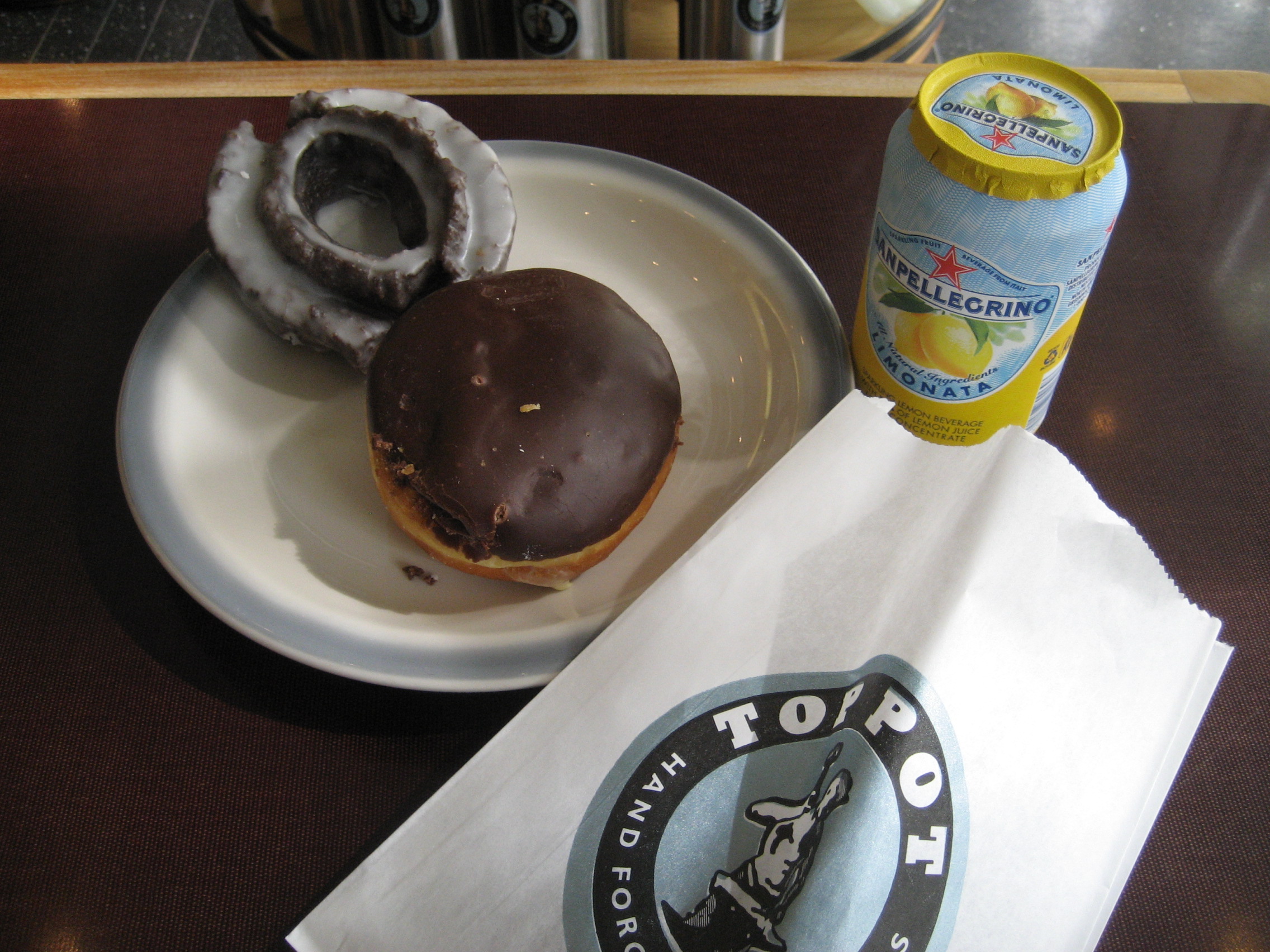
Out here in the Emerald City are several different doughnut-creating operations, one of them being Top Pot Hand-Forged Doughnuts. They seem to be venturing into ubiquitous territory, with locations at Qwest Field, and other stadiums, designated official doughnut of the Seahawks and Sooners (take that, Redskins!), and having signed some new agreement with Starbucks. Starbucks, people. That’s pretty big time, I suppose, in the hole-in cake world.

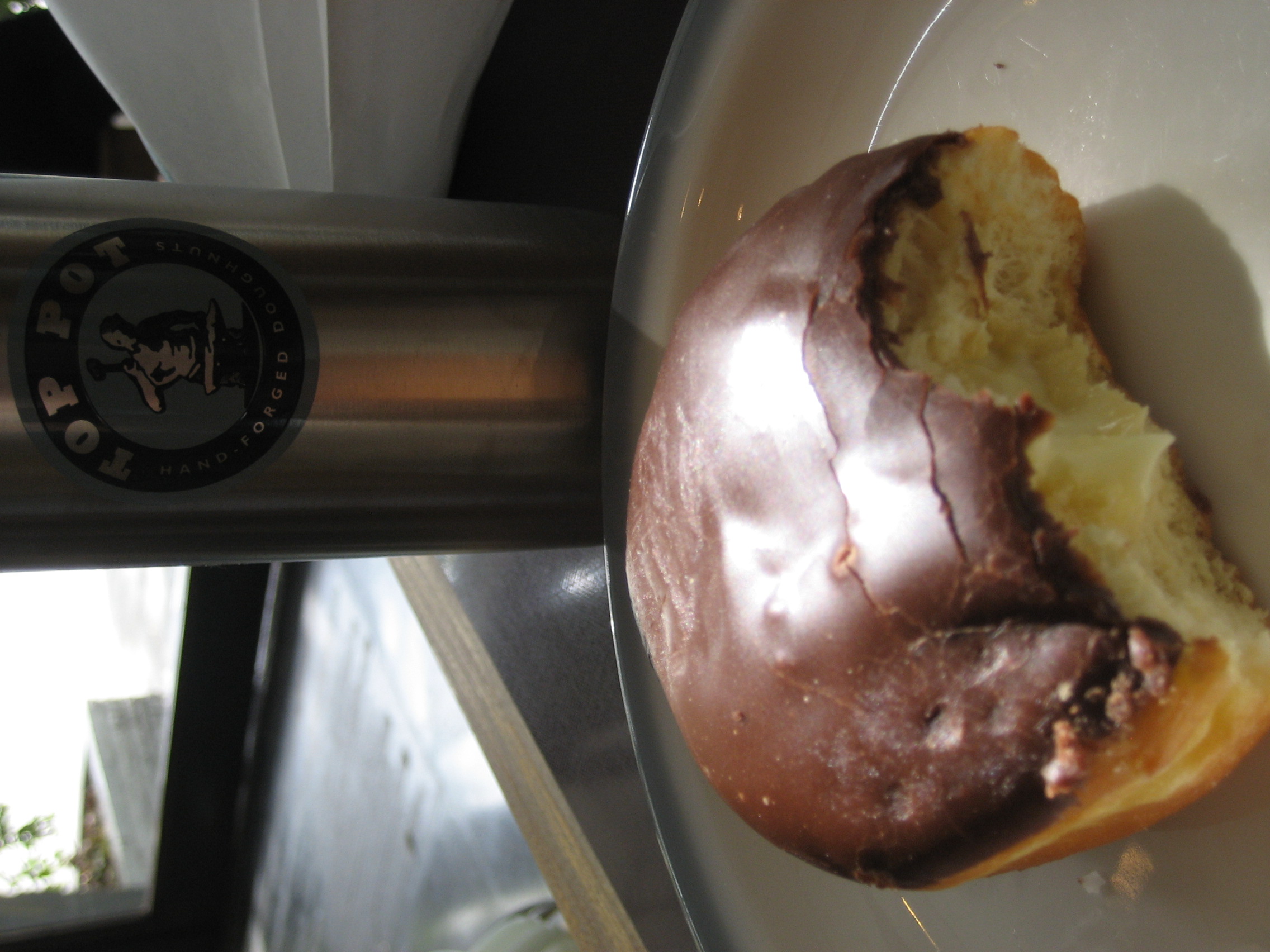
We walked over to the location by the monorail (still ferrying 30 people a day since the 1964 World’s Fare, folks, get your ticket today) and sampled four doughnuts: glazed chocolate cake, double chocolate, chocolate glazed cruller, and my all-time, number-one favorite doughnut, the Boston cream. I held off on the cream until last, like hoping for a big climax to a fireworks show. I should say here that all of the service staff at these places are ridiculously friendly, even as they’re serving hour-late burgers. The doughnuts were delightful. Hot damn, they were very good. The old fashioned, cakey doughnuts had a bit of nutmeg in them and even a hint of lemon extract, a detail that we appreciated. But the Boston cream stole the whole show. Yeasted unbelievably well, it defied descriptions of its texture. It was buttery, light, but dense next to the Bavarian cream, moist, vanilla-infused, it was amazing. The chocolate sauce wasn’t a careless artifact from a Hershey’s bottle, but also nuanced and almost a little nutty. And the cream was thick, mouth-coating, and really fresh, a great friend to the other parts of the doughnut. I was also happy, at least initially, to see how much was inside the cake; no skimping going on at Top Pot.

We suffered a tremendous sugar-crash after our walk home. So I recommend not eating two in one sitting. But we’ll be back for more nibbles, I’m sure. (Top Pot Doughnuts, several locations, downtown phone 206.728.1966)

Need I say how grateful we are to be in Seattle? There are a lot more places to check out and people to meet. And even so, we’re definitely missing our friends in DC and Walla Walla.

The paper chase

On the surface, it’s easy to see how a big city like DC would differ from a small town like Walla Walla. (Hint: no tumbleweeds in DC.) And it’s probably not hard to identify areas of similarity. (They both have a lot of hot air.) And yet there are things that less identifiably, mark a place as its own, where the limitations of its geography, its people, its culture, draw lines over the topography, creating and precluding the universe as the residents know it.
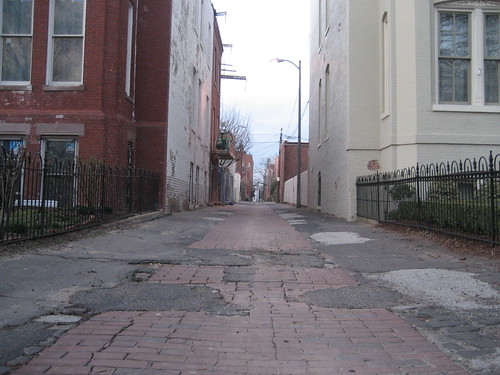
Just as an example, one plucked out from the gazillions of vying possibilities, is how one disposes of large items, such as furniture. For people living in apartment buildings, trash chutes are right out, but so are Dumpster containers, usually because it’s illegal to clog them up with furnishings (mattresses may be an excepted item in some cases). In DC, one is supposed to call the city waste department and set the item on the curb for pickup, when they tell one to do so. In other words, people have to schedule their own trash removal.

When we were getting ready to move out of our District apartment and relocate across the entire country, we made a decision to leave behind a chair and some of our crappy IKEA furniture (sorry IKEA, but it’s true; your designers have never met a particleboard they didn’t like). The pressed wood collection could get broken down and put in the Dumpster, so that wasn’t a big deal, but we had an upholstered chair that wouldn’t be coming, either, and that was too damaged to sell at our yard sale. This thing, while still comfortable, really had been tasked as a collection spot for whatever clothes I stepped out of at the end of the day but that were still clean enough to wear another time. I hate that gray area of clothing, by the way. I’d rather my outfits smell only of detergent and not be mixed up with my vague scent, whatever the hell that is, and the odors of wherever I’ve been that day. Generally speaking, I don’t need any memory of deep-dish pizza three days after I’ve made the mistake of consuming it.

I called the city waste department, as I was legally obligated to do so, and told them I had a chair to discard. I wasn’t expecting them to be happy about it, but the clerk on the phone seemed pleased enough that anyone gave enough of a crap to follow the city procedure. She gave me a date with chair death and I marked my calendar. So imagine my surprise when I headed out to my car for work the next morning after setting out the poor chair.

There was a note pinned to it. A nastygram, for me.

I don’t remember much what it said anymore, but it was angry, and reading it made me angry, too. It was a magnet to angry—something about me needing to take the chair to the garbage container in the back of the building and not littering here on the street. I looked around. The chair was still on the grass—the treelawn, as Ohioans call it—so it wasn’t impeding any sidewalk traffic. It certainly wasn’t littering. And the note, such as it was, held illegal instructions. Certainly I could clear this up with just a little edification-slash-clarifications. “Cations” were definitely needed here.

Already called for DC Waste to pick up. Leaving in Dumpster is illegal in DC.

Inside of three minutes and the horrible crawl toward my office, I forgot all about the pissed off note.

I came home and the chair was still there, even though the garbage had been cleared. Maybe DC didn’t have enough room in their truck? It had rained at some point that day, and the chair looked particularly forlorn. It also still had its note with my addendum, but it now bore a new codicil:

Move this fucking chair to the garbage.

Whoa. Seriously, I couldn’t believe someone would throw a gasket over this. All of the trials in the world and this little off-white, ugly flower print chair is the cause of such distress? How about the tsunami victims? That we were in Iraq, killing and dying by the thousands? How about Robert Downey Jr.’s drug troubles? Go tilt at those windmills, angry person! And I had already said leaving it in the Dumpster wasn’t kosher. I looked around at the windows to my apartment building and the one across from us, with which we shared a walkway off the street. Paranoia crept into my arteries, flooding my brain with terrible ideas, and the fear that they were watching me right now, read their evil missive. It was like a Poe story, and I could hear my own blood flow. I reached for a pen in my bag, and wrote on the wet paper about what they could do with and to themselves.

A couple of mornings later, the chair had been thrown in the Dumpster. DC came along and took all of it with their next pickup. I had been totally irrelevant to the process, whatever process there was. But I did take it as a sign that it was time to leave DC.

Fastforward to our stint here in Seattle. It is a continent away from DC. The drivers in each commute of the day are just as awful, and hampered by a strange stitching of on ramps and exits that make I-5 more of a crawling experience than a commuting one. But overall the people are much less prone to being nasty and uptight. Although it’s counter-intuitive, it seems to be due in part to all the caffeine they consume here, but I’m not an expert, of course.

Twelve days into living here, our phone rang, and it was the circulation department of the Seattle Times newspaper. Now, I am a big fan of newspapers, because they’re active organizations that don’t know they’re extinct yet. I’ve also stood in front of the old Washington Post presses on H Street—they’re no longer there, sorry to say—and to watch a newspaper press the size of a city block is an experience every person should have, because it is amazing. It’s the real steampunk, right there: all those knobs and cylinders and gears and moving metal, each part producing its own little noise that together, creates a symphony of sound and then! Then there is a folded series of paper all together, at the end.

I also firmly believe that reading a city’s paper is to catch a glimpse of what that city is about. Of course things are prioritized by editors and reporters, but what there is to tell comes out of the city itself, which people are here and which words they emanate, and why these stories were picked for the telling—I enjoy parsing through all of that. And then I’ll hunt for the unsaid and the untold, and the alternative version. But I do like to start with the paper.

So I said yes to the caller, send me your paper at the Sunday price only, and I’ll be happy to add a tick mark to your sales for the week. I gave him the address, he who now sounded really super pleased that somebody said yes to him, and to the frown on the face of my wife, who would never read a newspaper on actual paper if she could read it online for free. I don’t think she ever watched the WP press machine.

Now then, I’ve been staying up late these days, writing, getting in my daily dose of Bejeweled Blitz, and reading up on the publishing market, so I haven’t been waking very early. Maybe 8:30 or 9. Then I’m banging out blog posts, checking through email, doing my grant writing work, and later, taking my shower, probably around 10 or 11. I write all of this down not so my mother will know when it isn’t a good time to call, but to explain that for the betterment of the common area in my apartment building, I like to stay inside until I’m freshened up, or at least showered and smelling vaguely of pizza. So I might not reach for the Seattle Times until noon.

Three times now, it hasn’t been out there. Someone has been stealing my paper.

When I realized this, I took some time to digest it. For some while, people have been living here and making their way with no physical newspaper in their midst. Nobody gets the Times except me, because only one ever appears (I have been up early enough to hear the delivery on a couple of days). So for all these many weeks, months, and years, people have gone about their business, and then one day, a newspaper shows up. What about that change in their universe tells them it’s okay to abscond with it? It clearly isn’t theirs. On what basis or set of expectations that I don’t know about do they then make off with my paper?

I felt the sting of that angry chair note all over again. It seized me, like a masked marauder, demanding my negative emotion, and I handed gobs of it over. Thinking about what I would do all day, yesterday, my chance spoiled for knowing what wine Seattlites were talking about, the list of Wednesday night movie times all over the city, the latest comic from Non Sequitur, I glowered and grumbled, and finally, at long last, wrote a note. And I was, in my opinion, beyond polite:

Please stop stealing my paper. If you want one, you should subscribe. Thanks.

I said please and thank you. I was moderately shaming, yes, but I gave the thief another option for better behavior (subscribing) and I gave a thumbs up to the circulation department (subscribing again). I hoped this wouldn’t start another feud. I taped my note to the front door at 9:30PM, then sneaked back into my apartment.

This morning, I got up at 8, threw on some sweats and a ball cap, and went to the door, trying not to flinch in anticipation of anger magnet.

The sign was gone. My paper was there.

This is Seattle.

Just enough ego

I’ve written before about having the wearwithal for taking up writing as a career, or if not a career, an ambition. There’s writing for one’s vertical filing cabinet, and then there’s writing with the intention of getting the thing published. When one isn’t a writer, it looks like a cakewalk. There’s the throngs of fans, the languid lounging at the hotel pool while on a book tour, the eating of many bon bons, and the excitement of the book signing or reading session.

I don’t think that world ever really existed, much as Truman Capote’s legend would have us believe. Writing is a thing people do because they feel a compulsion to do it. At the writer’s conference I attended this summer, I heard the same narrative repeated by many of the participants there—they have always felt an urge to tell stories, to write things down, to play with language. I have my story about my beloved Royal typewriter. It made me a pugilist just to use it, whaling on the keys and throwing the carriage back to pound another line of ink onto the page. And damned if I didn’t introduce a typo on the second to last line of a sheet. Nothing taught me typing accuracy like not having any correction fluid.

And yet, as soon as I came to the act of writing things down, I learned about rejection. Well, almost as soon. Rejection was nailed to the heels of excitement. This is great! We can’t use it. Welcome to our summer program! Sorry, you didn’t make it to our elite finalists group! You’re a finalist! Sorry, you didn’t win this year. We loved your piece but it doesn’t fit with our line right now.

Often, encouragement mixed with regret. Push, pull. Wait for another day. As Johanna Harness said in her blog last week, those rejections are still progress. It can be challenging to see that when one is bogged down in nos from agents and journal editors, and therein lies the way out of hopelessness.

  1. Not everyone makes their career their identity. We writers often do. Just the word writer implies a connection between the act of writing and the human being performing that action. But it helps me, at least, to remember that this is a thing I love to do. There is more to me than writing stories and memoir and commentary about crazy politicians.
  2. Rejections are never about the writer, they’re about the writing. I saw firsthand when speed pitching to four agents in 8 minutes that even face-to-face, they have no idea who I am or what I’m about. They can’t deduce anything in 2 minutes beyond the language I give them. The looks of disappointment and sincere apology that they’re not into my project are great reminders that I’m seeking a business relationship, and so are they. I’m sure I could have had a great conversation with any of them over coffee or a beer, but that’s a whole nother level of connection we weren’t seeking.
  3. Because rejections aren’t personal, my ego need not get involved. This is tough on a daily basis, or more accurately, just after a nice rejection arrives at my in box. My tendency is to cringe that my writing, what I produced, truly sucks at awful nadirs of suckage, which makes me a bad writer and thus a bad person—see where this train is headed?—but then I recover. It’s my ego that does the heavy lifting here, telling me that actually, it’s just a bad fit for that agent.

To take the Freudian sense of the word, “ego,” in which I understand who I am in the world, and thus my relationship to others, I need to be ego-minded enough to take criticism and rejection and move on. My ego tells me that I still like writing and I still think I’m good at it and publishing is a goal I still seek.

This is different from being an egotistical ass, the vernacular of which means I’m immune to criticism because I think I haven’t earned any of it. This is not a writer with whom anyone cares to work. This is the guy who emails a certain science fiction-inclined agent every day for the last two years with the same bloody query, even though she’s rejected him a couple of times and gone silent to his repetition. This is the writer, peddling her unpublished first book of 160,000 words who just can’t understand why she would ever even consider cutting 60,000 of them, or turn it into two books. Never mind that agents and publishing houses love the multi-book deal.

I try to keep myself honest. I don’t declare that I’m the next David Sedaris, even when others have said that to me. I think I’m a good writer, and sometimes I’m funny as hell, which I hear has quite the comedy club going, somewhere on the third circle. But I do need a tough enough skin, enough confidence, enough ego to keep pushing even after getting rejected. Because it is, in fact, forward momentum.

The death of the adverb

I’ve heard from a few people recently—in the last few months, for sure—that they’re “against” adverbs. As if adverbs occupy a political position which one could oppose.

The point that each of them made was that adverbs get used way too often by lazy writers. Take the following example that I composed off the top of my head for illustrative purposes:

“Stop it,” said Lucinda angrily. “You know I hate popsicles.”

Do we really need the “angrily” here? No. We can tell Lucinda is angry. Or rather, we ought to be able to tell Lucinda is angry.

In yesterday’s Friday Flash fiction that I posted, I think I wrote “He was livid.” No adverbs present. It was a tell, for sure, but I had other reasons for putting it in the story. Letting an adverb expound on the action in the sentence, however, can take away from the rest of the line. Or, title, as in (already noted by Stephen King) Harry Potter and the Deathly Hallows.

“Rowling  has never met [an adverb] she didn’t like.” Harry, he noted, “speaks quietly, automatically, nervously, slowly, and often—given his current case of raving adolescence—ANGRILY.”

So Stephen King is not behind adverbial use, either. As a long-time King reader, I have to say I’m not surprised to learn this, given his writing style. That’s like saying Ernest Hemingway didn’t much care for compound sentences or long predicates.

Of course adverbs can be used poorly, but so too, do other parts of speech make themselves rather unbecoming. Superlative, excessive, overburdening adjectives can destroy the simple peacefulness of a noun. Nouns themselves become pretentious when authors reach for “practicable” over “practical,” or “sublime” instead of the more accessible “awe-inspiring.” There may be reasons for their usage, certainly, or they could just be a writer pushing too hard or too dedicated to her thesaurus.

Conjunctions and articles, to their credit, are too utilitarian as to be go-to tools for the lazy writer. And verbs, well, verbs can get writers into trouble in one of two ways—the eternal passive voice problem, or its evil twin, the over-active verb. Again, let’s go to fake dialogue to emphasize the point:

“Katrina,” he screamed, “Why did you rub mud all over the sofa?”

“Because you love the sofa more than you love me,” she hissed menacingly.

I couldn’t resist the adverb there, sorry. There is no reason in the world, the whole entire, land mass and oceanic experience of Planet Earth, why we can’t just use “said.” Said is not pretty, not lyrical, not powerful, but whatever. It’s a great worker for what it does—letting the reader cognate that there is speech happening, and by whom, and then getting them to move on to the next bit. What’s important are the words around the verb. Sometimes the verb is important, sure. I would never tell writers to go for the most banal verb possible—”said” being a special exception, in a class of its own—but writers don’t need to hit every verb out of the park. Readers get stopped by highfalutin verbs. Yet, if the verb is right for the sentence, there’s little need for lots of adverbs to shore it up.

For me, as a writer, I don’t want to single out any part of speech and write its death certificate. Language isn’t about trends, and writers who attempt to write only for fashion are writers who will always be behind the times. Adverbs are great, all on their own. There’s no way to answer the question, “How are you” without an adverb. To focus just on adverbs is to frame the subject of poor writing incorrectly. Poor writing leaves a lot of hot mess in its wake beyond just adverbs. There are usually, in my experience, a whole host of similes and other metaphors floating in the water of bad writing. Nay, the cesspool.

Good writing lets us know it’s good writing because we don’t remember most of the pieces, save the exquisite sentences that we mull over long after we’ve closed the book. It’s not the adverb which is the problem.

It’s the author.

Even the cops have tattoos

It’s August, as we all know, so there are still a lot of sunny days here in Seattle; I’ve heard but not experienced the loss of direct sunlight that arrives in fall and sticks around until the next summer. That’s how it worked in Syracuse, New York, so I can steady myself for the little bits of insanity that pop up as human beings go through vitamin D withdrawal. It gets weird, that’s for sure.

But if I don’t have the lack of sun to remind me I’m in Seattle, there are other hints:

  • Nobody carries an umbrella in the rain, but everyone wears raincoats, even when the sun’s out
  • Black and brown are the top choices for clothing, unless one has opted to select a bit of hot pink
  • There is apparently some contest to see who can plaster the most bumper stickers on their car
  • People wear jeans to business meetings
  • No glasses frames are “too retro” to wear out in public
  • Instead of just garbage and recycling bins, there are bins marked Garbage, Recycling, Compost, and Hopeless

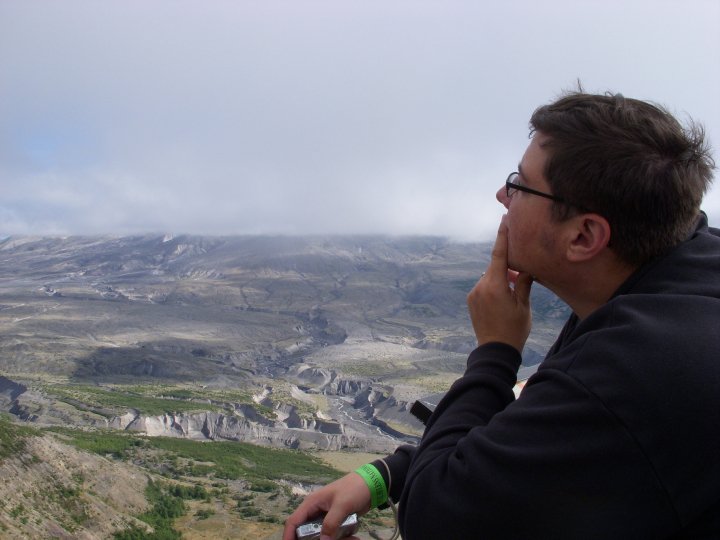
It is its own little city. I enjoy seeing skyscrapers once again, not for the earth-destroying resources they consume, of course, but for the fact that it signifies there are a lot of people here. In New York City, they seem to touch the clouds but never make it; in Seattle the clouds like to dive in from time to time, I suppose to take in a show or slam poetry event. Even the volcanoes hide behind gray blobs of cloud. It’s almost as if Mt. St. Helens is embarrassed that it threw up all over eastern Washington in 1980. Girl, 30 years later, you can be okay with it. We all see you blew your stack, and it’s okay.

Some folks warned me that Seattlites are passive-aggressive, and so far, this has held up to be fairly accurate. Back when Susanne and I first moved to Walla Walla, I was shocked at how indirect people were. For example, if I am staring at cans of beans in the grocery store, assessing which I should procure, and someone from the Northeast comes up behind me, they’ll either say, “excuse me” and reach in around me, reach in around me without saying anything, or push me aside to get their damn beans. But in the Northwest they’ll just stand behind me, waiting, quiet as a door mouse, until I finish thinking about whatever it was that brought me to this corner of the store in the first place. I find this unnerving, because I need and expect directness. But what I didn’t understand until this last week of living here, is that they’re really just fuming behind me, wishing they could say something, wholly unable to break their social contract.

Another story: I used to commute into DC on the Metro, taking a bus to the Pentagon station and traveling by the subway up to Foggy Bottom near the George Washington University campus. When I was on my morning schedule I saw the same people, also heading to work, which included one nice lady who was aided by a seeing eye dog. We got to know each other a little, in that way that repeat commuters do. Because she got off at the same station as me, she’d often take hold of my elbow as we walked to the escalator. It wasn’t anything I said she could do, but it didn’t bother me, either. One day, heading up the escalator, a businessman in a hurry mashed her dog’s foot into the step, severely injuring the animal. I was shocked that he didn’t lose one step on his mighty important commute to Satan Company, Ltd., and I rushed over to him and yanked him aside before he hit the turnstiles, yelling at him to see what he’d done. It was clear he didn’t want to deal with the aftermath—the woman trying to figure out how badly her dog had been maimed, the dog doing its best to be calm but crying and whimpering all the same—but me and the other commuters got his card out of him. I later found out that he’d ponied up the money for the veterinarian, as well as the re-training the dog needed to get back on moving stairs. Cornered, he had no option but to admit his liability, even as he’d tried to just sneak away.
Fast forward to Monday night, here in Seattle, and while we were at the trivia game in a local bar, a woman stepped on a service dog’s foot while meeting up with her friends. Her initial response was, “oh, there’s a dog there?” A few words were exchanged with the dog’s owner, but then she walked over to her group of pals, muttering, “I don’t know why someone brings a dog in here, anyway.” Lady, it’s a service dog. It’s wearing a bright orange back harness that reads: Service Dog.

That was a primo passive aggressive response as far as I am concerned. Damn that dog for being under my feet!

Lest I sound like I don’t like Seattle, let me list a few wonderful aspects:

  • Great, self-contained neighborhoods that nestle lovely little eateries, like Moka Coffee, the Baguette Box, and Sushi Whore
  • Water, water, everywhere one looks
  • People aren’t afraid to play wonderful music—everything from old Sonic Youth to Average White Band, to contemporary indie rock
  • Few places can support many people wearing socks and Birkenstock sandals
  • Even the cops have tribal tattoos

I went ahead and subscribed to the Sunday newspaper because I still believe, even in this anti-paper world, that a subscription to the local rag provides great insight into a place’s culture, people, and environment. And yes, I’ll note that I’ve been quite unwilling to purchase the Walla Walla Union-Bulletin. I don’t find that it actually contains news or much else of interest.

So Seattle, I want to get to know you. We’ve had a few dates here and there, but it’s time to take our relationship to the next level. Where will we go together, oh city of wet weather and shades of green?

If land or by Seattle

Everett contemplates a volcano

I contemplate a volcano

It was in the parking log at Costco where a woman, looking wholly bereft of home and afflicted of something came right up to me as if I were an old friend and asked if I could help her out by giving her money. I had been completely focused on how to get twenty pounds of flour into a space the size of one small Pomeranian, which assuredly is no easy task. So I nearly jumped from hearing her inquiry, and it took me longer than it should have to explain that I didn’t actually have any cash on me, sorry. She shuffled off, not unlike a zombie, and I realized she could have been a posterchild for the anti-meth campaigns of the Pacific Northwest. My heart went out to her, and even so, I was a bit unnerved.

It occurred to me after this incident that different places have different expectations for interacting with strangers. In DC it’s either tourists who are chronically clueless about their surroundings, laden with a map of the city or not, or it’s someone panhandling. The lobbyists, lawyers, government workers, hotel staff, cab drivers, administrative assistants, Metro drivers, and other commuters all keep to themselves, wanting no part of any conversation with anyone else. I rode the Metro for years, and very infrequently did I ever hear two people conversing who hadn’t boarded together. MP3 players were the best thing to happen to the silent travelers of DC—suddenly everyone had an easy means for ignoring the world around them.

So people looking for money from the hands of strangers kept, for the most part, personal distance, and requests were limited to the actual sidewalk or on public transportation. I think that’s why I was startled here in Seattle. I actually had to spend the better part of a second realizing that this wasn’t an old friend or acquaintance of mine, because she walked right up to me, and I in turn was right up against my open vehicle. It was her lack of recognition for whatever vulnerability I had at that moment that started my first sense of anxiety.

But for my part, I was just as destabilizing to her, because as soon as I recognized that all she wanted was money, which I was actually out of, having just left Costco, I went immediately into my DC-generated response when I don’t have cash to donate, which is, “I don’t have any money on me, sorry.” In DC this ends the exchange, 7 times out of 10 the requester will then ask God to bless me or tell me to have a nice day, and then I’ll wonder how much of their request was tinged with a need for human interaction and a measure of dignity that someone will talk to them. This woman, on the other hand, seemed shocked that I’d make eye contact with her, much less have a quick answer.

It occurs to me that people are less straightforward in Seattle than in DC, so people looking for handouts need to be more in their face. But the other big adjustment seems to be about sobriety: I can’t remember even a single instance of a non-sober person asking me for money in DC. Not a one. But everyone in Seattle who has asked for money has seemed to have an affect for one reason or another. And there seem to be many more homeless folks here than back out east, and I have no idea why that is. I’m sure there are experts out there who analyze such things, who advocate for this solution or that, but I don’t know who they are or what their positions amount to. But I’ve never thought about how different cultural expectations for civility play into how people on the margins express themselves. And clearly, there’s some kind of effect or panhandling would look the same no matter the geography.

For our part, I’m very glad to once again have a home. We might have been without a fixed location for two months by choice, but I don’t for a minute want to lose sight of the millions of people who have lost their houses or who are without their own home but who desperately need their own place. We are very lucky people.

Welcome to Emerald City

Three days driving for half the day or more seems to be my personal limit on time I can spend driving and still call it a positive experience. This I now know because we did just that in our little Honda CR-V (that’s Can’t Resist Vehicle for the non-Honda laypeople), going from Detroit to Minneapolis in one day, to Miles City, Montana, the next, and finally to Walla Walla. Except not finally, really, since our end destination was Seattle. But we needed to make a stop at Wallyworld to get some of our things out of storage, put them into a moving van, and haul the detritus, I mean, erm, our belongings, to the city with the Space Needle.

Just as an aside, the Space Needle only looks good from a distance, and especially good as a line drawing, as in the opening credits of Frazier. I suppose it helps that we’ve got Grammer’s singing to distract us from even this abstraction of the building. But up close, it just looks meh, like a toy I played with in 1978 that had a lot of white plastic and faded to some ever-dingy urine-y yellow. Okay, it’s not as bad as that, but it’s not much further up, either. And I am a little incredulous that we still had a World’s Fair in 1964 or whenever this thing was built.

We rolled into Walla Walla on Friday night with the wheat almost as grown as it gets before the farmers chop it down and burn the fields. Everything in town had a bit of a golden hue from the light of the crop, or maybe it was just the lighting from the maximum security prison, I’m not sure which. We had plans to get the moving truck in the morning at 11:30—this was our pick up time. And as friends of mine know, I am fastidiously punctual. So we checked the address to Budget truck rentals online, went to bed, and ventured out in the morning.

This is where we had a quintessential Walla Walla experience. Let me explain. While the Web site gave a street address on East Isaacs Avenue for the truck rental agency, all we found was an empty lot with one rather damaged rental truck—the rear view mirror was broken, and the left side had a long, arching dent. We could see the key drop-off  box, so we had some reassurance that this was the right place, but in every other regard we intimated that this was the very most definitely wrong place to do our paperwork. For other than a few McDonald’s wrappers slowly blowing in the desert wind, there was no paper.

I found two phone numbers attached to the drop-off box, so I called the first and waited. Two rings, five, seven, and then I clicked in to some other part of the Budget Rental Universe. Headquarters was less than helpful, only giving me the address to which I’d already wandered. Maybe there was a parallel dimension to the office that I was just missing, or a secret word, or perhaps I needed to pull on my ears or tape up an X on a window. They suggested I try the airport. But it was an offhand gesture, not a solid directive. Small town living at its finest.

With some degree of trepidation—for maybe someone pulls up in a truck the second after we’re gone—we left for the airport, which, because it’s Walla Walla, and as regular readers of this blog know, is only a 5-minute drive away. That’s because everything in Walla Walla is only 5 minutes from any other thing. I hopped on the highway and by 11:37 we were at the counter, a just-beyond-teenager there who knew all about our rental. The kicker: this was in fact where we were supposed to do our paperwork for the truck, but then we had to drive back to where we’d just been to get the actual truck. Fortunately our truck wasn’t the beat-up one in the parking lot. Unfortunately, when we met up with the manager back on East Isaacs, we found our truck had no gas cap. We tried taking the gas cap off the damaged truck, but lo and behold, it was stuck onto the tank. What the hell did those people drive through? I agreed to drive the truck across the street to the auto parts store and voila, the manager presented me with a new cap.

Then it was just the matter of nearly falling over from heat exhaustion as we cleared out what we needed from our storage unit, which in the summer heat, wavered somewhere around 108-112 degrees. It was like slow-cooking our brains, and eventually, we got a little discombobulated, pointing at boxes we wanted but not knowing anymore how to get them from where they sat to where we wanted them—for example, in the truck. I was reminded of Weeble Wobbles, another toy from my youth in the 70s, because we did start teetering around as we carried things, and after an hour or so, we were done. We did what any intelligent person would do at that point; we headed to the Colville Street Patisserie, and if any place could serve as muse, this place does. I don’t know what Tiffany and Dave put in the confections, but it makes my fingers get to typing.

The next morning we got ourselves some mochas and yogurt and headed out in our mini-caravan, over the Snoqualmie Pass through the Cascade Mountains, which is the range responsible for keeping the westernmost third of Washington and Oregon wet and the eastern two-thirds nearly bone dry. I kept the truck at a steady 65, and this was an improvement over the U-Haul I’d rented in 1997, which threatened to come apart at the seams at one tick higher than 52mph. I found some amazing country station on the way to Yakima and bojangled myself all the way to Seattle.

We promised ourselves on Sunday that we’d unpack right away, and as of this post, we’ve mostly held true to that goal. I’ve got one still-sealed Space Bag with my clothes in it, and we have a bathroom shelf to assemble, but otherwise, that’s it. Note to people thinking about buying Space Bags: two of ours opened up spontaneously in the back of the car, which wasn’t good, and when you vacuum seal them up, they become heavier than the particle of matter responsible for the Big Bang. But other than that, they’re great.

Susanne’s younger brother met us at our new place to help us move in, and more to the point, to collect the box of pottery he’d asked us to bring with us from Michigan. Nobody is more cleverly frugal than this fellow. But we made short order of the moving in process, and now I have the next 5.5 months to take in everything Seattle has to give. Already I see that our neighborhood is unusually populated with seafood restaurants, unhelpful to us as a couple since one of us can’t eat fish or seafood of any kind. But it is Seattle, and we can partake of the many, many coffeehouses here. Six are scattered in the streets around us—there’s also a German tavern, three pizza-making establishments, one used book store, and a business to help one improve one’s golf swing.

I’ll get right on that.