Latest from the Blog

Recapping Last Night’s Debate

Town Hall Debate 2012While we’re all chuckling at the “binder full of women” jokes, I’d like to look at a few other moments from last night, some of which I thought were powerful and some which troubled me. After a night of slumber, my brain has drawn these conclusions, presented in no particular order:

The town hall format is not good for showing the candidates’s aggression, but it makes for exciting TV—Was Mitt about to grapple with the President? It looked like that from the vantage point of my sofa, on at least two occasions. The film stills make it look like they’re blessing each other or practicing their “sit down” drills for their dogs. Turns out, podiums make good fences.

Someone told Barack Obama to keep his back turned on Romney—I lost count of the number of times that the President would respond to his challenger while facing the opposite direction from him. And he kept his eye contact to a minimum. I don’t know if David Axelrod’s new schtick is to act all above the contender, but Obama brought out the cool shoulder last night something fierce. Read More…

The Rise and Fall of TV Commitment

This originally appeared on I Fry Mine in Butter in 2010.

In a world where there were three television networks, people watched them.

Here are a few finale viewing numbers from years past:

M*A*S*H, 1983: 105.9 million viewers

Roots (mini-series), 1977: 36.38 million households

Cheers, 1993: 80.4 million viewers

Friends, 2004: 52.5 millions viewers

The Cosby Show, 1992: 44.4 million viewers

Lost finale shotLast week, Lost’s series finale garnered 13.5 million viewers, and still it seemed like everyone and their neighbor had glued their eyes to their flatscreens. It pales in comparison to most Super Bowl games and any time Michael Jackson gave an interview. And it should be noted that the season 1 finale of Lost attracted more than 20 million viewers, so the show had definitely seen a decline of its viewership. But Nielsen numbers be damned, whatever happened to cult favorites?

Jericho, the terrible post-apocalyptic, conspiracy theorist’s daydream came back to television after a fan campaign roared its demands to the network, and got a whole 7 more episodes before it was canceled again.

So color me confused that FlashForward was canceled last week due to low ratings, even as it was at least as watchable—in my humble opinion—as V. And here’s where I get a little steamed: I know we’re going to be left hanging, forever. After I’ve dedicated significant attention to Charlie and Mark and Dmitri and Lloyd, to wrapping my brain around seeing things in the future that can’t have happened without seeing them in the future, and to remembering which agent is a double agent, which strings on Mark’s board lead where, and that we still don’t really know who D. Gibbons is. Even if some of the dialogue is stilted or some of the acting a bit forced and strident, I didn’t watch the show thinking “I bet they’re all in purgatory and waiting to die.” If I want to watch that crap I’ll rent Heaven Can Wait again. Ain’t nothing like a little Dyan Cannon screaming her guilty head off. Hell, I’d even watch The Heavenly Kid over again before I’d spend 5 years combing through Lost. (For the record, I gave up on the series after a few episodes into season 2.) Read More…

On the Road for an Unknown Writer’s Book Tour

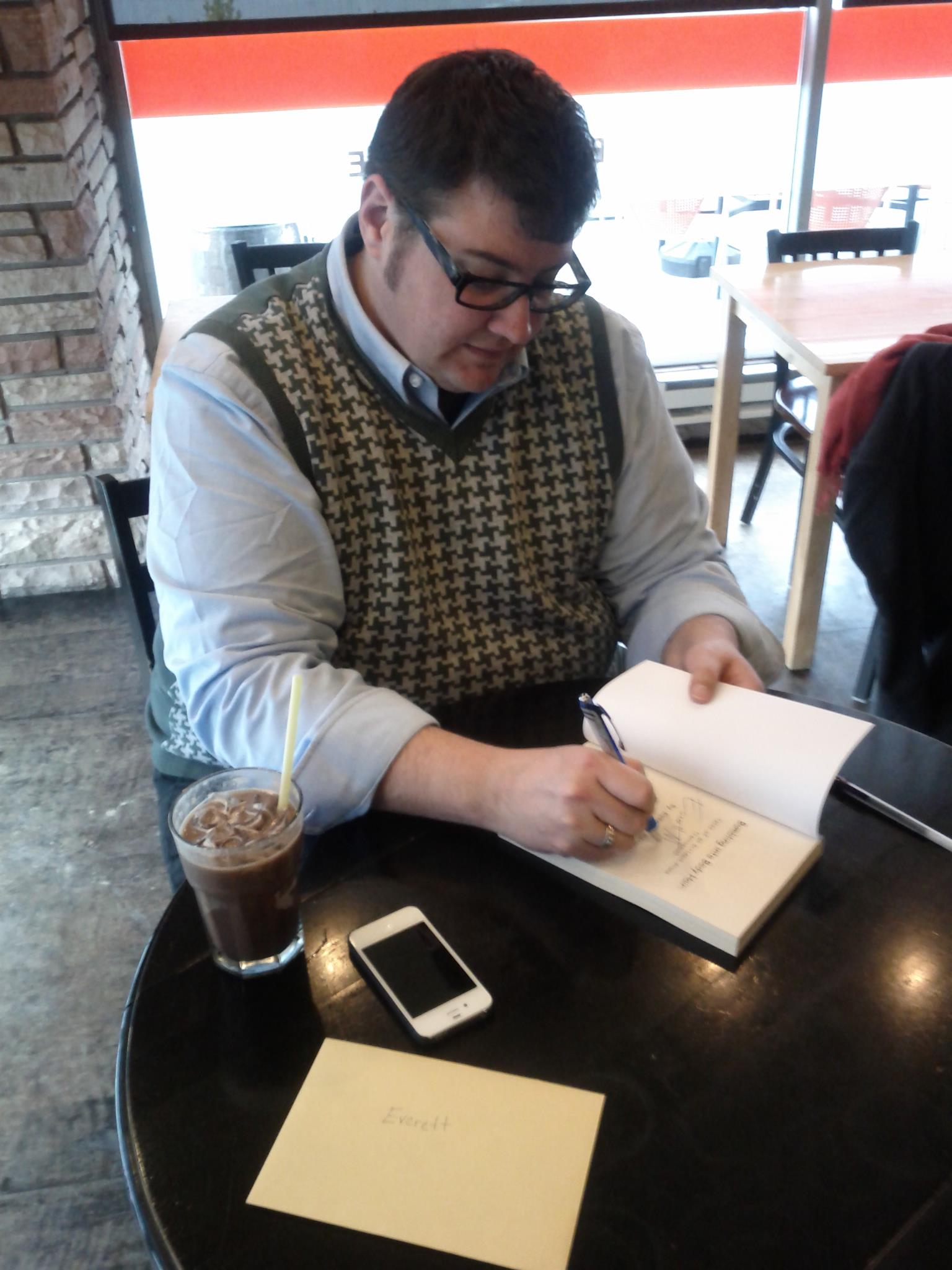
The book tour is an endangered species, part of the soon-to-be archaic practice of publishers in getting publicity for top- and mid-list authors when their latest books hit the market. I remember book tours from the bookstore perspective, because I was once a book buyer and I coordinated readings up in Syracuse, New York. Stephen King, impeccably nice. Oliver Stone, not so nice. Mollie Katzen had lots of culinary tips, William Bennet was reserved, and Donna Shalala had a great booming laugh. For each of these events we ordered 30, 40, 75 copies of their tomes, and the lines stretched out of the store and into the student life building atrium. We’d put extra people on shift and listen to the cash registers ring with sales. It was something of an assembly line: customers waiting, picking up books, paying for books, getting books signed, out the door. A signing could last one or two hours before the interest petered out. We tried not to frown when people arrived with their own books or with books that had been released years earlier, because the authors were sure glad to see everyone. Some of the authors had requests up front or in their contracts that we had to fulfill, things like having sparkling water, or having a rival’s books tucked out of sight, and of course, of course, we were more than happy to oblige them.

When I do a reading, I count it as lucky if the store remembers I’m showing up that night. One reading had me and a few friends standing nervously on the sidewalk, the store dark and empty of staff, while I called my publicist. We were saved from reading on the street or walking away in sorrow when a random car with three store employees drove by us, wheeled around, and opened up the building. By the time I started reading in the quickly rearranged room, 15 people had shown up. Read More…

Guessing the Killer

I originally wrote this for I Fry Mine in Butter in 2010.

Perry MasonWhen I get a little afraid to admit just how many hours I’ve spent watching cop shows and courtroom dramas, I just add up all the hours spent reading, which is impossible, I suppose, and then I feel better. Because even loving popular culture the way I do, I still worry that what my elementary school teachers told me is true: TV will rot my brain.

Here I am, still intact in the higher functioning way. I must still have a few capable synapses. So since I’ve made it with all these years of television viewership under my belt, I’d like to spend a little time looking at one sliver of television narrative: the giveaway shot.

I want to give some due to the camera action that does what foreshadowing did for Mary Shelley. It’s usually less than a second, sometimes is accompanied by dialogue, but mostly not. I like to think it’s something TV picked up from Alfred Hitchcock, because he really started the quick cuts and shots that we have come to expect in suspenseful storytelling. Read More…

Macho Sport Meets Female Body

I originally wrote this for I Fry Mine in Butter in 2010.

2000 China women's gymnastics teamThis week the Chinese women’s gymnastics team that competed in the 2000 Sydney Olympics was stripped of its bronze all-around team medal for having a member under the minimum age of 16. That so much evidence existed and was in the public for years before this move by the International Olympic Commission—including the athlete’s personal blog and inconsistent birth certificates—is compelling, especially given the furor during the Beijing Olympics in which the same rumors swirled around the 2008 team. Several sports writers and experts have written that the IOC caved in and refused to call China on its willful doctoring of documentation because it was the host country that year and heck, for various other potential reasons that run the gamut from probable to a conspiracy theorist’s dream.

What I want to know is, what is the advantage of the too-young gymnast? Well, when it comes to women’s gymnastics, smaller is better. A shorter length from head to foot increases the likelihood of balance, which is important for pretty much all of the exercises; smaller bodies don’t receive as much stress on their joints from the whipping through the air and hard landings and dismounts; and pre-pubescent bodies still have flexible cartilage at the ends of the bones that make the body slightly more flexible and presumably, a modicum lighter. Read More…

Fleeing vs. Invading

This originally appeared on I Fry Mine in Butter.

In thinking about the anti-immigrant it’s-okay-to-use-racial-profiling law that passed in Arizona last week, my mind flashed back to V, all the way back to 1983. Knowing that it’s only a matter of time before the Gestapo, I mean, the Visitors, come to take them away for being illegal, I mean, scientists, they ask their former landscaper, Sancho, to get them over the border. Though this storyline and plot moment is fraught with all kinds of stereotypes about Latinos, Jews, police, and the power dynamics between these, it’s still written from the point of view of the smuggler as hero. Of the Latino smuggler as hero, no less. I can wrack my brain (okay, I have wracked my brain, through a nasty course of stomach flu, in fact) and I cannot come up with another instance in the last 40 years in which a mainstream television show or movie depicted illegal immigration by Latinos in this way. (To see the clip, start watching about a minute into the segment below.)

I can, however, come up with dozens of positive depictions of other people fleeing across borders illegally and/or without proper documentation, including, but certainly not limited to: Read More…

How the Promise Keepers Killed My Masters Thesis

Promise Keepers logoI’m a little tongue in cheek here, emphasis on cheek. Call this a cautionary tale; as it is, it’s taken me 18 years to write it down anywhere, and that is saying something for a dedicated memoirist.

There’s a lot from my early twenties that I regret, or would at least like to see in do-over. On the other hand, my many, many mistakes have brought me to my life at 42, and with a supportive, charming partner, my adorable child, and burgeoning writing career I can’t say making youthful mistakes has doomed me. But long before I learned that being respected was more important than having people like me, I enjoyed a litany of self-made errors.

Let’s take graduate school. The very reason I found applying to postgraduate work appealing was my extreme fear of entering the “real world.” This is frightening as a trope for college seniors, I get that, but in the past year I’d just come out, been gaybashed, accidentally broken my leg in three places and dealt with devastating news in my family, and trying to succeed outside of an academic institution seemed overwhelming. I’d gotten it into my head that I could stick around my now-familiar campus at Syracuse and continue to bloviate about cultural theory for another two years–and after that, I could go on and get my Ph.D. Anxiety attack solved.

Being a teaching assistant was thrilling, especially in the midst of an excited discussion with students, less so when I came face-to-face with their response papers. We were supposed to keep the curriculum contemporary in order to keep students engaged. More than one student rebelled against charged conversations about vivisection, reproductive rights, the electoral college, and the like, but I found my way through such ephemeral controversy. Even if I had to explain myself to the rhetoric and composition program director. Twice.  Read More…

I’ll be reading with several other fantastic people. Be there, and be square with us!

Kelli Dunham's avatarQueer Memoir

QUEER MEMOIR is NYC’s community based queer storytelling event. This month we’ll be hearing from a bunch of really fascinating folks with amazing stories, all on the theme of NERD. Please join us. The suggested donation is 5-10 bucks to cover costs, but if you want to come and and don’t have the cash PLEASE just come anyway. No one ever turned away.

WITH STORYTELLERS

Alexis Clements

Calvin S. Cato
Everett Maroon
Laura Duncan
M.Taueret Davis

With hosts:

Genne Murphy (one night only from San Francisco)
Kelli Dunham

Alexis Clements is a playwright and journalist based in Brooklyn, NY. She is currently a Fellow at the Cultural Strategies Initiative. Her creative work has been produced and published in both the US and the UK. She is the co-editor of the two-volume anthology of performance texts by women titled, Out of Time & Place, which includes her performance piece, Conversation. Her…

View original post 572 more words

What Would Ev Do?

Dear Abby photoA writer friend of mine sent a question to me, suggesting I should have a column. So let’s pretend I have an advice column for writers. Feel free to add your own advice in the comments! Here’s our exchange:

Dear Ev–
I’ve been working on a science fiction novel for most of the summer, having fun and seeing where it goes. I’ve got about 20k words, two fleshed-out protagonists, and an endpoint in mind. My usual approach to writing is to just plow ahead and get it done, then go back and revise for plot consistency, etc. But! I recently had a realization about the plot that will completely change what I’ve already written and will change how I proceed. Should I go back and change it now and risk getting caught up in endless polishing ruts? Or make a plot outline that reflects how I will re-shape the plot in the second draft and push forward? I’m leaning towards the latter.
Thanks a bunch!
Rachel

Explosion in the Produce Aisle

Several scientist type people insist that between our first and second years, humans set up their palates for the rest of their lives. Give your toddler too much sugary stuff and it’s all she’ll eat later on. Lean toward too many processed foods and you’ll have trouble getting him to eat macrobiotic, more nutritious food when he’s entering grade school. Nothing beats the tension of worrying that during those exhausting days after the infant stage you’re merely preparing for culinary disaster. Thus I attempt to balance the following when figuring out not only each and every meal for the baby, but my overall nutritional and taste goals for Emile:

  • Include whole grain and fiber, protein, vegetables, and fruit
  • Put out a melange of shapes and colors, some finger foods that he can wrestle on his own, and some spoon-fed
  • Keep everything in rotation so he doesn’t get bored by the same stuff
  • Make each piece of food easy to swallow so he doesn’t die
  • Ensure only organic, homemade, or all-natural food passes his tender lips

Above all else, however, is this:

Show no stress about trying to remember all of the above rules. Read More…