Latest from the Blog

The Political Issues Next Year

For the past few years I’ve done a bit of cheeky prognostication on the popular culture front–picking which elected official will get caught up in a sexting scandal, which celebrity will get the most tabloid coverage, that sort of thing. But 2012 has left me with no heart for such frivolity, not with the Susan G. Komen attack on Planned Parenthood, the vitriol that spewed all over the nation through the election season, and Newtown. Now I’m left scratching my head and asking big questions about getting proactive on the issues I think are most important. I mean, I want to stay funny, I really do. I’m just having a tough time isolating my giggle button when it comes to civil rights, the lives of people on the margins, and our political atmosphere that seems hell bent to take us all down. Fiscal cliff, anyone?

Reproductive Rights and Sneaky Fake Women’s Clinics–We saw many examples of the fight against women’s health and reproductive rights this year, everything from the sound bites of the stupid (“Women’s bodies have ways of shutting that down”) to the attempt to gut Planned Parenthood funding, to new impossible regulations for abortion clinics to follow if they want to remain open. Late in the year, a woman died in Ireland, a state which doesn’t (barring new proposed rules since her death) allow for abortion except under extreme circumstances to save the life of the mother, with “extreme” being open to debate. It was a harrowing moment for abortion rights advocates in the States because so many of the GOP’s members are for just the same language and restrictions here. Read More…

How America Could Be Better in 10 Simple Steps

balloons, hot airPersonally, I’m not complaining about 2012. I published a book and one of my short stories was selected for the first transgender anthology in the US, and I’ve spent all kinds of wonderful moments with my baby, who is fast approaching the Defiant Toddler Years. 2012 was really pretty great for me, in that my candidate won another term as President, there are three more states with marriage equality on the board, and I got to go to some great cities, meet impressive people, run into Angela Davis and Alice Walker (sorry my stroller bag was in your way!), and read my writing to more than 500 people. But for many other reasons 2012 has been a terrible awful tragic year, and I lived through the trials, too. We all listened to that drawn-out, nasty election, filled with one sour sound bite after another, we saw the return of voting laws designed to stifle the electorate, and we watched a relentless attack on reproductive rights. The last two years have been nasty, with self-described conservatives vying for the attention of the most extreme right-wing ideals, their comments filling up the 24-hour news stations like a frothy volcano in a science experiment gone wildly wrong (which I suppose isn’t far from what their comments were). It’s hard to be inundated with incendiary rhetoric and news of the awful and still think we live in a great place. Forget best. We’re not the best country, we arguably never were, and I really don’t know why my fellow Americans keep insisting on this exceptionalism concept. But maybe if we can put our folly aside, we could carve out a renewed sense of community and “we’re in it together”ness that we sorely need these days. Here are 10 simple things we could do:

1. Turn off the pointed, partisan “news” shows—Most of us know that FoxNews isn’t either fair nor balanced, but MSNBC isn’t, either. It may feel good listening to talking heads from “your side” telling you what you want to hear, but it’s often inaccurate, and the skewed perspective only reinforces an “us/them” mentality that keeps us too distanced to listen to each other. I hate to use the word “old-fashioned” when talking about media outlets, but the old-fashioned, “objective” news rooms who fact-check every statement provides better reporting and has not set up its business model on the idea of partisanship. Who are these news outlets? That’s up to each of us to identify, frankly, because managements shift and reporters move around, but AP and UPI reporting are pretty steady, NPR has a mandate to be objective, and there are many foreign news organizations who are not beholden to US interests and so they tell it like it is. But please, shut off the Rush Limbaugh and the Chris Matthews. Go for a walk or something. Read More…

The Persistence of Unreality

assault riflesNot only do we have vapid debates in America about which beer is better, which sports team is more fearsome than which other sports team, and the like, but in the wake of our nation’s latest mass shooting, in which 20 children under age 7 perished, now we debate about whether it’s appropriate to debate. Now is not the time, many people attested this weekend, to talk about gun control. Some folks threatened to “unfriend” others on Facebook if those people persisted in posting about mental health support or gun laws, saying that they were obviously making it about “political issues.” Never mind the idiom about the personal being political that’s been around for 40 years, perhaps there is a time for mourning and a time for reflection about what’s led us to these moments. I say moments because a 6-year-old died in the Aurora, CO shooting, a 9-year-old in the Tuscon, AZ shooting  of Congresswoman Gabrielle Giffords, and of course there are hundreds of kids under 14 killed by guns every year in the US that get next to no media coverage. But even when the guns in an incident were purchased legally, even when there is no long history of mental health instability, and even when the majority of victims are defenseless kids, some among us insist on sticking to the same talking points to defend the status quo. Let’s look at these talking points, and hopefully it’s okay, four days later, to start some kind of dialogue about gun violence and gun rights. If I get defriended on Facebook, so be it.

If we don’t have assault rifles, we won’t be able to prevent the government from becoming a fascist state–Let’s see . . . the Department of Defense carries a budget of more than $680 billion. Read More…

Zombie Risk During the Holidays

zombie christmas greeting cardMany of us think of the time between Thanksgiving and the New Year as a happy season, filled with parties, presents, feasts, and family. The more cynical among us may grouse that such occasions are not cause for celebration, but very, very few of us see the holidays for the danger that it poses, which is this:

If the zombie apocalypse happened during the holidays, more people than usual would perish.

There are many reasons for this. In order to better protect the public good, I have listed them forthwith. Read, share, remember, people.

The Santa Myth–It sounds sweet to leave the back door unlocked or the sliding door unbarred, or the flue to the chimney in the open position, but these are all easy entry points for the undead to get into your house and ruin your merriment. Those aren’t reindeer hooves on the roof, people. Look, if zombie doomsday lands during Christmas season, you’re going to have to own up with your children about the fact that Santa does not exist. There’s no need for putting out cookies and milk, and there’s no reason to remove the barricades around the perimeter outside the house, either. Just hole up and hold on to dear life that DARPA or some one who still has a living brain will figure out how to help humanity survive.

Driving on Treacherous Roads to Visit People–The sun sets early at this time of year (Australians and Chileans excepted), which means that the howling for human flesh begins in the middle of the day. If you insist on seeing Aunt Maude because she gets lonely on Thanksgiving, for heaven’s sake depart at 8:00AM, an hour after dawn. You really owe it to your loved ones to take care while traveling in such trying times; bring those tire chains, crank-operated radios, and flamethrowers.

Giving Presents–Who knows what lies behind the pretty wrapping paper? To be extra safe that there’s nothing amiss in any given box, just hand out the presents in gallon-sized ziplock baggies. Remember the old adage: If you can’t see it, you don’t need it!

Drinking Lowers Alertness–Holiday celebrations sound like a good idea, sure, but consider that slowed reaction time, inhibited instincts to sense danger, and lowered ability to communicate could be the difference between getting away from hungry zombies and becoming a late night snack. Pass on the bubbly and pour yourself another mug of coffee instead. Also consider that gorging on Christmas cookies may make you sleepier than usual, another potential problem if you need to speed away to safety.

Christmas Lights Are a Beacon–Nothing says tasty person treat like an inflatable glowing, giant snow globe on the front lawn, or string after string of holiday lights. Even with their reduced intellectual capacity zombies will scrape over to ENORMOUS GLOWING OBJECTS. Save more than your energy bills. Save your lives and turn the lights out. You can have the Hannukah spirit in the safety of your walled off basement. Just tell yourselves the Maccabees had it worse and still somehow came out of it.

Happy holidays, everyone!

Seek and Reclaim

BR catalogI love cargo pants. I love cargo pants almost as much as I love ye olde sweater vests, but trousers receive decidedly less attention from my friends and family. Maybe it’s because they’re in neutral tones, or situated too far from my face, the area where people look when we’re conversing. Peripheral vision only extends so far. In any case, I have several pairs of cargo pants, and I’ve owned at least one pair since Banana Republic sold its wares out of a hand-drawn catalog. I like them not because I have some strange affection for marsupial pouches, but because I don’t like having stuff in regular pants pockets; it’s more comfortable to keep my wallet in a bigger pocket that pressed against my hip or ass cheek.

Until yesterday, cargo pants had always been good to me. Until yesterday.

Left pocket stores my iPhone, right pocket my wallet. Lanyard goes around my neck with my office pass key, and my keys are either in my ignition or on a table nearby. I only put keys in my pocket if I’m out somewhere, walking, and even then, I’ll try to find a spot for them off my person if I can (read: baby stroller drink cup holder). But as my pants have aged the kangaroo pockets have gotten more pliable, and when sitting in my car, a couple of times I’ve felt my phone slip out and fall to the floor. I hadn’t identified it as a general problem, and that is on me. Because when I was running from the office to home on my way to an HIV testing fair, it slipped out, only this time it found the pavement in the parking lot rather than the floor of my Honda. I drove away and didn’t notice it missing until I crossed the threshold at home, giggling at Emile in his high chair. I patted my pockets once, twice. Wallet in my right hand. Where was the phone?

Now then, I presumed I’d left it on my desk at work. When I’d run out the door to the car, I had a stack of folders for taking down testing and specimen information, a fist full of HIV tests, a few pens, a paper sack filled with condoms, lube, and dental dams, and a banana. It was more than likely that in all of my flusteredness I simply forgot the little white iPhone. As I bundled up the baby and took his diaper bag from Susanne, I reminded myself to log on to the computer in the student center (where I’d be doing the testing), and email my case manager to ask if he could find my phone back at work. Nope, not here, he said. Read More…

Review: Roving Pack

SassafrasLowreyRecommended reading.

I finished Sassafras Lowrey’s debut novel Roving Pack last weekend and was struck when page after page of the protagonist’s diary managed to pull and push me with each bit of hys life experience. I’m at once familiar with being gender non-conforming in an urban space in the early aughts, and apart from the young genderqueer community Lowrey describes. This is a book, after all, located in a particular place (mostly Portland, Oregon) and time (late 2002 onward), and about a group of folks two trans generations younger than me. I know the situations the protagonist Click talks about–abusive and absent parents, inconsistently disbursed resources, a peer group that sometimes causes deep heartache, and living on the margins through gray markets and under-the-table agreements. I know these experiences, yes, but I’ve spent years trying to forget those struggles, so reading the universe through Click’s eyes is painful if not also somehow validating. It’s difficult to make it through late adolescence without the additional struggles Click and hyr friends have on their backs. Read More…

Old Movies Young People Should Watch

I’m 42 years old. I’m staring middle age in the paunch. I refuse to have a crisis, in part because it’s a trope, but after having a crisis in my mid-30s over the whole gender shenanigans I’m hesitant to create any more angst for myself. It’s like reflecting on the 9 years I lived in Syracuse. I counted up the snowfall for all those years and determined it was 1,100 inches. That is more snow than I care to experience in this and my next lifetime (note to the reincarnation powers: please don’t stick me in a desert next time around just because I wrote that). So snow and angst have been crossed off my bucket list, great.

buddy hackettGetting older brings with it some other unfortunate awkwardness, however. I make cultural references that people under 30 don’t understand. And for me these pop culture mini-Litmus tests are even more out of date than my age would suggest they’d be, because my father was 41 years old when I was born, so he harkened back to the freaking swing era. I can make a Hoagie Carmichael mention and not even have the 50-year-olds in the room know what I’m talking about.
There’s a lot of wonderful stuff in those bygone eras from the middle of the 20th Century, for sure. And it’s a high bar to think that in our Internet age college students would spend any time paying attention to anything produced in the previous millennium, but on the other hand, we’ve never before seen such effort made to restore old film, make out of print books available again, or set up tributes to once-forgotten authors. So with the wealth of content available to us today, it’s good practice to see older stories, for the first time, or on repeat. These are some of our cultural predecessors, inspiration for the generation of writers and directors once removed from our contemporary literature and film professionals. It’s also good to retain our collective history–I see young adults all the time at the HIV nonprofit that I run, who have never before heard the evidence supporting safer sex practices. These individuals didn’t live through the advent of AIDS, didn’t lose close friends, didn’t wonder who would come down sick next, didn’t watch their government ignore them while so many people, nearly 600,000, succumbed to the virus. And there is a whole body of written and cinematic literature out there that works through that pain, and offers insight into our problems today, including and beyond AIDS.

With the rewards of such reflection in mind, I offer a list of suggestions for anyone under 35. These are movies they should see: Read More…

Lighting the Uh-Oh

Emile has lived through a holiday season once before, but last go around, he didn’t notice much of it. Holding up a 14-month-old to a Christmas tree bursting with colored lights is a bit like holding a moth up to the sun, except for the lack of fluttering. For me it just isn’t December if there’s not a tree bedecked with garland and sentimental ornaments, but we worried about setting anything up in the same space as our new walker of the household. I hatched a plan to hide the tree behind our click-clack futon so that until Emile learns to climb, direct access would be prevented. This also means that the lowest third of the tree is obscured by black vinyl, but whatever, for the wee one this Kmart brand 6.5-foot tree is like an amazing magical fortress.

Now then, for the sake of context, let me point out that for a 14-month-old, Emile is quite verbal. His vocabulary now includes the following:

  • Ow
  • Mama
  • Dada
  • Mommy
  • Daddy
  • Woof (usually said to dogs or puppies)
  • Meow (usually said to cats or dogs)
  • Hi (his actual first word)
  • ‘Lo (short for hello, usually said to anything resembling an electronic device, always positioned in his hand at the back of his skull where naturally these devices reside)
  • Uncle
  • Apple (used for apples but also oranges and pears)
  • ‘Nana (for bananas, not grandmothers)
  • Bye-bye
  • Mwah (said in conjunction with a blown kiss)
  • No, or no-no-no (said with increasing frequency)
  • Yesh (often said with a nod that makes my heart explode because cynics like me can’t handle the cute)
  • Uh-oh Read More…

A List of Inspiring Trans People Huffington Post Hasn’t Mentioned

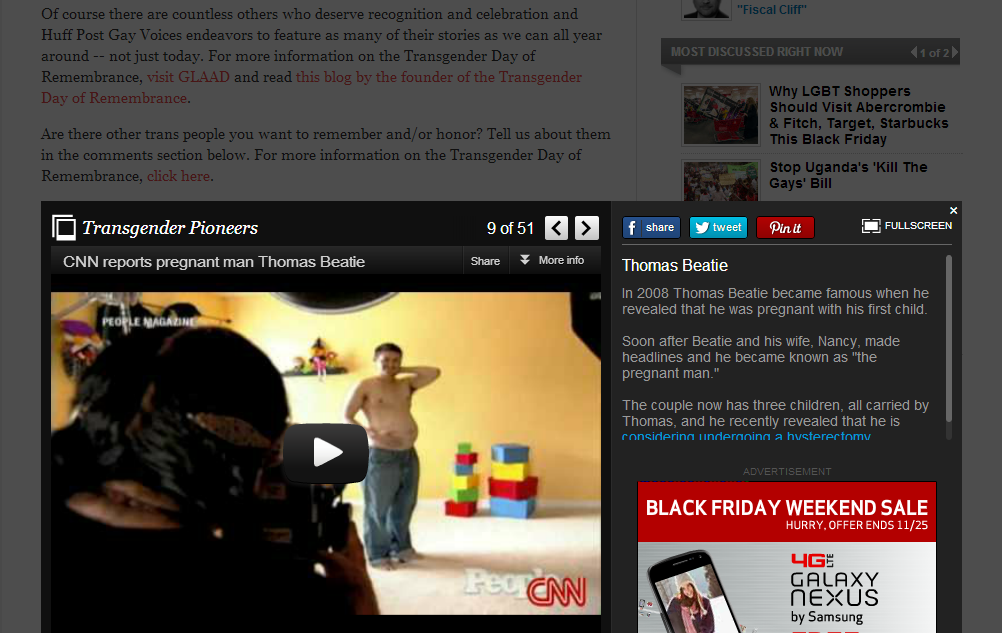
The Transgender Day of Remembrance came around last week, and to commemorate the day several web sites ran articles about transgender people, but not necessarily with regard to the individuals who died due to violence or suicide. The Huffington Post, for one, ran a list of photos of “transgender pioneers” which for many people in the trans community, myself included, seemed an odd way to memorialize murdered people. Was the intent to offer our most stellar examples of humanity for the nontrans masses so that they could learn more about us? To contextualize the extremely stark statistics about hate crimes? Or did the list of 50 “pioneers” distract from a more helpful conversation about marginalization and the media’s avoidance of these stories and lives?

So I offer instead a better list of outstanding transgender and transsexual and genderqueer individuals. While there were some in the list on Huff Post (and why, by the way, is the column called “Gay Voices” when it encompasses LGBT-spectrum topics?) who are known for being inspirational, or who really did pave the way for others, there are several people included who are really only known for being media hogs, or who have a history of problematic behavior or comments. If we’re going to celebrate people in the transgender community why not make a list of people engaged in social justice work, progressive arts and publishing, and health care? Read More…

How to Get Through Thanksgiving Without Overly Gendering Everything

It’s one thing to recognize I’ve reached adulthood, but it’s quite another to be able to look back over many, many years and see that the threshold was crossed quite a long time ago. I’ve now got under my belt a large swath of experiences that have pointed in the direction of today. When it comes to Thanksgiving, I’ve learned to perfect my turkey preparation, just one of many aspects to the day that are now part and parcel of the holiday for me.

I’ve also gotten attached to a certain table setting for Thanksgiving, and to having the Macy’s Day Parade on in the background as I cook, which let me just say really sucks for people in the Pacific Time Zone. For those of us who grow up with Thanksgiving through our childhood and into adulthood, we have expectations around something that happens in that day. Eating the crappy green bean casserole, or at least having it on the table, arguing about who sits where, making a particular holiday cookie, there’s always something.

Also in my personal history is the need to dress up. It’s a formalish dinner, with the special china laid out and the polished silver on the fancy schmancy tablecloth. Mom would even enlist me in ironing the napkins, which of course I hated but which of course she hated worse. Which is why the job fell on me. (Remind me sometime to tell you about the enormous Jabba the Hut pile of ironing in the downstairs laundry.)

Now then, dress up often meant dress, which by the time I’d reached adolescence was more often a clean sweater and khakis, but my point, as obtuse as I’ve made it, is this: Thanksgiving is a gendered experience. Who sits on the couch, yelling at the football game, and who is in the kitchen prepping the meal. Who does the dishes afterward, who carves the turkey, there are many moments throughout the day that tell us something about gender roles and expectations.

Now that Emile is more aware of his surroundings and the relationships of the adults around him, it’s occurred to me that there are things I can do–as the adult that I am now–to help dial down some of the more sexist traditions that my culture has handed to me. There’s nothing revolutionary here, but maybe if we can make it through the next 15 Thanksgivings with less emphasis on sexist ideology, we’ll have made a small difference in the experience for our family and friends. Some of the ideas that come to mind are: Read More…