Archive | Uncategorized RSS feed for this archive

Cycles of adventure

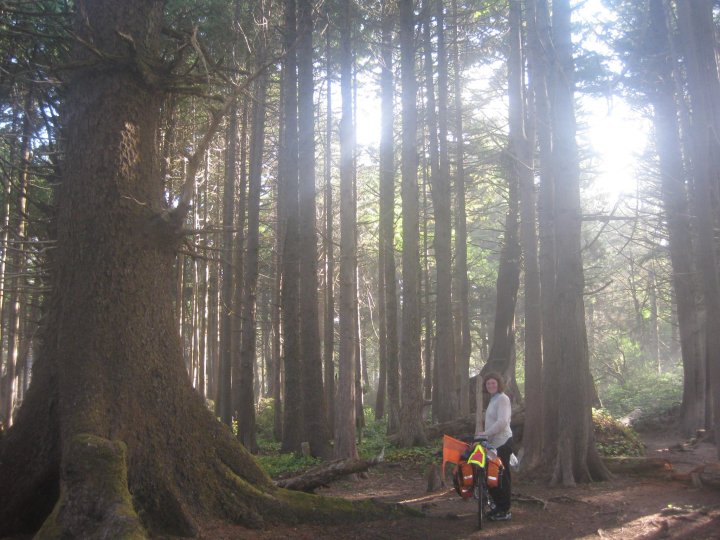
In the midst of my wild summer plans, family visits, and national park exploration, I learned that my friend, Jamie Moorby, had cycled across the US for charity, raising money for the DC Area Books to Prisons Project, which has a two-part mission: donate reading material to prisoners and educate the public about prisoner literacy. They aim to bring in reading material because many prisons do not have libraries, and the ones that do often have limited access or selection of materials. This cross-country bike ride was something Jamie and several other people participated in, ending in Oregon last month. I asked Jamie a few questions to talk about her experience.

What inspired you to cycle your way across the US, and how long have you been a long-distance cyclist?

I have dreamed of going on a long bike trip since I was a kid, but never pursued it I until this spring a friend asked me if I’d ride with her from New Orleans to the SXSW music festival in Austin Texas. I was quitting my job at a worker-owned/operated food coop in the DC area and moving to VT this summer anyway, so I said sure. Towards the end of that 10 day trip, another friend called me up and said “since you don’t have a job right now, why don’t you bike across the country with me?” I didn’t have any good reasons not to, so I agreed. Less than a month after finishing my 620 mile ride across Louisiana and Texas, we left Yorktown, VA for a 10 state, 3 month, 4,500 mile ride to Astoria, Oregon. Read More…

Link love for Sunday reading

I’ve got a lot to do this Sunday, somehow, so until my next post tomorrow (and a podcast coming up), please see some other lovely things on the Web, and have a great end of weekend:

  • There’s a great story by Cat Rambo over on the science fiction site Clarkesworld Magazine. I got to see Cat read a couple of weeks ago, and she was hilarious, not to mention talented. Definitely check out the comments after her piece.
  • Matt Davis for Salon writes about how the black diaspora caused by Hurricane Katrina hasn’t really reconstituted back in New Orleans. The city is whiter and richer than before.
  • Sara Reihani for Bitch asks us to please reconsider bossa nova as a musical styling we can enjoy.
  • There’s no new treatment for delaying or stopping Alzheimer’s symptoms once they start, say the National Institutes of Health, to the New York Times.
  • Endangered is the feeling of success when one has spent many minutes looking through the enormous Oxford English Dictionary, which is now going online-only.
  • Forget the Beck rally in DC. Min Lee writes how 80,000 people in Hong Kong marched in protest against the bus shooting in the Philippines that left 8 people dead.
  • Tension ratcheted up again as Iran withdrew its national assets from European banks, seeking to avoid expected sanctions for its nuclear program. From the Lebanese Daily Star.
  • Oh, and Tony Blair wrote a memoir.

The paper chase

On the surface, it’s easy to see how a big city like DC would differ from a small town like Walla Walla. (Hint: no tumbleweeds in DC.) And it’s probably not hard to identify areas of similarity. (They both have a lot of hot air.) And yet there are things that less identifiably, mark a place as its own, where the limitations of its geography, its people, its culture, draw lines over the topography, creating and precluding the universe as the residents know it.

Just as an example, one plucked out from the gazillions of vying possibilities, is how one disposes of large items, such as furniture. For people living in apartment buildings, trash chutes are right out, but so are Dumpster containers, usually because it’s illegal to clog them up with furnishings (mattresses may be an excepted item in some cases). In DC, one is supposed to call the city waste department and set the item on the curb for pickup, when they tell one to do so. In other words, people have to schedule their own trash removal.

When we were getting ready to move out of our District apartment and relocate across the entire country, we made a decision to leave behind a chair and some of our crappy IKEA furniture (sorry IKEA, but it’s true; your designers have never met a particleboard they didn’t like). The pressed wood collection could get broken down and put in the Dumpster, so that wasn’t a big deal, but we had an upholstered chair that wouldn’t be coming, either, and that was too damaged to sell at our yard sale. This thing, while still comfortable, really had been tasked as a collection spot for whatever clothes I stepped out of at the end of the day but that were still clean enough to wear another time. I hate that gray area of clothing, by the way. I’d rather my outfits smell only of detergent and not be mixed up with my vague scent, whatever the hell that is, and the odors of wherever I’ve been that day. Generally speaking, I don’t need any memory of deep-dish pizza three days after I’ve made the mistake of consuming it.
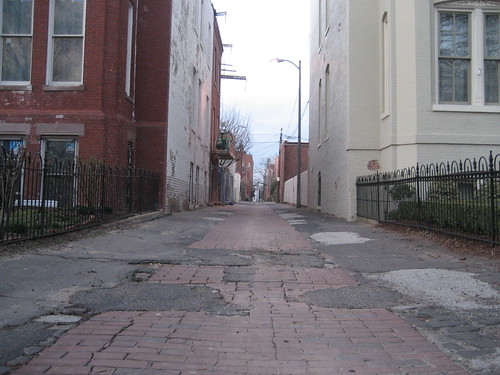
I called the city waste department, as I was legally obligated to do so, and told them I had a chair to discard. I wasn’t expecting them to be happy about it, but the clerk on the phone seemed pleased enough that anyone gave enough of a crap to follow the city procedure. She gave me a date with chair death and I marked my calendar. So imagine my surprise when I headed out to my car for work the next morning after setting out the poor chair.

There was a note pinned to it. A nastygram, for me.

I don’t remember much what it said anymore, but it was angry, and reading it made me angry, too. It was a magnet to angry—something about me needing to take the chair to the garbage container in the back of the building and not littering here on the street. I looked around. The chair was still on the grass—the treelawn, as Ohioans call it—so it wasn’t impeding any sidewalk traffic. It certainly wasn’t littering. And the note, such as it was, held illegal instructions. Certainly I could clear this up with just a little edification-slash-clarifications. “Cations” were definitely needed here.

Already called for DC Waste to pick up. Leaving in Dumpster is illegal in DC.

Inside of three minutes and the horrible crawl toward my office, I forgot all about the pissed off note.

I came home and the chair was still there, even though the garbage had been cleared. Maybe DC didn’t have enough room in their truck? It had rained at some point that day, and the chair looked particularly forlorn. It also still had its note with my addendum, but it now bore a new codicil:

Move this fucking chair to the garbage.

Whoa. Seriously, I couldn’t believe someone would throw a gasket over this. All of the trials in the world and this little off-white, ugly flower print chair is the cause of such distress? How about the tsunami victims? That we were in Iraq, killing and dying by the thousands? How about Robert Downey Jr.’s drug troubles? Go tilt at those windmills, angry person! And I had already said leaving it in the Dumpster wasn’t kosher. I looked around at the windows to my apartment building and the one across from us, with which we shared a walkway off the street. Paranoia crept into my arteries, flooding my brain with terrible ideas, and the fear that they were watching me right now, read their evil missive. It was like a Poe story, and I could hear my own blood flow. I reached for a pen in my bag, and wrote on the wet paper about what they could do with and to themselves.

A couple of mornings later, the chair had been thrown in the Dumpster. DC came along and took all of it with their next pickup. I had been totally irrelevant to the process, whatever process there was. But I did take it as a sign that it was time to leave DC.

Fastforward to our stint here in Seattle. It is a continent away from DC. The drivers in each commute of the day are just as awful, and hampered by a strange stitching of on ramps and exits that make I-5 more of a crawling experience than a commuting one. But overall the people are much less prone to being nasty and uptight. Although it’s counter-intuitive, it seems to be due in part to all the caffeine they consume here, but I’m not an expert, of course.

Twelve days into living here, our phone rang, and it was the circulation department of the Seattle Times newspaper. Now, I am a big fan of newspapers, because they’re active organizations that don’t know they’re extinct yet. I’ve also stood in front of the old Washington Post presses on H Street—they’re no longer there, sorry to say—and to watch a newspaper press the size of a city block is an experience every person should have, because it is amazing. It’s the real steampunk, right there: all those knobs and cylinders and gears and moving metal, each part producing its own little noise that together, creates a symphony of sound and then! Then there is a folded series of paper all together, at the end.

I also firmly believe that reading a city’s paper is to catch a glimpse of what that city is about. Of course things are prioritized by editors and reporters, but what there is to tell comes out of the city itself, which people are here and which words they emanate, and why these stories were picked for the telling—I enjoy parsing through all of that. And then I’ll hunt for the unsaid and the untold, and the alternative version. But I do like to start with the paper.

So I said yes to the caller, send me your paper at the Sunday price only, and I’ll be happy to add a tick mark to your sales for the week. I gave him the address, he who now sounded really super pleased that somebody said yes to him, and to the frown on the face of my wife, who would never read a newspaper on actual paper if she could read it online for free. I don’t think she ever watched the WP press machine.

Now then, I’ve been staying up late these days, writing, getting in my daily dose of Bejeweled Blitz, and reading up on the publishing market, so I haven’t been waking very early. Maybe 8:30 or 9. Then I’m banging out blog posts, checking through email, doing my grant writing work, and later, taking my shower, probably around 10 or 11. I write all of this down not so my mother will know when it isn’t a good time to call, but to explain that for the betterment of the common area in my apartment building, I like to stay inside until I’m freshened up, or at least showered and smelling vaguely of pizza. So I might not reach for the Seattle Times until noon.

Three times now, it hasn’t been out there. Someone has been stealing my paper.

When I realized this, I took some time to digest it. For some while, people have been living here and making their way with no physical newspaper in their midst. Nobody gets the Times except me, because only one ever appears (I have been up early enough to hear the delivery on a couple of days). So for all these many weeks, months, and years, people have gone about their business, and then one day, a newspaper shows up. What about that change in their universe tells them it’s okay to abscond with it? It clearly isn’t theirs. On what basis or set of expectations that I don’t know about do they then make off with my paper?

I felt the sting of that angry chair note all over again. It seized me, like a masked marauder, demanding my negative emotion, and I handed gobs of it over. Thinking about what I would do all day, yesterday, my chance spoiled for knowing what wine Seattlites were talking about, the list of Wednesday night movie times all over the city, the latest comic from Non Sequitur, I glowered and grumbled, and finally, at long last, wrote a note. And I was, in my opinion, beyond polite:

Please stop stealing my paper. If you want one, you should subscribe. Thanks.

I said please and thank you. I was moderately shaming, yes, but I gave the thief another option for better behavior (subscribing) and I gave a thumbs up to the circulation department (subscribing again). I hoped this wouldn’t start another feud. I taped my note to the front door at 9:30PM, then sneaked back into my apartment.

This morning, I got up at 8, threw on some sweats and a ball cap, and went to the door, trying not to flinch in anticipation of anger magnet.

The sign was gone. My paper was there.

This is Seattle.
How not to pitch an agent

Call me Captain Obvious, but after reading a lot—and I mean a LOT—of advice about face-to-face pitching story ideas to agents, I wasn’t quite sure how to go about it when the time really came due. So much of it was contradictory, or impossible to do at once, or over the top, or not applicable. So here is my list, after taking myself to my first writer’s conference, of what not to do, as obvious as some of these items may seem. I’m not saying I did these things, but I or someone I noticed did each of the things in this list.

  1. Don’t use your pitch time or session for anything other than your finished work. They want to think you’re really into the thing you’ve written, and hello, you need to show you’re a closer and can finish a project.
  2. Don’t get so into memorizing your pitch that you’re a nervous wreck when you sit down to pitch. I’m going to put on my usability evaluator’s hat and remind folks that we humans hear differently than we read. A few interesting words are fine, but agents aren’t going to dissect your perfect language by ear. I like the notecard approach, personally. You know your project, be confident you’ll advocate for it well, and leave the memorization to the . . . memorizers.
  3. Don’t leave at the last minute to go to your pitch session. I don’t see how huffing and puffing and wiping sweat off one’s brow emits a glow of success. As I’m a classic overthinker, I also need to not give too much ramp-up time to myself, or I’ll work myself into a different kind of stress aura. Ten minutes beforehand to leave the workshop session, etc., is perfect.
  4. Don’t waste your pitch time blowing smoke up the agent’s ass. They have to endure this so often some may have mounted smoke detectors inside their underwear. Which I guess would make it hard to sit, but that’s not the point. I think there’s a middle range agents like to see—where the writer knows a bit about their client list and book selections, and can compare their work with each. But there’s no point to looking like a stalker-in-waiting. That’s just freaky.
  5. Don’t be an island unto yourself. Agents and editors and everyone in the book publishing business expects that writers are good readers—that we have knowledge of the other books in our genre of interest, that we know how to avoid duplicating other well known (or even somewhat known) plots and characters, that we want to contribute to the literature generally. Acting like we’ve been so well holed up in our literary caves that we don’t know what’s going on in the field won’t play well once the agent asks herself how we’ll market ourselves, because the answer will come back that we’ll look like asses.
  6. For email queries, don’t rush querying. I know, I finished my memoir and went straight to the “How to Query an Agent” blogs and books. It was like a hot potato in my pocket, that manuscript. Hey, I have big pockets, okay? Go back and make it tighter. Hack out sections that really don’t need to be there. Let it sit in the drawer for a while and in the meantime, go fishing, catch a movie or *gasp* read a book. When you finally sit down, after all of that, to write your query letter, spend some quality time with it. What was the point in writing the best book ever if you’re just going to send out a half-baked query? The query is the singer of the band—the bassist may be great, but very few people will get past poor singing to notice the bass.
  7. If an agent says no, leave them be and don’t hound them. One agent at the conference I attended says she receives the same query every day, starting more than a year ago. She’s never going to say yes to this person’s project. While that may be an extreme example, it’s a good reminder to respect an agent’s no. Keep refining your pitch and researching which other agents might be better advocates for your work.

I say all this in the midst of getting turned down for representation after the same agent asked for my partial manuscript, book proposal, and then full manuscript. That’s a long way to go in the process just to be rejected. It’s not easy, for sure, but I tell myself that if my project didn’t have any merit, I wouldn’t have heard back from anyone, much less the half dozen who’ve shown interest. And at least I know now that I should cut it down to about 80,000 words. It may be my baby, but heck, I’m trying to sell my baby, so who am I to complain about cutting it a little?

Okay, bad metaphor there. I do not encourage traumatizing babies, let me just point that out.

Writers, put yourselves out there. Keep pushing to be better. One of these agents, one of these days, is going to say yes.

Writing non fiction book proposals: Rita Rosenkranz

One of the presentations at PNWA this past weekend focused on writing non fiction book proposals, those business-side documents that outline what the market is for a non fiction title and the pitch on why this new idea will sell, sell, sell. Rita Rosenkranz, one of the agents at this year’s conference, presented. I missed the first 15 minutes at an editor’s session, but here are my notes for the rest of her talk. While I’d learned much of this by making mistakes over the past year, I also found a lot of new information that I think will be really helpful for future projects.

What to put in your non fiction book proposal:

On the cover page:

  • Title
  • Book Proposal at top
  • Subtitle
  • Author info lower right or left hand corner—don’t bury the contact info.

Follow the file format the agent asks for.

Table of Contents (TOC) page—all the sections of the proposal with page numbers

The Overview—should make a case for the book and author showing how it meets a need on the publishing market. Create context for the book. What is the argument for the book. Why does this book need to be? It should not feel generic. It should be about a page, maybe a page and a half. Make sure that you’re not overwriting. Outline your social context that makes the book attractive to a market. Identi the market as well as you can, but don’t overreach or the agent won’t trust you. Talk about what’s practical and what you can control. Know how long it will take you to complete the work, and say it.

Qualifications—personal experience, professional expier., history as a public speaker.

Competition—would the editor agree with your opinion? How will the receiver review your work? What other books are in this market? Look at Amazon to see if your book has merit. You may see all the other books and worry your market is saturated. You have to make an honest case for your book and the reasons you’re particularly suited to write this book. List competing titles by title, publisher, year, and price. Include a description of the strengths and weaknesses of it. What is your twist? How will your book sell differently? Give about a page and half. The summaries should be concise, not long-winded. Different categories will require different time spans you’ll have to go back. Some books are old but still very ore sent in the marketplace.

Audience—be clear about your intended audience, even if it includes cross over. Is it a niche readership, and can you lifer demographics?

Marketing—will you have special sales? Will you buy quantities up front? That won’t clinch the deal, but it’s good to note. Many folks assume back room sales. What Web sites will mention your work? Are there natural tie Ins on the call dar to your work? Are there hooks to your work that could pique media interest? Are you a member of associations that could help with marketing? Could ppl you interviewed for the book help you market it? Read book marketing books. Not all marketing costs a lot of money. Put in your solid platform plan. Red hot internet publicity. Get known before the book deal.

Blurbs—get advanced blurbs for a submission if you can. Not necessary, but helpful. Quotes help attract attention to the work, requires advance planning, you must send the best version of your book to your blurb writers. Avoid using your relatives.

Include the book’s actual introduction, so you can show the voice. It should run no longer than three pages.

Book’s TOC. This sets up the body of work. It prompts a customer’s purchase. Should be comprehensive with a logical layout.

Sample chapters. Must see the first one, to show me how you frame the work and how it will welcome me. Also a key chapter that is a signature of the work, even ifi it’s chapter 20. If you have more chapters ready, let me know, so I can look at them if I want to see more. They will help me determine If I will bond with the author and will want to invest my time. You can put in a handful of graphs or illustrations if you think they’ll help make the book clear to me.

Book content—this should come at the end, since everything has been leading up to it. But don’t stress about the order of the other things.

It’s the single most important thing to sell the nonfiction book. It shows the editor what will be coming. No editor would consider an oral presentation an adequate substitution. The actual writing of the proposal is useful to yourself to work through what you’re writing, to make it the best book possible. It will help you reevaluate the work and that you’re presenting it the best way you can.

Cover letters are very important. The cover letter will show that you can communicate what the book is about, why it’s exciting. You must be adept at articulating what it is. It is your most effective advantage to getting your foot in the door. As a rule, a summary of the work. Just be clear, not lyrical. Second paragraph, about you. How are you aligned with your subject? No disconnects. Avoid saying the work is hard to describe. Don’t say you have 25 unpublished works. Manage a tone that jibes with the book. Limit yourself to one page. Include full contact Info. Don’t go on vacation the next day.

Rejections: we are all rejected, agents too. Rejections are part of our environment. What is in this letter that will help me get better? Don’t let rejection crush you. Be smart and savvy and know that rejection that tells you something is a gift. You’ll be able to get on to the job of selling your work.

Look at Amazon sales. Does the category consistently do well? Some of the numbers on amazon are misleading. Agents have bookscan, though. Just get a rough guess. Obviously bestsellers are doing well.

PNWA: Editor’s forum

I’ll start off with my notes from the Editor’s Session on the second day, since I promised them earlier. Here they are. I do of course have my own opinions threaded throughout the conversation but hello, they’re my notes, so I get to put in opinions when I want to.

JB Haleck, WindRiver, publisher. Three imprints. Christian fiction, homeschooling, blah.
Adam Wilson. Editor with Mirrorbooks, and Harlequin. Personally looking for romance suspense womens fic, also do Gina show alter. Largely women, but have some guys
Michelle Vega, Berkely Publishing Group. Penguin, crime line. Cozy mysteries, paranormal, sic fi, urban fan.
Peter Lynch, Sourcebooks. We do everything, he works adult side, memoir, history humor, hist fic, womens fic. Strong female pro tags.
Paul Dinas, Alpha Books, Idiot’s Guides. Highly formatted. Little complex. Welcome first time authors. 100 new ideas a year.
Monica Howick, Winthrop Pub. History and inspirational. General or religious market, looking to expand religious market. Also roman e and young adult.
Michelle Richter, St. Martins Press. Not corporately owned, really commercial really diverse books. Some celebrity books. Looking for memoir with strong point of view, female protag, food writing but not cook, pop science, pop culture, no Christian, not paranormal, big fan of mysteries, police proceed, cozies.
Shane Thompson, Variance Publishing. Like to get thrillers, military or special ops, YA fantasy is a new focus, sci fic. Looking for interesting voices. Pacing, plot, craft, voice. Got to have a voice. No gratuitous sex or violence or profanity. Want broad appeal. Market research shows that there is huge readership that don’t want that. Looking into ebooks.
Lynn Price, Bailer Pubs, small independent press in southern Calif. Memoir with strong social relevance. Issues that are not cliched, timeless. Not interested in the what’s hot now.
Paula Munier, of Adams Media. Not as polite as the other pubs up here. Lot of single title, in your face humor, sophomore guy humor. WTF series. 1001facts that will scare the shit out of you. Toxic Man. Why Men Love Bitches. Looking for self help, new age, YA.
Editors may love books, love the writing, but there is more to it. So what is it that gets a book in the door or gets a no?
Shane: I got a bk, read a submission, liked it, gave it to his ten yo, and said he loved it. I was sold on it. What sold me on it was moral of the story, the themes. They were real, provocative, not raw or edgy. It resonated with me and the editorial staff. When we looked at logistics of pubbing a YA fantasy when we’re not in the market there, we thought it would be too tough, building a new author at the same time. But I asked her to send us the pitch again. If you don’t find success in selling me a book today, it’s just today.
Adam: the worst thing is to get a book you love but can’t get to market right then. Some pubs are really corporatized now. Pubs are worried about the bottom line. There are a lot of pol with a lot of input. One of the worst things we can do is publish it and not support the author. We want to do this successfully, not taint an author’s numbers. We also don’t want to lose money.
Moderator: how much editing do you all do still?
Michelle R: when I get a submission I really love and I see things that need work, that’s part of the process. Plots that need work, chars that need strengthening. My job is to make it fit better I to what we do. To improve something thTs already great.
Paula: editors still really edit. A lot of first time authors need a lot of help. Development edits, line edits, copy edits, at Adams we’re all editing. Youre going to get edited, you need to get edited.
Lynn: if we get two good stories, we’re going to take the tighter one. On the other hand, we’re going to edit, if only to put it in our copy style.
Moderator: I’d rather have it be edited now than have it go I to print with problems.
Questions from the audience.
Culture of the business: how likely are any of you to call an Ed in another company and say this isn’t right for us but you may like it.
Michelle R.: it just doesn’t happen.
Lynn: I’ve done it. I ask the author first, but it’s not like they’re going to say no. I do, because I’m little.
Michelle R.: that said, editors are a very incestuous group in new York. We all know each other. So it may happen.
Q: Do you prefer direct subs or thru an agent?
Lynn: little independents like agents because they’re good vetters. If you’re coming to me directly, I don’t know you. I go to agented authors first.
JB: some really good quality works fall by the wayside. It’s a volume issue. You get three minutes of our time on the first pass. Random House gets hundreds of thous of sub,issions a year.
Paul: I welcome direct contact with authors, ESP by email. Fiction is a little bit ,ore complicated. But I like it. A lot of times their agents follow up to negotiate the deal.
Q: Explain strong social significance.
Lynn: strong social sig from history? As long as you can bridge it to modern times and show how it will continue on, then great, that gets people talking. I they not to get too limited. I also have to be able to sell it to a wide audience.
I just published a fic in a smaller house in the Midwest. But do you have speed to market thoughts about using smaller pubs?
JB: trade journals want four to six months ahead. Distribution channels take time. It’s not a printing issue. Come talk to smaller pubs if you’re an experienced author who didn’t lime bigger pubs.
Michelle R.: ouch. You need that time to build the interest a,ong the sales force. We are trying to tighten up the process, but sometimes the work suffers I’d you crash it through. Don’t wreck your book. If you’re looking for a career, doing a book a year is really tough.
Paula: for writing video game books, I’ve done it in 30 days. For crash books, first to market wins. But it does present problems.
Peter: in all kinds of houses you’re going to find great and not so great ppl to work with. Some places won’t market it right. Find the right people.
If you self publish, does that hurt the book bc first rights are gone?
Michelle R.: I worked with two docs who started self publishing and became traditionally published authors. We did follow ups with a diet guy and a cookbook guy.
Adam: it’s not as big a deal in nonfiction. It’s a harder sell with fiction. Or eds might ask, what else do you have going on?

Sunday link love

I recap some of my favorite summer-themed movies over at I Fry Mine in Butter. The good, the bad, and the ones with many teeth.

Over at Feminist Music Geek, Alyx Vesey looks at Veronica Mars, the would-be Buffy series from a few years ago.

For a link love within a link love, check out Bitch Magazine’s “On Our Radar” from this week. Very good articles from the blogosphere in there.

Tasha Fierce on her blog at Red Vinyl Shoes, looks at how President Obama is problematically deconstructed as a “half-white” man.

And for the iPad-obsessed, check out Gizmodo’s marathon review of apps.

Also find an amazing overview of teenage romance novels from long ago by the ever-talented Snarky’s Machine.

Read up and enjoy!

A new kind of stick shift

This post contains adult content.

There were a few odd moments on our 3,500-mile journey to DC, not the least of which was the “I have no guilt” stockbroker cheering on the recession in Lava Hot Springs, ID.
Then there were the children, all through Grand Teton and Yellowstone national parks. Screaming children, temper tantrum-having children, sobbing, inconsolable about something children. There was even one kid who started hitting his mother while Old Faithful was going off, because she wanted to watch it and he, apparently, wanted to do something else. Buy some moose fudge, maybe. Note to self: if my 3-year-old is hitting me or Susanne, I will need to rethink my parenting approach.

We noticed out in the wild West that many things that call themselves “hotels,” “inns,” and “suites,” are in reality, motels. If you drive up to your room’s door, it’s a motel, people. It’s okay to be a motel. Don’t worry, motel owners, that people still think Psycho when they see you. I don’t really care if it’s a motel or hotel if the inside of my rented room is nice, and free of a boil water notice (it’s happened before).

The Corn Palace, in addition to serving as basketball arena, community center, and kitsch emporium, is also a venue for corn-created ethanol gas. There were two or three displays about ethanol with some misrepresentation of corn’s value—corn is actually the toughest crop to turn into the substance, with switchgrass being one of the easiest. I also didn’t care for the subject-verb agreement of the following sentence that was in one of the displays: Guess where livestock gets their food?

Collective nouns, people! Livestock is a collective noun, like army, staff, or herd.

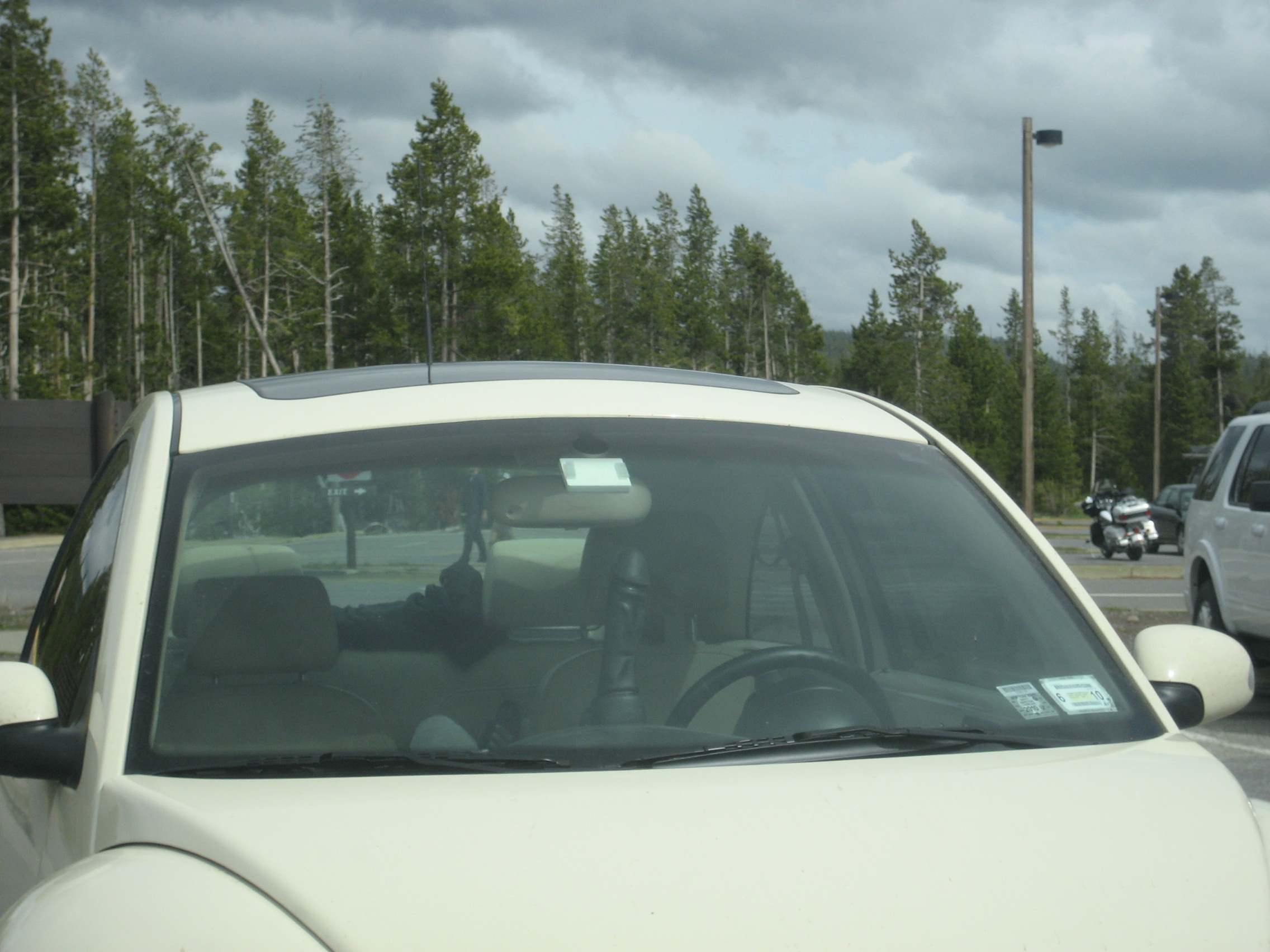
But the winner of our strange, hilarious, bizarre moments on the road belongs to whoever owns this car:

dildo on a WV dashboardThis was in the parking lot of Old Faithful. Lemme tell you about some old faithful!

I think I prefer seeing a daisy in the bug-standard flower vase.

Friday link love

Ev at the Corn PalaceI’m hitting the road again, this time on my way to the greater Washington, DC metropolitan area, and just in time for DC Pride. So in the meantime, enjoy these other nuanced and flavorful writings:

Snarky’s Machine: She takes on Eat, Pray, Love, one of the most annoying memoirs I’ve had the opportunity to listen to while driving. I didn’t even make it past Italy. And the book was about food!

Tasha Fierce over at Red Vinyl Shoes sounds off with some skepticism about news coverage of this week’s primary elections, and I always love me some skepticism.

When I feel the need to laugh long and well, I check out Go Fug Yourself, introduced to me by the supreme English professor friend of mine in Walla Walla. She knows who she is, and you don’t need to know. Just chuckle at Helena Bonham Carter’s outfit!

S.E. Smith shares my same morbid fascination for Sarah Palin, deconstructing Palin’s brand of “feminism.” Whew! I’m glad she cleared that up for us.

Over on Bitch Magazine’s blog page, later today, will be my latest entry, also on Sarah Palin (and Carly Fiorina, and Helen Thomas), and Snarky’s latest cinematique. Enjoy!

Where I write

Maybe it’s a sign of my age or limited cognitive capacity, but I do all of my thought organizing on paper, not in some computer application. It just doesn’t feel as accessible to me if I have to open a program and scroll around looking for each bit that may be important to me at that moment. Add to this that I may want to look for information in several documents or programs, and there’s no way I can fit everything on the screen. My actual writing goes into a computer, yes, but all of the character descriptions, time lines, visual ideas, and back story goes on paper. After learning the hard way that paper can run away from its owner, I now prefer that such paper be bound together with other paper and protected with covers, so I am a notebook kind of guy. And while I don’t prefer the color black for things around the house, I do like it in a notebook. It’s no nonsense and not fussy. I don’t need a Power Puff Grrl or fancy stitching to look at me every time I want to write something down. I just want to write it down.

AmPad Gold FIber notebook, Miquelrius graph-lined notebook, Moleskine notebook

These are the three I’ve used in the past seven or eight years:

  • AmPad Gold Fiber notebook—This moderately large notebook, about an inch thick, has lined pages, a bookmark ribbon, and a hardcover binding (sewn through the fold, for those who care to know). It’s been jammed in my briefcase hundreds of times now, dropped, stepped on by a small child who admittedly didn’t weigh much, and after all of this abuse, it’s held up rather well. The pages feel substantial but perhaps let a bit too much ink show through on the other side. I do tend toward roller ball and felt-tip pens these days, so perhaps I’m being a bit hard on it. But overall it’s a good sized book, I like the rounded corners and reinforced edges, and as I’m one to dog-ear a corner on purpose, like that the paper holds up to me.
  • Miquelrius graph-lined notebook—Two jobs ago I hired a woman who showed up on her first day with this notebook, and she brought it to every meeting, copiously copying down whatever we were saying in case it would prove important later. No worries, she could have written a new bible in there, it was so thick with paper. I asked her where she got it, saying I’d never seen a notebook like it, and she pointed me to the tiny bookstore in town that stocked them. They come lined, blank, and with a square graph. I picked graph because I find the light blue lines helpful but not overpowering on the page, and sometimes I write down diagrams instead of words, which I find a graph aids. My employee, on the other hand, had a blank book. That’s as daring and carefree to me as a hang glider. This notebook has two inches of paper and an impenetrable glue perfect binding. It’s got a real leather cover that survived a late-night attack from one of my cats, but it is really heavy, weighing in around 2.5 pounds. It is good at letting me sneak a business card or other paper into it and not batting an eye, but who could tell anything else was in there for all the sheets of paper?
  • Moleskine ruled pocket notebook—Straight from Hemingway to hipsters to me. This is the notebook that people tease me about, but it doesn’t just play at being pocket-sized. It really is pocket-sized. I’m not as much of a purist with this notebook; any given Moleskine in my possession will have story ideas, grocery lists, character thoughts, directions to a city hours away, and my always-evolving writing to do list. It has, of course, a bookmark ribbon and an elastic band that keeps the book shut when say, you’re on an African elephant hunt. I shudder to think of Hemingway hunting elephants. What an ass of an avocation. At least we agree on a notebook. I’m also a fan of the little pocket in the back, and I’ve used it to collect receipts while I’m at a conference, or store a business card or something until I get home. It is hard bound (thread bound, this one) with a hard leather cover and rather thick pages so there isn’t a lot of bleed-through. But I do burn through a Moleskine quickly. Must be all those directions for Portland and Seattle.