Archive | transplanted RSS feed for this archive

All alone in the moonlight

I had an epiphany yesterday, round about 2 in the afternoon, that I should be contacting LGBT agents for my memoir. Why, I wondered, have I been trying only the mainstream folks—that’s like dressing up in my nerdy best and asking out the lead cheerleader to a rodeo (no offense to cheerleaders who like nerds). Trouble was, I didn’t really know how to find them, aside from searching for them on Google, your friendly neighborhood search engine. And that approach was fraught with danger, read, the Big Bad Fraudulent Agent. Apparently, they lurk everywhere, in the corners of the interwebs, waiting to steal one’s money (I don’t have much, so I’m safe there) and ideas (hey, if they can do anything with them, more power to them!). So I figured that for every name I identified, I’d just double-check them somewhere else. This presumes, of course, that there is a long line of clearly identifiable gay, lesbian, bisexual, and transgender literary agents just lined up for writers like me.

Perhaps I was off the mark a little. Or maybe I can blame the search engine algorithm. I did get some lovely lists of agents, and then . . . then I had to do some text searches. In a list of 100+ agents, there were maybe three or four who admitted they worked with GLBT writers specifically, or who represented gay/lesbian work. This was going to take some time.

I did come up with one name, for the few hours of my effort, and I sent along a queery [sic] to her. And then it was bowling time. I made the hour-long trek, grumbling that my iPod strangely decided not to play about a quarter of the songs I’ve fed it over the years. Damn update.

My bowling mate asked me how I was doing and I said I’d figured out I should try to find GLBT agents. She gave me a look.

“See, and I thought you were all smart and stuff,” she said. I lovingly punched her in the shoulder.

I figured the hunt for an agent would be renewed in the morning. But again, it’s like looking for a four-leaf clover. I’ve already gone through the small gay presses and not heard so much as a ping back, but looking at their book releases I can see why. I don’t write about being drug-addicted, or living in San Francisco, or going through a string of abusive lovers, or being homeless, or anything else edgy. I do write about mental illness, but well, that’s been done by very good writers. I write about the wonderfulness and insanity of city living, and we all know that great writers have tackled that one, many times over. So I think to myself, well, being an Arab American formerly gay transgender professional city-turned-country dweller who survived a bout of major depression, a bad relationship, and a dozen years of Catholic school, and grew up in a mixed race and ethnicity, mixed religion household in New Jersey and somehow came out of it without a Jersey accent, well, there are some marketable things in there, somewhere.

I’ve been working on something like a short story a month, cranking out the ideas that have been crowding around for attention, and then launching into rewriting for a few versions before beginning another one. I’m sure I’ll go through and revise them again, but my point this winter was just to keep writing, identify my best simmering point of productivity, and play with all of the things I love about the craft of writing, until I either decided it was time to go back to the super/stupid power story (in which queer folks save the world) or I decided to tackle another long-form project. The superpower story needs a major rewrite/redesign, and I have to change one of the stupid powers because I really can’t allow myself to reference Dan Savage anymore, after he came out with that ridiculous column last week about the Washington State Attorney General.

I’ve got a good outline for a mystery novel I began a few years ago, and I’ve wanted for a very long time to tackle a memoir or close-to-real story about my childhood, centered on my epilepsy. Really, I’d like to try to relay the experience of having memory gaps and false memories that petit mal and grand mal seizures gave me. They each had their own strategy. The petit mal seizures (which no one calls petit mal anymore) stole time away from me, leaving me hanging in the middle of a sentence and restoring me, many seconds or half a minute later, either attempting to finish what I’d started, or leaving me disoriented about my thoughts. My mind was wracked with 90 of them a day before the doctors—who wouldn’t tell my mother what was wrong with me—got them under control.

The grand mal seizures (they’re not called that anymore, either) played a different trick. They filled in the lost time with whatever my child’s experiences could cobble together. Singing Thanksgiving carols around a grand piano my school didn’t own. Winning the Showcase Showdown in a bright orange t-shirt. Seeing buildings by Route 33 in Hightstown burn to the ground and feeling, really feeling, the thick wave of heat it gave off. I’ve spent hundreds of hours thinking about this book, even as the gender change story was more urgent for the telling of it. I want to write this book in a way that isn’t trite or cliche. Agents apparently loathe book openings with dream sequences, but darn it, false memories aren’t dreams. They’re closer to near-death experiences, in the way I’ve encountered them, like reaching to a different plane or a sticking one’s face into a parallel universe for just a moment and then trying to write down everything seen. I want to write this book.

And I’ll write it even if there are no agents for it. Because writers are supposed to just push on and write.
Dead cows tell no tales

When Mom visited us last week, we tooled around town. No really, we tooled around town, on the outskirts, north, east, and west. This is surprisingly easy, because two streets this way or that, and suddenly one finds oneself in a wheat field. Or at least, we thought it was wheat. It’s been a while since my farm girl of a mother saw wheat up close, but then there she was, clambering out of the car and her head down near the ground, surveying and investigating. She could have been Jessica Fletcher scouring a crime scene.

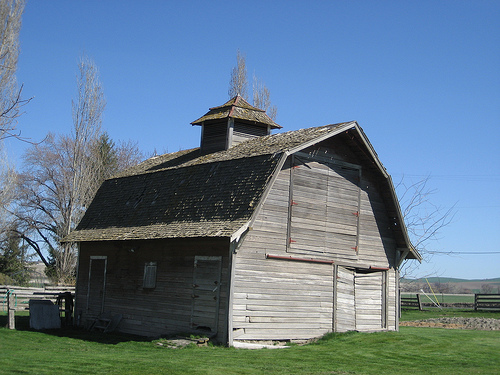
abandoned barnAs she was looking at the bright green whateveritwas, a man in a pickup truck drove by us on the dusty road. He managed to keep a tall western hat on his head, and he gave me the man nod as I waited for my parent to finish checking out the foliage. I nodded in return, but I’m not really sure why. What is the man nod supposed to mean? That I’m not here to pillage your town? That I’m in agreement on giving the most masculine salutation afforded by social expectations? It doesn’t make a lot of sense to me, even as I acknowledge that rolling down our windows to high five wouldn’t have made any more sense. But still, I nodded back at him.

She got back in her seat and announced to the two of us that in fact, it was wheat.

“I just didn’t remember it looking like grass,” she said, almost as if she really wanted to check the earth one last time, like running back into the house to make sure the oven is really, really, super turned off. We rumbled back along this road I’d never traveled, kicking up red dust behind us. We could have been a Mars rover, for all the wheat fields knew, although they were probably more certain than I was of where they came from.

We dead-ended at a T intersection, the car idling, bored, while I tried to figure out if Walla Walla was to our left or our right.

I picked right, making a guess. At noon the sun wasn’t going to give me any indication of where I headed. Where were my so familiar DC streets with their quadrant markers?

It should be noted that DC was once a small town in the midst of farms, fields, and livestock. Pierre L’Enfant liked it because of its intersection of two large waterways, the Potomac and Anacostia rivers. In that way it wasn’t very unlike what Walla Walla is now, I suppose. But certain things—population density of the East Coast, cheapness of land at the time, intentional urban planning by L’Enfant and Masons—helped DC metamorphosize into the large metropolis that it now is. Those things don’t really exist for the Wheat Farming Town that Could, even as it was the site of incorporation for the State of Washington, and its original capitol. Now Walla Walla is only big compared to Dixie, Washington, which has only a single school, and Milton-Freewater in Oregon, best known for the frog statues that run along its main thoroughfare.

So Walla Walla doesn’t need quadrants.

We drove past a farm with several head of cattle, and I saw one cow nudging its face on the still body of a calf. The baby was indeed lying at an awkward angle.

“Oh no,” I said, “I think that calf died.”

Mom looked through my side window. She nodded.

“That’s so sad!”

“Well, maybe he’s just resting,” she said, patting me on my knee.

“No, really?” We’d passed them now so I couldn’t keep looking back.

“I mean, I’ve never seen a calf rest like that, but sure, maybe.”

My mother was mothering her nearly 40-year-old child who really didn’t live in the if-I-don’t-know-for-certain-it-might-not-be-real world anymore. But it was nice, for a minute, to pretend that I was still that gullible.

Sheepishness

sheep in the blue mtns.With my mother visiting for a week, I came up with an ambitious list of things to do in and around Walla Walla. The Colville Street Patisserie. Klicker’s farmer’s market and antiques. Petit Noir chocolatiers down in Milton-Freewater. Main Street and downtown. The Kirkman House, Pendleton Mills factory, Ice Burg drive-in, and the college campus. I added items on the vacation to do list never thinking about my mother’s energy levels or capacity for long car rides. Seems my tolerance for getting from Point A to Point B has expanded since we moved here, like Mercury comparing itself to the gas giant Jupiter.

Reality, at some point, was bound to take over. It had watched me with my black felt pen and growing list and chuckled quietly to itself, knowing it wouldn’t have to do much to stymie my plans.

We did make it to most things in and around town, except the museum. Something about a historic house with a suffrage exhibit just wasn’t grabbing my mother, who obviously takes voting for granted. She did get some sorbet at the Patisserie, and a chance to look around.

“So this is where you write,” she asked. I nodded.

“Hmm,” was her response. It’s a little difficult to ascertain what was layered into such a mouthful, but I think she approved. I know already she thinks I’m a little weird, so that’s not a big deal anymore.

We looked at items in a home furnishings store on Main Street. She told the owner everything was overpriced. I covered my face with my right hand, a 3-year-old’s response of “if I can’t see you, you can’t see me.” I explained to her that most of the shops on Main Street aren’t for Walla Wallans, they’re for the wine tourists from Seattle, the executives who like to show off to their friends about things they’ve purchased. It doesn’t make any sense to this grown-up farm girl. It just sounds like tinny silliness.

Traveling down to Milton-Freewater in Oregon, I show her the obsession they have with frogs. I can’t tell her how it started because I don’t know, and everyone I’ve asked seems not to know the origin, either. But literally every 50 yards there is another frog statue or mural.

“There’s a whole group of people out there who love frogs,” she says, and in my brain I morph it into one of those annoying Facebook statuses: There are two types of people in the world, it begins. People who love frogs, and people who don’t give a shit.

I am in the latter. Nonetheless, the frog statuary are kind of cute.

She takes a while chatting with the chocolatiers in Petit Noir, while I smile and pretend not to worry that we’re there too long. Mom thinks it’s all just nice conversation, and maybe it is, but I’m wondering if as customers, we are using our bizarre power over them to hold them hostage, all for the promise of buying $30 worth of prettily packaged product. I’ve certainly paid people to talk to me before, but there was usually some therapy or counseling going on in the exchange. And I mean that literally, not as some euphemism for “I pay prostitutes for my mental health,” so don’t go there. Mom’s back starts to ache so we head back to the car and head back to Walla Walla, leaving Pendleton unexplored.

“Is Pendleton open on Monday,” she asks.

“Pendleton’s a town, Mom.”

“I mean the mill.”

“Oh. I don’t know.”

“I know Pendleton’s a town, silly.” She laughs, in the same way I’ve taken to laughing.

We go tooling around the next day, east of town, over to Klicker’s, the strawberry pickers. I just made that up. I should sell that phrase to them for a couple of berry buckets. They’ve probably already thought of it. Mom likes the antique store, even though it’s littered with faketiques—things are made to look old, but were mass produced a few years ago. She can spot the real things easily. I pick up the handle on an old phone, the kind with a tube for a mouthpiece and two brass bells at the top like eyes, and marvel at how heavy the ear piece is.

“We had one of these on the farm,” she says, referring to Section 28, where she grew up in Saskatchewan. So the weight doesn’t surprise her. She hands it back to me and I hang it back on the hook. Immediately she flips it over. “It goes that way,” she tells me, smiling at my ignorance.

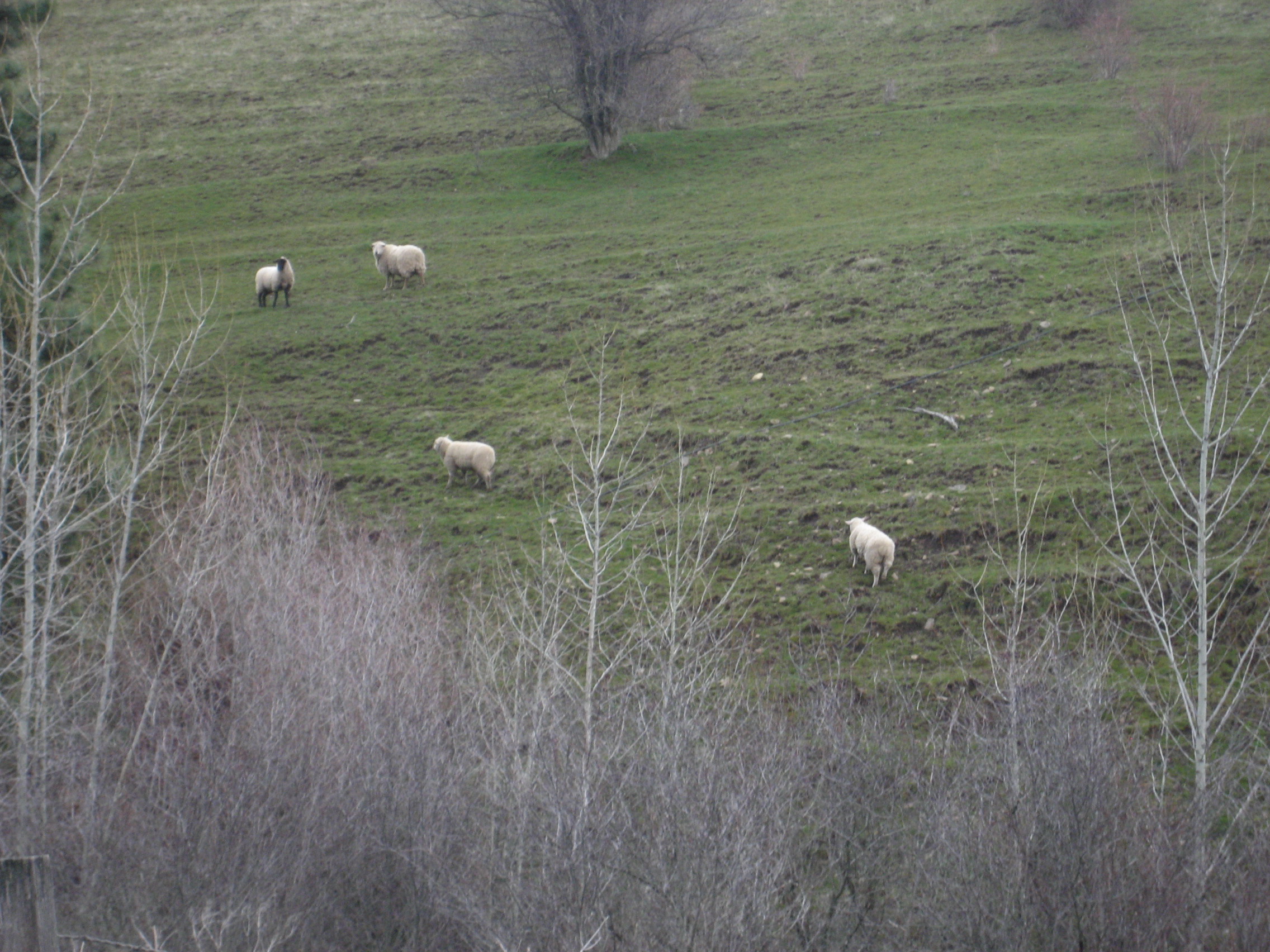
At the end of a winding road into the Blue Mountains we see sheep, and she gasps. She didn’t have any excitement for the horses or cattle or goats we’ve seen, but the sheep get her to draw a sharp intake of breath. A dog comes out onto the road, barking at us for coming too close to his house. Thirty yards away the county road stops and their private road takes over.

“My back hurts,” she says.

I say I’m sorry, I thought these bucket seats were pretty comfortable.

“It’s not the seat, it’s my back.”

I laugh, and Mom asks what I think is so funny.

“It’s not the hot coals, it’s my feet,” I say. Now she’s laughing.

“It’s not the machete, it’s my bleeding cut.” We laugh harder.

We can coast at 50 m.p.h. on the downward slope out of the mountains. We’re still laughing.

“I can try to tell Gary about this,” she says, referring to her husband, “but I think you had to be there.”

Skunk smell FTW

the bowling pins are a blurBack in DC, I bowled regularly, a.k.a. was in a bowling league. But not just any league, I was in a GAY bowling league. My colleagues had fashioned snarky team names like Men with Balls and Always in the Gutter. My team was called the Evil Bitches. This was much closer to how we wanted to see ourselves than our actual collective temperament, and there was more than one occasion when the opposing team members would shake our hands at the end of a night, only to say, “you know, you aren’t really that bitchy.” We considered changing our attitude to suit the title, but were too lazy to make it happen.

Blowing my knee out at my wedding, it was a while before I could execute my proper bowling approach and land my weight on my left leg. Seven months from my surgery, to be specific, and I felt a little unsure at first. But now the knee is comfortable. Good thing, since I joined a league again. A GAY league. Now now, there is no gay league in Walla Walla, but there is one in the Tri-Cities. This means that out of a population of 170,000 people (according to 2008 Census estimates), there are 40 gay bowlers, or GLBT bowlers, to be exact.

There are still the tongue in cheek team monikers—I’ll note here that a women’s team stole the “with Balls” phrasing in this league, Dolls with Balls—but at this point the similarities with DC’s teams cease. They are much more laid back players, classic Northwest, if you will allow me the indulgent reference. Gutter ball? No big deal! Missed the head pin? Just try again!

Trust me, I never, never saw this during my three or four years of league play in Virginia. I think people would have ejected their hearts right out of their chests if they’d had to actually say cheerleady things after bad throws.

Not that we weren’t nice out east. We just really wanted to do well, and reward greatness. We gritted our teeth after an errant ball and grunted, “next frame,” or the more desperate, “next game.” Sometimes these were followed with a half-sincere “it’s okay.” More common was the line of strikes and spares down one team’s frame, followed by cheering and high fives. There is so much high fiving in bowling that it is practically a sport within a sport.

The high fives are often done by teams who are very peppy, the kind of team that one hates to play because they’re just so in your face about their excitement, when all one wants to do is just figure out the oil pattern and throw a good rock or thirty. There’s the team that went to great expense to procure matching bowling shirts that look fantastic until you see the simply awful-looking attempt at a logo on the back. People, sometimes less is more, or at least, more easy on the eyes.

The funniest opponents are the teams who are either mad at each other that night, or who are so frustrated with their bowling that they begin taking it out on each other during the night. I can really mess with their already wobbly psyches, like telling them, almost condescendingly, that maybe this next ball will be The One, like Keanu Reeves in The Matrix. (Seriously? All hope for humankind rests on Ted Logan’s shoulders? I’ll never get over this.)

Such attempts at sinking a foundering ship don’t work in the Tri-Cities league, which is so close to the Hanford nuclear Superfund cleanup site that everything in that area begins with the prefix of “Atomic.” Atomic Muffler, Atomic Storage, and Atomic Bowl. The best part about this atomic neighborhood, in my opinion, are the little hydrogen atom graphics that accompany these buisneses, friendly little electrons that practically have a smiley face, as if the last thing they would ever dream of doing is harming anyone. Hanford, of course, is the place that created the nuclear material that the US dropped on Nagasaki. I don’t suppose those hydrogen atoms had smiley faces that day.

The folks in the Tri-Cities league are well aware of this history, and yet, they all carry on in what is basically a factory town’s final resolution, courtesy of the Department of Energy. Bowling is a release for them from their work days, to be savored and enjoyed, even if it is only a few pins knocked down at a time. For me, traveling the 50-some-odd miles from Walla Walla every week, it’s a way to be around geeky and fun gay people again, and to help string together things I’ve enjoyed before with my life out here.

It is a 50-mile drive, however, and it takes me right past the awful Boise Cascade paper mill. Last night I was relieved of the putrid odor by, of all things, a skunk. It’s saying something when dead skunk smells better than the process of turning trees into cardboard. How nice of Mr. Skunk to take one for the team.

Peach chicken noodle soup

chicken noodle soupI am a very good cook, if I do say so myself. I don’t brag often, or at least, I’ve been told not to brag, so in my attempts not to be a condescending ass, I button my lips rather than assert things I think I’ve gotten good at over the years. Perhaps it’s out of fear that someone much more gifted will be sent to my side the very moment I start posturing, and suddenly, I’ll be next to James Beard who will smile authentically, and I’ll just look like a total dipshit. And anyway, my list of things on which I have any hope of bragging is rather short.

But, at risk of sounding stuck on myself, I’ll go ahead and say I’m a good cook, and I’ve picked up a sense of tastes that go together, how to build a complex and enjoyable flavor profile, good ideas on textures and color and pacing people through several courses. I don’t have perfect skills—looking at a pile of minced onions, there is too much variation among the pieces for me to pretend at a French Culinary Institute degree. But I know the difference between minced, chopped, julienned, or rustic cut. I can make a mother sauce in the French tradition of Bechamel or Veloute, though I have no master’s sauce to compare mine, so it’s possible my vinagrette tastes like horse ass. I do presume someone would have mentioned this by now, however.

All this said, I don’t always use a recipe when I’m making something. In fact, I rarely use instructions unless it’s a cuisine I don’t know. So when Susanne, sick on the couch with a croaky voice asked for some chicken noodle soup, I said sure and headed to the basement to get some organic stock. This was only because I thought I’d used all of my homemade chicken and duck stock for a beef noodle soup I’d made earlier in the week, also to help soothe her cold. And there is nothing that doesn’t feel a little more luxurious when duck stock is added to it. Nothing culinary, that is. I don’t advise adding duck stock to say, one’s Mark Twain first edition book collection.

(Note to college students everywhere: if you are hacking up your gallbladder all over passersby on your way to class, just turn around and go back to bed. Your professors don’t like it when you make them sick or give them laryngitis.)

I chopped up some chicken tenderloin and threw it in my pot with some heated olive oil, letting it brown and crisp up a little, then deglazed the pot with one box—the last box—of stock, making a mental note to get some more from Costco next week, because well, we buy our cooking supplies in bulk. This meant I’d made about 4.5 cups of soup.

A while later I added some egg noodles and once they’d plumped up, saw that the stock had cooked down a bit too low. I just couldn’t bring myself to add water. That would kill the gorgeous balance of flavors and seasonings I’d added, not that Susanne’s palate could taste them at the moment. It has been scientifically established that chicken soup boosts one’s immune system, so what would watering it down do? Weaken it, I supposed.

Not acceptable. I opened the fridge, remembering Susanne telling me that we still had one jar of homemade stock in there—cue the little oval of Susanne over my shoulder, saying “we still have one jar of homemade stock in there,”—and I stuck my head in, looking for something beige in color, liquid, and in a mason jar.

Alas, this is not as exclusionary as I would have hoped. I smiled, seeing my target, launching my hand upon it, grasping it with my opposable thumb, my marker of humans’ dominance over this realm for the last 50,000 years, and triumphantly emerged with my prize. It did not occur to me that I should check the contents, primarily because the back of our refrigerator is like Siberia, and things only dream of decomposing there. I think there’s a member of the czar family back there. It really limits the usable space in the rest of the fridge, which is kind of annoying.

I will say that I had a moment, half a second at best, where I wondered why the jar didn’t have any fat floating on top, but that thought didn’t slow me down, not one bit. I poured in the entire jar and stirred the pot—lest I be lazy and not really combine the new contents well, or something—and put the lid back on, letting it simmer a bit more before I served any to Susanne.

Several minutes later she passed through the kitchen on her way to the bathroom and noticed that jar of the peach syrup I’d made last summer when canning peaches was sitting, empty, on the counter. Even in her sickened haze, she knew what the jar was, and lifted the lid to the soup. A unique odor of savory chicken and syrupy, peachy goodness greeted her.

She put the lid back on the pot.

I was on the couch, giggling at some news story or other. Oh, the French Canadians! Or oh, that silly Glen Beck!

“Honey,” she asked me gently, “why did you make peach chicken noodle soup?”

“What,” I asked. The poor dear, she was losing her mind. I should do more for her to get her better.

“You put the jar of peach syrup in the soup. Why did you do that?” At this point, she began chuckling.

“Oh no, did I?” I thought it was chicken stock. . . .

“Mm hmm.”

“Crap.”

She did her best and ate half a bowl, and honestly, I think it was only possible because she couldn’t taste a darn thing. For my part, I poured it down the toilet this morning. It’s not a flavor anyone needs to try. Just take my word for it.

Photo by Kevin H. from Flickr.

Northwesterners wear black in spring

This year winter was like a photo negative of last year; except for a few inches of snow in December, none has fallen on the streets of Walla Walla. The last month didn’t even bluster much, with a few days of overcast and a few days of rain, and a whole lot of days during which we didn’t ask much of the heater in the basement, so it sat there like a sleeping dragon with a chest cold, happy not to cough up any fire for us. Back out in DC all of our friends were moaning, then foaming, then apoplectic about the endless bands of snow that covered absolutely everything. They posted angry statuses on Twitter and Facebook. They took pictures as evidence. With way too much time on their hands, they made time-lapse movies of porches increasingly blanketed, forgotten toys buried, and personal vehicles inconveniently blocked in by an inconceivable amount of frozen precipitation. I watched this all from 3,200 miles away, exhaling in wonder and relief that my nonconsensual isolation in the house from 30 inches of snow and no plowing last year did not repeat itself. It would have been some kind of very cruel irony if I’d been back in DC this winter. And to everyone who had copious amounts of time with their loved ones while they were instructed to stay home, day after agonizing day, you have my sympathy.

Spring clearly has sprung around here, has been springing for a while, actually. The wineries are readying for the tourist onslaught, and people are smiling with notable more frequency, often looking at the big yellow ball in the sky, so happy for their skin to generate some vitamin D, even as their retinas fry away from the radiation.

But this is the Pacific Northwest, well, kind of, and damned if we’re not all still wearing earth tones and lots of black and gray and navy blue. We have to separate ourselves from the color of daffodils, after all, for we might confuse pollinators otherwise. It’s an ecological imperative, see. We feel that much warmer when the sun beats down on our black hoodies than if we were simply wearing a white t-shirt. There is absolutely nothing wrong with wearing a down vest over a dark gray long-sleeved shirt (or even better, a black hoodie), even if it’s 74 degrees outside because look, just over there, see the mountains? Snow on the mountains! Never mind that they’re 3,000 feet higher than us. If we can see snow, it must be cold.

Some Northwesterners complement these heavy jackets with wool socks and Birkenstock sandals. It’s actually a rather popular look, and it separates the wheat from the chaff; people with any hesitation about wearing socks and sandals together, especially with cargo shorts, have simply not lived in the PacNW long enough. People who wear this combination and live in some other geographic area, you need to put everything you can fit in your car and move out here, because you have some like-minded crazy people out here who really, really want to meet you.

Sure, we enjoy spring. We don’t want to compete with it. We’ll walk through wildflowers and scrub brush, and all the sage that survived becoming tumbleweeds over the reasonably short winter, but we’ll walk through it in ecologically friendly clothing and gear, we’ll take reusable water bottles with us, and some of us will  cover up our tracks on the way back, lest we leave anything behind that wasn’t there before we passed by. And when the temperature hits 100 degrees in June, then fine, okay, we’ll ditch the socks. But the synthetic down vest stays.

Next to the Blue Mountains is a roastery

I come here on Monday afternoons because my favorite coffee haunt is closed, but truth be told, they make a very good cup of coffee at this place, which I suppose one can achieve when one has roasted the beans that very morning. This place also has the benefit of sitting at the foothills of the Blue Mountains, so if one cares to say, type on one’s laptop outside, on say, an overcast day in which one can actually read one’s screen, one can take in the beauty of snowcapped moutains, even in July.

Walla Walla, February 2010There is a downside, namely a professor from one of the town’s institutions of higher learning who tends to date his students. He does that lean in too close to gauge your reaction thing that pushy people do. I mean, this is never directed to me, of course, given that he seems to focus on people other than fat, nearing-middle-age men who wear wedding bands. I feel like I’ve dodged a bullet, I suppose. But he absolutely flees my presence whenever I show up. I’ve never said one word to him, though I’ve heard several of his conversations with coeds. One time, at the start of the fall semester, a newly minted alum sat across from him, at the table next to me.

“I’m so glad we waited,” she cooed, not nearly enough under her breath.

“I’m so glad you’re here.” He has, it goes without saying, unwavering eye contact. Their hands were mere inches from each other, teasing at touching.

“Summer took so long,” she said, and I felt a shudder of uncomfortableness go through me. “But it’s so worth it.”

“You packed everything,” he asked. My mind, against my will, flashed to a pill container of ecstasy, some bright pink rope, and a French maid’s outfit. I cursed myself for forgoing my iPod that day. I would have listened to anything to drown them out: metalhead, steampunk. Slam poetry. And I really detest slam poetry.

Before I was an unwilling witness to this grotesquery of a dating lead-in, he didn’t really notice me if we were in the same space. But since then, he has absolutely fled the room when I come in, or if I’m somewhere ahead of him, he doesn’t stay for long. I wonder if I’ve raised one too many eyebrows or if he realized I was disgusted by his machinations with the barely-legal set. I don’t speak to him, so I don’t know.

A few months ago I decided to conduct a decidedly not scientific experiment to see if maybe we were just two ill-timed ships attempting to pass in the night, like the Andrea Doria and the Stockholm. Well, that didn’t go so well, I suppose. But, I thought, perhaps this was just a schedule conflict. And seeing as I have this amazingly flexible schedule, well, why not sneak a peek into some kind of insight?

I have thus showed up at the roastery at 11am, noon, 1pm, and 2pm. And each time I come in, if he’s here before me or comes in after, he stays an average of 14 minutes and then skeedaddles. Sometimes he’s had to gulp down his beverage, other times he seemed to be blithely carrying on, typing into his laptop or grading papers. But in each case, he was gone, usually less than a quarter hour later.

I’m not sure what this is about. I don’t think of myself as an intimidating figure, in my Merrel sneakers and comfortable hoodie that continually proclaims “Capitol Hill”, confusing anyone from that Seattle neighborhood. (It’s for the other Capitol Hill, FYI.) Maybe he’s embarrassed that I heard him that day, which means he knows what he’s doing is wrong. Or perhaps I’m just so handsome he figures he has no chance with a pretty girl if I’m even in his vicinty, and the idea that he’s cock-fighting with me nearly drives me into peals of hysterical laughter.

Anyway, he’s around so often when I’m writing that I’m a little concerned he’s going to make it into one of my stories, or that sexual predatory-ness will become some kind of unconscious theme in my work, and then people will be wondering about me, not him.

And then, at long last, the terrorists will have won. Damn it.

Garbage in, more garbage in

Nobody I know spends much time talking or thinking about garbage. Sure, there’s the nice abstract “I’m against landfills/I’m so green I’m Kermit” comment that comes up now and again, mostly when people have drunk a bit of locally produced wine and someone brings up Hummers, disposable diapers, or plastic shopping bags. And then there are the avid composters, which out here are more common than say, in northeast DC, where one has, on average, enough space to compost as a couple of used coffee filters and some uneaten toast crust. Although on a side note let’s recall that there have been not one, but two, compost fires in Walla Walla in the last three years, as the sun really starts cranking out the gamma rays midsummer, so while we may have space aplenty, we still need to consider safety. You hear that, compost-people?

But garbage needs its due consideration beyond knowing when one’s household garbage pick-up day is. What can’t go into the garbage? What should be recycled? What needs to be taken directly to a landfill, and how should one dispose of unused medication?

I’m not saying I know the answers to all of these (I do know that you fill up the medicine bottle with water, let the pills dissolve, and then throw it in the trash once it’s become a solid mass), but neither do my neighbors. And not even my neighbors—I’m speaking more of the endless stream of people who drive up to the recycling center across the alley from us, looking confused at the locked gate. These people intentionally put cardboard, old cans, and 13 gazillion empty wine bottles into their car, only to find the center closed. This is because the recycling center at the college is only open from 8 in the morning until noon, Monday through Friday. Certainly this is for the general public’s convenience, because who is busy then?

I presume people don’t know about garbage (and its more popular cousin, recyclables) because this is where they do something that makes absolutely no sense to me whatsoever:

They see the locked, 6-foot, chain link fence, and they walk across the alley to our house, and throw their recycling in our personal bin.

This makes me lose my mind. I find it soon after, little bits of gravel and dust clinging to it as it cowers in a corner next to the non-functional air conditioner, but I lose it nonetheless.

And not only do they dump their recycling, they dump their illegal recycling. This tells me a couple of things:

1. They’re not reading the instructions on the recycling bin

2. They’re not reading the instructions on the bin because they either can’t be bothered, or they know they’re doing something wrong.

I began trying to dissuade these cardboard interlopers and trespassers in much the way I used to try to keep deer out of my vegetable garden in New York. I put down dog hair. Okay, I didn’t put dog hair on the gravel, but I’ve tried moving the bins. And when that didn’t work, I put the car right next to the bins, sacrificing space to swing the door open, and making it so that on Wednesdays, the day before pick up, I’d come nose-to-stench with the garbage bucket each time I left the house or came home. Still, they contorted themselves around the private car in the private driveway to the private recycling bin, across the alley from the space declaring itself available (if not open) for their discardement. Faced with other people’s castoff glass, which is fine to recycle at the center but not in the weekly city pickup, I’m faced with a choice I don’t want. I can pick out their glass and take their recycling to the center, 40 feet from my kitchen, or I can leave it in the bin and get chastised by the recycling crew.

All of my determent failed last week, and the bin nearly didn’t close from all of the crap stuffed inside. I fumed. Susanne fumed. I picked up my mind again, brushing it off and promising it better, brighter days. Grabbing a marker from my office upstairs, I formulated two signs, one for each bin.

FOR USE BY

RESIDENTS OF

37 MERRIAM

ONLY

Maybe that would get through to them.

Unfortunately, I put these signs on the bins the day before trash and recycling pickup, so this morning, I was met with a scrawled note from the recycling  pickup staff, telling me NO GLASS.

It’s not me, I cried to nobody. I take my glass to the recycling center! I am abiding your rules! I just don’t want to touch other people’s crap! Please don’t make me touch other people’s crap!

A squirrel on the front lawn looked at me quizzically. I hissed at it.

Hopefully the signs in big, bold letters will work for us.

If not, I’m buying locks next week. Or I’ll fit the bins with an exploding Jack in the Box. That’ll show ’em.

Cows on the wrong side of the fence

There’s nothing like reading the newspaper of a quiet farming town to make one feel like their own tiny city is a bustling metropolis of activity. The rag in Dayton, Washington, for example, seems to have composed its crime section from the entirety of phone calls to its police office. The headlines read like some bizarre melding of David Lynch and Dave Barry:

Lotion Squirted on Car, No Suspects

Dead Skunk Still Lying on Patit Rd

Cow on Wrong Side of Fence

If I lived in Dayton, I’d be tempted to pull my own pranks and then call them in as complaints.

“Hey, those crazy kids dumped a mess of cow manure on the mayor’s truck again.” *click* And a few days afterward, I could scour the paper to see if I’d made the crime section.

My other idea is to replicate some of the news bits over here in Walla Walla, picking up as many of the details as possible so the police force won’t suspect a copycat. But maybe it would be like all of those television crime dramas, and I’d be foiled either by confessing to the drone of some low, ominous cello, or I’d like, use the wrong brand of lotion.

“We left out that the lotion used in Dayton was Avon Skin So Soft,” the detective would growl at me. “You used Aveda rosemary mint, so we knew you were just trying to fool us. The question is . . . why.”

Okay, who am I kidding? This county doesn’t have enough money to drive the plow it owns to clear 30 inches of snow from five main roads in town, they’re not going to do some molecular analysis of skin lotion.

But hey, good cops would know to use their noses.

My ruminations aside, I have learned a few lessons this week, one of which of course is not to commit crime. Okay, perhaps I learned that lesson at 7, when I stole a remarkably cute stuffed animal from a Hallmark store and my mother caught me in the parking lot and made me take it inside to tell the proprietor that I was a thief. Three or four bats of my big brown eyes and she crumbled, saying I could have the little orange donkey if I wanted it. My mother was outraged. How was I going to learn this important life lesson if I could just flirt with older women and get away with anything? And thus it was that I determined that the life lesson was to flirt with older women to get away with most anything.

It’s Friday and I’m rambling. My point is, I’ve learned a few things this week. Specifically:

1. No matter how much it annoys one, one should not attempt to remove overly long nose hair with needlenosed pliers or superiorly sharpened scissors.

2. No espresso drinks after 2PM.

3. Be careful when teaching one’s friends’ children cute little sayings. For example, teaching a child of 22 months to say, “Oh, snap!” may in fact result in the child enunciating “Oh, shit!” (Apologies to my friends’ children’s playmates’ parents.)

4. Be aware that the older the man, the more dedicated he is to his science fiction hobby, and the far less he is to his own personal hygiene. This is especially useful to remember when attempting to look for books at a local organization book sale.

5. Lots of food tastes great going down but makes one miserable later. It’s helpful to know which foods are on one’s own list, so that when out in public one can at least plan for sudden moments of abdominal pain and wincing.

From the mouths of babes

I have known the little baby Akio since he was six weeks old, no bigger than a loaf of bread and cute as the dickens. As his mother is another professor at the college here, I would take him while she had class, little babysitting increments of an hour or two. Longtime readers of this blog may remember a post last May in which after several incident-free babysitting appointments, he let loose with a firestorm of explosive poo. Nonetheless, our relationship continued, and he continued to grow and learn and bond with the village around him. At eleven months now, he is an expert crab-crawler, enjoys clapping, babbling, and long walks on the beach. Okay, scratch that last item. But I’m sure he’ll enjoy that some day.

While I was happy to help out Akio and his mother last spring, she hasn’t needed my support in many months. But we still see them on a regular basis. So she was apologetic when she emailed last week to see if I could sit him for just one hour while she went to a late afternoon meeting of the faculty. Oh, no problem, I said, and to help her feel better (and enjoy her company) I told her she and the little one should stay for supper. I could throw a chicken in the oven before assuming sitting duties, and then it would be ready when she came back home with Susanne.

In the meantime, since he’s now a mobile baby, I vacuumed the carpet in the living room, put the coffee table in front of the fireplace—he has previously shown an interest in logs that are alight—laid down a soft blanket on the floor, and spread out a variety of toys and plush animals so that we could have some quality time together. I do like to be on the level of an almost one-year-old when the opportunity presents itself, after all. We would have a giggling, drooling blast, I figured.

I forgot that eleven-month-olds have big time separation anxiety. It’s been a long time since I was eleven months old, see.

All went well as I opened the door. I got a big grin and saw that there are two more teeth to count. She gave him a last-minute bit of food, we checked his diaper, and found nothing notable. The three of us sat on the floor and Akio selected a green plastic Slinky as his first toy of choice. His mom quietly exited, stage front door. I asked him questions about why the Slinky. He answered me by babbling, and then turned to look to see where his mother had gone.

Four minutes. Four minutes had elapsed. And by elapsed, I mean, the child made it all of 240 seconds.

At second 241, he started sniffling and frowning. Second 243 brought on the wailing.

I put my hand in an Eeyore puppet and tried to renew his interest in either the Skinky technology or the Christopher Robin mythology. Neither of these made the cut for him. He began crab-crawling away, toward the front door.

“Okay, okay, Akio, I know it’s rough, but we have…53 minutes left, at least. What else could we do?”

He screeched in such a way as to communicate that I could go sit and spin for all he cared.

I had to think of something. I should be smarter than this, I thought. I picked him up and for one nanosecond, he relaxed a little, happy to cling onto my shirt. One nanosecond, by the way, is over before one knows it. He was back to wailing, this time much nearer my ear.  I tried bouncing him. No avail.

And so it began that “Uncle Ev” attempted a variety of tactics for trying to soothe the baby. Singing. Touring the downstairs. Flight simulation. Bottle time. Each was met with a look of complete disgust and a furtherance of crying. My heart began to melt to see him in such despair. I rechecked his diaper, burped him, and tried to tell him a story about a baby who must journey after the loss of his parents. No, wait. That’s not a good idea. And though I’d had this thought before, I started reviewing all of the little kid stories I know that involve parental death. Bambi, Cinderella, Finding Nemo, they’re all about death and grief. What’s up with that?

The baby was still crying, inconsolable. I had to do something. At this point he was a wet mess, so I grabbed a tissue and mopped up his face. He hated me for that, but really, I wasn’t sure what would happen if tears, snot, and drool all combined into one puddle. The universe could evaporate or something. It wasn’t me, I told the little one, it was for the good of the whole fabric of space-time. He continued screaming unabated. I only hoped he could channel this stamina later in life. I looked at the clock.

We were 8 minutes in. Jesus, Mary, and Joseph, I needed something to distract him. Something interesting, compelling, that would be so riveting to him that the entire concept of “missing mommy” would evaporate like a fart in a stiff breeze. I didn’t have a stroller, though I wasn’t sure if I would have used it anyway, lest I annoy the entire neighborhood with his unhappiness.

I caved in and turned on the television. I knew it was wrong of me. Bad, bad uncle! This is how it starts, out of desperation. This is why that Baby Einstein crap took such hold in US households, even though it was scientifically shown to make babies stupider as a result. I flipped through the guide and found some kid’s show set in Africa, with lots of shots of lions and other safari animals.

He was entranced. I was guilty. He even let me wipe his face while he sat on my lap, mesmerized. I couldn’t believe it, and yet, I could.

I started watching the show, and then realized it had all sorts of messages I didn’t want him to see. No, no, this is too imperialist, my brain cried. It’s devoid of an understanding about race and post-colonial Africa, even as it’s preaching about conservation and wildlife protection! These issues aren’t this simple, and it’s not for Westerners to tell citizens of African nations how to balance an economic incentive with global warming and species protection concerns! No!

But oh, how he loved it. I was selling out for the price of twenty minutes of happiness.

He picked up the Slinky in my hand, starting to babble again and looking content and happy. And then I made a rookie mistake.

I put him back on the blanket so he could play. This reminded him, of course, of turning around and not seeing his mother, which made him realize, all over again, that she was GONE. G-O-N-E. Maybe forever. And here he was stuck with a stupid person, for the rest of his life, who clearly didn’t know the difference between African diaspora politics and children’s entertainment.

The wailing began anew. I tried the bottle again. He threw it back at me. I turned off the TV, figuring I’d done enough damage.

He looked a little bit like the Staypuff Marshmallow Man at the end of Ghostbusters when he realizes he is not among friends. His entire chubby face had twisted into a knot of anguish and anger. I picked him up again and showed him all the pictures of the little people we know. I put him in front of a mirror, since he likes to see himself and the room in reflection. This made him realize all the more how incredibly unhappy he was.

We went into the kitchen, and I attempted to see if tiny chunks of tofu would make his day. They did not.

Just then, the wagon man came into view, with a fresh batch of cardboard to recycle. Akio liked this. He started to settle down, crying only every few seconds, almost like a hiccup. I gave him some commentary to go along with the wagon man’s activity.

“Okay, and now he’ll throw this piece of cardboard over the fence. Ooh, look at it go, Akio. Uh, oh, he doesn’t like where it landed. I bet he squeezes behind the fence so he can pick it up and throw it again. Yup, there he goes, see? Now he’s behind the fence. Before, he was in front of the fence. In French, you say, ‘derriere la cloture,’ and ‘en face de la cloture.'”

He was tuning me out, I could tell. Heck, I wished I’d shut up, too.

He grew heavy in my arms, but I was afraid to shift him to my other side. My back began to groan, but as its version of complaining is noiseless, I ignored it.

The wagon man finished. I briefly considered throwing an egg carton and a cereal box out the window so he’d have a couple more things to throw at the recycling center. I figured I’d gone around the bend, all to keep the baby somewhat happy. We watched as once again a person important to Akio’s life left him behind. He cried.

I took him back to the couch and sat down with him, lower back pressure relieved. Ear drums, not so much. They should be home any minute, I thought, and then I worried that they’d stand around talking to all of the other 120 faculty or rather, the 75 faculty who’d gone to the meeting. I texted Susanne with my free hand.

HE REALLY MISSES MOMMY, I typed, and sent the message.

I heard Susanne’s cell phone joyfully receive the message from its location in the dining room.

I wiped his face with the 27th tissue of the afternoon.

“I’m sorry I’m teaching you to hate tissues,” I said to him. “They really are your friends.”

He was not buying any of my shit.

Finally the door opened, and my utter lack of success at entertaining Akio was made plain to his mother and my wife. She wrapped him up in her arms and began bouncing him, as only she could.

“Don’t I always come back,” she asked him. “Mommy always comes back. It’s okay.”

Behind my shoulder, Susanne petted me.

I slept like a rock that night.