Archive | Travel RSS feed for this archive

Across the continent, unlike Lewis & Clark

Boo.

On the ever-growing list of Things that Make DC and Walla Walla Different, let’s add Halloween.

Halloween in DC is hit or miss. You may get three very young trick-or-treaters in half homemade costumes with helicopter parents standing behind them, looking nervous to be out after dark with their precious ones. One gets the impression that they badgered their otherwise overprotective caretakers to let them out of the house for the promise of bite-sized waxy chocolate, and that only the most vocal, pushy kids and the most pushover adults are the ones making the trek. Or one may get no knocks at the door, even if the light is on outside, and there’s a fake ghost on the foot-wide lawn, looking especially scary next to two broken 40 ounces and one used condom—because of course context is everything. The last possibility in DC is that one will get gaggles of middle school and high school kids, all dressed in white t-shirts and torn jeans in a far reach for “zombie.” And then one has to drop the candy into their pillowcases or they’ll grab three and four bars each, causing one to run out of candy all too quickly and leaving one to cower in the corner of the kitchen, far from the front door, pretending not to be home. And that gets old fast.

In Walla Walla, trick or treating is limited to the arranged rendezvous with candy. Kids are orchestrated by well meaning adults in some central location, like a dorm on the Whitman campus, which is then decorated to communicate that for this night only, ghosts are on the prowl in the dorm that would surely, on any other day, fire up the college students’ parents to demand at least partial refunds of their room and board payments. There are also trick and treat events in some of the nursing homes in town, on a two-block strip of Main Street, etc. But house-to-house soliciting, as far as I can tell, is limited to Mormons, Seventh Day Adventists, and Jehovah’s Witnesses, and they’re not seeking confections so much as offering eternal life.

To sum it up, Susanne and I got stuck with a boatload of candy last year, and she brought it to her office in hopes of limiting the damage to our pancreases and transferring the potential dental issues to the students and staff.

We bought no candy this year, expecting that once again, only two kids will show up at our house. At that rate, I can rummage through the kitchen and come up with some Orbit gum and an old Peppermint Patty from that Thai restaurant on 9th Avenue, no worries.

In the list of differences, I went to one and only one costume party in DC, but out here in Walla Walla, they seem to be a dime a dozen. However little the children dress up to gather candy from strangers, the adults go nuts pretending to be someone else. I can’t blame them—I’d like to be someone else out here, too, other than an unemployed, has-few-prospects, wanna be novelist who is tongue in cheek running for City Council, but that’s beside the point. The point is, they like a good costume party in this town.

We went to one last Saturday and have another to attend next Saturday. Last year I wore my Eeyore costume that I had purchased in 2002 for the one and only costume party I attended in DC. It is head to toe blue fleece, complete with floppy ears, depressed looking mane, and tail held on by a few strands of string. It also includes a little press pad in the top left paw (paw!) that says alternately, “Hello, I’m Eeyore,” and “Thanks for noticing me.” The thing gets so hot that I can’t wear anything underneath it other than some boxer shorts and a tank top. We’re talking stifling—the kind of heat surrounding one’s body that gives one the urge to run outside into a blizzard or make snow angels for 3o minutes, whilst banging the paws against the ground, to the beat of “Hello, I’m Eeyore,” and “Thanks for noticing me.”

I’d agreed to lend out this costume for the party this next Saturday, not realizing that I myself was obligated to attend. I’m a little bemused that anyone else would want to dress up as Eeyore, even knowing that the costume has been worn some number of times by a sweaty man in just his boxers, but whatever. What is life without risks, anyway?

This led Susanne and me to go to the K-Mart—which we affectionately call the “Sad Mart,” because it’s so dilapidated, with few customers actually shopping (as opposed to standing in front of a sales fixture, staring mindlessly, as if the nursing home dropped them off for a few hours so they could go “outside”). We looked through the costumes that they had for sale, knowing we couldn’t repeat the Magnum, P.I. and Perry Mason outfits of last weekend. It would be like wearing the same dress to two inauguration balls!

The costume perusing quickly devolved into shock as we saw what they had stocked on the shelves. An inflatable ballerina costume, because everyone loves obese ballerinas. An inflatable ninja costume, because why not mix in a little Orientalism while we’re being fat-phobic? And then, I gasped, and Susanne rushed over to look at what I was seeing.Woman/Man costume

The Woman/Man costume. Split right down the middle. Someone had watched too much Victor/Victoria. But seriously? Who would wear that, and why?

Please notice that the Woman/Man wig is sold separately. Since it can be worn for so many other occasions. If you don’t buy the wig, what else do you wear with this albatross?

“That says a lot about something,” I said.

We moved on, giggling at the human-sized whoopi cushion costume. Alas, it did not actually make a farting noise, probably because there is no left paw for a small speaker. I suppose the idea of whoopi cushions with paws is too frightening to deal with anyway.

So, I don’t have a costume for Saturday. Maybe I’ll go as a zombie councilman. Or affix several tumbleweeds to my clothing and give people small scrapes all evening. Or I could just wear a tank top and boxers and tell people I’m wearing an invisible Eeyore costume. I’m sure any of those ideas will work.

Happy Halloween, everyone!
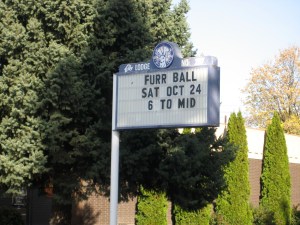
Come see our Furr Ball on Saturday

In DC, amusement was going to the National Portrait Gallery just to see Steven Colbert’s picture hanging over a water fountain next to the men’s room. In Walla Walla, anything goes. Such it is that driving by the Elks Lodge in September bestowed upon our eyeballs the following notice:

WED CHIC AND DUMP

Instructions for a short-lived marriage a la Britney Spears? What to do immediately after exchanging vows so as not to die of embarrassment after drinking too much the night before?

No. The sign is shorthand for Wednesday, Chicken and Dumplings. Such is the flavor of titillating humor in these parts.

To be sure, there are other notes of hilarity. The man who works at the muffler shop on 9th Avenue is also a folk artist, crafting human-sized and -like statues from the leftover car parts. As Drew Bledsoe of former NFL quarterbacking fame is from Walla Walla, there’s a muffler man to his honor, as well as a guy reading whilst perched on a toilet. The toilet itself is the standard porcelain contraption, and not comprised of rusty metal. And the proximity of the two is not a statement on the artist’s opinion of Bledsoe. The New York Store, which used to be downtown on Main Street and is now in “Eastgate” near the edge of town, sells western ware, an intentional misdirection known to make at least one native New Yorker burst into tears upon reading the sign. But for Walla Wallans, it’s a hoot, if not popular enough to sustain sales that can make the rent payments in the more expensive part of town.

A chiropractor in town also changes up his black-lettered sign every so often as well. These are more existential in nature, the humor only coming into play if one is already equipped with the sort of wit that would allow for a good snort after reading whatever he’s put up there.

WE’LL SCRATCH YOUR BACK SINCE YOU CAN’T SCRATCH OURS is something I would write, if I’d lost my mind and was a mad scientist chiro guy.

A colleague of Susanne’s nodded in my direction at a cocktail hour last Friday, “cocktail hour” meant in all seriousness and not as a joke, for the purposes of this blog. I greeted her with a smile.

“You’ll have to check out the Elks Lodge before Saturday,” she told me, in the same kind of tone as “Mick has some really good shit on the street right now and you better get there before it sells out.” I asked if it was camera-worthy and was assured that yes, it was.

What could surpass WED CHIC AND DUMP?

Furr Ball sign

“The furries are coming to town,” said the colleague, with fake astonishment.

“It’s like that CSI episode,” I said.

The Furr Ball, as it turns out, was a fundraiser for the local Humane Society. Paintings and other art were auctioned off at the event. One of the pieces was done by the as-yet-still-small child of a friend, and sold for $300. It must have been like something by that child prodigy that nobody believed could really paint, although now that I look at it, her work sold for $24,000. That’s probably one dollar for every homeless dog and cat in the city confines.

However, this child is better, for many reasons, I’m sure, but one of those reasons is this—she made a lawn sign for my write-in campaign for city council. She also managed, in 5 or 6 places, to include the greeting “HI” to whomever paused to read the sign, and for this, I decree that I’m glad my supporters have taken a stand against mud-slinging. Such a scourge on our democracy, those negative campaigners. Let it never be said that Everett Maroon slung any mud toward his opponents, even if he did refer to them as “jackasses” a couple of blog posts ago. That was only meant for incumbents who left the 30 inches of snow in Walla Walla unplowed last winter.

So, I suppose we try to take everything with a dash or pinch of dry humor. As opposed to wet humor. Since you know, it’s a desert.

Running for difference

Walla Walla has a City Council. This I knew before we moved here. The Mayor position is filled on a rotating basis with someone from the Council, voted on by members of the Council themselves. So the good citizens of Walla Walla don’t directly vote for a mayor. Representative government at its best?

Possibly not. I received my ballot in the mail on Friday, which I still find unsettling as a process, this whole vote by mail thing, and looked at what was on it. The Referendum 71, to keep or ditch domestic partner benefits for Washington State, and the Initiative 1033, to gut funding for programming from libraries to nursing homes, I already knew about. There are signs all over for the state representative job, so I knew I’d see that on the ballot. I’d heard a peep about the two men running for the commissioner of the Port of Walla Walla, but not much, and I’d heard absolutely nothing about the three people running unopposed for the open slots on the Council. Unopposed. All three of them.

What was this about? Were they all shoo-ins? Or did no one care who sat on the Council?

I ran to the Internet—okay, I didn’t run, seeing as my laptop was a few feet away—and looked up information on the races. Well, when I say “looked up,” I typed in a few keywords (namely, walla walla election city council 2009), and then voila, I got bupkus. Maybe on page 2. Nope. One article on the contested Port Commissioner job, and nothing else. Apparently “Walla Walla” is a link at the bottom of many pages on Washington State politics, skewing my results. Three pages into my search I gave up.

On the Walla Walla city Web site it lists the current members, and with five minutes more of digging, I found the name of the mayor, Dominic Elia. Sheesh, no need to put your names out there, folks, you’re only running the city.

So where were these people who were campaigning for positions 1, 2, and 3? What were their ideas about making the city a great place to live and work? Where did they think we need improvement? How are they prepared to handle the tax revenue issues in these difficult times? And my biggest question of all:

Why didn’t you jackasses move the snow off the streets last year?

Feeling frustrated and fanciful after inking in oval after oval on my ballot, I wrote in my own name on Position 3. Too bad for you, Daniel Johnson, who I’m sure will be elected anyway. I sealed up the envelope, avoiding the paper cut of last year, and put my poll tax—I mean, stamp—on the front.

Later that day, a friend who’d just lost her grandmother came over for some apple crisp and tea. As we were chatting, I mentioned I’d audaciously written myself in to the council, figuring I’d be right down there with Mickey Mouse and Yoda. Her reaction surprised me.

“I’m voting for you!”

“Oh, really, you don’t need to do that,” I said, waving my hands in front of me like they’d save me against her 18-wheeler of a response.

“No, I’m writing you in, and I’m telling all my friends to do it, too!”

Oh my God. How . . . how, fantastic. I mean, there’s no way I could win, what with 30,000 registered voters in the county and me knowing exactly 138 people here. So they would be throwing away a vote for one seat in an unopposed race. Low stakes. So why not tell her to shout from the Blue Mountain range if she wanted to?

I’m up to 12 votes at this point, and kind of tickled pink. Maybe I should have a motto, but everything I come up with seems to have a serious drawback:

Vote for Everett Maroon, Because Maroon Means Mayor in Arabic

Because Someone on the Council Should Be Able to Rock a Bejeweled Blitz Game

Putting Walla Walla’s Nondriscrimination Clause to Work!

He’s Even Named After a City in Washington

Because Who Cares, Really?

I may even take a picture of myself mailing in my ballot.

Swine-ing about nothing

This week the new swine flu shot is available for health care workers. For people on the front lines of what is likely to be an intense fall and winter of virus-laden illness, some people are happy for the quick availability of the vaccine, but others are chafing at the compulsory nature of the shots. I’ve seen no fewer than five articles just today on—

Excuse us, Mr. Maroon.

Yes? Who are you? I’m trying to blog here.

Hi, we’re the USDA.

Uh, hi. I need to get back to—

Yeah, um, about that blog thing you’re doing. We have a request.

Okay. What’s up?

We’d really like it if you and everyone else could please stop calling it the “swine flu.” It’s the H1N1 virus.

Well, I understand that’s the flu strain we’re talking about, but I think more people understand it as swine flu.

Sure, sure, maybe they do right now, but it’s really harming the pork industry right now.

The what?

The pork industry. People are afraid to eat pork. In these tough times, it’s making it tough for pig farmers.

I’m sorry, just so I get this straight: you, the USDA, want me and other bloggers to call it only the H1N1 virus?

That’s right.

But that actually communicates a lot less about the thing than “swine flu” does. Can you show me one pig farmer who’s gone out of business because of the phrase swine flu?

Well, no, but, that’s not the point.

But you said it was.

Well, see, it’s only part from a swine flu strain. There are also avian flu and human flu strains in the H1N1 virus.

I see.

It’s a lot more like the 1918 influenza than any swine flu.

Oh, so should we call it pandemic flu, then?

Well, no. That sounds—

Fear-instilling?

Yes.

Well, I’m glad we’re in agreement on that. But I have a question.

Yes?

Didn’t this flu originate on a pig farm?

That’s not the point.

Oh. Not the point. I see. Okay, I’m lying, I don’t see why that’s not the point.

Because it’s not just swine flu.

Can I call it Swine Flu Plus? Or Swine Flu +?

Please don’t.

Okay, okay. I’ll call it H1N1, even though I have a right to free speech. Can I get back to blogging now?

Sure, sure. Thanks for your help.

Okay, bye.

Sheesh. Okay, so anyway, while some health care workers are complaining that they’re being required to receive this vaccine, even though there’s a long history of required vaccines out there, there is a point to be made about how the H1N1 flu vaccine was rushed to market. Of course it was rushed, having only come into existence last spring. Here in Washington State, our limits on the amount of mercury makers can put into a vaccine were suspended so that producers could get them out to the public in time for flu season. H1N1 was excepted from the limit even though the vaccine is recommended for pregnant and breastfeeding mothers. This must mean that the mercury in these shots knows not to wreak any of the havoc it normally would on fetuses and newborn children. I suppose, more seriously, that they think the risks of the disease are greater than the potential effects of mercury poison, but it calls into question for me what the calculus is for what must be a high-stakes cost/benefit analysis.

For our part as general citizenry, here in Walla Walla I now see antibacterial gel everywhere: next to cash registers, in the weight room at my gym, next to the shopping carts at the grocery store, even at the concessions counter of the cinema. We are a germ-killing, germ-fearing populace, all the while as we isolate and grow the strongest germs by using these products.

Walla Wallans consider themselves an enduring lot, and happily isolated from population centers. Perhaps this gives us a sense that swine flu won’t hit us here, but we forget the global nature of everything around us. Eighteen wheelers  roll into the city everyday, visitors from Seattle and Portland come out here on the weekends to taste our wine, and people fly out of here all the time to see that civilization that exists elsewhere, picking up who knows what along the way. Can’t there be a balance between vigilance of our health and hygiene, and ignorance of the genetic makeup of the H1N1 virus? Do we need to expose our children to mercury, obfuscate what to call this virus or that, turn away from vaccines altogether because a blog somewhere on the Web insists they cause autism? Where is the voice of reason in the midst of all these conflicting messages?

All that writing made me hungry. I’m gonna go grill up some pork chops.

Rain, rain, go ahead

It hasn’t rained here since June, if my memory serves. What was a rushing stream in the spring has dwindled down to a sophomore of a creek, propelled more by the turbine at the source of it than its own volition. The campus in our part of town has run in-ground sprinklers everywhere, including our front and back lawns, so we continue to see emerald green grass everyday, even while other parts of town are blanketed in shocking states of yellowness. A few times some dark clouds have rumbled through, menacing the ground with threats of a downpour, but none have come, even when we hear thunder overhead. It’s almost as if the rain refuses to fall all the way down to us because we aren’t worthy of anything but bone dry stillness. I can almost appreciate the oddity of last winter’s incessant snow, but as the television was out of order for five weeks, almost is as good as it gets.

Susanne and I have been staring at little blue lines this past week, namely the lines on the ovulation indicator multi-packs we’ve bought. These packs were found between the KY “his and hers” jelly and the female condoms, as if the pharmacy itself was in conflict over procreation. According to the back of the box, one will see a clear blue line on the right indicating a “control” condition—showing us the indicator strip is working. If you also see a clear blue line on the left, it means you’re ovulating RIGHT NOW, so you should run to your nearest sperm producer and harness his goodness. Or you could settle down and not jump on the first available man in proximity.

The issue with the test, however, is that these lines are nowhere near as clear as the little illustrations on the box. And by nowhere near, I mean something like the distance between, say, 3rd base at Yankee Stadium and the outermost ring of Uranus. So there we were, scrying into the vast whiteness of the indicator strip, our noses precariously close to a swatch of material very recently peed upon by Susanne. Is that a line or not a line, we wondered? It’s certainly not as dark as the test line, but that line isn’t very beefy, either. So maybe we’d just pee again, “we” meaning her, and “again” meaning tomorrow. So on we went.

Same result. Next day. Same again. I looked at all three test strips in my hand. Maybe this one was darker. Maybe yesterday’s was better, or maybe not. I looked away after memorizing the potential trajectory of lutenizing hormone as documented on the indicators, and saw a big black box in the air with two impossibly thin,  yellow lines, wherever I cared to look. Dear me, I’d burned the darn things into my retinas! I was going to see hormone levels until I died now. I wondered blithely how many people have lost their sanity staring at hormone indicator strips and realized, astonished, that even one life lost to this is too many. Where was the public outcry?

Meanwhile, our impregnating friends sat in the corner of the dining room, which was an arbitrary choice, really, as neither of us were trying to make a statement about the dining room. It’s got the nicest furniture in the house, actually, so what’s not to like? According to our “vendor,” the little helpers are guaranteed to be frozen solid for at least a week, so we strung ourselves along from blinding ovulation test to blinding ovulation test, reassuring ourselves nervously that any minute now, we’d be ready for prime time.

Tick tock, went the days, which sounded something like the biological clock noise we were hearing anyway. Okay, we don’t believe in bilogical clocks, but we were watching the calendar all the same. Finally, the indicators indicated something slightly more than a ghost of a line. Would we ever see a definitive line? Where did we draw the line [sic] at saying we should try now or not? We understood intellectually that we should only expect ovulation was happening when the lines were the same width and darkness, but we also read online that some women just don’t have that huge surge, and ovulate anyway.

All bets were off. The swimmers were waiting near the head of the dining table, calling out to me in the night. We’re so cold, Everett…help us! Save us!

Neither did we want to miss the timing window nor did we want to open up the canister to a warm vial of sperm corpses. So now was the time.

“Please tell me there are instructions inside this thing,” I said, and I broke the seal and opened the lid.

Inside sat another container, this one metal, with another seal. I began wondering if I wasn’t going to find a gate to hell inside a Russian doll set of containers. Helpfully, a set of instructions was sitting on top of the inside container.

I read through them, then went to the kitchen and put on oven mitts. It was at this point that Susanne saw me, started laughing, and ran to get the camera.

Really? Our child should see these pictures someday? Can i t be the cover of our baby photo book? I pulled out the vial, at the end of a long metal stick, and watched the air around it condense and freeze in a bright white frost. We put the vial on a table mat to thaw out. Both of us came down with a case of the giggles, the likes of which we hadn’t experienced since 6th Grade sex ed class. I don’t think people understand how funny the collision is between “Catholic school” and “sex ed class,” but I always thought it was hysterical.

Fast forwarding to this morning, I called FedEx and requested they pick up the containers, and left everything out on the front stoop. I really didn’t want to have another conversation with the truck driver, in case he asked me how the animal husbandry went.

I looked up and saw dark clouds in the sky, and laughed at them. Waiting for a rain drop is like waiting for two thick blue lines around here.

Shorter than a 100 meter backstroke

Like standing on a straightaway section of train track, Susanne and I have looked ahead and known children are in our future. We’re good with it, excited at the prospect of little fingers and toes, unintentional smiles, and impromptu cooing. We’re also well aware of the all-night feedings and intense lack of sleep, followed by intense stress and a certainty that you have lost your everloving mind.

canister of fun

canister of fun

Understanding that one can’t actually plan a pregnancy, we went ahead anyway, armed with optimism and a copy of the Mayo Guide to a Healthy Pregnancy. This was better, we’d heard, than the What to Expect When You’re Expecting, which apparently should be renamed What to Fear Greatly When You’re Expecting. Fear-mongering was not going to be a part of our process. We patted ourselves on the back for our intelligence and ability to learn from our friends.

Susanne, ever the feminist, wants not to refer to the little one—when there is a little one—as an unborn child or as a baby. I asked what we should call it instead, and she immediately responded, “let’s call it my parasitic fetus.”

“Really,” I asked, not wanting to betry my own feelings on the subject, since this is her body and her pregnancy, after all.

“What? It’s a parasite, you know. It’s going to suck nutrients out of my body and grow in my abdominal cavity.”

This is true, I thought. Still, I felt it was a little negative. I kept my opinion to myself.

“Okay, honey, it’ll be our little parasite.”

“Parasitic fetus,” she corrected.

So there we were, me reading the Mayo Guide to her before bed, interjecting the phrase “parasitic fetus” or “parasite” into the text where “unborn baby” and “fetus” were written. Things got a little convoluted when I came across “child.” What could I use for “child”? In a heartbeat, I had it.

Reading aloud, I said: “Nutrition during your pregnancy can have long-term consequences for your parasitic fetus after birth.” Susanne giggled.

“It’s okay, honey,” she said, patting me on the arm. “You can just call it a baby.”

Whew. The book would have taken 14 percent longer to read.

Looking forward again, on our metaphoric train tracks, we felt some vibrations from a vehicle ahead, and knew it was time to place an order with the sperm bank. Yes, I am not a sperm-producer, so last spring and summer, we identified some candidates for the job, whittling down to two finalists: the nerdy biochemistry student and the sweet librarian. Sweet librarian won out in August, mostly due to his sentimental answers to the questionnaire and the lack of autoimmune disease in his family. We did notice, however, that having a drunk uncle is an excellent indicator that one may choose to donate sperm—nearly every family history we read showed a maternal or paternal uncle with an addiction problem. I began wondering if it wasn’t code for something else, but so far, I haven’t come up with any ulterior meaning.

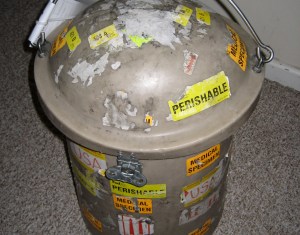
Lo and behold, the FedEx driver showed up on Thursday with our Very Special Delivery. I say “the driver,” because in Walla Walla, there is literally one FedEx Ground driver, a strapping middleaged woman with curly hair, always tied back, a body frame like a wine barrel, and a determined air. This woman could jerk and lift 300 pounds, I bet. There is also a sole FedEx Air driver, a beanpole, balding guy with wire frame glasses from the 70s and a chatty manner. He rang our doorbell. On our stoop stood a beige plastic container the shape of a Chinese mushroom, plastered with “medical specimen” and “perishable” stickers.

“Wow,” he said, clicking buttons on his electronic inventory machine, “I don’t usually deliver these to private homes.” He had a wild look in his eyes that concerned me.

“Oh,” I asked automatically, not really wanting to have this conversation.

“Yeah, I usually take them—”

Here I thought that he was going to say a fertility clinic, or something else that would make it obvious that we needed help in the getting pregnant department.

“—to a vet lab or a ranch.”

Okay. I did not anticipate that one.

“Well, we have a horse in the back yard,” I said, and I could feel Susanne cringe in the next room.

“Oh, the horse sperm container is much smaller,” he said, using his hands in a “this is much smaller” gesticulation.

He thought we’d ordered bull sperm? Seriously?

I may have, at that point, emanated more sounds in an attempt to form words, but I don’t recall much.

“You’ll open this up and find like, a tuna can in there.”

The FedEx driver was schooling me in animal husbandry. Yes, he was.

“Well thanks,” I said, picking up the container, the height of a toilet seat.

“Sure thing,” he said. “See you soon!”

Oh my God, let this happen on the first take. Please, sweet baby Jesus.

Just add water

After we picked up my sister and her girls and successfully motored back to Wallyworld, running on plenty of gasoline, we settled in for a few days’ respite before heading out again to the western part of Washington State. Our plan was to go white water rafting on the Wenatchee River in Leavenworth. Newly familiar with white water rafting since we’d done it exactly one time previously, Susanne and I were confident. My nieces had never done this before, but my sister Kathy is a pro, having rafted in West Virginia many, many times.

All we needed to do was make a 3-hour car trip to the rafting site. We’d meet up with the guides at 1 in the afternoon.

We pulled in to Leavenworth a bit early and instead of hanging out for an hour at the rafting departure site (read, bunch of old school buses by the side of Hwy. 2), we ventured into the town proper. And then we were amazed at what we saw.

It was Bavaria. Better, it was Pretend Bavaria. Everything in the town was Germanic—from the chatel-inspired McDonald’s to the lettering on the gas price signage at the Texaco. They didn’t miss a single building. This was not some half-ass attempt at reinventing the Alps the way they’ve never existed, no sir. This was a complete overhaul of what had been, 40 years ago, a desolate mining town a bit too far from Seattle to be interesting. Well, now it’s interesting, if not extremely strange in its—dare I say fascist—adherence to the Bavarian aesthetic. It was so comprehensive we had trouble finding things we wanted to find, like the pharmacy. Or the Mexican restaurant we were told to try for dinner. Just take a minute to wrap your mind around a Germanic Mexican restaurant. Yeah. Now you know what Vicodin is like.

Squandering our time on a putt-putt golf course, it was even more surreal to see the miniature version of Fake Germany. And here the height of the nieces came into wonderful relief.

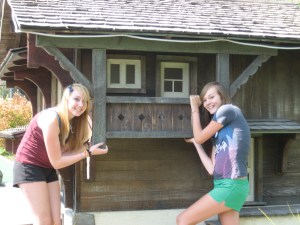
Emily and Jamie are giants

Emily and Jamie are giants

Other than the really cute buildings, I am sad to say that this mini golf course is not really worth the cost of admission. But hey, we had time on our hands.

Then it was off to the river, where we put on our lifejackets (always stinky, but they’re kind of a part of the gestalt of it all) and got a quick course in river safety. We’d been informed of safety considerations the last time we’d been rafting, too, but this time, well, there wasn’t much of a need. In August, on the Wenatchee, after a summer of heat and blue skies, we were lucky the water was up to our knees. This was not so much white water rafting as lazy river floating. I’ve seen higher waves getting into my tub. We got stuck a lot, mostly under my fat ass, as it happened. It was a pretty course, though, and stands to be a lot more active if one travels there in say, late spring.

Our guides informed us that in two days they were expecting 75 Microsoft developers, which they would spread out over 15 rafts or so. I could only imagine. Talk about a team-building exercise. They could lose half their staff on some of those thick rocks. It’s one thing to get stuck at a management retreat trying to figure out how to survive on the surface of the moon with 18 inches of twine, 27 bottle caps, and two pounds of Limburger cheese, but it’s another to actually need to paddle together. I kind of wanted to tag along to see how it would go.

But we had other adventures to conquer—taking the ferry to Victoria, the wonderful and colorful Butchart Gardens, and the idiosyncratic fish-throwing mongers of the Seattle market. Low-water rafting was just our gateway vacation event.

Down from on high

August rolled around and we were thrilled to take our honeymoon, finally, a little more than a year after getting hitched. This is fine, as it turns out, since my knee is all better and I’ve had time to rehabilitate the joint such that it doesn’t blow up like a balloon animal after short walks.

And the cruise, as already noted, was fantastic, full of animal sightings, a tour of endangered glaciers (as well as one advancing ice pack), and some funny-because-it-sucked shipboard musical performances.

Then we docked back at the Port of Seattle. This wasn’t like disembarking off of an airplane, which has its own annoyances, including the rush to ignite one’s cell phone, waiting for the dumbasses in rows 5-20 to get their bags out of the overhead compartment so you can move forward, and the lovely time wasting exercise of standing in baggage claim. No, to depart a ship, you have to give your stateroom steward your bags ahead of time, thus leaving each person in your cabin precisely one bag of toiletries, dirty clothing from the day before, and all of your valuables-slash-electronics. Then you proceed with your dirty clothing carryon to some previously assigned room, such as the drinking lounge three decks below your stateroom, so that you can wait around until your specific departure time. This departure time, other than seemingly based on how many prior cruises you’ve taken with the line, is an algorithm of the finest mathematics, calculating  your likelihood of throwing a total caniption if you’re forced to sit around next to a bag of smelly underwear for more than two hours.

Fortunately, one dining room out of five is open this morning, so feel free to stand on your head while waiting for a table.

Finally, we were off the ship, roughly at 10 o’clock. We found a cab after standing in a long taxi line, and made our way over to our car across town. One quick cup of coffee back on land and we were off—to the airport. This would have been a great time to gas up the car, but as is my neurotic need to be early or on time, I could only rush down to SeaTac, as if the seconds were ticking away before my sister and her two daughters were landing. Of course, the seconds were ticking away. A full 7,200 of them. So really, we had time to take it easy. But I think our time in the Vista Lounge had addled my brain somewhat, so we did some more sitting as we waited for their flight to arrive.

Finally, it did, and then we were in the car, heading back to Walla Walla, and oh, what was this on the freeway? Traffic?

Bad traffic, as it turned out. It took us 2 hours to travel about 25 miles. Eventually we were able to go faster, and then we were out of the confines of the city, and the metropolitan area, to boot.

At this point I realized we were seriously low on fuel. Now our Honda CR-V is a handy little vehicle, and by handy, I mean it has a computer for everything. It will tell me if a tire is low, as it did on this day. Not which tire is low, mind you, but that one of the four presently supporting the vehicle, take your guess or buy a gauge. It communicates this status with what looks like two parentheses and a very upset-looking exclamation mark, the whole thing in italics, like this:

(!)

That this means “pull over, your tire is low,” is simply an amazing moment for technology to me. Because it SUCKS.

Another attempt at useful computering is the gas gauge. Not only do I have a pixelated series of columns showing me how many twentieths of a tank of gas I have—with 14 gallons in the tank, it’s showing me every .7 gallons per column on my dashboard—but I also have a “miles remaining” calculator. My brain likes this little number, like a friend gently telling me how great the road is ahead. This is so much better than that 1980 Ford Escort I used to drive that actually always pretended I had three quarters of a tank, presumably because 3/4 was just its favorite setting EVAR. I have therefore walked, usually accompanied by rainfall, a couple of miles to a gas station, needing to get a gallon so I can drive to the pump. But now I don’t worry, because my car tells me I have 79 miles left in my tank.

79 glowed at me, all happy and reassuringly. And then it read 78. We had passed an exit with gas a few miles back, well within 78-mile range, but who needed it?

I’d forgotten that the gas calculator takes into account, among other things, and for perfectly understandable reasons, the labor on the engine cylinders. So it was as we began to make our way into the Cascade Mountains, yes MOUNTAINS, that the “remaining gas estimate” changed.

Twenty-seven miles. 27. Fifty miles of level terrain navigating gone, just like that.

We kept motoring, and I saw the road sign ahead. The next town was 42 miles away.

I quickly did the math in my head, because I’m a sentient being, and frankly, it wasn’t hard, and realized we were screwed. Sure, I could turn around, but now we were in the middle of the mountain range, so we weren’t going to get many of those miles, the Lost Miles of 2009, back. I wasn’t sure we’d make it in either direction.

I stopped listening to the conversation in the car, and started sweating instead. It was like I could only do one or the other.

Susanne noticed my silence first, and as she was sitting behind me, she only had to look over my shoulder to read the dash and see the root of my concern. It was at this point that she started gearing herself up, getting ready to start walking for gas when our fumes gave out on us.

Now everyone was aware of our little issue. We had 22 miles, or so the car said. I was grateful for a couple of downhill sections of road, and coasted my way in the right lane. We pulled off as soon as we could, but we were really in the middle of nowhere. Next exit, nothing.

Next exit, down to 17 miles of fuel, and we found a ghost town. It really was like something out of a western movie, with boarded up storefronts on one dusty main street, but darn it, they had a gas station with one pump. You never saw people so excited for crappy noname gas. The girls bounded into the convenience store, and came back out, thrilled to find some kind of purple Monster cocktail that drives parents crazy in 6.4 minutes. And we were off again, 503 miles of gassed up goodness sloshing around in the tank. We may have spiked the sales tax income of that little town for that day.

Walla Walla neighborhood neighborhood

Living next to a recycling center, as I’ve mentioned before, is fascinating for its ethnographic opportunities. We see a specific kind of person venturing here: because it’s only supposed to service the college, the managers of the center have posted signs not to dump here. So the people who pull in at all hours of the day and night, are doing something very strange—they’re recycling, which is good, but they’re using a facility not meant for them, which is wrong. They make their way down the gravel-lined alley, frustrated that they can’t approach in stealthy silence, unbuckle their seat belts, for one should click it or ticket, and quickly remove their folded cardboard, tossing it over the chained and locked fence, before scrambling to get back in their Volvos, Saabs, and BMWs, acting like they’ve just bought a dime bag in the red light district. I can barely fathom such inconsiderate but ecology-focused behavior.

My favorite dumper, if such a thing is possible, is a man who comes by in the spring and summer, with a faded yellow bike jury-rigged to a red wagon. He wears only overalls, sometimes wet at the cuffs from standing in the nearby stream, and work boots. A neighbor posited that he is only “two clips away from fun,” because he’s obviously not wearing a shirt, and possibly goes without underwear as well. I had no idea why he kept coming by with boxes until I saw him one day in a coffee shop, collecting recycling for the transaction of a Mountain Dew. He does the dew. And then it was like looking through the lenses at the eye doctor’s office, and I could see—he goes around town, collecting cardboard, getting a few bucks for it or a soda, and this is his hobby.

He’s very regimented about how he disposes of the boxes. When the college wanted to stop the flow of recyclables coming to the center, it installed an 8-foot fence that it could close when the sole part-time employee left for the day. This was like putting up a Kleenex as a room divider. People just toss boxes over the fence, or push them through the gaps in the gate. They, for their trouble, look an extra modicum of guilty, but they do it nonetheless.

But my wagon man was thrilled. No more simple, setting the box on the ground. Now he could fling them over with gusto! Even when he comes by and the gate is rolled back, he still stands next to the fence and one by one, tosses them like frisbees. If he doesn’t like how they land, he’ll walk in, pick them up, and toss them again. In a sea of entitled people who ought to know better and use the city recycling center, I enjoy that he enjoys the cardboard fling so much. And I wonder who takes care of him.

Catch it if you can

We spent our time on the Pacific hopping around to every function that the ship had to offer. Salsa dance class. A Wii bowling tournament. Big band concerts, large-screen showings of Star Trek and some Jennifer Aniston flick that looks like all the rest she’s made. Lots of time staring at the water, looking for whales. Many, many mohitos served on the Sun Deck. At some point our lower limbs acclimated to the water movement and we didn’t look like drunken sailors during fleet week anymore.

Getting off the ship and into port, however, was exciting for us. So it was with much anticipating that we drew into our berth at Skagway, a once-was gold mining town further up the Alaskan coast from Juneau. Skagway has a winter population of 700 and this doubles in size during the summer months, when the cruise lines bring their business. It was here that I first started noticing the signs, hung over a small portion of the shop entrances, that read “locally owned and operated.” What does that mean, I wondered. Why wouldn’t it be locally owned? Starbucks, maybe, would want to cart all of their supplies up here, but I was sure I wasn’t going to run into a Bloomingdale’s or Red Robin. As it turns out, the cruise lines have bought up most of the storefronts, which is why we saw so many jewelry outfits along the way. I don’t suppose they do much for the local communities, which in Alaska, don’t have a lot of sales or property tax income, most of the state revenue coming from the oil industry. So some of our native shopkeepers had a little chip on their shoulder, and if I were them, I might, too.

restored White Pass train

restored White Pass train

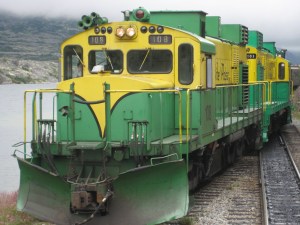
We had signed up earlier to take the White Pass train up from Skagway to the summit of the mountains, just over the border into Canada. This was the route that the gold miners had blasted out to make exploration easier. As we chugged our way up the 18 miles of rocky landscape, I took note of the near-vertical terrain. And then it hit me. These guys were crazy. I can’t imagine the desperation they must have felt to put up with what must have been absolutely horrendous conditions—white out blizzards, frostbite, inaccessible or absent supplies, inaccurate or nonexistent maps, hyper-competitive people. That surviving through years of this place seemed like a good idea was almost beyond my comprehension. I can’t even think of a metaphor for who these people are today, other than daredevils who jump off of city buildings or people who decide living in a broken down bus in the middle of nowhere is the life for them, but they’re not trying to make money out of those endeavors, it seems.

After we drew haltingly toward the summit, we passed the US Customs building, which was 6 miles away from the border. The border itself is barren of everything except rocks, the obelisk marking the actual crossover point, and the few green weeds that can handle the climate here. The Mounties are no more hardy; their customs office is 7 miles north of the marker. I suppose we’re two trusting nations. One person on the train with us remarked that we probably would put up with the elements if the neighboring country were Mexico. Wow, so much for the glory of the Yukon—we travelers today are jaded and cynical.

our train heading up to white pass

our train heading up to white pass

Up at the summit, we saw a quiet and pristine wilderness. It had taken two and a quarter hours to traverse 18 miles. A small creek snuck by the rails on the right, giving way to yellow and purple wildflowers. Maybe this site was a brute in winter, but it was a gentle lamb today. I wished we could have stayed a while, but as we were in Canada, nobody who wasn’t an employee was allowed off the train.

We could, however, go stand on the caboose. We’d climbed into the first car when we set out, but the engineers removed the engine and drove it down to the rear of the train for our return down the mountain. So now we could stand at the end and watch the world go by us, which we did. Wow, was that worth the $200 for our tickets. We gasped the first third of the trip back down.

The next day, we were in Ketchikan, known as the salmon capitol of the world. Come on, I thought. Everyone says they’re the capitol of something, but what does that really mean? Lots more tourist traps, I thought, and I might have gagged if Ketchikan were a place that sold 3,200 versions of jade jewlerly carved into whale tails. I had really seen enough of those.

Ketchikan harbor

Ketchikan harbor

They weren’t kidding, though. Ketchikan had every salmon in the world, fighting through its ocean inlet and streams. More gawking ensued. It was hard to appreciate the natural resource with 9,000 other ship passengers attempting to do the same, but we found some quiet corners that morning. Seeing these tiny pieces of Alaska only made me want to return. Maybe the gold rush is over, but it really had a lot of other riches that a person could get into.