Archive | Pop Culture RSS feed for this archive

All things cultural narrative

Macho Sport Meets Female Body

I originally wrote this for I Fry Mine in Butter in 2010.

2000 China women's gymnastics teamThis week the Chinese women’s gymnastics team that competed in the 2000 Sydney Olympics was stripped of its bronze all-around team medal for having a member under the minimum age of 16. That so much evidence existed and was in the public for years before this move by the International Olympic Commission—including the athlete’s personal blog and inconsistent birth certificates—is compelling, especially given the furor during the Beijing Olympics in which the same rumors swirled around the 2008 team. Several sports writers and experts have written that the IOC caved in and refused to call China on its willful doctoring of documentation because it was the host country that year and heck, for various other potential reasons that run the gamut from probable to a conspiracy theorist’s dream.

What I want to know is, what is the advantage of the too-young gymnast? Well, when it comes to women’s gymnastics, smaller is better. A shorter length from head to foot increases the likelihood of balance, which is important for pretty much all of the exercises; smaller bodies don’t receive as much stress on their joints from the whipping through the air and hard landings and dismounts; and pre-pubescent bodies still have flexible cartilage at the ends of the bones that make the body slightly more flexible and presumably, a modicum lighter. Read More…

Fleeing vs. Invading

This originally appeared on I Fry Mine in Butter.

In thinking about the anti-immigrant it’s-okay-to-use-racial-profiling law that passed in Arizona last week, my mind flashed back to V, all the way back to 1983. Knowing that it’s only a matter of time before the Gestapo, I mean, the Visitors, come to take them away for being illegal, I mean, scientists, they ask their former landscaper, Sancho, to get them over the border. Though this storyline and plot moment is fraught with all kinds of stereotypes about Latinos, Jews, police, and the power dynamics between these, it’s still written from the point of view of the smuggler as hero. Of the Latino smuggler as hero, no less. I can wrack my brain (okay, I have wracked my brain, through a nasty course of stomach flu, in fact) and I cannot come up with another instance in the last 40 years in which a mainstream television show or movie depicted illegal immigration by Latinos in this way. (To see the clip, start watching about a minute into the segment below.)

I can, however, come up with dozens of positive depictions of other people fleeing across borders illegally and/or without proper documentation, including, but certainly not limited to: Read More…

How the Promise Keepers Killed My Masters Thesis

Promise Keepers logoI’m a little tongue in cheek here, emphasis on cheek. Call this a cautionary tale; as it is, it’s taken me 18 years to write it down anywhere, and that is saying something for a dedicated memoirist.
There’s a lot from my early twenties that I regret, or would at least like to see in do-over. On the other hand, my many, many mistakes have brought me to my life at 42, and with a supportive, charming partner, my adorable child, and burgeoning writing career I can’t say making youthful mistakes has doomed me. But long before I learned that being respected was more important than having people like me, I enjoyed a litany of self-made errors.

Let’s take graduate school. The very reason I found applying to postgraduate work appealing was my extreme fear of entering the “real world.” This is frightening as a trope for college seniors, I get that, but in the past year I’d just come out, been gaybashed, accidentally broken my leg in three places and dealt with devastating news in my family, and trying to succeed outside of an academic institution seemed overwhelming. I’d gotten it into my head that I could stick around my now-familiar campus at Syracuse and continue to bloviate about cultural theory for another two years–and after that, I could go on and get my Ph.D. Anxiety attack solved.

Being a teaching assistant was thrilling, especially in the midst of an excited discussion with students, less so when I came face-to-face with their response papers. We were supposed to keep the curriculum contemporary in order to keep students engaged. More than one student rebelled against charged conversations about vivisection, reproductive rights, the electoral college, and the like, but I found my way through such ephemeral controversy. Even if I had to explain myself to the rhetoric and composition program director. Twice.  Read More…

5 Mistakes Emerging Writers Make

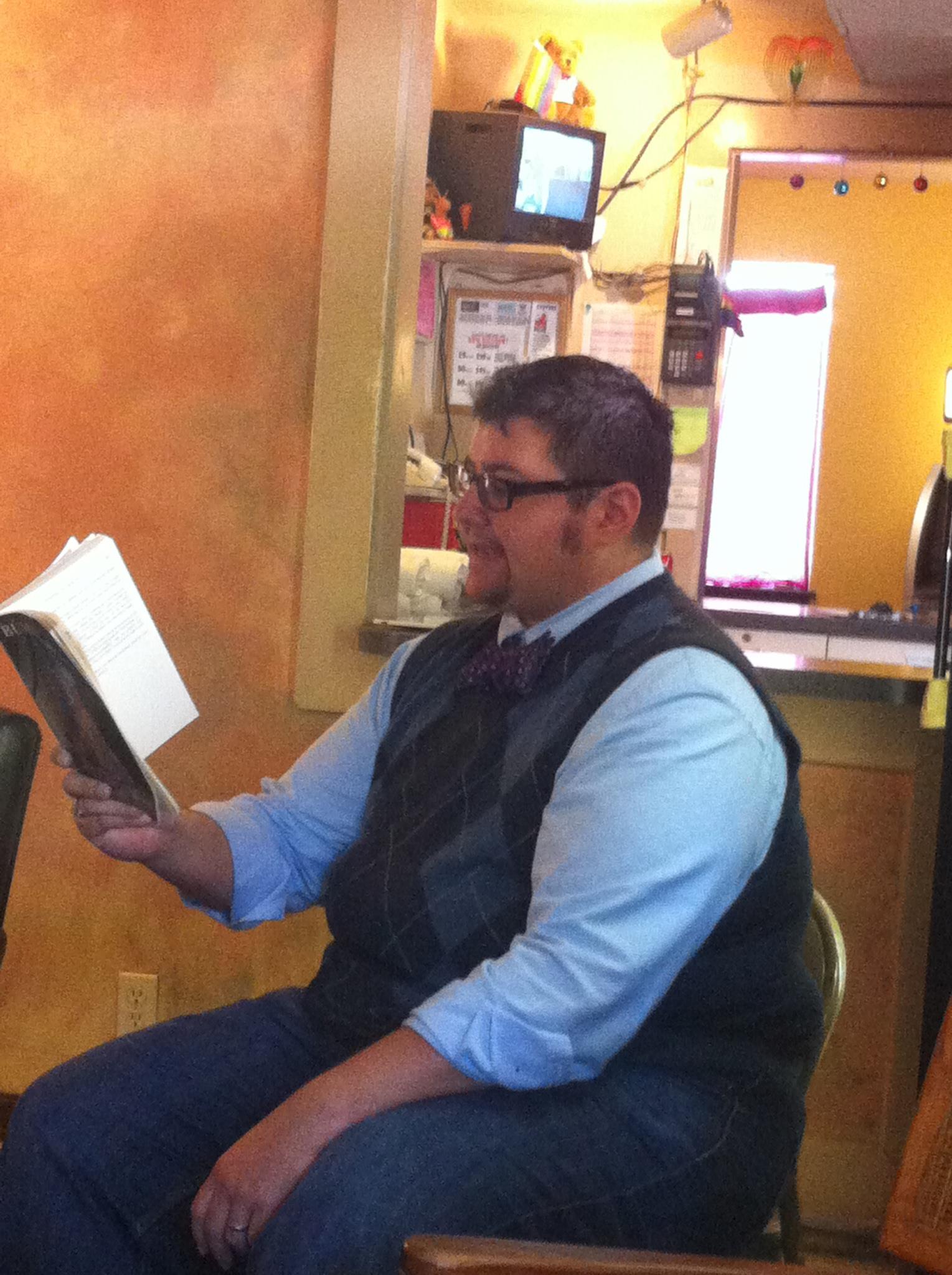
Everett reading in San FranciscoDepending on how I tabulate my time trying to get published, I’ve either been at it for 26 years or 4. (Long story.) At long last I found a publisher for my memoir, and a few journal editors who agreed to publish short work of mine. I’m grateful for those opportunities, understanding that all of this work amounts to a series of tiny steps toward making my writing a part of LGBT literature, however miniscule that part may be. When people come up to me and thank me for creating something that resonated with them or with which they could identify, I am beyond pleased. Writing is not about making money, after all, at least not for me. It’s about connecting people and adding what I think is a rare voice in the market. I neither apologize for being transsexual or bringing humor into my delivery, because both of those aspects are sorely missing in literature about people in my community.

I admit there are many ways for an emerging writer to keep her/himself from reaching the market, however. And I speak from experience on several of these points, as I’ve fought against making them or have actually gone full bore into materializing these errors. I’ll also note that this is certainly not an exhaustive list. Feel free to add on in the comments. But as I have lived it, the big missteps are these:

1. Grousing–There is so much stress associated with being an unknown writer, I get it. We worry if our work is any good, if anyone will notice our value, we incur piles of rejection slips, even while we watch vapid celebrity book projects get tons of hype from traditional publishing (hey, ghostwriters need to make a living too). One expert will tell us our book is too long, another says it’s not long enough, and so on. But if you’re working on establishing an audience, remember that readers–seasoned readers in your genre especially–have no tolerance for complaining. Nothing will make you look unprofessional faster and with less effort than negative statements about how crappy the publishing industry is or how blind agents are to your talents. Complain in private, among your most solid friends. Read More…

Television’s Sidekicks of Color

Author’s note: This post originally appeared on I Fry Mine in Butter in June 2011. 

Feeling somewhat blue in the doldrums of summer reruns and the NFL off season, I gladly tuned in last year to see the then-new show, Royal Pains. It was about an E.R. doctor who gets unjustly fired from his job for helping a sicker but less wealthy patient, and winds up going into extremely private practice for the extremely wealthy in the Hamptons, New York. Catch the irony there? It’s subtle, I know.

It was enjoyable enough, with Mark Feuerstein as the good doctor Hank Lawson (son of being lawful, get it?), Paolo Costanzo as his well intentioned, extremely frustrating brother Evan, and Reshma Shetty as Divya Katdare, a woman of Indian heritage who secretly becomes a physician’s assistant, hiding her vocation from her family. Watching through the season, it was her character who supported the brothers through Evan’s monotony of stupid schemes—how his character didn’t take the grand prize in the Darwin Awards, I have no idea—and Hank’s challenging sense of insecurity to become the backbone of “Hank Med,” Evan’s stupid name for the practice. She reminded me a bit of Stephanie Zimbalist in Remington Steele, although Hank was by most measures not a complete charlatan.

Then the fall rolled around and I took in the premiere of The Good Wife,which I’ve written about on here twice now. And lo and behold, in the midst of the fictional Florrick Sex Scandal of 2009, there’s a cutting-edge investigator at the defense attorney firm: an Indian woman, Kalinda Sharma, played by Archie Panjabi. Wait a minute, my brain fired at me. Is this just coincidence? What’s going on here with the sidekickery? Read More…

Why God Hates Us

rush limbaugh with cigarThis was originally a post on I Fry Mine in Butter from 2010.

In the beginning, there were good preachers and there were scary preachers. The good preachers seemed kindly, they talked about love, they talked about forgiveness, they talked about acting as Jesus did, minus all the getting betrayed and walking up a huge hill with a board, and getting crucified. And that was good. And they have remained basically the same, still talking about love and forgiveness and modeling.

There were also the scary preachers. They ranted about hell fire and damnation, and sin. Lots of sin. Everyone a sinner, with the implication, never acknowledged, that they must be sinners too. And while scary preachers could raise a ruckus, most people preferred the other kind of preacher, especially when the scary preacher got embroiled in personal scandal, showing that despite their invective, they were not better than the rest of us. Read More…

Out of Order

Author’s note: This is reblogged from I Fry Mine in Butter, from June 2011 when I originally wrote it.

I was still a teenager when Law & Order started on NBC, and while I liked it just fine, I don’t remember being immediately taken with it. Actually, it seemed a bit like one of my boyfriends, the first of three Scotts I dated in high school and college—fairly likable, but I wondered about how long it would last. Law & Order, on the other hand, grew on me over time; I may not have caught each and every episode as they aired that first season, but I would read the tiny printed previews in my parents’ TVGuide and remember to watch. Hey, it was 1990, after all, and the newspaper’s television guide was often wrong. Oh, life was so hard.

I wanted to know what was up with Ben Stone, the ADA who seemed a little, well, crazy. Robinette was the cool and collected one, often mediating between Stone and Adam Schiff, the District Attorney. Every episode the cops were nearly precognitive, until the attorney’s office took over and had to deal with the technicalities that threatened to have the case for the people thrown out. It was as if Giuliani’s New York weren’t even possible because these criminals knew it was a cakewalk. Still, with a little bit of magic and finesse, and a hell of a lot of drinks over what I can only presume were extremely old bottles of scotch, Schiff got his convictions. Or at least very intimidating plea bargains. Read More…

It’s Not the Same Press Anymore

This article originally ran at I Fry Mine in Butter.

Once upon a time, newspapers like the Boston Globe, the New York Times, the Philadelphia Inquirer, the Washington Post, and so on all had reporters posted in far away places from Moscow to Johannesburg, Rio de Janeiro to London. These folks were part of a press corps that wrote daily or near-daily stories and sent them back to their editors in the paper’s home town. Each paper published different articles on similar topics, because the ideas around what was “newsworthy” were generally the same, although it was common for one paper to run a story and another not to, if the first paper had confirmation of all of the details but the second one couldn’t muster them together. This is how we all came to know the concept of “getting the scoop” on the competition. Political reporters tried to form relationships with people in the political arena, so that they could get first dibs on juicy quotes or source material. I presume that a lot of backroom dealmaking popped up in this kind of relationship. Agreeing not to mention President Roosevelt’s wheelchair meant that one got to continue to sit in the White House press corps, for example. Agreeing not to mention JFK’s many affairs got them something I don’t know. But something. Read More…

The Coen Brothers Know How to Murder

Author’s note: This is reblogged from I Fry Mine in Butter, published in May 2011.

Please note, this post contains and focuses on images of fictional violence.

I was a fan of the Coen Brothers before Fargo came out, and then it was all over, I was nuts about Coen Brothers movies. I still think there’s never been a better movie opening than the one in Raising Arizona. There are a lot of things I could write about with regard to their work, but fortunately for me, it’s mostly been covered by the blogosphere. What I haven’t seen, however, is this, and coincidentally enough, it’s one of my most favorite aspects of their work—it is freaking hard to kill someone. On a larger level, it is inordinately hard to be a criminal. Shit just doesn’t work out very well.

In two films, the aforementioned Fargo and Burn After Reading, people who are otherwise desperate or ignorant try to deal with their circumstances by identifying get rich quick schemes. They even had the best intentions to start out, but faced with two juggernauts as adversaries—well established, smart and greedy businessmen, and oh, the Russian embassy, respectively—they fold like a house of cards in a day care center. Read More…

Support De Spite

democrat and republican fightingI’ve seen it at least half a dozen times on my Facebook wall–people who will write a status asking anyone who has clicked like on things like Romney, Paul Ryan, or the GOP, to just go ahead and defriend them now. Then they’ll list the reasons why a mouse click for the political right is so offensive. I don’t disagree that a vote for Republicans, generally speaking, is a vote against reproductive rights, LGBT civil rights, and the like, because yes, the GOP’s political platform reads that they’re opposed to those rights and communities. And even if Mitt Romney himself is in favor of a “rape exception” for abortion–even if there are no health practitioners in a given area to perform an abortion because overall the climate has dampened training in those procedures–his colleagues have been arguing quite forcefully that they will continue to push legislation that outlaws all abortions no matter the mitigating circumstances. So I understand that the nuances at play in our political parties are not enough reason to absolve members of a given party from the consequences they wreak on our fellow Americans.

But I’m not jumping on the defriend bandwagon. I read the primary narrative of FoxNews as divisive, pitching conservative keyword after keyword to their faithful audience, and attempt after attempt at alienating the rest of us from watching. It’s a process wherein less and less motivation falls on FoxNews to double-check their facts and sources, until disinformation is all they telecast, reality be damned. What does it mean to live in a country where a vocal minority attempts to steep an entire political party in hate and anger, and people at the other end of the spectrum point fingers and laugh derisively or shout back in frustration? When we dismiss each other as lost causes, what are we left with? Read More…