Archive | ponderings RSS feed for this archive

The writer’s conference that could be

I fly out in about a week to attend the Pacific Northwest Writer’s Association annual conference in Seattle. I’m excited, working on my pitch to agents, and a mite trepidatious about what I’ll find there. I’ve been to conferences before, sure, but no writer’s conference. As a quick recap, so far in my life, personal conference attendance has included:

The Popular Culture Association conference—This was held in the Chicago Hilton where they filmed the remake of The Fugitive, starring Harrison Ford. It wasn’t the closest I’ve come to meeting Ford, since that distinction goes to the Arlington, Virginia location of the Capitol City Brewery, when Ford and I were seated only two tables apart. For what it’s worth, he seemed like a genuinely nice person. As far as the conference goes, I’ve never had so much fun at an event as this one, and I’m pretty sure it’s not just because I was a completely broke graduate student who subsisted on sneaking in at the ends of coffee hours to eat from the appetizer tables. There’s something about going to a conference where one is giving a paper on Single White Female in the next ballroom to a serious discussion regarding why Bugs Bunny cross-dressed that makes boring conference centers more lively. I like the academization of The X-Files.

National Association for Welfare Research and Statistics—This would have been one of the more dry conferences I’ve seen, except for the moment when a garden variety social worker called out a speaker from the Heritage Foundation on using misleading numbers to say that poor Americans don’t have it so bad because look, they have televisions and telephones. I never saw so many angry middle aged women in one place. The other great thing about this conference was that it took place in Madison, Wisconsin, and that turned out to be a very cute, charming town.

American Association for Public Opinion Research—May in Phoenix is not a good idea, and not just if one is a Latina migrant farmer. It’s bad all around. It should not be 106 degrees in May unless one is standing in a shadow on the surface of Mars. And that’s a bad idea because of the whole lack of oxygen thing. I did appreciate skipping one afternoon of the conference to go golfing with a colleague, and meeting James Brown (the sportscaster, not the king of funk) on the plane to Las Vegas. The workshops and panels, however, were really far from what I would call intellectually rigorous. Sorry, AAPOR, it’s true.

Philadelphia Trans-Health Conference—I love this conference like a younger sibling who doesn’t know how to behave. I don’t really get the hyphen in the title, either. Trans . . . health to not health? What is the trans connecting? Oh, transgender people! Then say it’s about the people, people. Anyway, this is a vital meeting up for the trans community, even as it quickly descends into near meat-market status, with folks checking out each others’ outfits for minimal levels of hipness and outsider status. The more buttons on one’s backpack, the better. And every time I attend this conference, I see middle-aged trans women walking alone, not nearly cool enough for the too cool for school kids. It makes my heart ache. The workshops here are hit and miss, but again, they’re some peoples’ only conduit of information off the Web and/or means of meeting other like-minded people. I try to remember that.

So what will PNWA 2010 be like, I wonder? Are there writers squirreled away in tiny corners of the Northwest, just waiting for their weekend of fun? Will everyone be more successful than me—a low bar, I grant that—or will there be other folks in similar situations to mine? Will I totally screw up and puke on an agent? I mean, I really want to be more socially adept than George H.W. Bush in Japan.

I’m sure it will go well. At least I’ll have my little finalist ribbon to wear around, looking as dorky yet proud as possible. And for giggles, I’ll try tweeting a few workshops if it’s not too interruptive to the panelists. If anyone’s interested, I’m 4evermore over on Twitter.

In the heat of the dusk

I like fireworks as much as the next person, assuming the person next to me likes fireworks as an annual, but not more frequent, source of half-hour entertainment. But I made the trek into the steamy Michigan night thinking that my niece and nephews would really really very much yes want to see the light show. I learned something new in the process:

  • The 13-year-old girl was more interested in recording the entire half-hour event onto her camera, having almost no interest in watching the explosions with her naked eyeballs.
  • The 10-year-old boy remarked, “eh, you’ve seen one set of fireworks, you’ve seen ’em all.”
  • The 3-year-old was thrilled beyond belief.

So why do we drag out our blankets and children and slap mosquitos off ourselves, pushing through slow-moving traffic to find that last parking spot, half a mile walk away? An extreme need for patriotism?

I plopped down on the ground, cuddling Susanne a little and watching the toddler fight for all the patience he had in him, waiting for the brightness to light up the indigo sky. We found a spot that framed the fireworks by two very large poplar trees, the kind that drove my mother crazy with all of their pollen, and that I played under as a child, because my sandbox caught its enormous shade and was viewable from the kitchen window. I can’t remember a single organized fireworks show that I saw as a kid. Instead we’d light our own fireworks on the sands of Myrtle Beach where we stayed for a couple of weeks most summers. These were procured from our friendly tractor trailer container, parked in the lot of the local Piggly Wiggly, suggesting that The South was a far more dangerous place than New Jersey, where we lived, because such things were illegal there.

Mom was the risk-taker, almost eager to light the blasting caps like she were ready to mine for something under the sand. I have to say she’s an agile one; nobody moved away from the lit fuse faster than she, and on the challenging beach, no less. I have a hard time getting my feet under me just walking, when it comes to sand.

It got so that I liked hearing the booms from the explosions against the sound of the surf from the Atlantic. So last Sunday I didn’t hear that combination, but I’ve learned to be flexible and take things as they come. Hearing kids giggle gleefully while their parents oohed and aahed at the unexpected shapes appearing in the sky was enjoyable enough. But I think in a few years, I’ll have to go back to the beach for Independence Day.

And ask Susanne to handle the fireworks. We all know I’d blow off at least a couple of fingers. I’m a scared Yankee with that stuff.

Things I have won

I am a fan of the contest. I just plain like the concept that for the trouble of sponsoring my own entry into it, I have earned the privilege of getting X chance in millions of winning whatever thing it is that I covet. It’s a tiny taste of exhilaration, made all the smaller by my intellectual understanding that I’m probably not going to win bupkus. But in the years of me entering contests, I have walked away victorious a few times. It’s like a siren’s song, drawing me back, distracted by whatever bauble or accolade is dangled in front of my head.

A stuffed snowman. In 1983 I won a stuffed snowman, hand-knit by some other 8th grader’s mother. The real hook for me was the black hat on its head—inside, curled into itself, was a second scarf, in a different color, and you could change them out. Sweet! A snowman you could dress! For a kid who didn’t give a fig about Barbies, this was for some reason extremely appealing. Tim, a big bully of a kid, had bested me earlier in the school year in a campaign for class security guard—I don’t know how he beat my motto, Shoot for the Moon, Vote for Maroon—and had, upon the afternoon of his victory speech, insisted everyone passing him in the hallway should bow to him. Oh, how my fellow classmates rued their collective decision then! Tim saw me buy a raffle ticket for Mr. Snowman and like an arrogant parent, unrolled a loop of raffle tickets like baby pictures out of his wallet. I would never win, he said. Ruffled by his heckling, I capitulated and bought one more ticket. This doubled my chances of winning, I figured. Ah, 8th grade math. When the principal called my ticket number over the loudspeaker, I squealed and ran down the three flights to get my prize. And I’m positive I loved that changeable snowman far superiorly to Tim, would he have won.

Mill Road Camp Camper of the Week. I have no earthly idea how I earned this prize other than the counselors gave it out on a rotating basis and I just hit my number one week. I didn’t even enter or otherwise make my interest known to the day camp staff. I was just wasting my time perfecting my tetherball skills. Mad skillz, I say. But I still have the brick red banner with white lettering.

I have won roughly $200 in bowling league money. That I have bowled in a league at least 6 times reveals my sad-ass bowling skills. Even the last team in most leagues will walk away with something at the end of the season. But it’s not about winning or losing, it’s about having the coolest shoes in the league. Which I have.

A Panasonic stereo and 25 CDs. This was the strangest contest to enter in my personal history with contests. Sponsored by Dodge and Mothers Against Driving Drunk, or whatever it is they’re called, entrants had to guess how many CDs (in their cases) would fit inside the M.A.D.D. Music Mobile, a van that apparently was roaming around my college campus, hunting for drunk drivers, or something. That really sounds like an unsafe practice, but okay. I went upstairs to my dorm room, called 800 information (there was no Web, people!), and got the number for Dodge headquarters in Detroit. After a series of phone calls, I had the cubic dimensions of the van’s interior. I also, at the time, owned 12 CDs. I pulled two away so I would have an even 10, and I measured the cubic area, did some rough math—math keeps being so important! damn math!—and then went back down to the lobby to put in my guess. I’d all but forgotten about the contest when I got a letter in the mail, saying I’d gotten first prize. I’d missed the grand prize, which was oh, a sports car, but what would I do with a sports car in the snowiest place in New York? Crash it into the Music Mobile, probably, or a Delta Delta Delta on her way back from a drunken formal.

Employee of the Year. This award took me a bit by surprise, and without a doubt meant the most to me of all the things I’ve ever had the pleasure of winning. The vice president announcing the award at the annual dinner did the traditional, “let me tell you about this person before I give you the name” thing. I’m fond of that approach, actually, and not just because it reminds me of Sesame Street’s version of This Is Your Life. I had my suspicions that I’d be getting the award, but it was still great to get called up to the podium and accept it. Sometimes I think it’s silly to get so excited about a wood and brass plaque, but well, I worked hard to have that on my office wall.

It’s with this short but fun history that I entered the Pacific Northwest Writer’s Association literary contest, submitting my affable memoir last spring. I’d known upon entering that finalists in each genre category would be notified by early June, so when 6/15 rolled around I presumed I was not among them. But opening my email yesterday, I saw an email from PNWA with the subject line, PNWA Literary Contest: Congratulations! My very first thought was, “well, I guess I’ll see who the finalists are, since I must not be one of them.” Imagine my surprise when I read: “Dear Everett, Congratulations!” Say what? Holy memoir, I’m a finalist!

Susanne wanted to know why the blood had all gone out of my face. I told her, rereading the Web site details about the contest, that so far I’d won a “Finalist” ribbon to put on my conference badge when I show up at the event in July. I bet it’s red. I love a nice, red ribbon and I have no idea why. As it stands, there are 8 finalists in each genre category, and a first, second, and third place winner. So I have a 3 in 8 chance of winning something beyond my lovely strip of satin. Whatever happens, I’m excited and thrilled.

Contests are damn fun.

Deducing the tourist

We’ve been through four hotels in as many nights, and after our repeated exposure, I’m now prepared to say a few things about the Tourist of the West, at least as far as hoteliers are concerned. Using the set ups of our rooms as indirect indicators, I’ve deduced the following:

  1. Tourists in the West like extremely hot showers. If you are not a Tourist of the West, you need only turn the shower dial three-quarters of a scant inch to get the water in the hot tub range of 100–103.
  2. They are likely to bring along their small-to-medium size dog, even to national parks where the rangers tell them that those dogs only look like tasty snacks to the bears. Because clearly, they aren’t just dogs to the Tourist in the West, they’re part of the family. Would you leave your little sister at home while you go on vacation? (That’s rhetorical.)
  3. They still smoke. Nothing cuts through the crisp air of Wyoming and Idaho like a fresh Marlboro.
  4. They appreciate the free continental breakfast. Even the 2.5 star motels have a free continental breakfast of Costco-purchased food. Nothing says roughing it like making your own burned waffle while CNN plays on a communal television.
  5. The Tourist in the West either doesn’t noticed or has actually caused every bed in the hotel/motel circuit to be as lumpy as spoiled cottage cheese. Perhaps using topographical maps as beds is a form of massage that I simply haven’t yet noticed.
  6. The Tourist in the West likes to fancy herself a horse-riding, white water-rafting expert, although it would appear that she has done neither in a long, long time. The people out there riding horses and braving the Snake River seem to be different tourists altogether.
  7. The Tourist in the West likes to wear a ball cap from a college they attended roughly 40 years ago, or a ball cap from some relative or friend’s college attended roughly 20–40 years ago. This is because they think, it appears, that they are thus wearing a conversation piece on their head. DO NOT engage the Tourist in the West in any conversation, however, unless you have half an hour to kill.

Now then, back to my vacation! We’re going to see Mt. Rushmore today, and thus discover why South Dakota’s tourism revenue far, far exceeds that of North Dakota.

The more things change

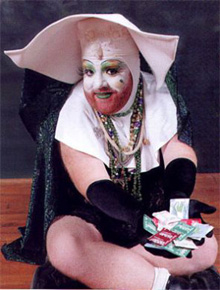
In 2003, I volunteered at DC’s gay film festival, which meant working with some very nice people and a few overly controlling people, but I was willing to take the long view and deal with challenging personalities in order to get passes to other movies for free. One of the films I went to see was Drag Nuns in Tinseltown (rereleased in 2006 as The LA Sisters of Perpetual Indulgence), a documentary about the antics and charity work of the Sisters of Perpetual Indulgence. Some of the Sisters attended the screening, laughing along with us and hosting a Q&A afterward.

Unlike other drag performers I’d seen before, the Sisters don’t eschew things like facial hair (a Ru Paul no-no) or insist on lip synching to women-sung songs, but instead will occasionally take on tenor or other “male range” compositions, singing in their own voices.

They also have a tendency to rework lyrics to songs we’d otherwise be able to belt out with them, in order to make a point. I’d forgotten that little bit of Sis-trivia until last night.

Susanne and I trekked to the Tri-Cities yesterday with a few colleagues from the college to see the Seattle chapter of the Sisters host a fundraiser for Walla Walla’s Blue Mountain Heart to Heart organization, a non-profit direct service charity for people with HIV, AIDS, and Hepatitis C. Heart to Heart is, in fact, the only direct service charity of its kind in southeast Washington state, and Franklin County, which it also serves, has the highest HIV infection rate outside of Seattle, so their work is rather desperately needed here. I would have gone to see the Sisters in any case, but knowing it was a fundraiser for Heart to Heart only solidified my commitment to making the 60-mile trip.

We found our way to the only gay bar in these parts which, on the inside, was a series of differently shaped rooms and a hell of a lot of seating: booths, high tables and stools, plain diner tables that looked like they’d been purchased from a going out of business sale from the empinada counter around the corner. A room in the front boasted a stage and short catwalk where the Sisters and local performers belted out everything from Xanadu’s I’m Alive (unfortunately not performed on 70s-style roller skates) to Bjork to School House Rock, Electrify, and some strange German song about genitalia that left me covering my face because I was there with a student from the college. Talk about awkward! Thank goodness there’s no sexual harassment policy at Susanne’s school. (Ironic, I’m being ironic.)

As the performances rolled on, audience members left their seats to slip money into the contribution basket at the end of the catwalk. Here’s where I was reminded of the unofficial rules about gay bars:

  1. No matter how gay the bar is, there will always be a creepy straight guy trying to strut his stuff or hook up with some random lesbian. Persistence of said creepy guy is in an inverse proportion to his level of attractiveness. And creepy guys tend toward creepy props/dress, like a pipe or opened up dress shirt.
  2. As soon as a couple first hooks up, they must stand in a corner or against a wall, making out. It helps if they’re anywhere near a heavily trafficked area, so that more people will notice their coupled upness.
  3. Older couples should feel free to bicker in the bar or stand apart from each other, at turns looking cold or hurt.
  4. There will be an overworked, overtired lesbian bussing tables and shooting daggers out of her eyes at the careless customers who spill their drinks for her to clean up.
  5. Even if the gay bar is occupied by 95 percent gay men and < 5 percent lesbians (the other 1 percent straight allies, transgender people, and lost people who haven’t realized they’re not in a straight bar yet), there will still be a long line for the women’s rest room.
  6. A small group of depressed looking older men will be quietly sitting around a video monitor of gay porn.
  7. A few young or questioning people will be in the bar on any given weekend night, looking astonished at the naughty humor and antics of the other people there.

All of these I saw with my own eyes last night, and nearly 20 years after walking into my first gay bar, I smiled a little to myself, because no matter what else changes, these dynamics are the same. Not that I don’t want all of those to stay the same, certainly not. But it’s kind of like I haven’t aged.

Who’s up for Gay Bar Time Machine? Or the Curious Case of Benjamin Buttman? We can make it happen, people. Actually, maybe I should do an Internet search and see if they’ve been filmed already.

From Chicken Little: Last Day for Sale on Sky

woman in emergency mask

Of course her goggles and irises match!

I mostly bit my tongue when 30 inches of snow fell onto our house during the winter of 2009 and after which no plows visited our neighborhood. Scratch that, no plow, as in singular, moved any snow. Susanne and I understood a little bit better why people in this corner of the state and country act like they don’t need government, because hello, government isn’t, or wasn’t, there for us.

Fine, I get it. One doesn’t feel the pulse of the Capitol this far away, which means, one doesn’t have any reason to think that any government worker in the entire 2.6 million-person force actually cares about the average human walking around in this country. That such an idea couldn’t possibly be true doesn’t stop folks from generalizing what the U. S. government is and what it does. So they generalize. And then do it some more.

Sensing a problem here? At some point, our assumptions about government intent and capability take us off the rails entirely as we try to get our 50-train car over the river with no bridge.

Over time, we’ve gone from “alert your police to suspicious behavior” in the wake of 9/11 and the anthrax-mailing assclown to “pass laws so we can carry our guns into church” because apparently we’re now better at policing than the police. Osmosis? Or maybe strapping explosive metal to your thigh infuses your quadriceps with law enforcement knowledge and then that is carried up to your brain so that you know at any given moment who to shoot and who to leave alone. Damn those police academies for keeping us in the dark.

Well, wherever there’s confusion and hysteria, there’s someone looking to make a few bucks. I was ignorant of a lot of this until the other night, while watching a rerun of NCIS, I saw a commercial for a 72-hour disaster response kit. A what? I went back with my DVR. Yes. I’d understood correctly. Flashing images of the Katrina hurricane, the aftermath of the Haiti earthquake, and the Chili earthquake, a deep-voiced, threatening voiceover told me that government wasn’t there for any of these people, and I should not sit around waiting for 1. a natural disaster nor 2. the government to bail me out. Bail me out? Wait a New Jersey minute.

Bailout is from seafaring, as in bailing water out of a sinking boat. It’s taken on a negative connotation because it’s used when the Feds have given money to a struggling company or industry. And the negativity has branched out to the struggling entity. So don’t call me a bailoutee in waiting! I haven’t asked for anything! I’m . . . I’m . . . I’m buying this nonsense, aren’t I? Of course it’s fine to expect that at least the national guard will roll in if half of Walla Walla blows away in a dust storm, leaving only Walla. That’s not a sign of weakness, that’s a sign that I’m an individual and not an institution, that’s all. Sheesh, for a minute there. . . well, I don’t want to think about it.

Okay, so this ad is comparing the non-Katrina response, the Haiti and Chilean earthquakes and saying they’re equally devastating, and suggesting the next one is around the corner and buying their $100 worth of plastic-wrapped product will what, be like having soldiers bringing me clean drinking water and tending to my wounds? Will it pull me out from a crumbled building? Is it like a Roomba on steroids with self-extending grappling hook? I had to laugh at the ludicrousness of this. I laughed, and yet my chuckles were laced with nervousness. Someone will buy this. Of course many someones will buy it. We bought Pet Rocks. We bought Snuggies. We bought ShamWOW!s. We’re Americans, darn it! We buy what we feel like buying! If I’m not spending money on insurance against Armageddon, I’m not a patriot!

I went online to see what was in these kits, anyway. And I was astonished to see how many different Web sites are hawking this schlock. Go on. Google it. 72 disaster kit, that’s what I typed. Open another tab and check it out, I’ll wait.

See? Holy preparedness, Robin! There is a lot of selling of crappy stuff! Light sticks, freeze-dried food, first aid kits, water pouches—I’m sorry, pouches? What’s wrong with water in bottles? Does it have to be so militaristic? I’d rather just put a case of Evian in the basement, okay?

I can buy pre-packaged kits or I can learn how to make my own from one of what, a dozen or so Web sites that have painstakingly put such content together. I’ll be good for 72 hours!

Doing the math, I see that that’s three days. Three days, really? Seriously? And then what? The earthquake ravaged buildings are renovated? The landslides are packed back onto the mountain? The flood waters recede like the hot air at the end of a car wash?

Oh. The government comes into town. The do-nothing, help-nobody government. We want to condescend enough to suggest we’ll need to sort out ourselves for up to three days, but then, we want our government to come to our rescue.

Let me know when any of this starts making sense. Maybe I’ll strap a banana to my thigh and walk into a church with it. That seems less kooky.

Not really an excerpt

There are two kinds of writers in the world, those who overwrite and those who work for test laboratories.

I often write more than will end up in a story or piece of nonfiction, and I see this as a blessing rather than a curse, since trying to pack things on a skeleton of prose is for me, difficult and prone to introducing everything from a non sequitur to a blatant inconsistency—I’m much more orderly when I stick to my process, which is:

Write down initial idea—this can be anything from a character I keep thinking about to a rare astrophysical condition to some circumstance that would explain a mystery

Expand on initial idea—Aliens on Parade grew out of a question I had about how traveling by wormhole could go wrong once in the hands of a lazy or in-over-their-heads government. I started thinking about technology: if we “discovered” how to open wormholes in space, would we also inadvertently be inviting people in? If answer = yes, then what happens?

Identify the actors—my bio sketches start out very simple and I grow them from there. Age, race/ethnicity, gender, orientation all help me figure out their positions, power, and privilege in society, whether it’s a society I’m trying to reflect or invent. Because I see these things at play in the actual world, I feel responsible to bringing them to bear in my writing. But their back stories are more complex. I’ll put in things like “was mugged two weeks ago,” “has unmanaged bipolar disorder and self-medicates with alcohol,” “won’t let anyone meet her mom because she’s on welfare.” I don’t feel the need to write out absolutely everything about them if I’m writing a shorter story, and I try to come up with circumstances for them that let me see greater depth of character when I need to.

Visualize the scenes—this gets harder for longer work, so I keep it flexible, and I will add and subtract to this list over time. I think of this like one would map out a scene shoot for a film. What do we have, where do we have it? I deeply appreciate any writer who can create scene description and keep it interesting, and not just because it’s a magical street in a magical city, which is supposed to be magically interesting all on its own. Once I’ve got a sense of my characters, I try to come up with places where they will be best expressed and then make sure it will work with the plot. If I can find a perfect setting to enhance the tone, then great. In my short story, Underwater, I tried to paint a minimal picture to ask the user to fill in with their starkest memories, while keeping the places in the story bereft of emotion other than tired and empty. I think it works for a story that’s under 2,000 words like this one. My novel-length sci fi piece, Superqueers, spends a lot more time showing different neighborhoods in Washington, DC, because I wanted to work against the every-city feel of other comic book hero stories. Incidentally that story grew out of an image I knew I needed to write 20 years ago, of a small greasy spoon diner and a very large man who drinks coffee there, spilling a lot of it and using many, many packets of sugar in the process.

Do the first draft and don’t stop—At this point, I can’t not write any longer; I have to type words out through my fingers now now now. I will take a few pages to get up to speed, although I don’t like seeing it this way. I’d love to think my work was perfect out of the gate, but in reality I’m in last place until the final turn, to drag the metaphor through the mud, mix it and beat it like a dead horse. I and most everyone I know need to do an awful lot of rewriting before I will say the words have been crafted. No blacksmith made a nail with the first strike. But this rewriting process will come later. I don’t worry about it because I’m writing, I’m progressing, I’m telling the story. I may not use the section or piece of dialogue later, but I will save whatever I write in the first draft. Everything lives in the first draft. If I sit down at the computer on Day 2 and I hate everything I wrote, I can start anew if I can’t write anything else, but I will not delete the crap from Day 1. Draft Number 1 holds onto everything. While I’m getting through this first draft I will return to the character bios and the scene list and the original idea, and update them. Matilda is allergic to strawberries. I need the boat out at sea, not at the dock. Those two characters are too similar so I’ll merge them into one and make a note to rewrite the dialogue in chapters 1–3.

Rewrite until it doesn’t suck—other people may have higher expectations for their writing, but I’m shooting for not laughable. Perhaps I’m being too modest; I think I’m a good writer, but I don’t want to get stuck on myself, and I know by now that things can always be improved. I have no love for self-absorbed writers, no matter their level of talent, so I strive not to become one myself. I can’t say when I think a story is done, but when I go through on say, the 20th pass and only have tiny changes to my language, it starts to occur to me to work on something else. I’m either blind to the quality of prose or I’m deadened to making changes and now’s the time to go revise something else or start something new. All the while pitching my best stuff to agents and journals. But that’s another post for another day. This rewriting phase starts out intense and mellows out, kind of like March. I’ll cut whole scenes, chapters, characters, change the ending, put in or take out subplots. Thank goodness I’m writing and not building houses, because I’d destroy every budget I saw.

With that in mind, here is the very original dream from my memoir that drove me, eventually, to transition. It’s no longer in the memoir itself, but it’s referred to and is the backstory for the main character—uh, namely me—and I revised it something like 10 times before I struck it entirely, so it’s rougher than the rest of the writing at this point.

Trees, everywhere, mostly evergreens. He looked around at them, some clumped up closely, branches looped together with their neighbors, some isolated from the rest, the lot of them with varying heights and apparent ages, climbing up the side of the mountain. Far below the side of the mountain the trees were reflected back almost perfectly from the surface of a very still, large lake. He wondered how he’d gotten here, patting himself down absentmindedly, as if identifying the things in his pockets would reveal a useful memory. Looking down at his clothes, he recognized an icon of sorts. Is that what they’re called? Icons? Stereotypes? He was struck by the idea of lumberjacks. This was probably because he was wearing a red flannel jacket, or shirt, he wasn’t sure. It was something in between, and it would later occur to him that there is in fact, a hybrid jacket-shirt-thingy for sale on the men’s fashion market, if one used a very loose definition of the term, “fashion.” But he did notice, after taking in the color and texture of it, that it wasn’t quite warm enough for the brisk morning air. Wait, was it morning?

He squinted at the sky, a pearly blue with a few wisps of cirrus clouds high, high away. Well, he knew what the hell a cirrus cloud was, that was a start. When had he learned about cirrus clouds? He had a clear memory of Mrs. Warms’ 8th grade science class at that crappy Catholic school on the main drag in Princeton. The one with the scary nuns. And then on graduation day with their caps and robes on, they all looked like nuns and none of their parents were clued in to the trauma that their children were experiencing.

So okay, he’s made it past elementary school. Good to know.

He took a few steps, only then realizing he had on light brown worker’s boots, with his jeans pulled down neatly over the tops. It occurred to him to touch his head, and to his shock he realized he had on a knit cap. He took it off and inspected it. Navy blue, maybe, or black. Size 7. Carhart brand.

Holy shit, he really was a lumberjack. That couldn’t be right, could it? He looked around for an ax and a large blue beast of burden.

Before he could continue on trying to figure out who the hell he was, he heard a voice behind him.

“Daniel! Daniel! What are you doing over here?”

He turned around and saw a woman running up a trail he hadn’t noticed, what with the sky looking gorgeous and the trail looking blah. She was wearing her own knit cap, plaid jacket, jeans, and work boots. There apparently was some kind of outdoorsy uniform going on here. Her cheeks were bright red from the cold and her spontaneous bout of jogging. Brown curly hair stuck out in gravity-defying directions as soon as it cleared the tight hat. She left the impression of looking like a balding Troll doll that had spent some good quality time under a diffuser.

He had no idea why he knew what a diffuser was.

“Hi, Kathryn,” he mumbled. He knew her name. Another surprise. Who was Kathryn?

“Daniel, we need you at the mess. Why are you all the way up here? We’re running out of pancakes and French toast, and Jackie doesn’t know how to make the dishwasher run.” She put her hands on her knees as she bent over, panting.

“Daniel?” He looked at her. He knew her name, but he didn’t know why she was calling him this.

“Yes?”

“Who’s Daniel,” he asked.

“You, silly.” She stopped a moment. “What’s wrong with you?”

“Nothing. I just didn’t think that was my name.”

“Uh, what did you think your name was?”

He started to say and then stopped. It wasn’t right. Under this brightening sky, in the cold air, dressed like an extra from a Monty Python movie, something wasn’t right.

“Nothing, I’m kidding. I just wanted to catch the last of the sunrise.”

“Well, we need you, Dan. Come on, before the President runs out of breakfast.”

“The PRESIDENT is here,” he asked, following her, feeling his footsteps crunch as he made them on the frosty ground.

“The President of the Bucks County PTA. It’s their group that picked the campground for their stupid conference this weekend.” She looked at him like he’d lost all sense. She wasn’t far off the mark.

“Right, right.”

“Jesus, what did you do last night?” Her hair bounced around as she shook her head. He had the distinct impression that her cap was about to shoot off of her head from the pressure of her curls.

They walked into the mess and half a dozen children were upon him, tugging at his shirt/jacket and looking for more flapjakcs as if they might be hidden in his pockets. He hoped he could remember how to make a pancake, if he didn’t even know this name she was calling him.

He passed by a mirror, and got a look at himself just before entering the kitchen. Tallish, with a big, thick beard, hairy wrists and hands, twinkling brown eyes, wrinkles that implied he had smiled more often than frowned in his life. He was a mini Paul Bunyan, in fact. He realized precisely then that he had always wanted to be Paul Bunyan and only Paul Bunyan. He loved who he was now more than ever, and it had taken a long time for him to become the man these people needed and cheered. And that was really odd, for some reason.

And then I woke up.

You know you’re old when…

One beer consumed with dinner still causes a hangover the next morning. Apparently I now need to drink twice as much water for whatever alcohol I’ve consumed which 1.) really doesn’t feel good to do at the time, sloshly stomach factor-wise, and 2.) makes one look like an old fart when he’s trying to be sociable. But okay, message from brain received. And I’m living in wine country why again?

The same set of stairs one has used for the past 19 months start to cause joints to sing a song, a little longer every time they are traversed. Once upon a time my right knee (the non-operated-on one) would click a couple of times while climbing the stairs in our house. Now it sings like Pavarotti. This is why I’m happy to announce that my right knee has a new recording contract from CBS Records.

You jump up and down with glee when getting carded for the beer mentioned in the first paragraph. And then you realize that jumping up and down doesn’t work so well anymore, so you just smile a lot, now looking like some creepy, semi-crazy dude. And the picture on your ID is horrible to boot, so you’d rather not show it to anyone. That gets the smile to go away pretty quickly.

Whatever skill you’ve gained from experience starts to become eroded by a lack of memory in how to repeat it. Sure, I’ve made the Joy of Cooking’s pancake recipe hundreds of times, but I still can’t recall the ingredient list, the page it’s on, or which measuring cup makes the best pancake pouring device. People are kind enough to eat them anyway. But I know they’re humoring me.

Those two gray hairs you’ve been avoiding suddenly decide to throw a gray hair party, and you realize you’re growing a clump that makes you look like Jay Leno. And that guy is such an ass clown nobody wants to look like him. A sudden red beard would be so much better, but there’s not a drop of Irish in you.

You see punk teenagers chasing ducks around for fun, and you yell at them to stop. Oh my, ain’t that just the mood killer? You realize you are That Guy. Long live the high school class of 1988.

Lessons from Walla Walla

walla walla balloon stampedeNearing the end of our initial stint in Wallyworld, I feel it only appropriate to take stock of what lessons I’ve learned thus far, as part of what I’ve tried to do while living here—otherwise known as how to carry on when lots of things in one’s life have gone awry. Through a torn ACL and meniscus, the free-fall of the world’s strongest economy, 30-some-odd inches of snow, for which our passengers tires were completely insufficient, and the sudden adjustment that accompanied moving from a town in which 70 percent of the residents were registered Democrats to a town that went 57 percent for McCain in the last election, I’ve tried to keep up, somehow, with my new reality. And along the way I’ve picked up a few things that I promise to take with me as we start our road trip and half-year sabbatical. These are, in no particular order:

  1. There is nothing that being in a hurry makes better, except possibly catching a ferry. I spent a lot of time in DC rushing around, and now I wonder why.
  2. Listservs just aren’t as good for meting out advice as real people. Sure, I appreciate the community list, but asking my local pharmacist who they recommend for something, even when it’s unrelated to pharmacy, helps get me information they feel attached to, and thus, it becomes better information. This is how I found the second dry cleaners in Walla Walla. For the record, there are two dry cleaners in Walla Walla. The first was cheap but a bit brusque, if anyone cares to know such things.
  3. It’s not what you do, it’s who you are. This was a hard one for me. Career was very important to me before we moved; it was something I worked hard for, found accomplishment in, and that I could appeal to when I asked the question “why.” I also quite enjoyed the salary I eventually made, but again, I worked damn hard for that salary, including working at 3AM on a Saturday for a company vice president who was just about completely incompetent, and having a report thrown at me because the president didn’t like how much it had cost to produce. Fast forward to today and I’ve now been out of a job for 19 months. As long as I was focused on what I didn’t have, I tasted my own bile with the level of frustration I felt. But in the meantime, I’ve mentored people who really needed someone to listen to them and encourage them, I’ve helped out a mom with her newborn when she needed a sitter, I’ve tried to help people just this side of lonely make new connections to others, and I’m currently working on shining a spotlight on the emerging Walla Walla food culture/community, and I think those are all good things. None of them has made me a penny, and in a way, that’s very liberating. My sense of self has shifted from me inside an office to me beyond an office.
  4. Sometimes you just need a nice glass of wine at the end of the day. Or if wine isn’t your thing, iced tea. Or some other refreshment, so long as there’s a moment to decompress from the day’s activities. And if chocolate could accompany this moment, all the better. But remember, we have to breathe before we take the next step.
  5. When faced with an opportunity to do something unknown vs. already experienced, go for the unknown. I suppose this is another way to say nothing ventured, nothing gained, but damn, that phrase is old and worn out. We could have stayed in DC and not come to Walla Walla, sure. And Susanne would still be teaching as a part-time instructor and I would still be working for the government. And I would not have found the time yet to get to my writing. This would all have amounted to limbo as humans live it. So even if this writing thing is a pipe dream, I’m glad to be doing it, and not a week goes by that I don’t hear at least once that what I’ve written has meant something important for someone. All because I arranged pixels on a screen. That is really touching to me.
  6. The more you make your life about learning Important Things, the less you’ll really know. Another hard one for me, since I’ve been all about the learning and growing my whole life. But I see now that I’m not less of a person for not knowing rocket science. The beauty of this position is that I can learn constantly, just by being aware and being principled. This drives me to keep picking up other people’s stories, because I can’t live everyone else’s lives. So the next best thing is hearing them, asking questions and paying attention. I aim to walk a whole lot of miles in other people’s shoes and spend less time fretting about what I don’t know.
  7. Having a sit-down supper most nights is a great excuse for talking. I know, this means I need to close my laptop. I’m okay with that, because on any given night, it could be cheese grits with asparagus and seared pork chops, or curried chicken over rice, or smashed red potatoes with roast chicken and wilted garlic spinach. And I wouldn’t want any of those things to get in between the keys. I also like recapping the day and enjoying another person’s company while having tasty treats.

These weren’t the lessons I sought out when we moved here, but these are the ones I’ve run into. And I recognize that the edge of interesting and trite is razor-thin, so if anyone has puked on themselves reading this, my sincerest apologies. But at the end of the analysis, these have turned out to be important to me. It’s not that they weren’t important before August 20, 2008, but they were just hard to hear through the din. I would genuinely love hearing other folks’ life lessons, so feel free to add them in the comments to this post.

Driving mechanics

railroad track signReflecting on all of the intersections within Walla Walla, I can’t recall a single NO LEFT TURN sign. Not by the Bi Mart, south side of town. Not at any point on Isaacs Road, which is a straight shot east into the Blue Mountains and which is littered with fast food shacks, auto parts stores, car washes, and oodles of plain gray parking lots. Not in the small downtown, even though every other city I’ve tromped through has boasted at least one stubbornly red sign.

It’s a small thing, I know, but it takes on a bit more meaning once one ventures into a large city with any kind of traffic issue. One finds oneself in a strange place and on the wrong street, and once the first battle with orientation is settled, realizes that the quickest way back to the tiny quadrant one does know is forbade by the local powers in charge. And then one is faced with a decision: break the law and feign innocence, or try to find another way over to the relief zone.

In DC, drivers could find themselves hitting a series of NO LEFT TURN signs, their frustration building quickly as they creep along, stuck behind other tourists, bicycle messengers, and a lot of men in suits with big briefcases.  And here the visitors thought government was trying to go paper-free. Little do they know that those are more likely the private sector guys. There are 50,000 practicing attorneys in Washington, DC.

In DC, defensive driving means watching out for all the Lexus owners texting while driving, the cars with fake paper license plates in the rear windows that add the important note, “STOLEN,” and the truly clueless in RVs. Who the hell RVs to a major city? Sometimes I would stand on a corner and laugh while they circled the block, trying to find parking. I wasn’t trying to be mean, it was just such a great pastime. Twice in DC my car was hit while I was idling at a red light: once from a guy who slid into me on black ice, and once when a driver in front of me backed up, trying to make room for a turning tour bus. These things just don’t happen in Wallyworld.

In Walla Walla, defensive driving means looking out for small children who’ve broken free of a parent’s grasp, slowing down for momma and baby ducks, and watching the red light runners, which I’ll get to later. These things tend not to happen in DC, although there is a street over by the army hospital with a goose crossing sign, and the two days I was on that road, I did in fact have to stop for crossing geese. It was almost as if they waited for my car just so they could cross, which I’ll note is the logic most pedestrians in the city, use too.

I’ve been made aware of the split between this corner of the United States and the world inside the Beltway that ensnares everything in the District. It has come in the form of massive snowfall. And it has come in the total lack of snowplowing afterward. It’s shown its face in the 5-minutes-to-anywhere nature of the city confines, a distinct difference from DC, in which most things are at least 35 minutes away, no matter how one travels. 2,800 miles away from the Capitol’s epicenter, how government really functions is invisible to people, who have en masse decided to decide that everyone in government has their worst interests at heart. And I try to explain as gently as possible that the government is just like every other office they’ve worked in, with all of those personalities working against and with each other for 8 hours a day.

These discrepancies remind me that we fear what we do not know. I’m not a subscriber to the “if we educate, we’ll have world peace,” because I’m far too cynical to believe that bigotry, oppression, and anger are only the result of ignorance. People have stakes. People earnestly believe their group (read: race, nation, state) has stakes that are threatened by some of other group. I could no sooner “educate” Rush Limbaugh and inspire him to be a bleeding heart liberal than I could teach a worm to fly, and I say this feeling pretty certain that even Rush doesn’t believe half the crap he spews out into his microphone. But Rush has a stake in his persona, and like everything else, if he’s not being increasingly conservative, he risks becoming irrelevant. And so he spews.

In the same way, people dig their heels in about what they think government represents, who they think it represents. It’s been a long time since I heard anyone say they feel personally supported by the Federal government, even as they drive on interstate highways, take their kids to the public library, call 911 when their kitchen’s on fire, or go to their child’s high school graduation. Instead when they make the pilgrimage to DC they get caught with one-way streets and NO LEFT TURN signs and it signals to them that they’re unwanted, when all it really means is there are way too many cars on the roads in the city and someone is trying something to make the system keep working.

Walla Walla is a place where people run red lights all the time. I was astonished when I saw the first runner, because I’d been conditioned out of it from all the ticketing cameras that have grown into the East Coast traffic system like kudzu, and because I’m such a law-abider, my exception that of speeding. I never saw a speed limit that 7 more miles an hour didn’t make better. But going through a red light, to me, was just jaw-dropping, in the same way that any minimally suicidal tendency is, like intentionally gaining 500 pounds, or BASE jumping.

But maybe it says something about the garden variety Walla Wallan. As if the rules don’t apply out here. Or that my neighbors and fellow car drivers won’t mind. It’s just one light. It’s just today. It’s just that it’s 3AM. It’s just that I see other people do it all the time.

In this kind of context, what else can the government represent but an angry nanny, an everything-is-rules custodian who seeks to end pleasure and red light running, out of spite? I shouldn’t be surprised at the level of distrust, I suppose.

I wonder what 20 months in Walla Walla has done to change my perspective, what new kinds of things I’ll see as we drive back across the country, and what I’ll miss that I wouldn’t have before. I am the guy who wants to discover the hidden world in the sidewalk crack, a focus on fascination that I’ve carried with me since I was 3. I want to start seeing where we come together because I am damn tired of seeing how far apart we are. I want people in DC and Walla Walla to know that they are closer than they think: in both towns I was a regular customer of several businesses, laughing with them about inanity. Both towns boast big, tree-covered parks. Both towns struggle with caring for their elderly, face cutbacks to their education budget, struggle with aging and fading infrastructure. We could learn a lot from each other.

I am not looking forward to being told I can’t make a left turn. But I won’t blame anybody about it, either. I’ll try to take the laissez faire attitude of the Northwest to the Type A personality of DC. I’m a peace ambassador.