Archive | ponderings RSS feed for this archive

Diagramming Isn’t Just for Nuns Anymore

A joke I’ve told over the years is that I have a 1950s education because I went to Catholic school in the 70s and they were twenty years behind. But it remains true that I learned penmanship using the Palmer method and I was forced to diagram my sentences as a means of mastering grammar and syntax. I’m sure I would have learned the difference between a complex and a compound sentence without diagramming, but hey, I had the additional instruction in seeing how words make patterns, and looking back, I appreciate the sisters’ determination even if it meant a lot of embarrassment in front of a chalkboard.

Before everyone rolls their eyes and runs off lest I carry on about sentence diagramming, know that it isn’t the focus of this post. Yippee! Actually, I want to talk about flow diagrams for novel writing. Read More…

The writer’s comment filtration system

I haven’t spent quality time in a writing workshop in years, and I was disappointed to find that the LGBT writing group in Seattle doesn’t really have a workshop per se. After college and graduate school studying American literature I don’t really have any more pep for talking about books, especially if I have to pay $100 a month to do it.

I went online to find some critique groups and I came up with three: two for speculative fiction and one for long format work. After underestimating Emerald City traffic congestion, I turned around and came back home from my first foray, now much better educated about where exactly Bellingham is, and which is the best on ramp to I-5 from my house. I will always marvel at how places so close together can take so long to reach in something as technologically advanced as a car. Read More…

Persistence for Dummies

I went back to Whidbey Island yesterday to hear Corbin Lewars give a presentation: How to Persevere with Your Writing. One could argue that driving four hours round-trip was in and of itself “perseverance,” so why even drive out there? But then if one didn’t go, then they wouldn’t exactly be persevering and well, I think I just found a paradox. Or an alignment of truth. Whatever. I only passed that logic class in college because the TA took a shine to me, I’m sure, because there is no way that 50 points on each exam equals a C. Read More…

An extremely brief outline of confession

Over on Twitter last Monday, folks were conversing about the concept of confession—in 140 characters or less, which is more demanding that it might seem at first glance. It got me thinking, as good conversations do, about confession. According to Merriam-Webster, confession means:

1: an act of confessing; especially : a disclosure of one’s sins in the sacrament of reconciliation b : a session for the confessing of sins <go to confession>
2: a statement of what is confessed: as a : a written or oral acknowledgment of guilt by a party accused of an offense b : a formal statement of religious beliefs : creed
3: an organized religious body having a common creed
In the vernacular, confession seems a bit more broad, including the telling of a deeply held secret, not necessarily one created by the teller. But that aside, it’s clear that confession is powerful—character- and plot-changing, something that can twist our expectations of the same—but it also, on further inspection, can be done in a manner of ways, some novel and some cliche. I think there are ten miles between those poles, too. So just to look at some aspects:
  • When is the confession made? Up in the prologue, to be semi-forgotten until later? Opening scene? Two-thirds through? Final page, leaving up primed for a next novel?
  • Who makes the confession? Maybe we’ll be reading about a flawed protagonist making up for his/her misdeeds. Maybe we’ve seen into the mind of the antagonist, giving us a more complex picture of that character’s relationship to the protagonist. Maybe the confessor is a side character with a large measure of effect on everyone else.
  • Is the confession made voluntarily? Are we watching someone with a gun to his head, or a character so distressed they can’t hold it in any longer? Does the confessor think this confession will do good for the telling of it? Or is it made to harm someone?
  • Is the confession whole? There’s a difference between saying, “Samira is not your mother,” and saying, “I’m your mother.” How would the state of completeness generate further conflict or draw things to a crisis?
  • Where does the confession take place? Courtroom? Bedroom? Out in the woods over the grave one is digging for their victim?
  • Who hears this confession? People who will use it for good? For ill? Who will retell it accurately? People who are implicated by the confession? People who already knew the story before it was confessed? People who are not allowed to tell anyone else about the confession?
Confession can sure be hokey. Or absurd and unbelievable. It seems to me that confession is a pretty good barometer of how well one’s plot is holding together; if the confession seems funny when it’s serious, or causes eyerolls for the reader, it’s a bridge to far, and that means the plot has gone too far on its own out of solid story territory.
We should be engrossed in a confession, even if it only leads us to another big moment, but if that’s the case, this can’t be the pivotal moment. We writers all want to think that we can write in this twist and that, and that’s fine, but there can only be one big pivot, because that’s where the characters make their important shifts, if we believe in the “characters must change from the beginning to the end of a story” concept.
I believe in that concept.
Confession is not merely a revelation, and not merely the opening of a new angle to the story the writer has already shared with readers; it must shift something important within the bounds of the story’s world. Protagonist, possible outcomes, direction of the plot, something. It must be concurrent with the idea of that character who is telling it—drama divas usually deliver it with flair: “You can’t HANDLE the truth!” Quieter characters may tell it so softly it goes unnoticed for hundreds of pages. Or it could be something confessed only to the readers by a character not otherwise in the book or the Unseen Narrator.
What’s lovely and fascinating to me is that there are as many kinds of confession as there are characters. And I love it when they’re as well nuanced.

Just enough ego

I’ve written before about having the wearwithal for taking up writing as a career, or if not a career, an ambition. There’s writing for one’s vertical filing cabinet, and then there’s writing with the intention of getting the thing published. When one isn’t a writer, it looks like a cakewalk. There’s the throngs of fans, the languid lounging at the hotel pool while on a book tour, the eating of many bon bons, and the excitement of the book signing or reading session.

I don’t think that world ever really existed, much as Truman Capote’s legend would have us believe. Writing is a thing people do because they feel a compulsion to do it. At the writer’s conference I attended this summer, I heard the same narrative repeated by many of the participants there—they have always felt an urge to tell stories, to write things down, to play with language. I have my story about my beloved Royal typewriter. It made me a pugilist just to use it, whaling on the keys and throwing the carriage back to pound another line of ink onto the page. And damned if I didn’t introduce a typo on the second to last line of a sheet. Nothing taught me typing accuracy like not having any correction fluid.

And yet, as soon as I came to the act of writing things down, I learned about rejection. Well, almost as soon. Rejection was nailed to the heels of excitement. This is great! We can’t use it. Welcome to our summer program! Sorry, you didn’t make it to our elite finalists group! You’re a finalist! Sorry, you didn’t win this year. We loved your piece but it doesn’t fit with our line right now.

Often, encouragement mixed with regret. Push, pull. Wait for another day. As Johanna Harness said in her blog last week, those rejections are still progress. It can be challenging to see that when one is bogged down in nos from agents and journal editors, and therein lies the way out of hopelessness.

  1. Not everyone makes their career their identity. We writers often do. Just the word writer implies a connection between the act of writing and the human being performing that action. But it helps me, at least, to remember that this is a thing I love to do. There is more to me than writing stories and memoir and commentary about crazy politicians.
  2. Rejections are never about the writer, they’re about the writing. I saw firsthand when speed pitching to four agents in 8 minutes that even face-to-face, they have no idea who I am or what I’m about. They can’t deduce anything in 2 minutes beyond the language I give them. The looks of disappointment and sincere apology that they’re not into my project are great reminders that I’m seeking a business relationship, and so are they. I’m sure I could have had a great conversation with any of them over coffee or a beer, but that’s a whole nother level of connection we weren’t seeking.
  3. Because rejections aren’t personal, my ego need not get involved. This is tough on a daily basis, or more accurately, just after a nice rejection arrives at my in box. My tendency is to cringe that my writing, what I produced, truly sucks at awful nadirs of suckage, which makes me a bad writer and thus a bad person—see where this train is headed?—but then I recover. It’s my ego that does the heavy lifting here, telling me that actually, it’s just a bad fit for that agent.

To take the Freudian sense of the word, “ego,” in which I understand who I am in the world, and thus my relationship to others, I need to be ego-minded enough to take criticism and rejection and move on. My ego tells me that I still like writing and I still think I’m good at it and publishing is a goal I still seek.

This is different from being an egotistical ass, the vernacular of which means I’m immune to criticism because I think I haven’t earned any of it. This is not a writer with whom anyone cares to work. This is the guy who emails a certain science fiction-inclined agent every day for the last two years with the same bloody query, even though she’s rejected him a couple of times and gone silent to his repetition. This is the writer, peddling her unpublished first book of 160,000 words who just can’t understand why she would ever even consider cutting 60,000 of them, or turn it into two books. Never mind that agents and publishing houses love the multi-book deal.

I try to keep myself honest. I don’t declare that I’m the next David Sedaris, even when others have said that to me. I think I’m a good writer, and sometimes I’m funny as hell, which I hear has quite the comedy club going, somewhere on the third circle. But I do need a tough enough skin, enough confidence, enough ego to keep pushing even after getting rejected. Because it is, in fact, forward momentum.

The death of the adverb

I’ve heard from a few people recently—in the last few months, for sure—that they’re “against” adverbs. As if adverbs occupy a political position which one could oppose.

The point that each of them made was that adverbs get used way too often by lazy writers. Take the following example that I composed off the top of my head for illustrative purposes:

“Stop it,” said Lucinda angrily. “You know I hate popsicles.”

Do we really need the “angrily” here? No. We can tell Lucinda is angry. Or rather, we ought to be able to tell Lucinda is angry.

In yesterday’s Friday Flash fiction that I posted, I think I wrote “He was livid.” No adverbs present. It was a tell, for sure, but I had other reasons for putting it in the story. Letting an adverb expound on the action in the sentence, however, can take away from the rest of the line. Or, title, as in (already noted by Stephen King) Harry Potter and the Deathly Hallows.

“Rowling  has never met [an adverb] she didn’t like.” Harry, he noted, “speaks quietly, automatically, nervously, slowly, and often—given his current case of raving adolescence—ANGRILY.”

So Stephen King is not behind adverbial use, either. As a long-time King reader, I have to say I’m not surprised to learn this, given his writing style. That’s like saying Ernest Hemingway didn’t much care for compound sentences or long predicates.

Of course adverbs can be used poorly, but so too, do other parts of speech make themselves rather unbecoming. Superlative, excessive, overburdening adjectives can destroy the simple peacefulness of a noun. Nouns themselves become pretentious when authors reach for “practicable” over “practical,” or “sublime” instead of the more accessible “awe-inspiring.” There may be reasons for their usage, certainly, or they could just be a writer pushing too hard or too dedicated to her thesaurus.

Conjunctions and articles, to their credit, are too utilitarian as to be go-to tools for the lazy writer. And verbs, well, verbs can get writers into trouble in one of two ways—the eternal passive voice problem, or its evil twin, the over-active verb. Again, let’s go to fake dialogue to emphasize the point:

“Katrina,” he screamed, “Why did you rub mud all over the sofa?”

“Because you love the sofa more than you love me,” she hissed menacingly.

I couldn’t resist the adverb there, sorry. There is no reason in the world, the whole entire, land mass and oceanic experience of Planet Earth, why we can’t just use “said.” Said is not pretty, not lyrical, not powerful, but whatever. It’s a great worker for what it does—letting the reader cognate that there is speech happening, and by whom, and then getting them to move on to the next bit. What’s important are the words around the verb. Sometimes the verb is important, sure. I would never tell writers to go for the most banal verb possible—”said” being a special exception, in a class of its own—but writers don’t need to hit every verb out of the park. Readers get stopped by highfalutin verbs. Yet, if the verb is right for the sentence, there’s little need for lots of adverbs to shore it up.

For me, as a writer, I don’t want to single out any part of speech and write its death certificate. Language isn’t about trends, and writers who attempt to write only for fashion are writers who will always be behind the times. Adverbs are great, all on their own. There’s no way to answer the question, “How are you” without an adverb. To focus just on adverbs is to frame the subject of poor writing incorrectly. Poor writing leaves a lot of hot mess in its wake beyond just adverbs. There are usually, in my experience, a whole host of similes and other metaphors floating in the water of bad writing. Nay, the cesspool.

Good writing lets us know it’s good writing because we don’t remember most of the pieces, save the exquisite sentences that we mull over long after we’ve closed the book. It’s not the adverb which is the problem.

It’s the author.

If land or by Seattle

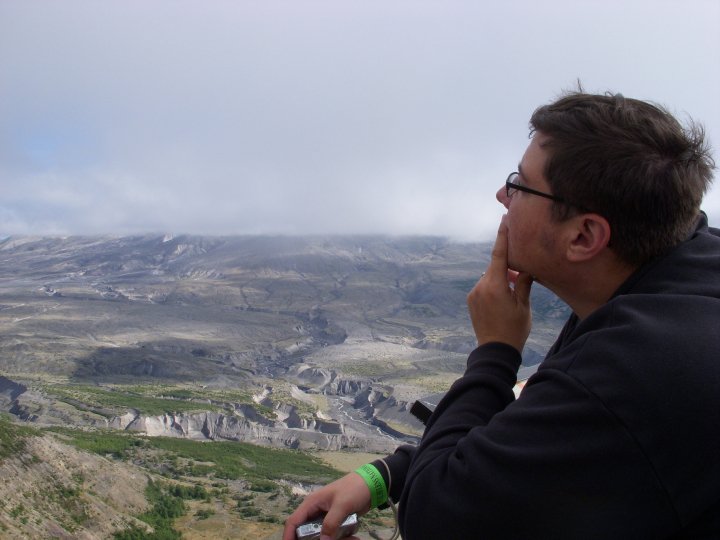
Everett contemplates a volcano

I contemplate a volcano

It was in the parking log at Costco where a woman, looking wholly bereft of home and afflicted of something came right up to me as if I were an old friend and asked if I could help her out by giving her money. I had been completely focused on how to get twenty pounds of flour into a space the size of one small Pomeranian, which assuredly is no easy task. So I nearly jumped from hearing her inquiry, and it took me longer than it should have to explain that I didn’t actually have any cash on me, sorry. She shuffled off, not unlike a zombie, and I realized she could have been a posterchild for the anti-meth campaigns of the Pacific Northwest. My heart went out to her, and even so, I was a bit unnerved.

It occurred to me after this incident that different places have different expectations for interacting with strangers. In DC it’s either tourists who are chronically clueless about their surroundings, laden with a map of the city or not, or it’s someone panhandling. The lobbyists, lawyers, government workers, hotel staff, cab drivers, administrative assistants, Metro drivers, and other commuters all keep to themselves, wanting no part of any conversation with anyone else. I rode the Metro for years, and very infrequently did I ever hear two people conversing who hadn’t boarded together. MP3 players were the best thing to happen to the silent travelers of DC—suddenly everyone had an easy means for ignoring the world around them.

So people looking for money from the hands of strangers kept, for the most part, personal distance, and requests were limited to the actual sidewalk or on public transportation. I think that’s why I was startled here in Seattle. I actually had to spend the better part of a second realizing that this wasn’t an old friend or acquaintance of mine, because she walked right up to me, and I in turn was right up against my open vehicle. It was her lack of recognition for whatever vulnerability I had at that moment that started my first sense of anxiety.

But for my part, I was just as destabilizing to her, because as soon as I recognized that all she wanted was money, which I was actually out of, having just left Costco, I went immediately into my DC-generated response when I don’t have cash to donate, which is, “I don’t have any money on me, sorry.” In DC this ends the exchange, 7 times out of 10 the requester will then ask God to bless me or tell me to have a nice day, and then I’ll wonder how much of their request was tinged with a need for human interaction and a measure of dignity that someone will talk to them. This woman, on the other hand, seemed shocked that I’d make eye contact with her, much less have a quick answer.

It occurs to me that people are less straightforward in Seattle than in DC, so people looking for handouts need to be more in their face. But the other big adjustment seems to be about sobriety: I can’t remember even a single instance of a non-sober person asking me for money in DC. Not a one. But everyone in Seattle who has asked for money has seemed to have an affect for one reason or another. And there seem to be many more homeless folks here than back out east, and I have no idea why that is. I’m sure there are experts out there who analyze such things, who advocate for this solution or that, but I don’t know who they are or what their positions amount to. But I’ve never thought about how different cultural expectations for civility play into how people on the margins express themselves. And clearly, there’s some kind of effect or panhandling would look the same no matter the geography.

For our part, I’m very glad to once again have a home. We might have been without a fixed location for two months by choice, but I don’t for a minute want to lose sight of the millions of people who have lost their houses or who are without their own home but who desperately need their own place. We are very lucky people.

Riding off into the sunset burns my retinas

To say I’m sick of driving would be to trivialize everything I’ve seen on my journey across the continent and back, would be to make too much light of the 8,600 miles of the trip, in which I’ve encountered everything from:

  • tiny baby bunnies
  • crystal blue boiling pools of adulterated water that are fueled by the unseen middle of the earth
  • exasperated parents who look like they’re questioning the entirety of their lives
  • all manner of coffeehouses and espresso shacks that dot the West like freckles
  • at least 50 species of birds—sparrows, swallows, hawks, eagles, kingfishers, vultures, quail, turkeys, hummingbirds, and more
  • barns and rural structures in all stages of their life cycles
  • blue-collar men who all looked dazed and stressed, no matter where I encountered them
  • lightning bugs outside a greasy spoon diner in Pennsylvania
  • long moments of coasting down from mountains just after fighting to get to the peaks
  • many, many anti-abortion and anti-Obama billboards
  • tired front desk hotel staff

All of these people, animals, and situations were notable enough that they left their impressions on me. I don’t know their stories, except in some rare instances in which we had time to converse. Like an unfinished painting, I’m left wondering about all of the open canvas and what could be drawn on to fill it in. Perhaps some of these things will get worked into a story or other over time, or my memory will do that thing I hate and blur different events together in its quest to find patterns and meaning. But that tendency is why I write things down—then I retain the edges of each experience.

That said, I am loathe to sit behind the wheel of the car right now, even to go set up Internet in our apartment or buy bread. I’m sure that this hatred will fade, but hopefully I’ll remember that I don’t particularly enjoy driving 3 days in a row for 12 hours a day.

We rolled into Walla Walla on Friday evening, having come through the evergreen forests along the waistline of Idaho. Sister cities Lewiston and Clarkston, watching each other from across a river and state boundary line, seemed small and a bit bedraggled, the road infrastructure not seeming to lead to any important point in either place. We opted to get some drive thru food, knowing how close we were and not wanting to take any more time at a pit stop. Finally, at long last, the wheat fields, close to harvest, signaling that we were almost back. I’d gotten so used to driving into the sun that I didn’t need to put on my sunglasses anymore. Around this turn and that, we swirled around the low mountains, revealing the last inkling of daylight and then burrowing into dark indigo again, weaving through what must have been a tapestry of bold colors, if only we’d had a bird’s eye view.

A bird’s eye view, I realize, is precisely what I’ve been interested in finding this summer. Something to help me understand my time in Walla Walla and how to get through the next portion of it when it inevitably sneaks up on me this winter. I’ve asked a lot of questions about who, what, how I am and I’ve enjoyed the funny moments, for sure (the leaky tub dripping into the kitchen below, not so much), but I do still feel the need for some larger perspective.

Maybe it’s all a big joke, a set on Laugh In that I haven’t realized is still being performed on a sound stage in southern California. Maybe I just need more time to elapse before I’ll come to the punchline, or the Big Reveal. In the meantime, we’ve reached Seattle, and wow, is this town a hoot. All this bluster about saving the planet but everyone chain smokes. Aren’t our lungs part of the planet, people?

I think this is going to be interesting, this fall.

PNWA, take two

I hopped on the bus, a sudden expert at the King County 560 route to Bellevue via Seatac. I don’t even know what half of that means. But it was the same driver, same bunch of drones heading to the office, and it kept occurring to me that I wasn’t seeing as many coffee thermoses as I’d thought I would. Maybe they all had stashes of coffee tucked away in their bags. Maybe I was in a parallel universe where coffee so perfectly absorbed light beams that it was invisible to the naked eye. Maybe coffee is illegal on public transportation in Seattle. But that would be too weird.

The bus ride went smoothly and I had plenty of time to grab my own cup of joe at the hotel before the workshops started, but then it all changed. I was at the courtesy vehicle ramp at the airport waiting for the hotel van. Waiting. For the vehicle marked Godot, apparently. More than half an hour ticked by, and finally he rolled by, stopping to pick me up. This wasn’t actually his choice, as I’d pretty much stood in front of him and blocked his path.

Now with six minutes to go until the editor’s panel, I had just enough time to grab some watermelon chunks, a muffin, and the proverbial coffee. Good thing I was there to network my six minutes, while stuffing food in my face before I fell over from low blood sugar. It was a great way to make a positive first impression, of course. The editor’s panel was interesting; I’ve posted it at the end of today’s blog. It’s good and somewhat dejecting to see how many kinds of editors, publishing houses, and distribution channels there are in this business. In my mind, trying to get that first book published looks like a daunting Venn Diagram: Agents in one circle, Editors in the second, Publishing Routes in the third.

Getting a book on the market is like playing pin the tail on the donkey, hoping you land in the sweet spot of the middle of the overlapping circles. In other words, it’s the dream of an ass.

And I’m all fine with that. I can ass around with the best of them. Especially while crunching my way through a few watermelon chunk seeds.

I went to a panel titled something like, “Vampires, Werewolves, and Zombies, Oh My!” and I appreciated the tip of the hat to The Wizard of Oz. It was great to hear what’s selling in that market right now—hint, it involves urban fantasy—and what is about to be done with, at least for a while. So I’ll have to shelve that book idea for the teen vampire romance, and here I thought I was being all original. I do actually have a book project going on right now that isn’t done enough to pitch, but I hope to lay out the concept and see if they think it’s marketable. These poor agents can barely stand in line to use the rest room without getting accosted, so I try really hard not to be “that guy” who doesn’t know when to shut the hell up. And by try really hard, I mean I don’t stop agents from urinating. Unless of course, my ideas during the pitch session are so bad that they spontaneously evacuate their bladders. That kind of effect I just can’t help. But when someone says, “Wow, I really need to go to the bathroom,” it’s only proper that you let her go, even though you know in your heart of hearts that if she just listened to The Incredible Idea she’d never have to pee again. That’s her loss.

I networked, I talked to other writers, a couple of editors, who are really my kind of people. I know what they do up close. I’ve done it, albeit for much drier material than this. But I get who they are as people, so I feel comfortable with editors. Agents just make me want to throw up with nervous energy. I have to dedicate a portion of my consciousness to slowing down when I speak with them so I don’t rattle off words like a machine gun.

I saw that my pitch session—which is a 10-minute block of time writers get at this conference with an agent one-on-one—was at the tail end of a workshop I wanted to attend. Its focus was on humor. I like humor. I walked in, looking for a chair near the door, but it was in a very small conference room, because hey, who gives a crap about humor? Note to PNWA conference coordinators, give a bigger room to humor next year. We nearly had to velcro attendees to the ceiling to fit us all in there.

I walked up to the presenter, Gordon Kirkland, who is Canada’s answer to Dave Barry. As if Dave Barry required answering. I apologized, saying I had to leave the session early and I didn’t want to be rude.

“Well, you’re going to be rude, but thanks for telling me about it in advance,” said the presenter. This was going to be a good workshop.

Kirkland had, legend tells it, basically locked himself in a room with a couple other writers in Edmonton, Alberta, to write a book in 72 hours. Fortunately we Americans don’t have to convert the time—it’s the same here as in Canada. But Kirkland brought this story up in his workshop, saying that nobody comes out of Edmonton except alcoholics and hockey players. I rolled my eyes, but most of the US folks in the room didn’t know the reference well enough to laugh too hard. Ha ha, they thought, hockey players. Those silly Canadians.

Some banter, as one can imagine, ensued. We talked about writing about our families, how humor works, etc., and then it was time for me to start practicing my pitch before my session. I stood up and started making my way through the throng to the door.

“And where do you think you’re going,” Kirkland called out to me.

“I’m going to my pitch session,” I said, “and by the way, my wife is from Edmonton!”

The room erupted in laughter.

Later, a writer to whom I had just told this story informed me I had left out a line in my response to him.

“You should have said, ‘my wife is from Edmonton, and she’s a hell of a hockey player!”

And that, right there, is why I love this conference.

I sat out in the hallway, and pulled up my pitch on my iPad. I read it something like 40 times in 10 minutes, not necessarily trying to memorize it, but so that I could hit every point in the synopsis/pitch. Gotta keep “edge of burnout,” gotta mention the bad hair dye job, gotta bring up the social networking profile for my cat. Once our time drew nigh we were to sit in chairs outside the ballroom doors and wait to be led in. This did nothing to lower anyone’s anxiety about the moment. Then a volunteer poked his head out and motioned for us to enter the inner sanctum. I drew my +3 Vorpal Blade.

Wait. Wrong story.

We walked down a hallway and then we saw the room of agents, each sitting behind their own table, each with a beverage at some point of fullness/emptyness. I had to walk by the agent with whom I’ve been corresponding. I nodded hello to her and she wished me good luck tomorrow, meaning the awards ceremony, for whom I’m a finalist (give a little yay! here). I found my agent and sat down. He was much smaller than I’d realized when I saw him sitting at the agent’s forum earlier in the day. He was actually a pocket person.

“I’m nervous,” I said. Jesus, Mary and Joseph, shut up! Just give the pitch, you dumb ass!

“That’s okay,” he said. “We can just talk.”

Suddenly this exchange had the tone of a teenage boy going to see his first prostitute. I figured I should just get up and walk away. Exploiting prostitutes isn’t right.

I told him I was going to pitch him a memoir. He sat back a little, waiting.

I said, “As Henry Miller supposedly said, the way to get over a woman is to turn her into fine literature. But that’s not why I wrote this memoir.”

Of course he wasn’t following me yet, because he didn’t know the Huge Transgender Topic of the memoir. But he didn’t look disinterested, per se. I told him the title, which is a giveaway on the whole book concept.

He looked straight at my chest. What a cute little pocket person agent. Thank God I usually query in letters. We talked for a bit, me giving the synopsis and then talking about my other writing, the speculative fiction stuff and the pop culture critique stuff.

“What other books are on the market like this,” he asked. I told him I’d made a book proposal with a full market analysis section, and he said, “oh good.” Quite the terse fellow, this one.

He never seemed really interested and I couldn’t get a feel for how I was coming across. I think perhaps future conferences should have a drop button so the writer can just fall through the floor onto a landscape of pillows. At least you’ll know their sentiment. He slid his card to me as the time for the session expired, asking for my book proposal. And then it struck me.

It was pity sex, this card. But I’d follow up and send it out to him. It wasn’t going to show him much in the way of voice, but it would show him that people buy books like this.

Next up was the dinner. This was a fiasco, as we stood in line for the buffet for half an hour, the hotel running out of food in the first 10 minutes and needing loads more time to restock. I was not pleased. When I sat down, other people had come to the table, not realizing folks were already seated there. I tried to turn it into another get to know new people thing. The keynote speaker was funny, but done way early for her time slot.

Several science fiction writers and I made our way down to the bar in the lobby, and decompressed from our day. It was a good day. I was glad my pitch session was over. Partway through my first 7&7 my friend who’s been hosting me arrived and he joined us. I could tell just in the car ride that I was going to crash once my head hit the pillow. And I did.

Day three starts in a few hours.

By the way, I lied, I’ll put the editor’s forum notes in another post.

Fly the Not Free Skies

Airplane movie stillThis was originally posted over at I Fry Mine in Butter.

Once upon a time flying was fun. Planes seemed shiny and glamorous, travelers dressed up, and nobody measured carryon bags with scales. Totally unthinkable were long lines at security and computers sniffing for explosive residue. Mottos like “fly the friendly skies” are long long gone.

It isn’t that I miss airline food, food being a rather broad category when it comes to what was served on airlines. I was one of those folks who chose to bring on his own meals, much like Hannibal lecture, minus the fried human brains. But at least one received a full can of soda. Not anymore. Now I get a plastic cup of semi-fizzy liquid and a piece of the iceberg that sank Titanic.

This is the first flight I’ve been on to offer wifi,and no sooner do 67 stickers adorn the inside and outside of the plane—so the birds can use it, I guess—than they’re charging for it, $13 a flight. That seems a little triskaidekaphilic to me. Why thumb your nose at Lady Luck, airlines?

So it’s one more luxury I won’t be getting, like pay per view on DirecTV or $10 beer in flight. But don’t call it for my convenience, that’s just disingenuous. If it were really for my convenience it would be free or $1. There are 30 rows of seats on this flight; $13 from each of us on multiple flights a day more than buys the modem in what, the first month? I know not everyone will want the service, but surely the price point was set to earn profit.

eastern airline wingsI remember as a kid getting to see the cockpit during flight and I completely understand why that’s not possible anymore. Yet can’t we give kids those stupid plastic wing pins? Those were cool. Kids don’t get crap these days, and it’s sad. Yes, I know times are tough for the airlines. We all cram our bags into the overhead compartments rather than shell out an extra $50 round trip for checking them. And then the air stewards get on the PA system and tell us there’s not enough room in the overheads so we need to be good traveling neighbors and put our smaller carryons under the seat in front of us. I’ve even had a steward hand me my briefcase after I’ve checked my suitcase, and that really got under my skin. If I’ve paid $25 to check the suitcase, I feel like I just paid for leg room, so don’t tell me to cram anything under the seat in front of me.

Also, I don’t get that money back when they lose my bags, which has happened more than a couple of times. It just can’t be that saving 3 ounces of soda per traveler is more important than customers feeling they’re not getting ripped off. I know, I know, I should be happy that I’m flying through the air on a bunch of metal and plastic. I think I just want to feel like I’m being treated a few rungs above chattel.

And yet, there’s that small cup of soda in front of me. I wonder how long I can make it last on this four and a half hour flight.

Oh my God, I think I’ve become a grumpy old man.