Archive | LGBT Civil Rights RSS feed for this archive

The thing that drives me

Not really an excerpt

There are two kinds of writers in the world, those who overwrite and those who work for test laboratories.

I often write more than will end up in a story or piece of nonfiction, and I see this as a blessing rather than a curse, since trying to pack things on a skeleton of prose is for me, difficult and prone to introducing everything from a non sequitur to a blatant inconsistency—I’m much more orderly when I stick to my process, which is:

Write down initial idea—this can be anything from a character I keep thinking about to a rare astrophysical condition to some circumstance that would explain a mystery

Expand on initial idea—Aliens on Parade grew out of a question I had about how traveling by wormhole could go wrong once in the hands of a lazy or in-over-their-heads government. I started thinking about technology: if we “discovered” how to open wormholes in space, would we also inadvertently be inviting people in? If answer = yes, then what happens?

Identify the actors—my bio sketches start out very simple and I grow them from there. Age, race/ethnicity, gender, orientation all help me figure out their positions, power, and privilege in society, whether it’s a society I’m trying to reflect or invent. Because I see these things at play in the actual world, I feel responsible to bringing them to bear in my writing. But their back stories are more complex. I’ll put in things like “was mugged two weeks ago,” “has unmanaged bipolar disorder and self-medicates with alcohol,” “won’t let anyone meet her mom because she’s on welfare.” I don’t feel the need to write out absolutely everything about them if I’m writing a shorter story, and I try to come up with circumstances for them that let me see greater depth of character when I need to.

Visualize the scenes—this gets harder for longer work, so I keep it flexible, and I will add and subtract to this list over time. I think of this like one would map out a scene shoot for a film. What do we have, where do we have it? I deeply appreciate any writer who can create scene description and keep it interesting, and not just because it’s a magical street in a magical city, which is supposed to be magically interesting all on its own. Once I’ve got a sense of my characters, I try to come up with places where they will be best expressed and then make sure it will work with the plot. If I can find a perfect setting to enhance the tone, then great. In my short story, Underwater, I tried to paint a minimal picture to ask the user to fill in with their starkest memories, while keeping the places in the story bereft of emotion other than tired and empty. I think it works for a story that’s under 2,000 words like this one. My novel-length sci fi piece, Superqueers, spends a lot more time showing different neighborhoods in Washington, DC, because I wanted to work against the every-city feel of other comic book hero stories. Incidentally that story grew out of an image I knew I needed to write 20 years ago, of a small greasy spoon diner and a very large man who drinks coffee there, spilling a lot of it and using many, many packets of sugar in the process.

Do the first draft and don’t stop—At this point, I can’t not write any longer; I have to type words out through my fingers now now now. I will take a few pages to get up to speed, although I don’t like seeing it this way. I’d love to think my work was perfect out of the gate, but in reality I’m in last place until the final turn, to drag the metaphor through the mud, mix it and beat it like a dead horse. I and most everyone I know need to do an awful lot of rewriting before I will say the words have been crafted. No blacksmith made a nail with the first strike. But this rewriting process will come later. I don’t worry about it because I’m writing, I’m progressing, I’m telling the story. I may not use the section or piece of dialogue later, but I will save whatever I write in the first draft. Everything lives in the first draft. If I sit down at the computer on Day 2 and I hate everything I wrote, I can start anew if I can’t write anything else, but I will not delete the crap from Day 1. Draft Number 1 holds onto everything. While I’m getting through this first draft I will return to the character bios and the scene list and the original idea, and update them. Matilda is allergic to strawberries. I need the boat out at sea, not at the dock. Those two characters are too similar so I’ll merge them into one and make a note to rewrite the dialogue in chapters 1–3.

Rewrite until it doesn’t suck—other people may have higher expectations for their writing, but I’m shooting for not laughable. Perhaps I’m being too modest; I think I’m a good writer, but I don’t want to get stuck on myself, and I know by now that things can always be improved. I have no love for self-absorbed writers, no matter their level of talent, so I strive not to become one myself. I can’t say when I think a story is done, but when I go through on say, the 20th pass and only have tiny changes to my language, it starts to occur to me to work on something else. I’m either blind to the quality of prose or I’m deadened to making changes and now’s the time to go revise something else or start something new. All the while pitching my best stuff to agents and journals. But that’s another post for another day. This rewriting phase starts out intense and mellows out, kind of like March. I’ll cut whole scenes, chapters, characters, change the ending, put in or take out subplots. Thank goodness I’m writing and not building houses, because I’d destroy every budget I saw.

With that in mind, here is the very original dream from my memoir that drove me, eventually, to transition. It’s no longer in the memoir itself, but it’s referred to and is the backstory for the main character—uh, namely me—and I revised it something like 10 times before I struck it entirely, so it’s rougher than the rest of the writing at this point.

Trees, everywhere, mostly evergreens. He looked around at them, some clumped up closely, branches looped together with their neighbors, some isolated from the rest, the lot of them with varying heights and apparent ages, climbing up the side of the mountain. Far below the side of the mountain the trees were reflected back almost perfectly from the surface of a very still, large lake. He wondered how he’d gotten here, patting himself down absentmindedly, as if identifying the things in his pockets would reveal a useful memory. Looking down at his clothes, he recognized an icon of sorts. Is that what they’re called? Icons? Stereotypes? He was struck by the idea of lumberjacks. This was probably because he was wearing a red flannel jacket, or shirt, he wasn’t sure. It was something in between, and it would later occur to him that there is in fact, a hybrid jacket-shirt-thingy for sale on the men’s fashion market, if one used a very loose definition of the term, “fashion.” But he did notice, after taking in the color and texture of it, that it wasn’t quite warm enough for the brisk morning air. Wait, was it morning?

He squinted at the sky, a pearly blue with a few wisps of cirrus clouds high, high away. Well, he knew what the hell a cirrus cloud was, that was a start. When had he learned about cirrus clouds? He had a clear memory of Mrs. Warms’ 8th grade science class at that crappy Catholic school on the main drag in Princeton. The one with the scary nuns. And then on graduation day with their caps and robes on, they all looked like nuns and none of their parents were clued in to the trauma that their children were experiencing.

So okay, he’s made it past elementary school. Good to know.

He took a few steps, only then realizing he had on light brown worker’s boots, with his jeans pulled down neatly over the tops. It occurred to him to touch his head, and to his shock he realized he had on a knit cap. He took it off and inspected it. Navy blue, maybe, or black. Size 7. Carhart brand.

Holy shit, he really was a lumberjack. That couldn’t be right, could it? He looked around for an ax and a large blue beast of burden.

Before he could continue on trying to figure out who the hell he was, he heard a voice behind him.

“Daniel! Daniel! What are you doing over here?”

He turned around and saw a woman running up a trail he hadn’t noticed, what with the sky looking gorgeous and the trail looking blah. She was wearing her own knit cap, plaid jacket, jeans, and work boots. There apparently was some kind of outdoorsy uniform going on here. Her cheeks were bright red from the cold and her spontaneous bout of jogging. Brown curly hair stuck out in gravity-defying directions as soon as it cleared the tight hat. She left the impression of looking like a balding Troll doll that had spent some good quality time under a diffuser.

He had no idea why he knew what a diffuser was.

“Hi, Kathryn,” he mumbled. He knew her name. Another surprise. Who was Kathryn?

“Daniel, we need you at the mess. Why are you all the way up here? We’re running out of pancakes and French toast, and Jackie doesn’t know how to make the dishwasher run.” She put her hands on her knees as she bent over, panting.

“Daniel?” He looked at her. He knew her name, but he didn’t know why she was calling him this.

“Yes?”

“Who’s Daniel,” he asked.

“You, silly.” She stopped a moment. “What’s wrong with you?”

“Nothing. I just didn’t think that was my name.”

“Uh, what did you think your name was?”

He started to say and then stopped. It wasn’t right. Under this brightening sky, in the cold air, dressed like an extra from a Monty Python movie, something wasn’t right.

“Nothing, I’m kidding. I just wanted to catch the last of the sunrise.”

“Well, we need you, Dan. Come on, before the President runs out of breakfast.”

“The PRESIDENT is here,” he asked, following her, feeling his footsteps crunch as he made them on the frosty ground.

“The President of the Bucks County PTA. It’s their group that picked the campground for their stupid conference this weekend.” She looked at him like he’d lost all sense. She wasn’t far off the mark.

“Right, right.”

“Jesus, what did you do last night?” Her hair bounced around as she shook her head. He had the distinct impression that her cap was about to shoot off of her head from the pressure of her curls.

They walked into the mess and half a dozen children were upon him, tugging at his shirt/jacket and looking for more flapjakcs as if they might be hidden in his pockets. He hoped he could remember how to make a pancake, if he didn’t even know this name she was calling him.

He passed by a mirror, and got a look at himself just before entering the kitchen. Tallish, with a big, thick beard, hairy wrists and hands, twinkling brown eyes, wrinkles that implied he had smiled more often than frowned in his life. He was a mini Paul Bunyan, in fact. He realized precisely then that he had always wanted to be Paul Bunyan and only Paul Bunyan. He loved who he was now more than ever, and it had taken a long time for him to become the man these people needed and cheered. And that was really odd, for some reason.

And then I woke up.

You know you’re old when…

One beer consumed with dinner still causes a hangover the next morning. Apparently I now need to drink twice as much water for whatever alcohol I’ve consumed which 1.) really doesn’t feel good to do at the time, sloshly stomach factor-wise, and 2.) makes one look like an old fart when he’s trying to be sociable. But okay, message from brain received. And I’m living in wine country why again?

The same set of stairs one has used for the past 19 months start to cause joints to sing a song, a little longer every time they are traversed. Once upon a time my right knee (the non-operated-on one) would click a couple of times while climbing the stairs in our house. Now it sings like Pavarotti. This is why I’m happy to announce that my right knee has a new recording contract from CBS Records.

You jump up and down with glee when getting carded for the beer mentioned in the first paragraph. And then you realize that jumping up and down doesn’t work so well anymore, so you just smile a lot, now looking like some creepy, semi-crazy dude. And the picture on your ID is horrible to boot, so you’d rather not show it to anyone. That gets the smile to go away pretty quickly.

Whatever skill you’ve gained from experience starts to become eroded by a lack of memory in how to repeat it. Sure, I’ve made the Joy of Cooking’s pancake recipe hundreds of times, but I still can’t recall the ingredient list, the page it’s on, or which measuring cup makes the best pancake pouring device. People are kind enough to eat them anyway. But I know they’re humoring me.

Those two gray hairs you’ve been avoiding suddenly decide to throw a gray hair party, and you realize you’re growing a clump that makes you look like Jay Leno. And that guy is such an ass clown nobody wants to look like him. A sudden red beard would be so much better, but there’s not a drop of Irish in you.

You see punk teenagers chasing ducks around for fun, and you yell at them to stop. Oh my, ain’t that just the mood killer? You realize you are That Guy. Long live the high school class of 1988.

Lessons from Walla Walla

walla walla balloon stampedeNearing the end of our initial stint in Wallyworld, I feel it only appropriate to take stock of what lessons I’ve learned thus far, as part of what I’ve tried to do while living here—otherwise known as how to carry on when lots of things in one’s life have gone awry. Through a torn ACL and meniscus, the free-fall of the world’s strongest economy, 30-some-odd inches of snow, for which our passengers tires were completely insufficient, and the sudden adjustment that accompanied moving from a town in which 70 percent of the residents were registered Democrats to a town that went 57 percent for McCain in the last election, I’ve tried to keep up, somehow, with my new reality. And along the way I’ve picked up a few things that I promise to take with me as we start our road trip and half-year sabbatical. These are, in no particular order:

  1. There is nothing that being in a hurry makes better, except possibly catching a ferry. I spent a lot of time in DC rushing around, and now I wonder why.
  2. Listservs just aren’t as good for meting out advice as real people. Sure, I appreciate the community list, but asking my local pharmacist who they recommend for something, even when it’s unrelated to pharmacy, helps get me information they feel attached to, and thus, it becomes better information. This is how I found the second dry cleaners in Walla Walla. For the record, there are two dry cleaners in Walla Walla. The first was cheap but a bit brusque, if anyone cares to know such things.
  3. It’s not what you do, it’s who you are. This was a hard one for me. Career was very important to me before we moved; it was something I worked hard for, found accomplishment in, and that I could appeal to when I asked the question “why.” I also quite enjoyed the salary I eventually made, but again, I worked damn hard for that salary, including working at 3AM on a Saturday for a company vice president who was just about completely incompetent, and having a report thrown at me because the president didn’t like how much it had cost to produce. Fast forward to today and I’ve now been out of a job for 19 months. As long as I was focused on what I didn’t have, I tasted my own bile with the level of frustration I felt. But in the meantime, I’ve mentored people who really needed someone to listen to them and encourage them, I’ve helped out a mom with her newborn when she needed a sitter, I’ve tried to help people just this side of lonely make new connections to others, and I’m currently working on shining a spotlight on the emerging Walla Walla food culture/community, and I think those are all good things. None of them has made me a penny, and in a way, that’s very liberating. My sense of self has shifted from me inside an office to me beyond an office.
  4. Sometimes you just need a nice glass of wine at the end of the day. Or if wine isn’t your thing, iced tea. Or some other refreshment, so long as there’s a moment to decompress from the day’s activities. And if chocolate could accompany this moment, all the better. But remember, we have to breathe before we take the next step.
  5. When faced with an opportunity to do something unknown vs. already experienced, go for the unknown. I suppose this is another way to say nothing ventured, nothing gained, but damn, that phrase is old and worn out. We could have stayed in DC and not come to Walla Walla, sure. And Susanne would still be teaching as a part-time instructor and I would still be working for the government. And I would not have found the time yet to get to my writing. This would all have amounted to limbo as humans live it. So even if this writing thing is a pipe dream, I’m glad to be doing it, and not a week goes by that I don’t hear at least once that what I’ve written has meant something important for someone. All because I arranged pixels on a screen. That is really touching to me.
  6. The more you make your life about learning Important Things, the less you’ll really know. Another hard one for me, since I’ve been all about the learning and growing my whole life. But I see now that I’m not less of a person for not knowing rocket science. The beauty of this position is that I can learn constantly, just by being aware and being principled. This drives me to keep picking up other people’s stories, because I can’t live everyone else’s lives. So the next best thing is hearing them, asking questions and paying attention. I aim to walk a whole lot of miles in other people’s shoes and spend less time fretting about what I don’t know.
  7. Having a sit-down supper most nights is a great excuse for talking. I know, this means I need to close my laptop. I’m okay with that, because on any given night, it could be cheese grits with asparagus and seared pork chops, or curried chicken over rice, or smashed red potatoes with roast chicken and wilted garlic spinach. And I wouldn’t want any of those things to get in between the keys. I also like recapping the day and enjoying another person’s company while having tasty treats.

These weren’t the lessons I sought out when we moved here, but these are the ones I’ve run into. And I recognize that the edge of interesting and trite is razor-thin, so if anyone has puked on themselves reading this, my sincerest apologies. But at the end of the analysis, these have turned out to be important to me. It’s not that they weren’t important before August 20, 2008, but they were just hard to hear through the din. I would genuinely love hearing other folks’ life lessons, so feel free to add them in the comments to this post.

Driving mechanics

railroad track signReflecting on all of the intersections within Walla Walla, I can’t recall a single NO LEFT TURN sign. Not by the Bi Mart, south side of town. Not at any point on Isaacs Road, which is a straight shot east into the Blue Mountains and which is littered with fast food shacks, auto parts stores, car washes, and oodles of plain gray parking lots. Not in the small downtown, even though every other city I’ve tromped through has boasted at least one stubbornly red sign.

It’s a small thing, I know, but it takes on a bit more meaning once one ventures into a large city with any kind of traffic issue. One finds oneself in a strange place and on the wrong street, and once the first battle with orientation is settled, realizes that the quickest way back to the tiny quadrant one does know is forbade by the local powers in charge. And then one is faced with a decision: break the law and feign innocence, or try to find another way over to the relief zone.

In DC, drivers could find themselves hitting a series of NO LEFT TURN signs, their frustration building quickly as they creep along, stuck behind other tourists, bicycle messengers, and a lot of men in suits with big briefcases.  And here the visitors thought government was trying to go paper-free. Little do they know that those are more likely the private sector guys. There are 50,000 practicing attorneys in Washington, DC.

In DC, defensive driving means watching out for all the Lexus owners texting while driving, the cars with fake paper license plates in the rear windows that add the important note, “STOLEN,” and the truly clueless in RVs. Who the hell RVs to a major city? Sometimes I would stand on a corner and laugh while they circled the block, trying to find parking. I wasn’t trying to be mean, it was just such a great pastime. Twice in DC my car was hit while I was idling at a red light: once from a guy who slid into me on black ice, and once when a driver in front of me backed up, trying to make room for a turning tour bus. These things just don’t happen in Wallyworld.

In Walla Walla, defensive driving means looking out for small children who’ve broken free of a parent’s grasp, slowing down for momma and baby ducks, and watching the red light runners, which I’ll get to later. These things tend not to happen in DC, although there is a street over by the army hospital with a goose crossing sign, and the two days I was on that road, I did in fact have to stop for crossing geese. It was almost as if they waited for my car just so they could cross, which I’ll note is the logic most pedestrians in the city, use too.

I’ve been made aware of the split between this corner of the United States and the world inside the Beltway that ensnares everything in the District. It has come in the form of massive snowfall. And it has come in the total lack of snowplowing afterward. It’s shown its face in the 5-minutes-to-anywhere nature of the city confines, a distinct difference from DC, in which most things are at least 35 minutes away, no matter how one travels. 2,800 miles away from the Capitol’s epicenter, how government really functions is invisible to people, who have en masse decided to decide that everyone in government has their worst interests at heart. And I try to explain as gently as possible that the government is just like every other office they’ve worked in, with all of those personalities working against and with each other for 8 hours a day.

These discrepancies remind me that we fear what we do not know. I’m not a subscriber to the “if we educate, we’ll have world peace,” because I’m far too cynical to believe that bigotry, oppression, and anger are only the result of ignorance. People have stakes. People earnestly believe their group (read: race, nation, state) has stakes that are threatened by some of other group. I could no sooner “educate” Rush Limbaugh and inspire him to be a bleeding heart liberal than I could teach a worm to fly, and I say this feeling pretty certain that even Rush doesn’t believe half the crap he spews out into his microphone. But Rush has a stake in his persona, and like everything else, if he’s not being increasingly conservative, he risks becoming irrelevant. And so he spews.

In the same way, people dig their heels in about what they think government represents, who they think it represents. It’s been a long time since I heard anyone say they feel personally supported by the Federal government, even as they drive on interstate highways, take their kids to the public library, call 911 when their kitchen’s on fire, or go to their child’s high school graduation. Instead when they make the pilgrimage to DC they get caught with one-way streets and NO LEFT TURN signs and it signals to them that they’re unwanted, when all it really means is there are way too many cars on the roads in the city and someone is trying something to make the system keep working.

Walla Walla is a place where people run red lights all the time. I was astonished when I saw the first runner, because I’d been conditioned out of it from all the ticketing cameras that have grown into the East Coast traffic system like kudzu, and because I’m such a law-abider, my exception that of speeding. I never saw a speed limit that 7 more miles an hour didn’t make better. But going through a red light, to me, was just jaw-dropping, in the same way that any minimally suicidal tendency is, like intentionally gaining 500 pounds, or BASE jumping.

But maybe it says something about the garden variety Walla Wallan. As if the rules don’t apply out here. Or that my neighbors and fellow car drivers won’t mind. It’s just one light. It’s just today. It’s just that it’s 3AM. It’s just that I see other people do it all the time.

In this kind of context, what else can the government represent but an angry nanny, an everything-is-rules custodian who seeks to end pleasure and red light running, out of spite? I shouldn’t be surprised at the level of distrust, I suppose.

I wonder what 20 months in Walla Walla has done to change my perspective, what new kinds of things I’ll see as we drive back across the country, and what I’ll miss that I wouldn’t have before. I am the guy who wants to discover the hidden world in the sidewalk crack, a focus on fascination that I’ve carried with me since I was 3. I want to start seeing where we come together because I am damn tired of seeing how far apart we are. I want people in DC and Walla Walla to know that they are closer than they think: in both towns I was a regular customer of several businesses, laughing with them about inanity. Both towns boast big, tree-covered parks. Both towns struggle with caring for their elderly, face cutbacks to their education budget, struggle with aging and fading infrastructure. We could learn a lot from each other.

I am not looking forward to being told I can’t make a left turn. But I won’t blame anybody about it, either. I’ll try to take the laissez faire attitude of the Northwest to the Type A personality of DC. I’m a peace ambassador.

Fleeing vs. Invading

This is cross-posted from an article I wrote for I Fry Mine in Butter, a terrific popular culture blog.

holocaust mini seriesIn thinking about the anti-immigrant it’s-okay-to-use-racial-profiling law that passed in Arizona last week, my mind flashed back to V, all the way back to 1983. Knowing that it’s only a matter of time before the Gestapo, I mean, the Visitors, come to take them away for being illegal, I mean, scientists, they ask their former landscaper, Sancho, to get them over the border. Though this storyline and plot moment is fraught with all kinds of stereotypes about Latinos, Jews, police, and the power dynamics between these, it’s still written from the point of view of the smuggler as hero. Of the Latino smuggler as hero, no less. I can wrack my brain (okay, I have wracked my brain, through a nasty course of stomach flu, in fact) and I cannot come up with another instance in the last 40 years in which a mainstream television show or movie depicted illegal immigration by Latinos in this way. (To see the clip, start watching about a minute into the segment below.)

I can, however, come up with dozens of positive depictions of other people fleeing across borders illegally and/or without proper documentation, including, but certainly not limited to:

The Sound of Music

Holocaust (American mini series, 1978)

The Terminal

In America

The Visitor

Gotcha

the visitorThere are also films too numerous to count with positive depictions of legal Latino immigrants in the United States. So why the gap? Wasn’t the U.S. founded by . . . uh, wait a minute. I suppose the U.S. was invaded, after all, over a course of hundreds of years, mostly by Europeans. So perhaps it doesn’t bother us to cheer for people who are emigrates from say, Austria to Switzerland. We can identify with wanting to leave the Continent, is that it? Those countries are so small anyway, it’s like you could sneeze from one sovereign nation to another, so it’s okay if you know, you happen to be on one side of the border, because it’s so likely it would like, be a total accident. Sure. We can get behind that.

Many of these positive narratives spend quality time explaining the circumstances that drove the characters to seek refuge in another country without proper paperwork, in fact, they justify why documentation wasn’t possible under the circumstances. Hell, Clan of the Von Trapps don’t skirt across the Alps until the last 20 seconds of the movie, and that shit is 3 hours long. So, for fascist governments, real or pretend, fleeing is okay. Emphasis on fleeing, as in leaving. Neither the Von Trapps nor the scientists in V are entering the USA.

elian gonzalez at 16The Arizona law also fascinates me because we’ve just passed the 10th anniversary of the Elian Gonzalez fiasco, in which his mother and he set out for the US, leaving behind Cuba and his father. His mother died en route, his relatives in Miami laid claim to him, as he was, after all, fleeing a Communist nation we would accept him once he set foot on U.S. soil. He was 6 at the time. The legal battle that ensued, the taking of Elian by gunpoint from his quiet Florida bedroom, those were shocking images at the time. But we were happy to have him here, even though he didn’t have a stitch of paperwork on him. He was fleeing from forces that weren’t his own making. He was running to a better life.

I think perhaps that’s where we all get caught up. It’s this idea of a better life that is possible here, and not in say, Canada. Mind you, tons of people immigrate to Canada every  year, but we don’t pay that much heed. We’ve got the damn melting pot. Those Canucks, as they told us last Olympic Games, have the tapestry. Whatever. My point is, we’re not paying attention to the circumstances of immigrants—legal or otherwise—when we talk about neo-fascist laws like this one in Arizona. We’re only debating the effects of the law. Immigrants in this polarized, often reductive debate get reduced merely to some monolithic infiltrator: they’re coming here, they want something from us. Maybe we don’t have enough melting pot goodness to go around, and they are looking hungry for s’mores.

It doesn’t suit hegemonic ideas about what the U.S. stands for to say this immigrant is not equal to my grandparents who were immigrants, because every new wave and new region of immigrants has received its due course of stigma in this country. But culturally speaking, as narratives go, the idea that new bodies are in our midst who want our jobs gets a lot more air time, and with the fear that Latinos will be in majority in just the next 20 years, well, that gets some English-only speakers a bit nervous, perhaps. Here, of course, jobs are watered-down as well, not the focus of the conversation, because once you get into which jobs we’re talking about, the hate-mongering around undocumented workers makes no sense. Are we really afraid that there won’t be enough migrant farm worker jobs? Or other poorly paid, under-the-minimum-wage jobs?

Maybe we could use some more narratives, some more instances to humanize the humans who are here with us. It would have to be better than nothing. I’m not suggesting that art and narrative changes culture, but I think the time has passed where we can continue to frame immigration from Latin America as a wave of less-than people coming to take something that isn’t theirs, when that isn’t the case and when that wasn’t the criteria for our Founding Fathers.

Note to self: chai means spicy

I’ve got a reading coming up Sunday evening as a local performer in the Tranny Roadshow, and thus I wasn’t terribly surprised when the Union-Bulletin, the local rag here in town, contacted me for an interview. I mean, it would never have happened had I remained in DC, unless one counts the Mirror company as a reputable newspaper. As it is, the “U-B” as people (affectionately) call it, is a bit more than a stone’s throw from being a paper that one retrieves gratis from the brightly colored  bins that litter the sidewalk like plasticized hawkers near a carnival. Apartment Guide! Great Jobs Listing! FREE Yellow Pages!!

It’s not that I have anything against the U-B, it’s that people I like have things against the U-B. Their Web site needs an overhaul, for one, with a one-inch column in the middle for the actual article content, and a thick bar at the right advertising things I will never buy, even if I live for 100 more years. I just can’t get worried enough about my nonexistent prostate, and I am not going to learn some random mom’s secret for white teeth. I suspect malware is part of her solution, see. But really, my indifference to the U-B is that there doesn’t seem to be any real reason to get a copy. I hear everything I need to from word of mouth or my news feeds. I know when the WW Balloon Stampede is coming, and I’ll be there. The rodeo happens the same Labor Day weekend every summer. If a resident of Walla Walla knows more than 5 people in town, then she probably will hear about every event for the next upcoming weekend that she cares about. If I wanted to know what the Elks Lodge is up to, I need only walk three blocks over and ask them. It’s just not that big a town. And I’m sure they know that’s a stumbling block to keeping revenue up.

So maybe I’ve been missing out by not procuring the U-B regularly, and now that one can’t read their articles online anymore without subscribing (even the New York Times is cheaper), perhaps I’m too cut off from the goings-on in my own city. After all, Walla Walla is light years away from having any interest in a Wallist-type blog.

The other thing that concerned me when I got the reporter’s email was that my bleeding heart liberal friends tell me the U-B is unflinchingly conservative. Now, I don’t care what they do in their own home, but I don’t want that stuff shoved in my face, know what I mean? Just what kinds of questions were they going to put to me regarding something called the Tranny Roadshow? On the other hand, I’m the one peddling my sex change memoir to every agent I can Google, so I’m not exactly hiding in a cave.

I thought about her offer, and talked to a few people, and said okay, let’s meet up. We agreed to meet at Cafe Perk, in the middle of downtown, which granted, is two blocks wide by six blocks long, but it has a heart, damn it. I tend to go to this place only when I’m having a meet up with someone, because the Patisserie has too many people I know in it, and I don’t want to blow the feeling of just rightness that I have when I’m trying to bang out another chapter or short story with memories of invasive questions and avoidant answers, the kind of repartee that Sarah Palin wishes she had with Katie Couric.

I got there a little early on Monday morning, and ordered a nonfat chai. I forgot to specify a vanilla chai, since out here in the Pacific Northwest, “chai” means “burn your mouth out” and true to form, I felt the tastebuds on my tongue sizzle and die. For some reason this made it a little difficult to speak, like I’d experienced when I’d gotten my tongue pierced at 28 and the thing had blown up to twice its normal size. Three days later I was fine, I swear, but in the meantime I sounded like I was wearing vampire teeth. Great. Maybe my mouth would settle down in the next 8 minutes.

It did not.

She seemed extremely young, like 4, so maybe she was a prodigy or maybe she would just ask softball questions, not wanting to get into the nitty gritty of What It Means To Be Transgendererer. I smiled. She looked like she was from Minnesota. Very Nordic. I guessed her father’s name was Thor.

Gosh, she was just so excited to write this article, to run in Thursday’s edition. Usually she got to write about things she knew. I could picture the small and worn-out newsroom: buzzing fluorescent lights in the ceiling, desk calendars filled with notes (buy ham) and doodles (Obama with horns on his head) dotting the desks, a ripped section of carpet fixed unceremoniously with duct tape, and one very tired entertainment editor contemplating retirement as he reads the press release that just came over the fax machine. Trans what? Give it to the pre-schooler, I’m not handling this.

I decided to give her a break. If I was the first trans person she’d ever met, maybe I shouldn’t be a total card.

We talked about how I’d come to know the Roadshow even existed. It’s not a very interesting story, and hopefully it will be revealed in tomorrow’s paper. It’s true that I met my future wife there, but it wasn’t our first date. I was still in the wake of a crappy breakup with a crappy person who’d spent two plus years being crappy to me, but I noticed that there was a cute, smart woman at the show. So what if our first date wasn’t until 10 months later? When she asked me why I thought people should go to the show, I had regular, plain, somewhat accurate things to say, but I did flippantly include the “you never know, you could meet your future partner there” line. I’m curious to see if that made it in there.

She didn’t ask either of the two worst questions to ask a trans person, which, for everyone’s edification, are:

1. What was your name before?

2. Can you come to the ladies room and drop your pants so I can see your hee haw?

Both of these have been asked of me, one on many occasions. I won’t say which.

She did ask, however, how I identified, and I didn’t want to answer that one, mostly because I didn’t think it was relevant to the article—it would be like asking the bronco riders how they identified as rodeo participants—but also because I didn’t want to be pinned down for all of my fellow residents to read, at least, not until they all jump on some list that gets hung on Main Street listing their most embarrassing moment, because that seems about equal to me. But her manner of asking was nice, almost apologetic. So I said that these terms are in contestation within the trans community and that they have different meaning in mainstream culture, and I didn’t want to take all of that on in this one article as my personal legacy.

See? I should go be a politician. We moved on to the show and I said it would be a lot of fun, tickets aren’t usually free, and people should check it out. She asked why I’d pointed the show organizers to the local liberal arts college. The smart ass in me wanted to reply that I thought it better than sending them to the local Jesus Christ of Latter-Day Saints church. But honestly, I don’t know about venues in town outside of the college. The Fairgrounds seem a skosh too big.

The reporter was nice, nodded a lot, didn’t seem to want to make me out to be a laughing stock—which we all know I do quite well enough on my own—and I felt pretty good after it was over. Now we’ll see, tomorrow, what the editors have done to the story. And come Sunday night, I’ll know how much of a success it was. For all of the LGBT folks in town who don’t get a lot of open air gay time, I think this will be a good thing.

And yes, I’ll pick up a copy of the U-B tomorrow. It’ll be the first one I’ve bought.

Requiem for a job

smurfette in her declineI spent a lot of time thinking about what I should do, occupation wise, when I grew up. I had a poster of a smiling Smurfette sliding down a powerfully bright rainbow, exhorting that girls can do anything. Being a precocious 8-year-old, I aimed straight for the top, Icarus or no Icarus, and settled on POTUS. Why not president, after all? After a time I saw reason, and selected doctor instead. This wasn’t as big a leap as it might seem, since I spent a good amount of time as a child in hospitals and medical offices, and doctor clearly equaled boss. Which is who I was. I was boss, at least until I stepped out of the house to wait for the bus and came into uncomfortable proximity with the bullies from my neighborhood, and at that point I was pretty much clear that they weren’t responding to my personal sense of leadership.

For a decade, I had picked physician, and it’s difficult for me to explain why I was quite so attached to the concept for so long. I was a kid who thought that there would come a point in my life during which I would have learned everything there is to learn. I hadn’t thought about the progress of humans, clearly, but I also hadn’t given any quality thinking time to the space after I’d absorbed it all. What would I do then? Reread it all? Become a globe of light?

Someone at some moment exposed me to the idea of histology, and my dreams of Dr. Maroon evaporated. That just seemed too hard. I went with the wave of young women giving up, perched as we were, at the precipice over the ocean, quietly taking our turns leaping in. So willing, those lemmings. My friends had gone from talking about fighting fires and scuba diving to find new marine life to being secretaries and nurses. Don’t get me wrong, there is nothing wrong with office employment or nursing. There is something wrong, in my book, with giving up on one major life goal due to insecurity, but to add the arbitrary nonsense of insecurity from one’s gender, race, or ethnicity, and the world starts to go off the rails a little.

And yet, even as I write this, there are four women in orbit around Planet Earth. Clearly the confines of the 1970s have relaxed quite a bit. I only had the Space Camp movie and Sally Ride as models and hell, I was a long in the tooth teenager by then, my fate already sealed. Okay, of course it wasn’t but I also believed, having not yet acquired a distrust of stupid talking people, everything adults said to me, even when they were clearly incorrect or limited statements. For example, upon graduating high school after 12 years of Catholic education, I honestly believed that people were only ever one of the following:

  • Catholic
  • Jewish
  • Protestors

I have no explanation; we all had to take world religions our third year of high school. I read about Confucius and Hinduism and the Qaran, but I didn’t see those kids in my world, so they must not have been in the United States, or at least, New Jersey. But these contradictions didn’t worry me one bit; I bought what was told to me soup to nuts, and trusted that I was not science-y enough to be a physician. I did get praise, however, for my writing.

rorschach inkblot testWriter, however, was not a word that instilled happiness in my parents. It sounded to them like a straight shot to poverty and narcissistic delusion. Before I could blink my mother whisked me off to Philadelphia to take a battery of tests otherwise known as career counseling. I sat in a wooden chair for 6 hours filling out Myers-Briggs questions, a Stanford Binet IQ test, ink blot and other occupation-oriented tests. And voila, a couple of weeks later, a lovely letter came in the mail with the answer, as if a civil servant and a carnival fortune-teller had a love child with a fixation on material wealth.
I was strongest in expressing myself, I had a genius ability to handle spatial relations, and I was scraping genius on verbal ability, with an exceptionally average ability at math. So of course they decided I should be a lemon grower. Okay, they didn’t say lemon grower. And sadly, there is no Lego Building major at our institutions of higher education, anywhere. The letter said I’d be good at mass communication, journalism, writing, and oh gosh, this was probably the worst news for my parents. And now they were out $400 to boot.

I considered a career as a book editor. That was steady salary and I still got to play with books and words. And suddenly, it was my career path, until I realized that I could easily lose my mind doing such a thing.

I hit college and realized I’d been letting everyone else make my decisions for me, however well intentioned they’d been. I took classes in television writing and directing, only to learn that collaborative writing entails other writers, who are sometimes burned out, sycophants to someone else, or mind-numbingly closed off to learning new stories. One workshop had Sally Field’s son in it, and he was a good writer, but the professor couldn’t do enough to rave on and on about every word he farted out of his ass. For what it’s worth, I thought his work in the workshop was boring and a little too misanthropic for me, but hey, we were all there to learn and grow, right? Over time the prof started showing up drunk, and then he stopped coming altogether. Word in the Hall of Languages was that he was going through a divorce. I just wanted feedback on my story, or for some of his colleagues to help him out. Neither happened.

I realized the end of my college career was fast approaching, so I did what any reasonable person would do, I took the Graduate Record Exam and went straight into graduate school. Even deferring the real world for two years was better than nothing, and when that was over, I looked at my 24-year-old self and still wasn’t sure what the hell to do with my life. I knew I was tired of living on a $9,000 stipend, but I didn’t—still—feel any confidence in my skill set. So I puttered around my college town for a few years and finally took a job selling and buying books down in the nation’s capitol.

It was a terrible, painful, unproductive job, with overworked staff who wanted to know why the boss had hired outside of them, who the fat white girl was, and how long I would last. Anyone who’d placed a bet on less than a calendar year, I hope you made some good money off of me. Ten months later I was out the door, scrambling to find anything in the very-more-expensive-than-upstate-New-York city. Four months into my search—it was well before the tech bubble burst—I found a job as a publications coordinator. This started me down a waterslide of jobs into the heart of information technology, and 8 years later, I was pretty much at the top of the technical ladder. None of this had come from an ink blot.

Moving out to Walla Walla, the people who read this blog regularly already know, has been a helluva big adjustment, and not just because I haven’t found a single decent job lead since we moved. But I do think that it’s given me some things I haven’t had before: time to write and work on my craft, a sense that I can really sit back and think about my next career move, absent the kind of heart-pounding pressure I’ve felt before, and an opportunity to re-evaluate self-evaluation. Maybe I am not my career. Maybe I don’t have to take job names: usability specialist, bookseller, writer, and pretend they are all I am. Those are good things.

I’m not sure what my next move is, although I did get a call from the Census (two, actually, which makes me wonder how many people they’re actually about to hire this spring) to do enumeration for the next ten weeks, and I may have a job with Microsoft, which up until this move has been like spokesperson for Satan. And yet I know that if I go with either of these options, I don’t have to make them about me. I can just be me.

Smurfette taught me I can be anything, after all. And while I didn’t really take any vocational advice from her, that rainbow in the picture? It made me kind of gay.

The likes of others

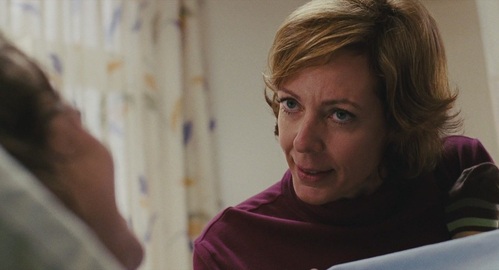
There’s a scene early on in Juno where the audience meets Allison Janney’s character, Bren MacGuff, and learns about her dog obsession. She’s got sweaters of knit dogs, a dog mouse pad, dog statuettes galore, they’re everywhere. I at least appreciated the absurdity of her character’s predilections, but it also served a purpose in Diablo Cody’s script, namely to knock us off guard. For she is the last person, this stepmother, who we all know are supposed to be evil doers in the world of the protagonist, to support the pregnant teenager. And then, she does, wonderfully, in fact.

And that is why I like absurdity, and humor writing, or in this case, a comic screenplay. It helps of course, that Allison Janney played her, because the woman has some really good timing, as evidenced throughout her Emmy-laden career on The West Wing. For what it’s worth, I would really love to see a series about congressional staffers and the polarization of the political parties, told in the same quickfire and witty way. I hear NBC has a few time slots they could use.

But seriously, humor is not easy to write. Good humor, anyway. Often, it demands accessible cultural reference, or audience identification with the situation and punchline. Some of the funniest stuff out there takes a common experience and turns it around, creating a completely new take, like making an origami swan out of a greasy KFC wrapper and giving it to one’s older brother as a lunch treat, since one had previously eaten the chicken inside that he was expecting to receive. Or something.

I was not a regular viewer of Seinfeld, but Larry David is very funny to me when it comes to showing the annoying side of people, and laughing through it. Elaine, stuck in a toilet stall, begging her neighbor for just one square of tissue paper, George’s unintentional killing of his fiancee because he insisted on buying the cheapest invitations to the wedding, and those came complete with toxic envelope glue, these are moments I remember even though it stopped airing in the last millennium. There’s also something about how humor makes for a full and breathing character—it takes loving big parts of George for viewers to be okay with the fact that he’s relieved he doesn’t have to get married, because otherwise, he’s an abhorrent person. Well, he’s kind of abhorrent anyway, but he’s still got his lovable parts. For me, David sometimes gets a bit too mean-spirited, so I can’t be counted among his big fans, but that’s okay, there’s a long list of folks I have to admire for their contributions to comedy.

All of this is to say comedy writers and humorists are supposed to make it look easy, to tap into our frustrations or insecurities and turn them inside out, exposing the fluffiness on the inside, if our experiences were like socks. My experiences have a couple of holes in them but mostly look okay, thanks to OxyClean. I just try to remember that my goal isn’t to make writing funny, it’s to reveal that finding life funny in general should be documented, in case anyone else agrees with me. I didn’t venture out to be a humor writer because most young writers really, really, powerfully want to write the next great novel, American or otherwise. But the humor kept showing up, like Uncle Lloyd at our Friday night dinners, and we never really knew why he kept hanging out with us until we realized his wife made really awful Van deKamp fish on Fridays and he was just looking for a non-fishy-smelly house. Two weeks in a row of Gorton’s finest imitation cod and we were free. No, I haven’t found a way to banish humor, but I’m not looking for one.

I am the prepackaged fish dinner of writers, and I’m okay with that.

Buddy movies never go like this

A guy, his wife, his mother, and 25 million frozen sperm go for a road trip to Portland. No, it’s not the beginning of a joke. I took a road trip to Portland with my wife, my mother, and a million frozen sperm. Just for kicks, really. Okay, not for kicks. If it could have been avoided I would have, trust me, avoided it like the plague, like . . . oh, forget it. Who would wish such an event on themselves? But I’ll at least start at the beginning.

Some gentle readers may recall that we’ve tried this whole conception thing before, specifically last fall. It did not take, so we’re trying again, many months and lab results and sonograms later. Whereas the delivery fella from FedEx was uncomfortably cavalier the first time, on this occasion he was terse, almost gruff. It seemed he was frustrated with our incapacity to already be pregnant so he didn’t have to haul the 22-pound thermos to our doorstep.

“Good morning,” he said to me, loudly, with twelve minutes left before post meridian would take over. I’m glad he wished me a good 12 minutes. It was almost like he was casting his bet to Drew Carey from Contestant’s Row, but with no enthusiasm.

I didn’t really know what to say back to him, so I kind of nodded and kind of grunted a salutation.

“Guess I’m back here again,” he said, relishing in my humiliation, or something. I could have told him he was being redundant, throwing the shame of the moment onto him, but I was more interested in just completing our little transaction and having a door between us, as it was meant to be.

I hauled the plastic container inside. My mother, who was visiting us, took one look at it and suddenly seemed touched.

“Aw, it’s like a little robot,” she said.

I rolled my eyes at her, even as I appreciated her support.

Truth be told, our little million friends were joining us late; they were supposed to arrive the previous Saturday, but the bank in San Francisco hadn’t sent them out, and were horrified on Monday morning when I called to inquire. In their haste to make things right they reversed all of the shipping charges, which trust me, were plenty expensive, and promised we’d have them on Tuesday morning. So with a dozen minutes remaining, we had just gotten our guaranteed delivery.

I had disclosed to my mother earlier about our attempts at creating what Susanne still called a “parasitic fetus,” changing this to “baby” when I communicated with Mom so that she wouldn’t worry about our hearts being in the right place about this. Mom was on board and excited, as was Susanne’s mother when she was told of our plans. I actually wonder if there isn’t a room in her house, back in the Midwest, where all sorts of toys and clothing and supplies are piling up in expectation of our announcement that we’re having a child, because she seems that thrilled about it. But as we’re 2,600 miles away, we’re not privy to any potential hoarding, and we’re not about to ask.

Also, we considered it bad timing that my Mom’s visit was coinciding with the probable ovulation date, but I at least was willing to stick my fingers in my ears and shout, “blah blah blah” to pretend there weren’t any strange boundaries being crossed. Mom and Susanne really just seemed to prefer that I not discuss the issue with either of them.

So there we were, all standing around in the foyer, looking at our friend the robot with his little stash of swimming life-bearers. Should all sperm feel so attended to. Or not.

An ultrasound the day before this delivery indicated that we should attempt to knock Susanne up at precisely 11AM on Wednesday. This was not convenient news, as my Mom’s flight back home was scheduled for 12:15PM on Wednesday, out of Portland Airport, 3 and a half hours’ drive from here. So our options went from uncomfortable to awful to worse. We could, it appeared, pick from the following:

1. I could take Mom out to Portland and Susanne could do the whole kit and kaboodle herself, back at home. That was a non-starter.

2. I could take Mom out to Portland really super early and speed right back and do the deed. Grossly unrealistic, and risky, in terms of my driving at the end of the 8-hour round trip, and then being able to see my hands in front of me to know what I was doing back in Walla Walla.

3. We could take the robot and entrails along with us to Portland, stay the night, take Mom to the airport, and attempt to conceive in the hotel room.

We picked the last option, feeling like the first two were really just red herrings.

I broke the news to Mom, who was fine with it. “Well, you have to do what you have to do,” she said. I figured no matter the situation, it was pretty much always a little weird anyway.

Susanne had taken to calling it the Bargain Baby, because it was half off with the free shipping and all. That would be her kind of baby. I told her we couldn’t ever tell a child we’d called it that. She questioned my commitment to frugality. I attempted to reassure her.

multnomah falls, oregonReceipt of robot completed, our plan swung into action. I had already loaded up the car with everything else—foodstuffs for the trip, our suitcases, laptop computers, a pillow, and an updated iPod. Down Route 12 we traveled, out to the gorge west of Walla Walla, Lowden, and Touchet, along the banks of the Columbia, the deep blue water coursing through red rock covered in sage brush that stretched to the cloudless sky. It was a nice farewell to my mother’s visit, direct from Washington State, the Pretend Evergreen State. Mom oohed and ahed at the landscape but noted how lonely it looked out here. I agreed.

Susanne, for her part, slept almost the whole trip, until we pulled over at Mulnomah Falls just outside Portland. We walked around, and I tried not to think about everything in the trunk. Of the car, that is.

We’d driven so long, and not eaten much, so by the time we made it from our airport hotel to an Italian eatery in the Hollywood neighborhood, everything tasted like heaven. I nearly ate the table, just for the fiber.

“Oh, isn’t this marinara sauce wonderful,” asked my mother.

“It really is,” said Susanne, agreeing exuberantly. Jesus, we were eating cheese toast with red sauce. You’d have thought it was black truffle on top of foie gras and drizzled with saffron oil and Beluga caviar. But wow did it taste good.

Coming back to our hotel we settled in for some laptopping and crossword puzzling time. We slept like rocks until, at 5:30, with the sky still in stubborn nightfall, there came a great rumbling from the room above. Smash, went the ceiling. Pound, pound, pound, pound, said the heavy-footed occupant upstairs. It was like an elephant practicing her catwalk. Back and forth, back and forth. My mother sent me to the front desk. I looked a sight, with dark bags under my eyes, my face somewhat puffy, dried drool on my cheek, and my hair pointing in so many directions I looked like that guy from She Blinded Me with Science.

“Hi,” I announced. This is where telepathy would have been handy, but darn it, I had to use words.

“Hi,” he said. I could only guess at his expectation for why I was standing in front of him with an inside-out t-shirt and dingy Old Navy pajama pants.

“The person in the room above us is very loud, and has woken up my mother. Next my wife will be up. Please help.”

I probably should have explained my predicament in a different, better way, but he seemed to understand enough.

“Are you sure it’s the room directly above you?”

This was not a question I’d anticipated. I didn’t really even understand it, come to think of it. “What other room would it be?”

“You know, maybe it’s to one side or the other.”

Well, screw me for not memorizing the building blueprints before selecting this gem of a hotel on Priceline. I thought about the pounding noises.

“No, it was directly above us, right in front of where the beds would be.”

“Okay, I’ll take care of it,” he assured me.

I reported back to my bunkmates. There was hardly any way our circumstances could have been more awkward.

Susanne, who was of course awake after all of this, remarked that no way would the front desk knock on the door of the prancing pounder. She had worked at a hotel, and no way would she ever have checked on someone in a room unless she heard screams of bloody murder. But lo and behold, a few minutes later, the pacing ceased, and we went back to sleep for a time.

And then we needed to get Mom to the airport, which was around a corner, down a street, next to a highway, make another turn, and voila! Kisses and hugs goodbye, chirps of “what a wonderful visit” and “good luck with robot,” and then we were back in the car, making our way, making our way, making, our, uh oh, we missed a turn. And then another turn. And somehow we were at IKEA, and wow, 4 grand, 64 indecipherable instruction sheets, 2,387 tiny screws and dowels, and 28,291 swear words later, I hate IKEA. Especially when I’m trying to get to the frigging airport hotel so I can impregnate my wife. This is exactly when I am seriously not interested in buying an $89 POANG chair.

We needed to admit we were stressing out. Susanne gruffly suggested I call 411 and get directions from the airport to the airport hotel. Who was I to argue?

Finally, we pulled into the parking spot we’d left earlier that morning. Eleven o’clock was our time to trot, and it was 10:49. We raced back to the room, and I took off my shoes, because of course shoes would inhibit bargain baby robot creation. Susanne pointed to the storage container. Almost invisible, hanging loosely around the metal clasp, reveling in its securityness, was a thin plastic cuff. We had remembered to bring oven mitts to get at the vial in the frozen nitrogen—not wanting to sacrifice fingers to the cause—but we’d forgotten scissors. I scratched at it with a key.

I might as well have been trying to scratch my way out of Alcatraz. This was not the Shawshank Redemption.

I returned to the front desk. There was a new employee there, a young woman. Maybe I would impress her with my street clothes, since I’d changed out of my sleep wear.

She was reticent to lend me scissors, but I must have looked just pleading and pathetic enough. I went back upstairs and cut the plastic. Victory! I turned back to the door.

“Wait, there’s another one.”

Thank goodness one of us had some intelligence. I cut the second cuff. Back downstairs, return the scissors, back upstairs, sweating and really not in the mood for any of this nonsense anymore. I donned the mitts and opened the tank inside and pulled out the vial holder thingy, and . . . .

THERE WAS NO VIAL.

Now then, at this point, to say we were on our last nerve would be a bit of an understatement. I believe I screamed, and I believe I heard Susanne take in such a quantity of air as to resemble any kind of animal that has great lung capacity, and no, I would never call my lovely wife a whale. But a large lobed lungfish, maybe.

I plunged my mitt in again and pulled out the whole canister, and dumped it upside down on the desk, freezing the fake leather blotter, as the vial tumbled out. Screw you anyway, fake leather blotter. I put all the robot bits back and let the vial thaw on the desk. It was 11:06.

Finally, we were back on the road home, having made our checkout time of noon, and we enjoyed the sun and the light traffic as we sped through the rainforest side of Oregon.

We like the trees.

All alone in the moonlight

I had an epiphany yesterday, round about 2 in the afternoon, that I should be contacting LGBT agents for my memoir. Why, I wondered, have I been trying only the mainstream folks—that’s like dressing up in my nerdy best and asking out the lead cheerleader to a rodeo (no offense to cheerleaders who like nerds). Trouble was, I didn’t really know how to find them, aside from searching for them on Google, your friendly neighborhood search engine. And that approach was fraught with danger, read, the Big Bad Fraudulent Agent. Apparently, they lurk everywhere, in the corners of the interwebs, waiting to steal one’s money (I don’t have much, so I’m safe there) and ideas (hey, if they can do anything with them, more power to them!). So I figured that for every name I identified, I’d just double-check them somewhere else. This presumes, of course, that there is a long line of clearly identifiable gay, lesbian, bisexual, and transgender literary agents just lined up for writers like me.

Perhaps I was off the mark a little. Or maybe I can blame the search engine algorithm. I did get some lovely lists of agents, and then . . . then I had to do some text searches. In a list of 100+ agents, there were maybe three or four who admitted they worked with GLBT writers specifically, or who represented gay/lesbian work. This was going to take some time.

I did come up with one name, for the few hours of my effort, and I sent along a queery [sic] to her. And then it was bowling time. I made the hour-long trek, grumbling that my iPod strangely decided not to play about a quarter of the songs I’ve fed it over the years. Damn update.

My bowling mate asked me how I was doing and I said I’d figured out I should try to find GLBT agents. She gave me a look.

“See, and I thought you were all smart and stuff,” she said. I lovingly punched her in the shoulder.

I figured the hunt for an agent would be renewed in the morning. But again, it’s like looking for a four-leaf clover. I’ve already gone through the small gay presses and not heard so much as a ping back, but looking at their book releases I can see why. I don’t write about being drug-addicted, or living in San Francisco, or going through a string of abusive lovers, or being homeless, or anything else edgy. I do write about mental illness, but well, that’s been done by very good writers. I write about the wonderfulness and insanity of city living, and we all know that great writers have tackled that one, many times over. So I think to myself, well, being an Arab American formerly gay transgender professional city-turned-country dweller who survived a bout of major depression, a bad relationship, and a dozen years of Catholic school, and grew up in a mixed race and ethnicity, mixed religion household in New Jersey and somehow came out of it without a Jersey accent, well, there are some marketable things in there, somewhere.

I’ve been working on something like a short story a month, cranking out the ideas that have been crowding around for attention, and then launching into rewriting for a few versions before beginning another one. I’m sure I’ll go through and revise them again, but my point this winter was just to keep writing, identify my best simmering point of productivity, and play with all of the things I love about the craft of writing, until I either decided it was time to go back to the super/stupid power story (in which queer folks save the world) or I decided to tackle another long-form project. The superpower story needs a major rewrite/redesign, and I have to change one of the stupid powers because I really can’t allow myself to reference Dan Savage anymore, after he came out with that ridiculous column last week about the Washington State Attorney General.

I’ve got a good outline for a mystery novel I began a few years ago, and I’ve wanted for a very long time to tackle a memoir or close-to-real story about my childhood, centered on my epilepsy. Really, I’d like to try to relay the experience of having memory gaps and false memories that petit mal and grand mal seizures gave me. They each had their own strategy. The petit mal seizures (which no one calls petit mal anymore) stole time away from me, leaving me hanging in the middle of a sentence and restoring me, many seconds or half a minute later, either attempting to finish what I’d started, or leaving me disoriented about my thoughts. My mind was wracked with 90 of them a day before the doctors—who wouldn’t tell my mother what was wrong with me—got them under control.

The grand mal seizures (they’re not called that anymore, either) played a different trick. They filled in the lost time with whatever my child’s experiences could cobble together. Singing Thanksgiving carols around a grand piano my school didn’t own. Winning the Showcase Showdown in a bright orange t-shirt. Seeing buildings by Route 33 in Hightstown burn to the ground and feeling, really feeling, the thick wave of heat it gave off. I’ve spent hundreds of hours thinking about this book, even as the gender change story was more urgent for the telling of it. I want to write this book in a way that isn’t trite or cliche. Agents apparently loathe book openings with dream sequences, but darn it, false memories aren’t dreams. They’re closer to near-death experiences, in the way I’ve encountered them, like reaching to a different plane or a sticking one’s face into a parallel universe for just a moment and then trying to write down everything seen. I want to write this book.

And I’ll write it even if there are no agents for it. Because writers are supposed to just push on and write.