What the Hell Is Wrong with This Country (Part II)
Primary school government classes in the United States explain the ideals of representative government—that our democracy supports the election of (often ordinary) people who then keep access open to their constituents so that the needs in their local districts and states will have a voice in the voting body. Unfortunately, in many districts, this is not really how elections and governing operate anymore. Consider:
-

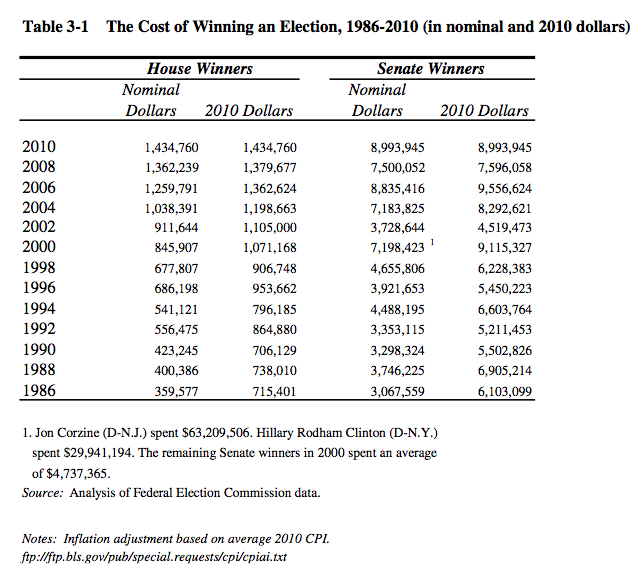
From The Campaign Finance Institute
Congressional elections averaged $1.4M for House elections in 2010 and and more than $1.5M in 2012. Senate races averaged nearly $9M in 2010 and more than $10.3M in 2012. The total cost for all congressional races for the 2014 midterm elections is estimated to run $3.5B. That’s billion. These extreme costs narrow the possibilities of who can run for seats, limiting elections to well networked or party-sponsored individuals, the independently wealthy, or people running on a cause that garners a lot of grassroots support. (See Table at the right.)
- The Supreme Court’s ruling on Citizens United has put a lot more money from organizations and corporations into elections, even local-level campaigns. Between 527 groups, PACs and SuperPACs, even small congressional districts see a lot of monetary input, often from groups outside of the state or district in contest. If candidate fundraising doesn’t come from kissing babies and shaking constituents’ hands anymore, then…
- Issues taken up by office holders may reflect the priorities of big donors and organizations rather than the general public. At the least there is evidence that so much corporate money spent in SuperPACs has been used to wage negative campaigns against the presumed opponent (SuperPACs are not allowed to raise money for a particular candidate). Thus candidates now must raise money to get their messages out and to defend against the negative campaigns from 527s and SuperPACs (hence the rapid rise in average campaign costs). Read More…
 It’s time for a little come to Xena—I’m going back to the gym. I’m not suddenly becoming my own health troll, or giving up my individual-sized mantle against fat phobia, far from it. I don’t have a weight goal in mind or a plan to count calories, or a tape measure to chart how big I can make my biceps. And I still think that the plethora of posts I see on my Facebook and Twitter feeds about how many miles someone ran, and how shitty the weather was when they did it, and how long it took them are, in aggregate, kind of annoying. (But I’m proud of you, too, for being so uh, disciplined or something. Really. Mostly.)
 1. The Fair Labor Standards Act—Passed in 1938, this law
  This news out of Texas was quickly supplanted by the SCOTUS decisions around marriage equality today, the Trayvon Martin George Zimmerman trial, and somehow, by continued coverage of Paula Deen’s racism. But it’s worth taking a closer look at the 11-hour filibuster by Texas State Senator Wendy Davis because it was a moment that perhaps can give us some lessons to remember for future political battles—which will inevitably will come our way. Or say, next month.
 As Emile keeps telling us, we are “flying plane Michigan” tomorrow to see “Grandma AND Papa.” (Can’t leave Papa out, after all.) Usually leaving for two weeks in the summer means that we’ll return to a brown lawn, shriveled annuals, and a stack of cobwebby newspapers. But not this year! Thanks to a helpful and intrepid recent college graduate, we will for the first time be employing a bonafide house sitter. So of course I had to give her a few instructions.
 Like many people, I have mixed feelings about Father’s Day. Sure, there are lots of tweets and Facebook posts that go something like “to all the Dad’s [sic] out there,” obliterating that actually, there are better and worse examples of those who parent from the masculine zones of gender. A few years ago I joked with at least four other individuals in the room that we should start a “I Had a Shitty Father” club. We could emboss t-shirts and stamp out buttons and make zines. Why not turn personal trauma and angst into fun? Misery loves a good zine. But there are definitely moments I shared with my father that I carry with me today, like the Sundays after church when he and I would feed the ducks at the local pond (we didn’t know in the 1970s that it was bad for the ecology of it all), or his love of bygone music, or the thoughtful way he’d lay out my cereal choices in the morning before school, with the newspaper opened up to the comics section. I think I got a better dad than he shared with his older kids, and I do appreciate that.
 The twelve members of the jury walked back into the deliberation room, after we’d handed over our verdict and individually attested that we voted freely and according to the instructions from the court.
 The criminal justice system in the United States seems to be founded on constraints. Who can get selected to serve on a jury. When the defendant can speak. Who can ask questions, and how those questions must be worded to be allowed in the courtroom. There are also the presumptions—the defendant is innocent until proven guilty, the jurors are presumed to be impartial, the judge is also presumed to be a fair referee in the battle between the opposing sides. Above all it is expected that justice will prevail. But nobody in the average criminal trial defines “justice,” even as they go to pains to map out the boundaries of “reasonable doubt.”


 Trans/plant/portation