Archive | 2009

Noodley legends

We like to ask for advice; there are columns in the paper, thousands of Web forums and chat rooms on every conceivable subject from pork rinds to rare, incurable diseases. Perhaps it’s part of the human condition to ask our neighbors about things we haven’t directly experienced. It creates community, sometimes, not just in a virtual Web browser window, but when we create support groups, go on themed vacations, join a club—we do a lot of advice giving and requesting, and then, if we get our first-hand moment ourselves, can appreciate how far away the advice of someone else’s experience was from our own.

And therein lies the rub. For one person’s touted recommendation is another person’s bout with mediocrity. Or there could be, in the case of a restaurant suggestion, a complete incompatibility between palates. It’s really a taste comparison; if we like the same 5 movies, maybe we’ll both hate the 6th. Your advice to go to so-and-so place for dinner might be anathema to me if I think that spiced crickets sounds disgusting but is your favorite appetizer. And then you might gently remind me that some of what I eat, such as corndogs, also can be just plain awful.* So one should have confidence in the taste buds of their friends.

What to make of the good friend with whom you’ve never actually compared culinary affections? It’s just a leap of faith that nobody would recommend a truly terrible venue and that there will probably be something on the menu that appeals. And that’s the pessimist’s approach. For those of us who are more risk-tolerant and/or optimistic, it’s a chance to venture into unknown territory and perhaps experience something new.


Legendary Noodle Restaurant

Legendary Noodle Restaurant

It was with this boldly go where we hadn’t gone before mentality that we ventured into the Legendary Noodle Restaurant in Vancouver, a favorite of our friend, Dex. She eats there often. We looked at fully four different kinds of noodle preparations. We started off sharing some steamed meat dumplings, which were fine if not a little pedestrian. Our food came quickly, which I’ve learned in the Northwest is a bit of an uncommon occurrence. Susanne had a noodle soup with beef, almost like a pho, and I had some noodles with beef, mung beans, and a light spice that was just hot enough to linger while not causing massive sinus activity. It was a little place, likeable in that hole-in-the-wall way. 

It was also conveniently located directly across the street from a patisserie. Unfortunately, we were too stuffed to put any more edibles into our stomachs. Fortunately, our friend’s housemate was having a gallery show that night, so the three of us walked around the corner to see her art. She was focused on painting animation-like pictures of Catholic schoolgirls. They looked very sulky. Some of them were against white, unpainted backgrounds. Some were sitting in trees. Many were set in dreary wooded locations. In a room in the back there was a silent auction with older pictures, namely giant robots in dreary wooded locations. I sensed a trend. 

After looking at the art for a while, we headed over to Sweet Revenge for tea and dessert. It was cramped, like visiting your Aunt Nellie who hasn’t thrown out the daily newspaper for 36 years and who has a penchant for collecting antique furniture. We found the remaining 4 square feet of space in the room and sat down at a low table that came up to our knees. I wondered aloud if this was the tea room for Liliputian royalty. 

Menus were carefully presented to us, lest the waiters knock something over. They were small men who looked like they had previously worked as circus contortionists, and they fitted their bodies around the furniture as they served the patrons, bending in strange ways like Keanu Reeves dodging bullets, but nary did they spill a drop of the drinks.
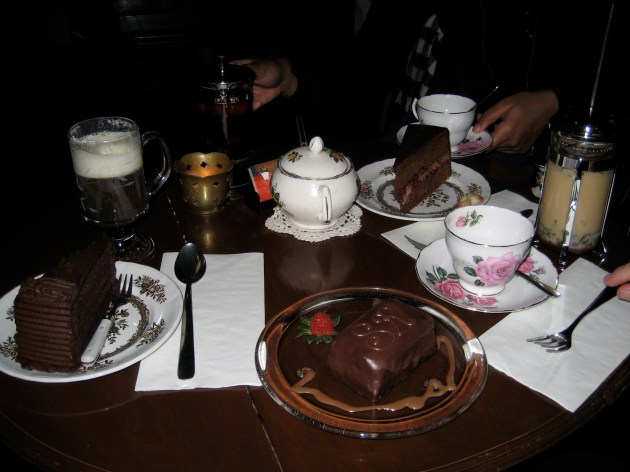
 

table of treats at Sweet Revenge

table of treats at Sweet Revenge

The cakes were very good, although one was a little on the dry side. A man at the next table (read, five inches away from me) asked which cake on our table was the favorite, so we pointed it out to him. There were six people at his table, Japanese tourists, and they were very excited to have cake recommendations from total strangers. How did he know I wasn’t a total smartass who had just told him to try the cake with the pickle juice in it? Such trust! It must have been because we were in Canada, and what Canadian would steer a tourist wrong like that? He’d never have had such faith in me if we were in Atlanta, I bet.

We finished our dessert and hugged our friend goodbye—but only for the moment, because we ran into her two days later in Vancouver’s Chinatown. I would have said small world, but well, I didn’t think it would have drawn the laugh. One must be selective about such things.

*For the record, I do not eat corn dogs.

Merriweather Blue and the not-so-long journey

Walla Walla is a stop on Lewis and Clark’s exploration across the North American continent, as is evidenced by the seemingly thousands of highway signs dedicated to preserving their memory. Because we had very recently purchased a new car just before our wedding and cross-country move, we needed to come up with a name for it, and well, Lewis and Clark now live on in our household, for we decided upon Merriweather Blue for the car. 

She’s been a reliable, fun vehicle to drive, with nice shocks and a comfortable interior. We enjoy trips in this car, possibly because Susanne used to drive a rather tippy Chevy Sprint, and I a Ford Escort that I pushed more than I drove. Everything is, after all, relative.

Pacific Ocean outside Vancouver

Pacific Ocean outside Vancouver


We piled into Merriweather B. in the middle of Seattle and made our way to the north of the city. Driving by Everett, Washington, was fun because I kept pointing out the amenities of the city as if they were my own. “Look, I have a middle school,” I would announce, pointing at some random building. “Oh, I’m working hard on road improvements using my citizen’s taxes,” I would say. Yes, it got old fast. But Everett was larger than I thought it would be, a proper suburb with all the sprawlish trappings therein.

Washington State pushed up upward into more rugged mountainous terrain and we started seeing snippets of snow alongside the road. Finally we came upon the border, and I mistakenly got in a lane that said, “Nexus Only.” Unfortunately for us, once I realized my error I could no longer leave the lane, lest I drive over orange divider cones and alert the Royal Mounted Police force/Border Patrol/Customs officials to my dalience from the rules. I sheepishly pulled up to the window, our passports in hand.

“I’m sorry, I think I got into the wrong lane. I don’t know what Nexus means.”

She looked at our credentials, very displeased with me.

“What are you doing in Canada,” she asked, tersely.

“We’re going to a conference,” I answered.

“Where?” She sounded like she was sitting on a chair of needles.

“Vancouver.” Hopefully she had heard of it. 

“And what is your business there?”

Was this a trick question? I thought it was a trick question. I looked at Susanne imploringly.

“We’re going to a conference,” she said. 

Say what? That’s what I said! Susanne didn’t know anything more than what I knew! Oh, crap. I count on her to have the right answers to this crap.

“What kind of conference,” was her next question.

I debated, in three nanoseconds, whether to say it was a conference for people who dress up as furry creatures in order to get aroused, then thought better of it.

“Political science,” answered Susanne, and the border guard frowned. Clearly we should have gone with furries.

She handed us back our passports and looked at me, with daggers shining in her eyes, saying, “A word of advice, if you don’t know what something is, don’t get in that lane.”

Well now, that’s extrapolatable to everything else. What a brilliant pearl of wisdom. I nodded, secretly cursing her in my mind, and we drove into Canada. With border patrol agents like her, I thought, Canada better start planning on spending more marketing money to keep its image as a country of nice people, Susanne notwithstanding.

Thirty kilometres outside Vancouver the sun ducked behind clouds, not to be seen for three more days. We made our way to the Hyatt downtown, and checked in to a fancy room devoid of anything complementary. Even the Wi-Fi cost $16 a day. It was like spending time with cheap, rich people, when you bring a nice bottle of wine over to their place and they keep it and open up some crap they bought at Costco instead, and you think to yourself, well, this is why they’re wealthy and I’m not. Yeah, it was kind of like that. But it had a nice view of the street below, and I think Vancouver is the only place on planet Earth where you have mountains and the Pacific across from each other like that. Well, maybe Japan is like that, since it’s been formed by volcanoes. But Vancouver is the first place I’ve ever seen with that kind of terrain, and I found it endlessly fascinating.

Our first evening in town we opted for Ethiopian for dinner, so we checked out Addis Cafe about 20 blocks away. Our Googled directions took us through a neighborhood that is called “Canada’s skid row.” This is funny for several reasons, including the following:

1. Canada has only one skid row.

2. It is this one.

3. Canadians know this because they’ve asked around.

4. Nobody has realized that “skid row” as a concept is like, 70 years old. We call them “crack neighborhoods” now.

While it seemed a bit rough around the edges, I am here to reassure every Vancouverian that really, it’s not a bad neighborhood. But okay, you wouldn’t want to hang around on the corner bleeding $50 bills.

The eatery was small, a row house-style building that was clearly focused on the food and not the ambiance. We ordered a veggie combo with wot and a lamb entree, and were greeted with a  beautiful plate of injera and really well done toppings. The wot was spicy enough to make its presence known to one’s tongue, but without so much heat that it upstaged anything else on the plate. The cabbage was crisp, well spiced, and a great compliment to the lamb, which was tender, rich, and free from gristle, always a possibility with lamb butchering. We also enjoyed the lentils, and the freshly made cheese. We also were delighted to converse with the chef, who was eager and beyond pleased that we’d enjoyed her cooking. She and the waitress were the only employees to be found. I highly recommend Addis Cafe for anyone looking for a low-key, affordable, and excellent meal in Vancouver.

Next up: The Legendary Noodle House and desserts at Sweet Revenge

Snacking through the northwest

Susanne and I took an enjoyable, leisurely stroll through Seattle’s Pike Place Market on Monday, indifferent to the intermittent light rain. We stopped at a cheese producer—DeLaurenti—and watched the large bins of curds get hand-sifted by the staff. Tasting the freshly made cheddar resulted in happy gasps from each of us. Having wanted to try my hand at cheese making, I asked if they had any rennet, an amino acid used to make curds. They pointed us in the direction of the Creamery, a small store, obviously focused on dairy products. Four oversized ceramic cows and one sleeping store dog later, I had the rennet in hand.

We stopped by a pirouska storefront and shared an onion and mushroom breaded pastry, warm and delighful and useful for keeping our hands from freezing in the 40-degree weather. We looked at pottery, always a favorite of Susanne’s, homemade children’s hats, stopped to smell the flowers, looked at some pasta from Pappardelle’s to get ideas for new pasta to make at home, and listened to a  banjo player who was sharing a bit of soul just out of reach from the drizzle.

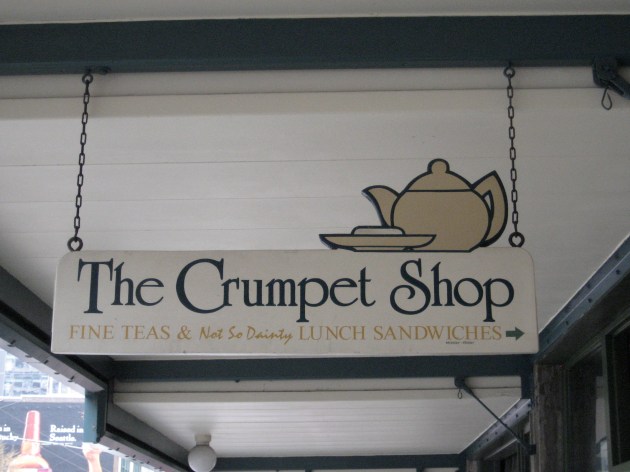
My knee finally started complaining after a couple of hours. We stopped for tea and crumpets—no, really, we did—and enjoyed some creamy Earl Grey. I have determined, sadly, that I just am not a fan on Yerba tea, finding that it’s too musty for my taste. I do, however, continue to enjoy the sound of the word Yerba. So I will have to like it from an intellectually removed distance. The crumpets were tasty—they’re a bit like the love child of an English muffin and a thick, buttermilk pancake. I had mine with butter, and Susanne chose honey. We thought we were pretty nifty folks until a woman walked by us with one covered in Nutella. Egads! Who knew such a thing existed? I attempted to make a move on her crumpet, but Susanne kept me in check. There’s probably a Crumpet Police force in existence somewhere. No laughing now, there are still places in the US where stealing a horse brings up the death penalty.

We ventured out, later that evening, to Quinn’s Pub in the Capitol Hill section of Seattle. For appetizers we shared some rather pedestrian pistachios and a nicely lime-and-olive-oil infused plate of green and black olives. Susanne and her friend Jesse each ordered a flank steak with frites, and I had fish and chips (same as the frites). The steaks were marvelous, a little over the top with the charring, but nicely tender inside, and paired well with a rich gravy and chewy, nobby little mushrooms. My fish was tender and delicious, but a bit too thickly battered, which quickly went from crispytown to mushville. I was content to eat the fish out of the batter. I was also surprised that the establishment doesn’t have tartar sauce.

After dinner we went to the Wild Rose, a women’s bar, for their weekly pub quiz game. I was a repeat customer back in DC, at Fado, where their trivia game brought something like 50 people in every Monday night. There’s something about sitting around a dark Irish pub with other frazzled government employees that equates to serious competition without the energy of turning foul. Here in Seattle the gang was much, much smaller, and the teams were limited to 4 people, max. Back in DC you’d get the whole of a division of say, the Census, and those folks were tough to beat. Crazy survey nerds!

After bombing out the first round of C-list celebrity photos, our team caught fire and won the contest, by a large margin. I really didn’t know what became of Danzig, though, and we missed that question in the round of “this place used to be this other name, what is it called now?” We walked away with $30. Not bad for a couple hours of answering questions!

Seattle in pictures


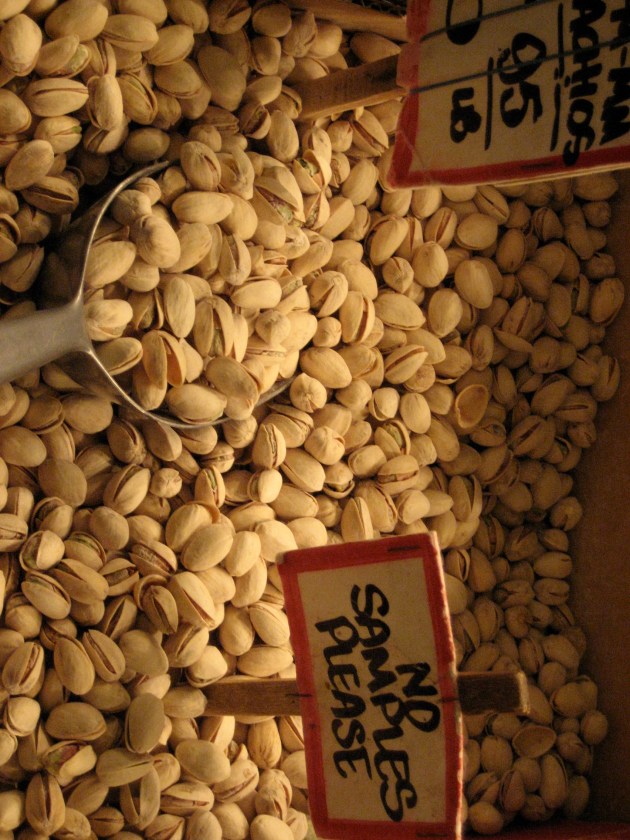
Pistachios at Pike's Place Market

Pistachios at Pike's Place Market


Seafood counter at Pike Place Market

Seafood counter at Pike Place Market


Pike Place Market

Pike Place Market


The Crumpet Shop sign

The Crumpet Shop sign


The first Starbucks

The first Starbucks

Long drive into absurdity

It started out well enough, our bags stuffed to the gills, some fresh homemade granola bars and drinks up front with us, needing to get gas but we had enough to get out of town and over to the cheap gas station, about 30 miles out of town. It was obvious to anyone alive that it was a pretty windy day—too brisk to say, picnic in the park, but not so bad you worry your dog will blow away on a walk. Well, hindsight tells me now that if it was that windy in town, it was two or three times that bad once we were clear of any buildings to slow it down. I got quite the forearm and biceps workout as I battled to keep the car on the road.

tumbleweed

tumbleweed


Next up were the tumbleweeds. Now then, let’s take a minute to explain tumbleweeds. Recall the theme from High Noon if you want to, sure, but I’m talking about something much less romanticized and rather more pure irritation. These were once scrub brush, small brown and green plants that grow in a clumpy cluster and huddle up on the rolling hills that surround the narrow roads. Summer came, and they flourished. They hailed the good times with regular downpours of rain, told themselves to put off making strong root systems, and just enjoyed the good life. Fall came and went. They were totally unprepared for winter. And then, the winds started. The rain didn’t go that deep into the ground. They started drying up. Panicked, they tried to consult their neighbors, only to discover whole groups of them that were now dead or dying.

Or were they? For it is such that nature decrees that any scrub brush bush that dies is sent to live again as the Undead Plantage. Humans call these tumbleweeds. They’re pushed along with no chance of fighting against the breeze, they thrust themselves under parked cars, roll down and up hills, hurtling themselves at the thin traffic on Highway 12 like it could be their last big event on this earth. They are like unwanted rodents—where you see one tumbleweed, there are hundreds.

They came at us from every direction. They lined up and assaulted the car like kamikaze Rockettes. Susanne informed me that I was the only car on the road attempting to dodge them. I can’t help it if a good portion of my childhood was spent playing Frogger on various gaming systems (Intellivision’s version kicked Atari’s ass!). We looked to our right at a fence that had heretofore never made sense to us and realized it was a tumbleweed-catching fence. There were literally thousands of them self-shoved into every part of it. In some sections there were so many new arrivals could jump the fence, wagging their tumbleweed fingers at the farmers who’d tried to keep them out, victorious in their zombification of the landscape. A couple particularly large ones (in fairness, they may have merged with other dead shrubs to form super-tumbleweeds) threatened to take out the car, and Susanne didn’t seem to mind that I worked to avoid those. A few of them were totally unpredictable and sort of spun in the roadway, instead of hightailing it from one point to another.

How we drove from desert wind storm to blizzard, I’m still not sure, although I have been assured I was in the same state. This microclimate thing is insane. No sooner had we left the foothills of eastern Washington than we started approaching 2,500 feet in the Cascades, getting ready to drive through the Snoqualmie Pass. And let me assure you that right now, this very minute, as I type this on Monday, March 16, at 9:25AM PDT, it is snowing in the Snoqualmie Pass. Yesterday, it was not just snowing. Yesterday, it was blizzarding. There were big, wet flakes that stung as they hit you. I know this because all non-4-wheel-drive cars were required to put on snow chains before they could go through the pass. Not that there were any state troopers to enact such a requirement. But everyone pulled off to the side, marked for such an event. We couldn’t get our chains to fit because clearly our tires have gained a lot of weight since Christmas. I keep telling them they need to drop a few pounds, but why would they listen to me? Fully an hour later, soaked, numb, and very, very bitter, Susanne (mostly) and me (a little) had gotten the chains on, and we were off—except the chain up area is 20 miles ahead of the actual pass. Given that the car wouldn’t drive over 25mph with the chains on, it was a long time before we actually made it to the pass. The pavement, all along the way to the pass, was wet but clear. So we more or less vibrated to the pass. And the hours trailed by, tick tock, tick tock.

Now we were in the national forest zone. Still snowing hard, had the defroster working, the windshield wipers, Susanne drying out her feet since her sneakers had soaked through in the slush. Surely we’d see snow-covered conditions now. Nope. Three more slow, anxious, vibrate-y miles later, we were in the actual pass. Thank goodness we had snow chains! Right?

Wrong. There was a little slush on the road, and NOTHING ELSE. Fully 90 minutes after the big slow down to put on chains, we realized we’d been had by the Washington State Department of Transportation. Sure folks, it was snowing, but all of the uh, traffic was keeping the roads clear.

We pulled over with every other frustrated motorist, and unhooked the @#%@#^% tire chains. And a friend in Seattle told us that it had been sunny since 11AM that day, where he was.

You can imagine how happy we were to hear that, 6 hours after we’d left Walla Walla.

So Walla Walla gets its laugh on us again, always causing some kind of calamity when we try to leave the city limits. It’s how it keeps its population of 30,000, I suppose. It’s like one great, big Amityville Horror, and the tumbleweeds are the evil flies.

East side, west side, all around the state

I got up early today, well, early for me, meaning 7:30, well after sunrise but hours before the sun would reach its peak in the spring sky. I got in the car for a long ride to Portland, first following the Columbia River and then dipping down to the interstate. I had plugged in my iPod which is bursting at the seams with 18 gigs of music, I had made a fresh thermos of coffee, and had downed a bowl of Honey Nut Cheerios. I had brought with me a banana, directions, my cell phone, and not much else. 

The road from here, Walla Walla, to there is filled with microclimates. East of the Cascade Mountains one will observe magpies; west of them there are none to be found. Out here in eastern Washington/Oregon there are many rolling hills as part of the scrubland landscape–red-brown rocks and outcroppings share space with tan brush that gives the effect of looking like sheep that need to be shorn for the year. Thirty miles west of Walla Walla the gorges begin, and the royal blue river winds through the high hills as if to thumb its nose at the typically pale blue sky up ahead. And that sky is empty; only the long series of enormous windmills dare to drive up that high, standing over the scene like silent giants, spinning slowly and methodically as I zipped by. (Note to Oregon State Patrol: “zipped” means under or at the speed limit.) 

The rolling hills slowly begin to grow, and as they acquire the status of height, they pick up other things: taller scrub brush, small evergreen trees, fine dustings of snow. These, in turn, evolve to another status as deciduous trees appear on the side of the road, the evergreens get taller and taller, and the dust gives way to a thickening green carpet of moss and wild grasses. Now the blue river cutting through the rock looks complementary to the other Mother Earth colors, and then the dams begin, controlling and harnessing its flow.

The dams are not without their controversy. Fishermen wail that their harvests are at all-time lows, just 40 years after the dams were installed. Farmers cry out to keep the dams because they rely on the steady irrigation. Conservationists fret about the livelihood of the salmon spawning capability, tourist guides in Idaho bemoan what the dams are doing to their industry, and security experts talk quietly about risk assessments. I, however, am single-minded in my quest to reach my destination, and decide to defer the arguments for another moment. Such is my luxury.

Dead ahead of drivers on I-84, all of a sudden, is Mount Hood. It looms in the background like a gigantic screen saver and I have to blink many times before I realize it’s the real deal. Snow-covered as far as I can see, top to bottom. A sign that flashes by on my right tells me that it is 11,000 feet tall. That’s two or so miles high, I calculate vaguely. I see the hillsides around it; now they look like a velvet cloth has been cast over them, with the soft grass and moss and the dry patches of sand worked in. I bet this is the doing of the giant windmills. I see parts of two or three windmills passing me on the highway, dismembered on a series of WIDE LOAD-marked semis. Each truck comes with its own pacer car that alerts other drivers to the mystery of the cargo — it can take two or three trucks to figure out what these very very large pieces of white metal are, until you’ve figured it out the first time. 

Eventually I hit actual traffic, and by traffic, I mean more than one tractor-trailer and a nervous-looking woman in a 1990 Ford Escort. I have a moment where my sense memory comes back to me, so I change my distance to the car ahead, lest some jerky driver try to cut me off. I tell myself this is one of the good things about Walla Walla. 

I finally make it to my goal, shut off the car, and walk inside the building, my legs having stiffened up during the long drive and barking at me for neglecting their care. One hour later, I’m back in the car, heading home, to go through the process in reverse, and this time, with the setting sun behind me, gradually turning to a burnt umber and snuffing itself out just as I pull in to the driveway.

Cycling for free

I’ve heard a lot of good things about freecycle over the years — people who see the value in giving or getting things for free instead of throwing them away or heading to Walmart yet again have told me they really like freecycle for handing them easy access to things they need or would like to pass on. It stops just short of bartering, so you don’t need to offer anything other than the obligation to come pick up the item yourself.

I signed on to the Walla Walla freecycle list. I didn’t really know what to expect. In a rural town of 30,000, what things would appear? How soon would people respond? 


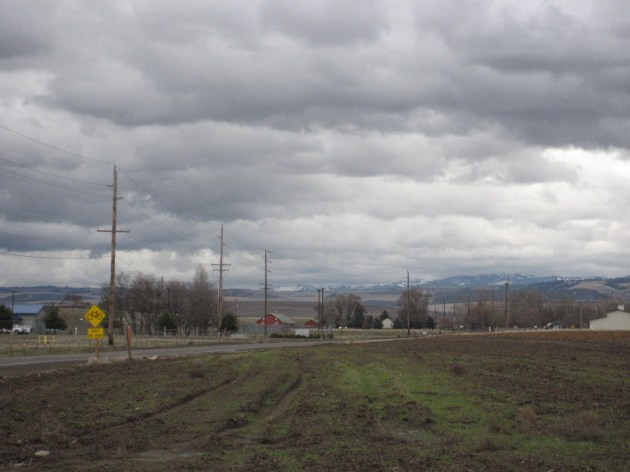
farm field east of Walla Walla

farm field east of Walla Walla

My friends in DC have gotten and let go of a lot of kids’ toys, but I haven’t seen anything like that. Ferret cages and supplies, on the other hand, are on the Walla Walla list. There’s also one particular person who puts out requests for things several times a week, items like a washer and dryer, baby clothes, that sort of thing. I read these email messages and I get nervous. Has the local Freecycle always been this busy, or is it an effect of a poor economy? Are people posting because they value doing things a little off the grid, or is there distress I should be reading into the letters?

Perhaps Freecycle is not for me, if it’s going to make me anxious like this.

Someone posted that they had a Betta fish to give away. Being a fan of such creatures, and wanting to get back in the pet-caring-for community, I sent in an email saying I could pick it up anytime. I didn’t hear back, and three days went by with no “Claimed” or “Retrieved” notice from the original poster. I stayed up all night — was the fish okay? Had he been on his last legs? Was he in the sewer system — the Valhalla for trusty but short-lived aquarium animals? Would he meet Chairman Mao in his next life, perhaps? The more I thought about it, the more concerned I became. My mind raced to thoughts of a painful, slow death for the fish and wondering if they thought I was somehow undeserving of parenting their little friend, based only on my email address. I reread my email — I didn’t sound like a fish-focused ax murderer. But then I went on to wonder if ax murderers realized they sounded crazy. Perhaps I was blind to my own insanity!

Days later, the email followup appeared: many, many people had written in to claim the fish. The forlorn, nearly-dead Betta I had pictured was a little off-base: clearly this was the most beloved fish in all of Walla Walla County. Loved and free.

I could make a flag of that. And put it on Freecycle.

Making flowers

While Susanne’s younger brother Kurtis was visiting us, his birthday rolled around. Given my penchant for enjoying producing confectionary creations, I asked what kind of cake he would like to celebrate the day. I was not ready for his response — an ice cream cake. While unexpected, I of course was not about to back away from a challenge. I thought about what I liked when it came to such things, and remembered many a frozen Carvel cake. Anyone from the Northeast of a certain age will recall the delights of Fudgie the Whale and Cookie Puss. Central to those cakes is the chocolate cookie layer, so I went about figuring out how to recreate it in my kitchen.

I cleaned out the filling from half a package of Oreos, crumbled up the cookies, mixed them in with vanilla and melted butter, and pressed it into the pan. I made homemade vanilla ice cream, Kurt’s expressed preference. I made whipped cream with a hint of vanilla, layering them and freezing them one layer after another into the pan. Then it came time, on the morning of his birthday, to decorate the top. I made some royal icing and colored it green and blue, two colors I know he likes. I wrote out his name and then attempted to make something from nature, an interest of his. I stood back and saw I had made a simple flower. Kind of girly. I needed to add something. I put down some more designs and stood back again and then realized my error. The cake looked like this:


ice cream cake

ice cream cake

Oh dear. This would have been perfect if Kurtis was an 11-year-old girl, but not a grown man. He seemed not to care, declaring it tasty and just the thing he’d wanted.

Backwards, upside-down, and topsy-turvy

We call our house the “Liar House” because it looks adorable on the outside but inside, living there, you realize quickly that except for being haunted, it’s about as welcoming as the Amityville Horror. To explain:

There are three kinds of outlets in the house. They are:

1. Outlets that don’t work

2. Outlets that work but that don’t hold a plug

3. Outlets that work and do hold a plug

We’ll call the first group -O. We’ll call the second group O-h, and the third group O+h

Now then, there are also holding tactics, consisting of tape (t), furniture (f), and small animals (a), which admittedly, don’t work very well unless they’re sleeping. It should also be noted that a is only a theoretical tactic, as yet unused in the household, but for the purposes of our exploration here, will be included in the analysis. Each tactic has its advantages and disadvantages. T, for example, does not require any remodeling of the room but may give way at any moment, or may dislodge paint on the wall. F, on the other hand, can be aesthetically more pleasing than gobs of tape, but may also require the user to be perfectly still for an extended amount of time (see deep vein thrombosis).

A typical scenario goes something like this: 

If –O, then identify new O

O-h+t=O+ht

Other scenarios may be more complicated, however:

O-h+a=O+ha until (af)(a+t)=O

In the above example, the animal holds the plug in the outlet with its body until it decides to claw the furniture and the owner(s) must bind it with tape to the wall to keep it in place. Future removal of tape is likely to be a significant disadvantage of this approach.

So no, the outlets don’t work so well. The refrigerator oozes a slow drip of water down the back interior wall such that we periodically have to take out the crisper drawers and mop out a small lake from the bottom. The dishwasher is nonexistent, as is the garbage disposal, so we keep an old cottage cheese container next to the sink to collect the small bits of food from the plates as we’re washing them. Large snowfalls seem to beget more waterfalls in the kitchen down a side wall, not unlike the fridge drippings. Our bathtub periodically backs up and spits back chunks of black detritus, or worse, sewage. And yes, we know it’s actual sewage. We have noses.

It’s been an interesting living experience, to say the least. Any given day might be shower-free, or we could skate across the kitchen floor because the fridge has overflowed again. But it’s nice at night, when we warm ourselves by the 62-degree heating ducts, knowing that some part of the house (right next to the boiler, probably), is availing itself of our $265 heating bill’s efforts. Yes, here in Walla Walla, things are a little reversed, if that’s a possible concept. There is one liquor store and yet more than a dozen wine tasting rooms. There is precisely one each Wendy’s, Burger King, McDonald’s, Taco Bell, and KFC, which is nice. There are two Rite Aid pharmacies in town. I think there may be more cattle in the county than people, but I’ll have to check on that. 

The businesses are holding their own for the most part, although a couple restaurants have closed since the big drop in the economy last fall. It’s not so much that Walla Walla has escaped the downturn, so much as it is that W2 is already pared-down. It’s not a flashy town, it has its snippets of hipness in an Austin is weird kind of way. But at its heart it is utilitarian, and what people needs survives. Even if Walla Walla aspires to be a resort for the Richie Riches of Seattle, Portland, and northern California, it is primarily supported by the residents here.

I am one of them. I make the city survive on my endless purchases of mopheads and Draino. So be it. 


Wintriest just before the spring

I am told that Walla Walla is in its glory in the spring, with the green wheat popping up through the dry hills, the return of songbirds, and immaculate gardens some of the townsfolk cultivate. This sounds quite a bit different than my past experiences:

In Princeton, you knew it was spring because the graduate students looked more worried and stressed than usual, you could smell all the new hair products the Guidos were wearing to woo potential mates, and people started talking about their tomato gardens.

In Syracuse, the snow would finally melt, revealing tulips and an unbelievable quantity of dog poop that made walking down any given sidewalk like jumping through an obstacle course. Snow-soaked dog crap is really nothing to dismiss.

In DC, you started sneezing your head off as the pollen count exploded to the outer rings of Saturn. Oh, and housing prices would start to skyrocket, and landlords would finally be able to start evicting people, so you’d see piles of belongings on the sidewalks, which I suppose is a whole different kind of awful from wet shit, although the two do start to resemble each other if they’re left out long enough.

I was at the coffeehouse yesterday, attempting to get my muse on, when four students from the college walked in and sat down at the large table next to me. It was regular college banter about confusion over how to approach an assignment, how they have no time to read novels anymore, which college men were best avoided from a romantic perspective. An uneventful afternoon, to say the least.

Now I mentioned some months back that Walla Walla has a different take on physical space, in that it’s not at a premium like it is on the east coast. If there’s a decrepit building, for example, it’s not a marker of a declining neighborhood or criminal activity. They just up and construct a new building right next to it. In that way, they also have a different relationship to people with developmental disabilities. Such it is that a local older woman who has Down’s syndrome is more than allowed to walk around downtown, into whichever business she chooses, to see her homemade paintings (only $5 each). I’ve never seen a business owner chastise her or chase her away, as I’m certain would be the case if she tried soliciting money from your average shopkeep in DC. 

So, to draw the picture, as it were, she walks into the coffee shop and marches right up to the college quartet to show them her wares. It’s not the most slick pitch, as you can imagine, but you have to give her points for determination and persistence. She basically came up to them and said, “hello, how are you,” and then proceeded to drop the paintings — about 30 of them, most on gessoed art boards (which themselves can cost about $2.50, so perhaps someone should talk to her about ROIs and profitmaking), some on thick cardboard. They are bright and simple and childlike — cats, bears dancing, birds with long beaks — most against bright blue or purple backgrounds, sometimes with clouds, sometimes with a sun hanging in the top corner. We have purchased two so far, for a total art investment of $10.

Well, the college quad folks didn’t know what to do about her. They started off pretty much ignoring her after saying a mumbled “hi,” but our intrepid artist doesn’t give up so easily. She went to the next person in the group, not understanding that they were collectively disinterested in her pictures. I leaned in and said, whispering, “she comes by every so often to sell her pictures for $5, and might not leave until you at least look at them.”

With a clear plan of action, they went for it, even oohing and ahing at a few of them. The artist was delighted, “oh you like that one,” perhaps thinking there was some money in this exchange. If so she was disappointed. I was really impressed with all of them, though, thinking that Walla Walla fosters niceness, if not jobs. And out of the corner of my eye, I saw the shop owner smiling.